Disclosure: As an Amazon Associate, umtsmarttool.com earns from qualifying purchases. Links to Amazon on this page are affiliate links; they cost you nothing extra. Prices and availability change often, so check the current Amazon listing before you buy.
Where to buy
Short on time? These are the six best dart flights picks from this guide, in the same order they are reviewed below. Linked picks say check price on Amazon because listings change often.
- Harrows Retina Dart Flights, Standard Shape, 100 Micron (5 Sets)
- CUESOUL ROST T19 Integrated Dart Shaft and Flights, Big Wing, 28mm
- CUESOUL TRAJ AK8 Integrated Dart Flights and Shafts, Very Slim Diamond Shape
- CUESOUL ROST Integrated Dart Shaft and Flights, Standard Shape
- Harrows Retina Dart Flights, Kite Shape, 100 Micron
- CUESOUL ROST 77 Integrated Dart Shaft and Flight, Big Wing
Start with the top pick: Check on Amazon
Read the full guide ↓
The best dart flights are the cheapest experiment in darts and, for many players, the most revealing one. A flight costs very little, weighs almost nothing, and yet its shape decides how much your dart corrects itself in the air, how it groups with the other two, and how often a good dart gets deflected by the flight of the dart before it. Players who have thrown the same flights for years are often one shape change away from understanding their own throw better.
This guide compares six flights across the two great families: traditional fold-flat flights, which slot into a separate shaft and are endlessly mixable, and integrated systems, which mould shaft and flight into one piece that can never pop out or sit crooked. Shapes run from the reference standard, through kite, to a very slim diamond for tight groupings. If you are building a complete set-up, the companion guides cover the darts themselves in best dart sets for adults, the board environment in best dart board lighting, and the consumables and cases in best dartboard accessories.
One principle runs through every pick: match the flight to the throw you have, not the throw you want. A big, stabilising flight is a genuine aid for a developing or loopy throw, and a genuine obstacle for a fast, clean one. The badges below are organised by that logic, so read the badge that sounds like your game rather than simply buying the first pick on the list.
In this guide
Quick Picks
| Pick | Badge | Key spec |
|---|---|---|
| Harrows Retina Dart Flights, Standard Shape, 100 Micron (5 Sets) | Best Overall | Standard shape, 100 micron, 15 flights |
| CUESOUL ROST T19 Integrated Dart Shaft and Flights, Big Wing, 28mm | Best Integrated System | One-piece moulded shaft and flight, 28mm |
| CUESOUL TRAJ AK8 Integrated Dart Flights and Shafts, Very Slim Diamond Shape | Best for Tight Groupings | Very slim diamond integrated shape |
| CUESOUL ROST Integrated Dart Shaft and Flights, Standard Shape | Best Integrated for Most Players | Standard-shape integrated system |
| Harrows Retina Dart Flights, Kite Shape, 100 Micron | Best Kite Shape | Kite shape in the proven Retina construction |
| CUESOUL ROST 77 Integrated Dart Shaft and Flight, Big Wing | Best Durability Upgrade | ROST 77 integrated big wing system |
How These Picks Were Chosen
Picks were chosen to cover the real decision space rather than six near-identical standard flights. Shape came first: standard, kite, big wing and very slim are the four shapes that between them suit almost every throw, and each appears here. Construction came second: the best-known fold-flat flight in the game is included alongside integrated systems at standard, big wing and slim shapes, so readers can compare philosophies at the shape they already throw.
Specifications were taken from listings and retailer descriptions we actually opened, and anything we could not verify, such as exact weights for individual flights, was left out rather than estimated. One pick, the kite-shape Retina, is flagged openly as a weaker pin because its listing provenance is thinner than the rest; it stays in the guide because the shape matters and readers deserve the option, labelled honestly.
We also weighted pack logic. Flights are consumables, and a guide that recommends a brilliant flight sold in a way that leaves you without spares mid-session has failed at its job. Every pick here is available in a format that lets you keep identical spares in your case, which is a small, unglamorous criterion that matters every single week.
A note on designs: every flight in this guide is sold in multiple colours and prints, and we have not treated design as a selection criterion, because at equal shape and thickness there is no mechanism by which a print changes flight behaviour. Choose the design you enjoy looking at; a set of darts you like the look of gets practised with more, and that effect, unlike print aerodynamics, is real. What we did check for each pick was that the shape and construction in the listing matched the product named, since flight listings are notorious for mixing shapes within one page of variants. Where a listing’s variants span several shapes, the sources file records the exact shape this guide recommends, and you should confirm that variant is the one in your basket before ordering, because a standard and a slim in the same listing are, aerodynamically, different products wearing the same name.
The 6 Best Dart Flights

Harrows Retina Dart Flights, Standard Shape, 100 Micron (5 Sets) — Best Overall
This suits the majority of players: anyone throwing a medium or heavier dart who wants a tough, honest, replaceable flight that holds its shape for weeks rather than days. The standard shape is the reference shape in darts for a reason, and the Retina’s 100 micron construction is the thickness most experienced players settle on.
- Shape: standard
- Thickness: 100 micron
- Pack: 5 sets, 15 flights in total
- Material: plastic with laminate finish (per listing)
Strengths
- 100 micron thickness balances durability with low weight
- Standard shape gives stable, forgiving flight for most throws
- Multi-set pack means a damaged flight never ends a session
Trade-offs
- Standard shape is too much flight for some light, fast darts
- Plain fold-flat flights can still be knocked out of the shaft
- Colour choice is a listing variant, so check before ordering
The Retina is the flight experienced players recommend when a beginner asks what to buy, and the reasoning is boring in the best way. The standard shape presents enough surface area to stabilise the dart without dragging it, the 100 micron material is thick enough to survive deflections and floor drops without tearing at the trailing edge, and the laminate finish keeps the flight stiff so it holds a true ninety-degree cross in the shaft, which is where consistency actually comes from.
Because flights are consumables, the pack format matters as much as the flight itself. Five sets means you can replace a whole set the moment one flight starts to warp, keeping all three darts aerodynamically identical, which is a detail casual players miss: throwing two crisp flights and one tired one is throwing three slightly different darts. With spares in the case, there is never a reason to nurse a damaged flight through another week.
The honest limitation is that fold-flat flights, however good, remain a friction fit in the shaft and can be knocked loose by a close grouping dart; players who hate re-seating flights should look at the integrated systems below.
Best for: most steel and soft tip players wanting a proven standard flight / Not suited for: players who want flights that can never pop out

CUESOUL ROST T19 Integrated Dart Shaft and Flights, Big Wing, 28mm — Best Integrated System
This suits players tired of flights popping out, bending at the shaft slot, or sitting at slightly different angles on each dart. An integrated system moulds shaft and flight as one piece, so the flight angle is perfect every time and there is nothing to re-seat between visits.
- Type: integrated moulded shaft and flight
- Shape: big wing
- Shaft length: 28mm (per listing)
- Construction: dual-material design (per listing description)
Strengths
- Flight can never pop out, bend in a slot or sit crooked
- Consistent ninety-degree flight angle on every dart
- Smooth moulded surface sheds deflections well
Trade-offs
- If the shaft snaps, you replace the whole unit
- One-piece systems cost more per set than plain flights
- Length and shape are fixed, so experimenting is slower
Integrated systems exist because the weakest point of a traditional dart is the joint between shaft and flight. Robin hoods split shafts, tight groupings knock flights out, and a flight pushed back in at a slight angle flies differently until you notice. Moulding the two parts together removes the joint entirely. The ROST T19 pairs that idea with a big wing shape, the larger-surface format that stabilises heavier darts and slower, loopier throws.
The dual-material construction described for this model aims the flexibility where it helps: enough give in the shaft to survive a direct hit from the next dart, and enough stiffness in the flight to hold its shape. The practical result players report with integrated systems generally is boring reliability: you stop thinking about your flights entirely, check them rarely, and replace a unit occasionally rather than fiddling every session. For players whose darts live in a case and travel, that set-and-forget quality is the whole appeal.
The limitation is cost per accident: when an integrated unit does break, you replace shaft and flight together, so a spare set in the case is not optional, it is part of the system.
Best for: players who hate loose flights and want identical darts every visit / Not suited for: players who like mixing and matching shafts and flights cheaply

CUESOUL TRAJ AK8 Integrated Dart Flights and Shafts, Very Slim Diamond Shape — Best for Tight Groupings
This suits soft tip players and fast, flat-throwing steel tip players who group darts tightly and want the smallest practical flight surface, so incoming darts have less flight to hit and deflect off. Slim shapes are the traditional answer when your darts already fly stable and you want them to land closer together.
- Type: integrated flights and shafts
- Shape: very slim, diamond (per listing)
- Brand: CUESOUL (TRAJ AK8)
- Fit: for soft tip and steel tip darts (per range descriptions)
Strengths
- Minimal surface reduces deflections in tight groupings
- Integrated build keeps the slim shape true and undamaged
- Suits fast, direct throws that need little stabilisation
Trade-offs
- Too little flight for slow, loopy or wobbling throws
- Slim shapes punish a poor release more than standard shapes
- Integrated format means whole-unit replacement
Flight size is a trade between stability and obstruction. A big flight corrects a dart in the air but presents a big target to the next dart; a slim flight corrects less and obstructs less. The AK8’s very slim diamond profile is built for the second half of that trade: players whose release is already clean, whose darts fly flat and fast, and whose problem is not wobble but crowding around the treble.
Because it is integrated, the slim shape keeps its exact profile instead of slowly bending wider or narrower in a shaft slot, which matters more for slim flights than for any other shape: a small change in a small flight is a large percentage change in its behaviour. Treat it as a specialist tool. If your darts fishtail or land at wandering angles, a slim flight will show you that mercilessly; fix the throw or step up a shape size first, using the guidance in the buying section below.
The honest limitation is forgiveness: this is the least forgiving pick in the guide, and beginners will score worse with it than with a standard flight, not better.
Best for: clean-release players chasing tight groupings / Not suited for: beginners or anyone whose darts wobble in flight

CUESOUL ROST Integrated Dart Shaft and Flights, Standard Shape — Best Integrated for Most Players
This suits players who want the integrated idea without changing how their darts fly. By keeping the familiar standard shape and simply removing the shaft-flight joint, it offers the reliability upgrade while leaving your proven aerodynamics alone, which is the sensible first step into moulded systems.
- Type: integrated dart shaft and flights
- Shape: standard
- Brand: CUESOUL (ROST range)
- Format: set of 3 (per listing)
Strengths
- Standard shape keeps your existing flight behaviour
- No popped flights, no crooked re-seating
- Good stepping stone from fold-flat flights to moulded systems
Trade-offs
- Less shape choice than the full fold-flat flight market
- Whole unit replaced if damaged
- Players must match shaft length to their current set-up
Changing two variables at once is how players confuse themselves, and this pick exists to change exactly one. If your standard flights fly well, the standard-shape ROST keeps that shape and simply deletes the failure modes: the flight that pops out on a deflection, the slot that widens until the flight wobbles, the slow drift of three darts into three slightly different set-ups over a month of small knocks.
What you notice first is not performance but absence: no mid-match fiddling, no checking flights between visits, no carrying a pocketful of spares for a friendly game. Over a season that absence compounds, because your darts are the same darts in week twelve as in week one, and consistency of equipment is the foundation every practice routine quietly assumes. Match the shaft length to what you already throw and the transition is close to invisible.
The limitation is experimentation: integrated ranges offer fewer shapes and lengths than the vast fold-flat market, so inveterate tinkerers may feel fenced in.
Best for: standard-flight players wanting moulded reliability / Not suited for: players who constantly experiment with shapes and lengths
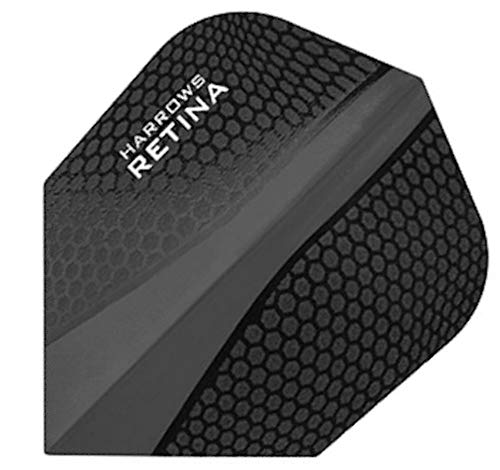
Harrows Retina Dart Flights, Kite Shape, 100 Micron — Best Kite Shape
This suits the player whose standard flights feel slightly too much and whose slim flights feel slightly too little. Kite sits between them, and it has a loyal following among players with medium-speed throws who want a touch more speed and a touch less drag without giving up stability. This listing is flagged as a weaker pin in our sources file because it came through a marketplace-style listing rather than a current brand page.
- Shape: kite
- Thickness: 100 micron (Retina construction)
- Pack: 5 sets (per listing)
- Construction: translucent centre with tough outer laminate (per range description)
Strengths
- Middle-ground shape between standard and slim
- Same durable Retina construction as the standard pick
- Useful experiment for players dialling in flight size
Trade-offs
- Kite is a minority shape, so local shops may not stock it
- Listing provenance is weaker than the other picks here
- Still a fold-flat flight that can be knocked loose
Kite is the connoisseur’s compromise. Its pointed, swept outline keeps meaningful surface area for stability while cutting the trailing bulk that makes a standard flight drag and deflect. Players who discover kite usually arrived by experiment: standard felt slow, slim felt nervous, and kite felt like the dart they meant to throw. The Retina construction gives that experiment a durable platform, with the same 100 micron build as the standard-shape pick.
We include it with an explicit caveat. Our source for this exact kite listing was a marketplace-style reseller page rather than a current manufacturer listing, so treat the ASIN as a weaker pin: check the listing carefully on arrival, confirm shape and thickness match the description, and know that the standard-shape Retina above is the safer order if you do not specifically want kite. The shape itself, for the right throw, is genuinely excellent.
The limitation is twofold: kite suits a narrower band of throws than standard, and this particular listing carries more provenance risk than the other picks, which is why it is flagged rather than hidden.
Best for: medium-speed throwers fine-tuning flight size / Not suited for: beginners, who should start with standard shape

CUESOUL ROST 77 Integrated Dart Shaft and Flight, Big Wing — Best Durability Upgrade
This suits heavy-handed, high-volume players whose traditional flights and shafts die young: league players practising daily, and anyone whose darts take hard deflections into floors and walls. When you are replacing fold-flat flights every fortnight, a tougher integrated system stops being a luxury and becomes arithmetic.
- Type: integrated dart shaft and flight
- Shape: big wing
- Brand: CUESOUL (ROST 77)
- Format: set of 3 (per listing)
Strengths
- Built for players who destroy conventional flights quickly
- Big wing shape stabilises heavier darts and slower throws
- Moulded construction holds its angle indefinitely
Trade-offs
- Premium per-set cost versus bulk fold-flat flights
- Breakage means replacing the complete unit
- Big wing is too much flight for light, fast darts
Durability claims are easy to print and hard to test from a desk, so judge this pick by its construction logic instead. A fold-flat flight fails at predictable places: the trailing edge tears, the slot in the shaft widens, the flight takes a permanent bend. An integrated big wing removes the slot, thickens the vulnerable transitions, and holds its shape because there is no fold to fatigue. For a player getting through conventional flights at a rate, the working life of each unit is the specification that matters.
The big wing shape pairs that toughness with maximum stabilisation, which suits the same players: those throwing heavier darts, or with a slower, higher arc that needs the flight to work harder in the air. It is not a subtle dart set-up, and it is not meant to be. It is the pick for the player who wants to fit flights and then not think about flights again for a long stretch of heavy play, whether the darts are steel tips from best steel tip darts or soft tips from best soft tip darts.
The honest limitation is value at low volume: a casual player who throws twice a month may never wear out cheap flights fast enough for this upgrade to pay for itself.
Best for: high-volume players who wear out flights quickly / Not suited for: occasional players and light, fast dart set-ups
Comparison Table
| Pick | Shape | Construction | Pack |
|---|---|---|---|
| Harrows Retina Dart Flights, Standard Shape, 100 Micron (5 Sets) | Standard | Fold-flat, 100 micron | 5 sets / 15 flights |
| CUESOUL ROST T19 Integrated Dart Shaft and Flights, Big Wing, 28mm | Big wing | Integrated moulded | Set of 3 |
| CUESOUL TRAJ AK8 Integrated Dart Flights and Shafts, Very Slim Diamond Shape | Very slim diamond | Integrated moulded | Set of 3 |
| CUESOUL ROST Integrated Dart Shaft and Flights, Standard Shape | Standard | Integrated moulded | Set of 3 |
| Harrows Retina Dart Flights, Kite Shape, 100 Micron | Kite | Fold-flat, 100 micron | 5 sets (per listing) |
| CUESOUL ROST 77 Integrated Dart Shaft and Flight, Big Wing | Big wing | Integrated moulded (ROST 77) | Set of 3 |
How to Choose Dart Flights
Shape: the decision that matters most
Standard is the default for a reason: the largest mainstream surface area, the most correction in the air, and the most forgiveness for a developing release. Most players should start here and many should stay here. Slim cuts the surface down for faster, flatter throws and tighter groupings, at the cost of forgiveness. Pear and teardrop concentrate their area differently for players fine-tuning a dart that lands tail-down or tail-up. Kite splits the difference between standard and slim. Big wing goes beyond standard for maximum stabilisation of heavy darts and slow arcs.
Change shape for a reason you can name. If your darts wobble visibly or land at scattered angles, you need more flight, not less. If your darts fly true but bounce off each other’s flights around the treble, you may need less. Changing shape because a professional throws that shape is not a reason; professionals have releases most of us will never own.
Fold-flat versus integrated
Fold-flat flights are the traditional system: cheap, light, available in every shape and design imaginable, and replaceable in seconds. Their weaknesses are the joint: flights pop out on deflections, sit crooked when re-seated, and shafts split on robin hoods. Integrated systems delete the joint, hold a perfect angle forever, and shed deflections smoothly, at a higher per-set cost and with whole-unit replacement when something breaks.
Neither philosophy is simply better. A player who enjoys experimenting should stay fold-flat, because the experiment space is enormous and cheap. A player who wants their darts identical every session, and who travels with them, will usually be happier integrated. Many players end up owning both: integrated for matches, fold-flat for practice experiments.
Thickness and material
Fold-flat flights are sold by micron thickness, and the numbers describe stiffness and durability. Thin flights around 75 micron are light and lively but tear and warp quickly. The 100 micron class, used by the Retina picks here, is the settled favourite of experienced players: stiff enough to hold a true cross, tough enough to last, light enough not to change the dart’s balance noticeably. Very thick flights add durability for some players and unwanted weight and drag for others.
Whatever thickness you choose, judge a flight by how it ages. A flight that holds its shape for a month of play is cheaper in every sense than a bargain flight that warps in a week, because a warped flight is not a worn flight, it is a different flight, and your other two darts are still wearing its twins.
Shaft length interacts with flight choice
Flights do not act alone: the shaft behind them sets the leverage the flight works with. Longer shafts give a flight more authority and tend to suit bigger shapes; shorter shafts make the dart more direct and pair naturally with smaller shapes. When you change one, expect the other to feel different, and change them one at a time so you know what did what. Integrated systems fix a shaft length into the product, so match that length to your current set-up when you order.
This is also why borrowing a friend’s darts tells you so little. Their flight, shaft, barrel and grip are a system tuned, accidentally or deliberately, to their hand. Borrow the idea of a shape, by all means, but test it on your own barrels with your own shafts before judging it.
How many spares, and when to replace
Carry at least one full spare set, identical in every respect, and replace flights as a set of three rather than one at a time. A single new flight among two worn ones makes three aerodynamically different darts. Replace when a flight tears, takes a visible bend that will not straighten, or no longer sits at a clean right angle in the shaft. With integrated systems, replace a unit when the shaft cracks or the flight deforms, and again, keep the set matched.
Keep your spares and your darts together. A small case from the range in best dartboard accessories protects flights from being crushed flat in a bag, which is how many flights die before they are ever thrown. And if your board area is dim, remember flights are only half the visibility story; best dart board lighting covers the other half.
Key Takeaways
- Shape first: standard forgives, slim groups, kite compromises, big wing stabilises.
- Integrated systems delete the popped-flight problem; fold-flat flights delete the cost of experimenting.
- 100 micron is the experienced player’s settled thickness for fold-flat flights.
- Replace flights as a matched set of three, and always carry identical spares.
How to fit and maintain dart flights
Fitting a fold-flat flight sounds too simple to get wrong, yet two small errors account for most flight frustration: pushing the flight only part-way into the shaft, and leaving the four fins at uneven angles. Work through the routine below whenever you fit a fresh set, and your flights will last longer and fly truer.
- Open the flight fully and crease each fin gently so the four wings sit at even right angles before it goes near a shaft.
- Push the flight fully home into the shaft slots until it seats; a half-seated flight will work loose and sit crooked in flight.
- Check all three darts side by side: the flights should mirror each other exactly in angle and depth.
- Consider flight protectors on the trailing edge if your grouping is tight; they spread deflections and extend flight life.
- After any hard deflection or floor drop, glance at the flight before your next visit; small bends caught early can be straightened once.
- Straighten a lightly bent flight between your fingers once; if it bends again in the same place, replace the set.
- Store darts in a case with the flights protected, never loose in a bag where fins get crushed flat.
How to test a new flight shape honestly
Flight experiments fail when they are judged in five minutes. A new shape feels strange before it feels better or worse, and strange gets mistaken for bad. Give any new shape a fair trial: fit a full matched set, throw your normal practice routine for at least three separate sessions, and score a simple benchmark, such as counting darts to finish a set number of legs or your hits on the treble twenty across a fixed number of visits, before and after the change.
Change one thing at a time. If you swap shape and shaft length together, you have learned nothing you can repeat. Problem: darts land tail-up with the new flight. Fix: that is information, not failure; try a slightly larger shape or a longer shaft before abandoning the experiment. Problem: more bounce-outs off other flights. Fix: step down a shape size, since your grouping has outgrown your flight’s surface area. Keep notes; the players who improve fastest are the ones who can say what they changed and what it did, which is as true for the darts in best steel tip darts as for the flights on them.
Flights for Steel Tip and Soft Tip: What Actually Differs
Players moving between formats often ask whether they need different flights for steel tip and soft tip darts, and the honest answer is: the same shapes and the same logic apply, but the typical dart at the end of the flight is lighter in soft tip, and lighter darts generally pair with slightly smaller flights. A soft tip dart in the common electronic-board weight range flies well on slim or standard shapes, and the very slim integrated pick in this guide is a favourite format among soft tip players for exactly that reason. A heavier steel tip dart, especially one thrown with a slower arc, usually wants standard or big wing area to keep it honest in the air.
What does not change is the method. Start from the shape that matches your dart weight and your arc, test it over several sessions, and adjust one step at a time. The darts themselves differ far more between formats than the flights do, which is why this batch treats them separately in best soft tip darts and the steel tip guide, while flights get one shared guide. One caution for soft tip players: electronic boards punish bounce-outs differently, since a dart that deflects off a flight and misses the board scores nothing and stresses the tip, so a slightly smaller flight that reduces deflections can be worth real points over a season.
Designs and colours, finally, are the one area where you should simply please yourself. Every serious flight in this guide is available in colours and prints beyond the ones listed, and there is no evidence that any design flies better than another at the same shape and thickness. Pick the look you enjoy, keep the shape disciplined, and your darts will be both personal and consistent, which is the correct order of priorities.
Flight Shapes in Practice: A Player’s Tour
Abstract shape charts become clearer when you attach them to real players. Consider the league player throwing a medium-weight dart with a looping arc that drops onto the board. That dart spends a long time in the air, wanders if it is released slightly off line, and needs all the correction a flight can give: standard shape, or big wing if the arc is pronounced, is not a compromise for this player but the correct tool, and moving them to slim flights in the name of fashion would cost them darts in every visit. Their grouping problem, when it comes, is solved by practice and by protectors, not by shrinking the flight.
Now consider the opposite player: a fast, flat thrower whose darts barely rise above the eye line and arrive at the board still travelling. That dart needs almost no correction, and a big flight mostly acts as a sail for the following darts to hit. This is the player slim and very slim shapes were made for, and the player who benefits from the integrated slim pick in this guide, because their darts land close enough together that flight-on-flight deflections are their biggest source of lost points. Between these two extremes sits the majority of club players, and for them kite and standard are the honest battleground, decided by testing rather than theory.
There is one more variable charts ignore: where the dart lands, not just how it flies. A flight change alters the dart’s resting angle in the board, and a dart that lands tail-up presents its flight over the bed below it, while a tail-down dart can obscure the bed above. Players chasing doubles at the bottom of the board and players who live on the treble twenty may rationally prefer different resting angles from identical throws. This is why the testing routine in the how-to section uses your own scoring targets, not a generic accuracy drill: the best flight is the one that improves the darts you actually throw, at the targets you actually aim at.
Keep a small flight library once you find your shape. One set on the darts, one identical spare set in the case, and one set a single step up and a single step down in size for experiments and for the day your throw changes, as throws do across a season. That modest library, costing very little, covers almost every situation a club player will meet, and it pairs with the cases and spares discussed in best dartboard accessories to make a genuinely self-sufficient darts kit.
Common Buying Mistakes
Buying the shape a professional throws
Professional releases are not yours. A slim flight on a developing throw removes correction you need and scores worse, however good it looks on television. Match the flight to your arc and your dart weight.
Replacing one flight at a time
A new flight among two worn ones makes three different darts. Flights are cheap; replace them as a matched set of three and keep the set identical in shape, thickness and age.
Ignoring a bent flight
A bent flight is a different flight. Straighten a light bend once; if it recurs, replace the set. Throwing a warped flight for weeks teaches your arm to compensate for equipment, not to throw better.
Changing flight and shaft together
Two changes at once teach you nothing repeatable. Alter one variable, test it across several sessions, record the result, then consider the next change.
Carrying no spares
A torn flight with no spare ends a session or forces a mismatched replacement. One identical spare set in the case is the cheapest insurance in the sport.
Judging a new shape in five minutes
New shapes feel strange before they feel better. Give any change at least three proper sessions and a simple scored benchmark before deciding.
Final Recommendation
For most players the answer is the first pick: the Harrows Retina Dart Flights, Standard Shape, 100 Micron (5 Sets) give you the reference shape in the proven thickness, in a pack that keeps spares in your case. The runner-up is philosophical: if you are done with popped and crooked flights, the CUESOUL ROST Integrated Dart Shaft and Flights, Standard Shape keeps your standard shape and deletes the joint entirely.
Flights reward the methodical. Pick the shape your throw actually needs, test it properly, replace as a set, and this smallest part of the dart will quietly stop costing you darts.
Treat your first purchase from this guide as the start of a small, cheap experiment rather than a final answer. Buy your best-guess shape, test it across three honest sessions against a simple benchmark, and keep notes. Darts is unusual among sports in that a meaningful equipment variable costs less than a round of drinks; the players who exploit that, methodically, are the ones whose set-up quietly stops being a topic and becomes a foundation.
Frequently Asked Questions
What is the best dart flight shape for beginners?
Standard, without much debate. It offers the most stabilisation and forgiveness while a release is developing, and it suits the medium-weight darts most beginners throw. Move to a smaller shape only when your darts fly consistently straight and your problem becomes crowding and deflections rather than wobble. The standard-shape picks in this guide, in both fold-flat and integrated forms, are the sensible starting points.
Do dart flights really make a difference?
Yes, measurably. The flight is the dart’s stabiliser and its largest aerodynamic surface, so its shape changes how much the dart corrects in the air, the angle it lands at, and how it interacts with darts already in the board. The difference between adjacent shapes is modest; the difference between a true flight and a warped one is not, which is why condition matters as much as choice.
How often should I replace dart flights?
Replace them when they tear, bend permanently, or stop sitting square, rather than by the calendar. High-volume players may go through fold-flat sets in weeks; casual players may get months from a set. Integrated systems last longer per unit. In all cases replace as a matched set of three so your darts stay aerodynamically identical.
Are integrated flights better than normal flights?
They are better at consistency and worse at flexibility. An integrated unit can never pop out or sit crooked, and it holds its angle indefinitely, but it costs more, offers fewer shapes, and is replaced whole when damaged. Players who experiment should stay with fold-flat flights; players who want identical darts every session usually prefer integrated, as the standard and big wing picks here show.
What do micron numbers on flights mean?
They describe the thickness of the flight material. Higher numbers mean a stiffer, tougher flight that holds its shape longer, with a small weight and drag cost. Around 100 micron is the settled choice of most experienced players for fold-flat flights. Very thin flights feel lively but tear and warp quickly, which quietly changes how the dart flies.
Can I use the same flights for steel tip and soft tip darts?
Yes, the fitting is the same and the shape logic is the same, with one adjustment: soft tip darts are usually lighter, and lighter darts usually pair with slightly smaller shapes. If you play both formats, the guides to best soft tip darts and best steel tip darts cover the darts, while this guide covers the flights for both.
Why do my flights keep falling out?
Usually because the shaft slots have widened, the flight is not pushed fully home, or the flight is too thick for the slot. Re-seat fully, check the fins are even, and if it persists, replace the shafts or consider an integrated system, which removes the joint entirely. Flight rings and protectors can also help a traditional set-up hold together.
Should I use flight protectors?
If you group your darts tightly, yes. A flight protector sits on the trailing edge of the flight, spreads the impact of an incoming dart, and noticeably extends flight life while reducing the deflections that knock flights out of true. They add a tiny amount of weight at the very back of the dart, which most players never notice. Players with loose groupings gain little from them, which makes protectors a good example of this guide’s rule: buy accessories for the problem you demonstrably have.