Disclosure: As an Amazon Associate, umtsmarttool.com earns from qualifying purchases. Links to Amazon on this page are affiliate links; they cost you nothing extra. Prices and availability change often, so check the current Amazon listing before you buy.
Where to buy
Short on time? Start with the Bulova Sutton Skeleton 97A161, the standout pick in this guide to the best skeleton watches. The full shortlist:
- Bulova Sutton Skeleton 97A161 — Check on Amazon
- Orient Bambino Open Heart RA-AG0003S — Check on Amazon
- Fossil Townsman Automatic ME3170 — Check on Amazon
- Fossil Grant Sport Auto ME3138 — Check on Amazon
- Stuhrling Original Winchester 44 Elite 165B2B.335B1 — Check on Amazon
- Seiko Presage Open Heart SSA359
Read the full guide ↓
The best skeleton watches answer a curiosity every mechanical watch owner feels: what is actually happening in there? A skeleton watch removes or cuts away the dial — and often skeletonises the movement’s own plates and bridges — so the balance wheel, gears and escapement become the display. An open-heart watch is the gentler version of the same idea: a mostly solid dial with a window, usually over the balance wheel, offering a glimpse rather than the full machinery. This guide covers both, labels each pick honestly as one or the other, and explains the difference in the buying section, because listings blur the two words constantly.
Two honest notes frame the whole list. First, every pick here is an automatic mechanical watch — skeletonisation only makes sense when there is a movement worth watching, and quartz has nothing to show. Second, skeleton watches trade legibility for theatre: reading the time through a forest of gears takes a beat longer than reading a clean dial, and the more completely a watch is skeletonised, the truer that becomes. Three of the six picks — the Seiko Presage SSA359, the Bulova Sutton Skeleton 97A161 and the Fossil Grant Sport Auto ME3138 — are listed without an Amazon link because we could not verify a correct ASIN for any of those exact models from an opened source; they are recommended in prose rather than through guessed links. Readers who prefer their automatics with solid dials will find plenty in our best automatic watches guide, and the dress-watch end of this style is developed further in the best dress watches roundup.
In this guide
Quick Picks
| Watch | Badge | Key spec |
|---|---|---|
| Bulova Sutton Skeleton 97A161 | Best Overall | Full skeleton, 21-jewel automatic, 100 m |
| Orient Bambino Open Heart RA-AG0003S | Best Dress Open Heart | F6T22 automatic, 40.5 mm, domed mineral crystal |
| Fossil Townsman Automatic ME3170 | Best Fashion Skeleton | 44 mm automatic skeleton, leather strap |
| Fossil Grant Sport Auto ME3138 | Best Sporty Skeleton | Automatic skeleton dial, black leather strap |
| Stuhrling Original Winchester 44 Elite | Best Budget Full Skeleton | Automatic full skeleton, 44 mm |
| Seiko Presage Open Heart SSA359 | Best Premium Open Heart | 4R38 automatic, exhibition case back, 5 bar |
How These Picks Were Chosen
The first decision was taxonomy. Listings use “skeleton” for everything from a fully open-worked movement to a solid dial with one small window, so each pick was classified from its manufacturer or retailer description as either a full skeleton (dial largely removed, movement visible across the face) or an open heart (a window in an otherwise solid dial). Both styles belong in this guide — buyers search for them together — but no pick is allowed to borrow the other’s name, and the reviews state the classification plainly.
The second filter was movement credibility. A skeleton watch is a display case for its calibre, so the calibre has to be worth displaying and, just as importantly, identifiable: every pick’s movement is named from manufacturer or retailer sources — Bulova’s 21-jewel automatic, Orient’s in-house F6T22, Seiko’s 4R38, Fossil’s automatic modules. Anonymous “imported movement” skeletons with no stated calibre were excluded, as were the ultra-cheap no-name skeletons whose finishing turns the theatre into a mess. Specifications were verified per model from opened sources; the three picks whose Amazon ASINs could not be verified (Seiko SSA359, Bulova Sutton Skeleton 97A161 and Fossil Grant Sport Auto ME3138) are prose-only by design. Badges follow the real buying patterns: full skeleton versus open heart, dress versus fashion versus sport, and the budget floor of the category.
The 6 Best Skeleton Watches
Bulova Sutton Skeleton 97A161 — Best Overall
The Sutton 97A161 suits the buyer who wants the complete skeleton experience from a real watchmaker. Bulova’s Classic Sutton pairs a fully skeletonised dial with a 21-jewel automatic movement offering roughly a 42-hour power reserve, luminous hands to keep the time findable among the gears, and — almost unheard of in this category — a 100 m water resistance rating in its 43 mm case. Most skeleton watches are dry-land jewellery; the Sutton is engineered like a watch that happens to show its movement.
- Movement: Bulova automatic, 21 jewels, approximately 42-hour power reserve
- Case: 43 mm stainless steel
- Display: Full skeleton dial, luminous hands
- Water resistance: 100 m
Strengths
- Full skeleton display with an identifiable, reputable automatic movement
- 100 m water resistance is exceptional among skeleton watches
- Luminous hands solve the skeleton legibility problem better than most
Trade-offs
- Costs more than the fashion-brand skeletons here
- Busy dial still reads slower than any solid-dial watch
- 43 mm case is substantial on slim wrists
What elevates the Sutton is that Bulova treats the skeleton brief as an engineering problem rather than a styling exercise. The movement’s bridges are shaped to be looked at, the dial furniture that remains — chapter ring, markers, logo — is placed to frame rather than fight the machinery, and the case is sealed like a sports watch. Owners coming from Bulova’s broader range, covered in our best dress watches guide’s wider context, will recognise the brand’s habit of over-delivering specification at a given price. The blue-accented version of this reference is the one our ASIN research verified on Amazon; confirm the colourway on the listing, as the Sutton skeleton family includes several finishes.
It also helps that the Sutton’s skeletonisation is honest about its price. The bridges are machine-finished with clean, even surfaces rather than hand-bevelled edges, and Bulova spends the difference on the things owners actually use: the water resistance, the lume, the bracelet-grade case finishing. Under a loupe a Swiss skeleton at twenty times the price wins easily; on the wrist, across a desk, the Sutton produces the same double-take. That balance — theatre where it shows, engineering where it counts — is why it leads this guide rather than merely appearing in it.
The honest limitation is the category’s own: at a glance, in bad light, mid-conversation, the Sutton takes a moment longer to read than a plain watch, luminous hands notwithstanding. If your watch is primarily a tool you consult fifty times a day, that friction accumulates. If it is a machine you enjoy, the friction is the price of the show — and this is the best-staged show in the guide.
Best for: buyers wanting a true full skeleton with real watchmaking behind it / Not suited for: glance-and-go time readers
Check on Amazon
Orient Bambino Open Heart RA-AG0003S — Best Dress Open Heart
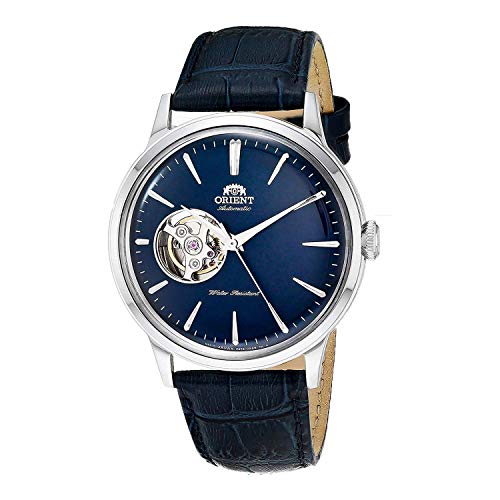
The Bambino Open Heart suits the buyer who wants mechanical theatre in a watch that still behaves at a dinner table. Orient — one of the few affordable brands that designs and manufactures its own movements — cuts a window at nine o’clock in the Bambino’s domed, vintage-styled dial, revealing the balance of its in-house F6T22 automatic calibre, which hacks and hand-winds and runs for roughly 40 hours. The rest of the dial keeps the Bambino’s beloved dress-watch manners: applied indices, dauphine hands, a domed mineral crystal and a 40.5 mm case.
- Movement: Orient F6T22 automatic, in-house, hacking and hand-winding
- Case: 40.5 mm stainless steel, 12 mm thick
- Crystal: Domed mineral
- Water resistance: 30 m
- Display: Open heart window at 9 o’clock, exhibition case back
Strengths
- In-house movement — rare and valued at this price level
- Open-heart restraint keeps it a genuine dress watch
- Domed crystal and 40.5 mm case wear elegantly on most wrists
Trade-offs
- Near-identical Bambino references exist — check RA-AG0003S on the listing
- 30 m rating is splash-only
- No date window — the dial prioritises symmetry and the window
The Bambino family’s reputation rests on giving buyers the vintage dress-watch experience — domed glass, warm dial, slim profile — at an entry price, and the open-heart version adds the one thing the standard Bambino hides: proof of the machinery. The window is placed where your cuff uncovers it first, and the visible balance, beating away at the dial’s edge, changes the watch from an accessory into a small machine you happen to wear. Orient’s in-house calibre matters here beyond snobbery: parts, service knowledge and long-term support for an F6-series movement are as secure as affordable watchmaking gets.
Details reward attention. The gold-tone case variant of this reference warms the whole design toward the vintage end of the Bambino spectrum, while the silver-dial and brown leather combination keeps it in classic dress territory; the domed crystal distorts the dial’s edge at oblique angles in the way collectors call “character” and everyone else calls pretty. Because there is no date window, the dial keeps perfect symmetry — a small purity that date-equipped rivals cannot claim, and one reason this reference photographs so well. If your wardrobe runs formal, this is the skeleton-category watch that will actually get worn.
The honest limitations are water and reference confusion. Thirty metres is a splash rating on a leather strap — this is a dry-weather watch. Check the reference number on the listing character by character before buying, as near-identical Bambino references exist.
Best for: dress-watch buyers wanting a mechanical heartbeat on display / Not suited for: water, or buyers who need a date

Fossil Townsman Automatic ME3170 — Best Fashion Skeleton
The Townsman ME3170 suits the buyer who shops with their eyes first. Fossil’s Townsman line is its automatic showcase, and this 44 mm version pairs a skeletonised dial with a rose-gold-tone case and a black leather strap — a combination built to be noticed across a table. The automatic movement is visible through both the dial and the exhibition back, and Fossil’s interchangeable strap system means the watch can be re-costumed in seconds.
- Movement: Fossil automatic, skeleton display
- Case: 44 mm stainless steel, rose-gold tone
- Strap: Leather, interchangeable
- Display: Skeleton dial with exhibition case back
Strengths
- Strongest visual impact per dollar in this guide
- Exhibition back doubles the movement display
- Quick-release straps make it endlessly re-styleable
Trade-offs
- Fashion-brand movement lacks the pedigree of the Orient and Seiko calibres
- 44 mm case is large for a dress-leaning watch
- Rose-gold tone finish will show wear at edges over years
Fossil understands something the traditional brands sometimes forget: most skeleton watches are bought as objects of fascination and style, not as horological statements. The Townsman leans into that honestly — big case, warm metal tone, the movement framed like a picture. The automatic inside is a serviceable Japanese-sourced module of the kind Fossil fits across its automatic range; it will keep time, show its gears and ask only to be worn or wound. Readers who like the approach will find the Townsman’s siblings and strap options multiplying quickly once they start browsing the best watch bands ecosystem.
The honest limitation is depth of watchmaking. There is no in-house calibre story here, finishing is decorative rather than fine, and a tone-coated case ages less gracefully than bare steel. None of that matters if the watch is bought as design — and as design, it is the most confident object in this guide.
Best for: style-led buyers wanting maximum skeleton drama / Not suited for: movement purists
Fossil Grant Sport Auto ME3138 — Best Sporty Skeleton
The Grant Sport Auto suits the buyer who wants the skeleton idea in a darker, sportier register. Where the Townsman is warm and dressy, the ME3138 is black-on-black: a black case and dial furniture, a skeletonised centre that exposes the automatic movement, and a black leather strap. It reads as the night version of the fashion skeleton — less boardroom, more bar — and the Grant case shape gives it a slightly more athletic stance than its Townsman sibling.
- Movement: Fossil automatic, skeleton display
- Case: Stainless steel, black finish
- Strap: Black leather
- Display: Skeleton dial
Strengths
- Dark, cohesive styling unlike anything else in this guide
- Automatic movement with a genuine skeleton dial at a fashion price
- Grant case wears comfortably despite its size
Trade-offs
- Black-on-black is the hardest dial here to read in low light
- Coated case will show scratches in silver over time
- Same fashion-movement caveats as the Townsman
Choosing between the two Fossils is a wardrobe decision. The Townsman’s rose gold and cream tones sit with tailoring and warm colours; the ME3138’s blackout treatment sits with monochrome and casual wear, and its skeleton window reads as texture as much as machinery. Both share Fossil’s ownership experience: an automatic that wants wearing several times a week to stay wound, standard strap fittings, and a price that makes the skeleton experiment low-risk. If the black finish is your concern, know that coated cases across all brands share the same fate — edges polish bright with wear — and decide whether that lived-in look suits the watch’s character; on this design, it arguably does.
One more sizing note applies to both Fossils. At 44 mm with skeleton dials — visually busier than plain dials of the same diameter — they read large, and on wrists under about 6.5 inches they will dominate the forearm. That is sometimes exactly the point: fashion skeleton buyers usually want the watch seen, commented on and asked about. But if your taste runs understated, the same budget in this guide buys the Orient’s restraint or the Seiko’s classicism, and no amount of strap-swapping will make a 44 mm skeleton whisper. Choose the volume you actually want before choosing the model.
The honest limitation is legibility, the weakest in this guide. Dark hands over a dark, busy skeleton dial in dim light is a genuine struggle, and no lume specification we could verify rescues it. Buy the ME3138 as a daylight and evening-social watch, and keep a legible alternative for the small hours.
Best for: monochrome dressers wanting a sporty skeleton / Not suited for: low-light legibility needs
Check on Amazon

Stuhrling Original Winchester 44 Elite 165B2B.335B1 — Best Budget Full Skeleton
The Winchester 44 Elite suits the buyer who wants a fully skeletonised watch — dial essentially gone, movement architecture as the entire face — at the lowest price in this guide. Stuhrling Original built its name on exactly this formula: dramatic open-worked automatics with decorated bridges, blued screws and exhibition backs at prices the Swiss skeleton tradition would consider a rounding error. The Winchester’s 44 mm black case frames the machinery like a picture, and for a first skeleton it delivers the essential experience undiluted.
- Movement: Automatic, fully skeletonised display
- Case: 44 mm, black finish
- Display: Full skeleton dial, exhibition case back
Strengths
- True full skeletonisation at the guide’s lowest price
- Decorated movement bridges make the display genuinely ornamental
- 44 mm frame gives the machinery room to be seen
Trade-offs
- Long-running model; listings and availability vary — check seller and stock carefully
- Movement is an anonymous calibre without the support network of Seiko or Orient
- Legibility is the most theatrical and least practical here
Stuhrling’s proposition deserves a fair hearing. Skeletonisation began as haute horlogerie — hand-cut bridges, bevelled edges, prices in the thousands — and brands like Stuhrling industrialised the look. The Winchester’s movement will not survive a loupe comparison with a Swiss skeleton, and it does not need to: from conversational distance, the layered gears, the visible balance and the decorated plates produce the same fascination that sells the category. As a first skeleton — a way to discover whether you love wearing machinery — it is the rational entry point in this guide, with the Bulova waiting as the upgrade.
Buy it with the right frame of mind and it will not disappoint. The Winchester is a long-running model, and stock on Amazon flows through a changing mix of sellers, so check the seller, the returns terms and the exact reference — 165B2B.335B1 — on the listing before ordering, and inspect the watch on arrival while returns are simple: the movement should start with a few crown turns, the hands should set without grinding, and the skeleton dial, which hides nothing, will show any dust or fingerprint trapped inside immediately. Treated as a fashion-forward mechanical toy with real guts rather than a lifetime instrument, it earns its place as this guide’s budget door into the category — and more than a few collectors who started with one still keep it in the box years later, which is the sincerest review a budget watch can earn.
The honest limitations are support and sourcing. This model has been sold for many years under this reference, stock turns over slowly, and the calibre inside is not one your local watchmaker will know by name. Buy from a seller with a real returns policy, verify the watch runs and the hands are correctly set when it arrives, and treat the purchase as the fashion-mechanical object it is.
Best for: first-time skeleton buyers wanting the full effect cheaply / Not suited for: collectors wanting calibre pedigree
Seiko Presage Open Heart SSA359 — Best Premium Open Heart
The SSA359 suits the buyer who wants the open-heart idea executed with Japanese fine-watch manners. Seiko’s Presage line is its dress-watch flagship at accessible prices, and this model sets an open-heart window at nine o’clock into a dark sunburst dial, backed by an exhibition case back showing the 4R38 automatic movement. Where the Orient offers vintage warmth, the Presage offers polish: applied indices, a refined case, and finishing that rewards a loupe rather than merely surviving one.
- Movement: Seiko 4R38 automatic
- Display: Open heart window at 9 o’clock
- Case back: Exhibition, showing the movement
- Water resistance: 5 bar (50 m)
Strengths
- Presage finishing is the finest in this guide
- Open heart plus exhibition back shows the movement from both sides
- Seiko’s service network and parts support are the safest here
Trade-offs
- Prose-only in this guide: no verified Amazon ASIN was found for this reference
- Costs the most of the six picks
- 50 m rating still means dry-land wear on a strap
The Presage argument is cumulative quality. The dial’s sunburst catches light the way only Seiko’s dress line manages at this level; the window is cut and finished cleanly rather than punched; the movement visible through the back carries Seiko’s own decoration. It is the open-heart watch for the buyer who has already owned the Orient and wants the same idea with every edge refined — or who simply prefers Seiko’s cooler, more contemporary dress language. Presage’s wider Cocktail Time family is the natural next browse, and Seiko’s range as a whole is mapped in our best seiko watches guide.
The honest limitations mirror the Orient’s: this is a 50 m, strap-wearing dress watch, and this guide could not verify an Amazon ASIN for the exact SSA359 reference, so it is recommended in prose. Authorised Seiko dealers stock the Presage line widely; check the reference on the case back against the listing before paying, as Presage open-heart models come in several similar references.
Best for: buyers wanting the most refined open-heart watch here / Not suited for: bargain hunters or water wear
Comparison Table
| Watch | Style | Movement | Case | Water resistance |
|---|---|---|---|---|
| Bulova Sutton 97A161 | Full skeleton | Automatic, 21 jewels | 43 mm | 100 m |
| Orient Bambino RA-AG0003S | Open heart | Orient F6T22 automatic | 40.5 mm | 30 m |
| Fossil Townsman ME3170 | Skeleton | Fossil automatic | 44 mm | — |
| Fossil Grant Sport Auto ME3138 | Skeleton | Fossil automatic | Steel, black | — |
| Stuhrling Winchester 44 Elite | Full skeleton | Automatic | 44 mm | — |
| Seiko Presage SSA359 | Open heart | Seiko 4R38 automatic | Steel | 50 m |
How to Choose a Skeleton Watch
Decide first how much machinery you actually want to see, because “skeleton” spans a spectrum. A full skeleton — the Bulova, the Stuhrling — removes the dial almost entirely; the movement’s bridges become the face, time-telling becomes a skill you practise, and the watch is a conversation before it is an instrument. An open heart — the Orient, the Seiko — keeps a proper dial and opens one window over the balance wheel; you lose the full machinery and gain a watch that still works in every social setting. Neither is the correct answer, but they are different products, and the most common disappointment in this category is ordering one while picturing the other. Look at photographs of the exact reference, not the product line, before deciding.
Second, interrogate the movement, because in a skeleton watch the movement is the product. Prefer named calibres from identifiable makers — Seiko’s 4R family, Orient’s F6 family, the Miyota and Seiko-sourced modules behind reputable fashion automatics — over listings that say only “automatic movement” and nothing more. Check whether the movement hacks (stops its seconds hand when the crown is out) and hand-winds; both features, present in the Orient F6T22 and Seiko 4R38, make an automatic far easier to live with in a rotation. Power reserve in this class clusters around 40 hours, so expect to wear the watch at least every other day or keep a winder habit.
Third, be honest about legibility and water. Skeleton dials scatter the eye; luminous hands (Bulova) and high-contrast chapters (Orient, Seiko) mitigate but never eliminate the cost. If you read the time constantly and quickly, choose an open heart. Water resistance in this category is mostly decorative — 30 to 50 m is typical — and the Bulova’s 100 m is the exception that proves the rule; leather straps across the list confirm the dry-land intent. Finally, buy the seller: skeleton and open-heart references have many near-identical siblings, so verify the exact reference number, and favour authorised dealers or marketplaces with strong returns — advice that applies double to the prose-only picks in this guide, which you will be buying away from the links above. Collectors building a wider mechanical collection should also read our best japanese watches overview, since three of these six picks are Japanese.
Key Takeaways
- Full skeleton and open heart are different products; choose deliberately, not by listing keywords.
- The movement is the display — insist on a named, identifiable calibre.
- Every pick here is automatic; skeletonisation only makes sense with machinery worth watching.
- Legibility costs rise with skeletonisation. Luminous hands and contrast are the mitigations.
- Water resistance is modest across the category; the Bulova’s 100 m is the exception.
How to Wind, Set and Care for an Automatic Skeleton Watch
An automatic skeleton asks slightly more of its owner than a quartz watch, and the routine is part of the pleasure:
- Start a stopped watch with the crown: unscrew or pull it to the winding position and turn it 20–30 times. The visible movement lets you watch the mainspring’s effect — the balance springs to life as you wind.
- Set the time by pulling the crown to the time position; on hacking movements (Orient F6T22, Seiko 4R38) the seconds hand stops, letting you set to the minute exactly.
- Wear the watch at least every other day, or wind it on the same schedule, to stay within its roughly 40-hour reserve.
- Keep the exhibition back and skeleton dial clean with a soft, dry cloth; never open the case yourself — the exposed movement you admire is exposed to dust the moment the seal breaks.
- Plan on a professional service every few years: oils dry and gaskets age in mechanical watches, skeleton or not, and a watchmaker familiar with the calibre family is worth finding before you need one.
Two troubleshooting patterns recur with automatics. Problem: the watch stops overnight despite being worn. Fix: a sedentary day may not wind enough — supplement with manual winding, and check the watch is not spending its days on a desk; automatics wind from wrist motion, not from existing near one. Problem: the time drifts minutes per week. Fix: first demagnetise (a watchmaker does this in minutes; phones, laptops and magnetic clasps are the usual culprits), then have the movement regulated if drift persists — both are routine, inexpensive services for the named calibres in this guide.
Skeletonisation: A Short History
The skeleton watch began as a watchmaker’s flex. In the eighteenth and nineteenth centuries, cutting away a movement’s plates to reveal the gear train — while leaving the structure strong enough to run — demonstrated mastery that a closed dial never could, and skeletonised pocket watches became presentation pieces. The wristwatch era industrialised the idea in stages: first the open heart, a single window that any manufacture could add to an existing calibre; then, as CNC machining matured, fully open-worked movements at prices far below the hand-made originals. The six watches in this guide are the modern result of that democratisation — the Bulova and Stuhrling put full skeletonisation on mainstream wrists, while Orient and Seiko refined the open-heart window into a dress-watch genre of its own. What has not changed in two centuries is the reason buyers want them: a mechanical watch is a machine that pretends to be jewellery, and a skeleton watch stops pretending.
The category’s modern boom has a second driver worth naming: the exhibition case back. Once affordable watches began routinely showing their movements through sapphire or mineral backs, the dial-side window was the logical next step — owners had already been trained to look for the machinery. That is why so many picks here show the movement from both sides, and why the open heart in particular has become the default “interesting” version of mainstream dress watches from Orient, Seiko, Bulova and Fossil alike. The skeleton watch is no longer an exotic speciality; it is the standard upgrade path from a first automatic, which is precisely the reader this guide is written for.
What Skeletonisation Does to a Movement
It is worth understanding what you are looking at, because a skeleton dial is a diagram of how every mechanical watch works. The energy starts in the mainspring barrel — the large drum usually visible near the dial’s edge — and flows through the gear train, each wheel multiplying speed and dividing torque, until it reaches the escapement, where the balance wheel oscillates and meters the energy out in equal beats. In a full skeleton like the Bulova or the Stuhrling, that entire path is on display: barrel, centre wheel, third and fourth wheels, escape wheel, balance. In an open heart, the window is almost always placed over the balance and escapement — the fastest, most alive part of the train — which is why a small window can carry so much of the effect.
Skeletonisation also changes the engineering bargain. A conventional movement’s plates are structural first and decorative never; a skeletonised movement’s bridges must be cut away for view while keeping every jewel bearing aligned to hundredths of a millimetre, which is why hand-made skeletons cost what they do and why machine-cut affordable versions, like the picks here, keep more material in their bridges. The practical consequences for owners are threefold. The movement is more exposed to dust if a seal fails, so gasket care matters more, not less. The dial’s absence removes a layer of shock protection for the hands, so hard knocks are less welcome. And servicing should go to a watchmaker who will handle decorated plates with the care they need — another argument for the named calibres in this guide, whose plates and parts are documented and replaceable.
Wearing a Skeleton Watch Well
A skeleton watch is the loudest quiet accessory a man can wear: it does not shout with size or colour, but it rewards every close look, and it changes how outfits should be built around it. With tailoring, the open hearts win — the Orient and Seiko read as dress watches at conversational distance and reveal themselves only on inspection, which is the correct order of events at a formal occasion. The full skeletons pair better with smart casual and evening wear, where their mechanical density acts as texture, like a woven tie or a patterned pocket square. Match the metal to your other hardware — belt buckle, cufflinks, ring — because a skeleton dial draws the eye to the wrist and everything near it gets audited.
Two practical styling notes come from the watches themselves. First, skeleton dials compete with busy shirts: plain cuffs and solid colours let the watch be the pattern in the outfit, while checked or striped cuffs turn the wrist into an argument. Second, strap choice steers the same watch between registers — the Townsman on black leather is an evening watch, on a tan strap a weekend one — and because every pick here uses standard fittings, that transformation costs minutes. Owners who lean into the mechanical theme often complete it with the exhibition back face-up in the watch box: a small ritual, but rituals are what this category is for.
Common Buying Mistakes
The first mistake is keyword shopping: ordering a watch titled “skeleton” and receiving an open heart, or vice versa, because the listing used both words. Always classify the exact reference from photographs and the manufacturer’s description, as this guide did. The second mistake is buying an unnamed movement. A skeleton watch displays its calibre forever; an anonymous, roughly finished movement will annoy you every day, and no watchmaker will thank you at service time. The third mistake is expecting tool-watch legibility or water resistance from a display piece — if your life needs those, the Bulova is the only pick here that truly splits the difference, and even it reads slower than a solid dial.
The fourth mistake is neglecting the ownership routine. Automatics stop when unworn, drift when magnetised and need periodic servicing; buyers who expect quartz-like neglect from a skeleton automatic end up convinced the watch is faulty when it is merely mechanical. The fifth is reference confusion at purchase: Presage, Bambino and Sutton families each contain several near-identical open-heart and skeleton references at different prices. Check the reference on the case back against your order — a discipline this guide applied by making three picks prose-only rather than risk linking the wrong watches.
Final Recommendation
Buy the Bulova Sutton Skeleton 97A161 if you want the full skeleton experience done properly: a reputable automatic, luminous hands, and water resistance that treats the watch as an instrument rather than a ornament. The runner-up is a matter of taste between the two open hearts — the Orient Bambino for vintage warmth and in-house value, the Seiko Presage for refinement — buy the Orient via the link above, and the Seiko from an authorised dealer after checking the reference in person. And if the whole idea is an experiment, start with the Stuhrling Winchester: the cheapest ticket to the full machinery show, and an honest way to learn whether skeleton watches are your thing before spending Bulova money.
A last word on expectations, because this category rewards buyers who know what they bought. None of these six will out-read a dive watch, out-swim a G-Shock or out-last neglect — they are instruments for people who find machinery beautiful and are willing to wind, wear and service it accordingly. Judged on that brief, the shortlist is unusually strong: two of its watches carry in-house Japanese calibres, one carries a genuine 100 m rating with full skeletonisation, and the cheapest delivers the complete visual experience for the price of a good dinner. The skeleton category used to demand Swiss money or fashion-brand compromise. These six are the evidence that it no longer does.
Frequently Asked Questions
What is the difference between a skeleton watch and an open-heart watch?
A skeleton watch removes most or all of the dial — and often cuts away the movement’s own bridges — so the mechanism is visible across the whole face. An open-heart watch keeps a conventional dial with a single window, usually over the balance wheel, giving a glimpse of the movement. Open hearts are more legible and dressier; full skeletons are more dramatic.
Are skeleton watches harder to read?
Yes, measurably so, in most lighting conditions. Your eye must find the hands against a background of gears in similar tones, which takes longer — especially in poor light or with dark-on-dark designs like the Grant Sport Auto here. Luminous hands, contrasting chapter rings and open-heart layouts all reduce the cost. If instant legibility is your priority, a skeleton watch is the wrong category.
Do skeleton watches keep good time?
As good as the movement inside them — skeletonisation itself does not harm accuracy in any way. The named Japanese calibres in this guide (Seiko 4R38, Orient F6T22) are proven automatic movements with everyday accuracy typical of affordable mechanical watches. Anonymous calibres vary more, which is one reason this guide insists on named movements.
How often does an automatic skeleton watch need servicing?
Plan on a professional service every three to five years in regular wear: lubricants dry out and gaskets age whether the movement is visible or not. Named calibres from Seiko and Orient are serviceable by any competent watchmaker with access to parts; fashion-brand modules may be replaced rather than serviced, which is factored into their lower prices.
Can I wear a skeleton watch every day?
You can, with eyes open. The Bulova’s 100 m rating and luminous hands make it the genuine daily candidate here. The others ask for a drier, gentler life: leather straps, modest water ratings and dress-watch crystals. Many owners rotate a skeleton with a tool watch — machinery for the office and evenings, utility for weekends and water. That rotation, more than any single purchase, is how most skeleton owners actually live with the category long term.
Why are some skeleton watches so cheap and others so expensive?
Traditional skeletonisation is handwork: a watchmaker saws, bevels and engraves each bridge, and the hours show in the price. Modern affordable skeletons machine their open-worked parts in volume, which delivers the visual effect at a fraction of the cost with less refined finishing. The gap is real but narrows at conversational distance — which is exactly why the category thrives at the prices in this guide. A useful way to think about it: at this level you are paying for the view and the movement’s honesty, not for the hand-finishing, and the six watches above are priced accordingly.
What should I check when a skeleton watch arrives?
Verify the reference number on the case back matches your order, confirm the movement starts with a few crown turns and the hands set correctly, and inspect the dial under bright light for dust or fingerprints inside the crystal — the one defect a skeleton watch cannot hide. Buy from sellers with straightforward returns, as this guide recommends, and any of these checks failing is a return, not a repair.
Skeleton or open heart: which keeps its appeal longer?
Owners report a consistent pattern: the full skeleton dazzles first and the open heart satisfies longer. The full skeleton’s drama is immediate, but because the whole movement is always visible, it becomes background within months — at which point its legibility cost is the thing you notice daily. The open heart reveals less, so the glimpse stays special, and the solid dial keeps the watch effortless to read for years. That is a tendency, not a law — plenty of owners love their full skeletons a decade on — but if this is your only watch, the pattern argues for the window over the void, and if it is your third, it argues for the drama you do not yet own.