Disclosure: As an Amazon Associate, umtsmarttool.com earns from qualifying purchases. Links to Amazon on this page are affiliate links; they cost you nothing extra. Prices and availability change often, so check the current Amazon listing before you buy.
Where to buy
Start with the best watch bands shortlist: these six bands cover leather, nylon, silicone, hybrid, and steel; confirm lug width and, for smartwatches, the exact model fit, then Start with the top pick: Check on Amazon.
- Barton Cordura Fabric and Silicone Hybrid Watch Band — Check on Amazon
- Ritche Silicone Quick Release Watch Band — Check on Amazon
- Ritche Stainless Steel Butterfly Deployment Leather Band — Check on Amazon
- Barton Quick Release Top Grain Leather Watch Band — Check on Amazon
- Barton Elite NATO Style Watch Strap (Seat Belt Nylon) — Check on Amazon
- Ritche Born Nylon Watch Band — Check on Amazon
Read the full guide ↓
The best watch bands are not a single product type; they are a small wardrobe. Leather for the office, nylon for travel and water, silicone for training, steel for permanence — the right band depends on the day, which is why quick-release systems have taken over this category. This guide picks the strongest representative of each major material: a Barton hybrid that blends Cordura fabric with silicone, a Ritche silicone sport band, a Ritche steel-and-leather deployment option, Barton’s top grain leather, Barton’s Elite NATO, and Ritche’s heavy nylon, so one purchase decision covers the whole rotation.
Two fit questions decide everything before material even matters. First, lug width: the millimeter gap the band must fill, covered in depth in watch strap size guide. Second, attachment style: standard spring bars (most traditional watches and many smartwatches) versus proprietary systems (notably Apple Watch, which needs bands with its own adapters — see best apple watch alternatives if you are shopping that ecosystem). Every pick here uses standard lugs with quick-release or classic bars, so they serve traditional watches and standard-lug smartwatches alike.
Specs are drawn only from listings and brand descriptions opened during research, and no prices are printed because band prices vary by width, color, and finish; linked picks say check price on Amazon. If you already know your material, go deeper with the dedicated guides: best leather watch straps for calf and oil-tan options, and best nato watch straps for the full nylon field. This roundup is the map; those are the territory.
In this guide
Quick Picks
| Pick | Badge | Key spec |
|---|---|---|
| Barton Cordura Fabric and Silicone Hybrid Watch Band | Best Overall Hybrid | Cordura fabric over silicone, quick-release, waterproof build |
| Ritche Silicone Quick Release Watch Band | Best for Workouts and Swimming | Silicone elastomer, quick-release, sweatproof and waterproof |
| Ritche Stainless Steel Butterfly Deployment Leather Band | Best Dress Upgrade | Handmade vintage leather with 316L butterfly deployment clasp |
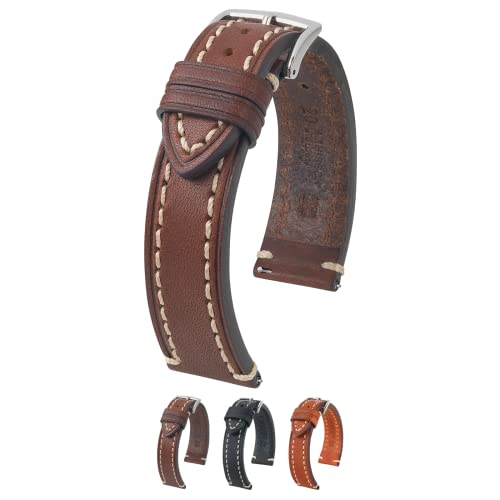
| Barton Quick Release Top Grain Leather Watch Band | Best Leather Band | Top grain leather, quick-release, 16–24 mm including odd widths |
| Barton Elite NATO Style Watch Strap (Seat Belt Nylon) | Best Nylon Band | Seat-belt weave nylon, 1.4 mm, 316L hardware |
| Ritche Born Nylon Watch Band | Best Rugged Band | 1.4 mm ballistic nylon, heavy-duty 316L buckle, sealed edges |
How These Picks Were Chosen
Selection started from the rotation a real owner needs rather than from six versions of one band. Each material family got one champion chosen on construction facts: leather judged on grade and width coverage, nylon on weave and hardware, silicone on compound quality and keeper design, steel on clasp type and link construction. A band also had to be a stable, model-numbered listing from a brand that sells bands as its main business (Barton, Ritche), not a one-off marketplace listing with no specifications.
Comfort and durability judgments are tied to verifiable construction — lining materials, keeper design, clasp mechanics, edge finishing — rather than claimed wear-testing. Where a band appears in a sibling guide in this batch, the verdict here is written for the cross-material comparison, so the two reads complement rather than repeat each other. The _SOURCES file lists the tying source for every ASIN, pending the central Creators API confirmation pass that covers the whole batch, including best smartwatches under $100 readers shopping for a first upgrade band.
The 6 Best Watch Bands

Barton Cordura Fabric and Silicone Hybrid Watch Band — Best Overall Hybrid
The one-band answer for active owners: a Cordura fabric top that looks like a proper strap, bonded to a silicone underside that does not absorb sweat or water. Barton describes the hybrid as waterproof, with silicone-lined eyelets and a locking keeper loop.
- Materials: Cordura fabric top, silicone underside
- Spring bars: integrated quick-release
- Widths: 18, 20, 22 mm (band tapers 2 mm at buckle)
- Hardware: 316L stainless or black PVD (per listing)
Strengths
- Looks tailored, behaves like a sport band
- Waterproof construction suits daily active wear
- Locking keeper stops the tail wandering mid-activity
Trade-offs
- Fabric top can hold dirt longer than plain silicone
- Sportier than a dress leather strap
- Taper and sizing vary by width; check the listing for your size
Most owners compromise: leather that fears water, or silicone that looks like gym equipment. The hybrid refuses the compromise. The Cordura face gives texture and a woven, technical appearance that works with field watches, divers, and smartwatches, while the silicone body underneath handles rain, sweat, and the sink without absorbing any of it. Barton’s listing details — silicone-lined eyelets, premium stitching, a locking keeper — are the small engineering choices that keep a daily band from feeling disposable.
Choose it as the default band for a watch that does everything: office hours, weekend hikes, travel. It will not replace a dress strap for formal wear, and this guide does not pretend otherwise, but as the single band on a one-watch rotation it has the fewest weaknesses here. Owners of rugged watches from best smartwatches for hiking will find it especially well matched.
One honest limitation: the fabric face, while durable, shows light-colored dirt more than black silicone does and needs an occasional wash to look fresh.
Best for: one-watch owners wanting a do-everything band / Not suited for: formal dress-watch wear

Ritche Silicone Quick Release Watch Band — Best for Workouts and Swimming
The training band: soft silicone that is sweatproof and waterproof, with a quick-release swap so it can live on your sport watch or visit your daily watch on gym days. Listings describe a skin-friendly elastomer and a secure locking loop.
- Material: silicone elastomer
- Spring bars: quick-release
- Widths: 18, 20, 22, 24 mm family (check variant)
- Features: waterproof, sweat-resistant, locking loop (per listings)
Strengths
- Rinses clean in seconds after training
- Soft compound stays comfortable on long, hot wear
- Quick-release makes it a true second band, not a commitment
Trade-offs
- Silicone attracts lint and dust more than nylon or leather
- Pure sport look; no dress pretensions
- Can feel warm on the wrist in very hot, still conditions
Silicone is the correct material when a band will be soaked repeatedly: it does not absorb water, does not rot, does not smell the way leather eventually does, and a rinse restores it completely. Ritche’s version is the widely sold benchmark of the type, with a soft-touch compound, a keeper loop that locks the tail, and sizing across the common widths. On a running or gym watch it disappears; on a diver it looks factory-correct.
The honest trade is aesthetics and dust. Silicone picks up lint from sleeves and towels, and its matte sportiness caps how formal the watch can look. That is why it is a rotation band rather than an only band for most owners — and at this tier, owning it as the water-and-workout specialist is an easy decision alongside best smartwatches for swimming style use.
One honest limitation: lint attraction is real and constant; owners who hate wiping a band down will prefer the hybrid or nylon picks.
Best for: training, swimming, and hot-weather daily wear / Not suited for: formal settings or lint-free perfectionists
Ritche Stainless Steel Butterfly Deployment Leather Band — Best Dress Upgrade
For dress-watch owners who dislike tang buckles: genuine vintage-style leather closed by a stainless butterfly deployment clasp, which opens symmetrically, preserves the leather (no creasing at a buckle hole), and looks like a bracelet from above.
- Material: handmade genuine vintage leather
- Clasp: 316L stainless steel button butterfly deployment
- Finishes: silver, black, rose gold (per listing)
- Widths: 16, 18, 20, 22 mm
Strengths
- Deployment clasp extends leather life by avoiding hole creasing
- Dressier, more jewelry-like closure
- Multiple clasp finishes to match cases
Trade-offs
- Deployment clasps add thickness under the wrist
- Fit adjusts in coarser steps than a tang buckle
- Vintage leather styling will not suit sport watches
A tang buckle bends leather at the same hole every day, and that crease is where dress straps age first. A butterfly deployment folds instead of bending, so the strap keeps its shape and its looks far longer — one reason factory dress watches from serious brands ship on deployments. Ritche brings that mechanism to an accessible tier, pairing it with vintage-toned leather and a choice of clasp finishes to match silver, black, or rose-gold cases.
Fit takes one extra minute: deployments adjust by moving the clasp position and choosing which side’s holes to use, and the fit steps are coarser than a tang’s. Once set, daily wear is faster and more consistent. For the classic end of best dress watches style rotations, this is the band that makes an affordable watch feel considered.
One honest limitation: the clasp’s under-wrist bulk bothers some wearers at a desk, where a flat tang buckle rests thinner against the surface.
Best for: dress watches and leather longevity / Not suited for: sport watches or wearers sensitive to under-wrist bulk
Check on Amazon
Barton Quick Release Top Grain Leather Watch Band — Best Leather Band
The leather representative in a cross-material guide has to be the versatile one: Barton’s top grain band, with integrated quick-release bars and the widest width coverage in its class, including the odd 19, 21, and 23 mm sizes other brands skip.
- Material: top grain leather
- Widths: 16, 18, 19, 20, 21, 22, 23, 24 mm
- Spring bars: integrated quick-release
- Buckle: stainless steel tang buckle
Strengths
- Covers odd lug widths competitors ignore
- Tool-free swaps across a whole collection
- Neat finish pairs with dress and casual watches
Trade-offs
- Uniform finish has less character than artisan calf
- Leather rules it out for swimming and hard training
- Light padding underplays very large cases
In a mixed-material rotation, leather is the formality anchor, and this Barton is the easiest leather to live with: it goes on in seconds, comes off before the gym, and its smooth top grain surface reads professional with a suit and relaxed with a sweater. The full leather-by-leather comparison, including the premium Hirsch options, lives in best leather watch straps; here the point is simpler — if your rotation has one leather slot, this band fills it with the least friction.
Care follows the standard leather rules: keep it dry where you can, rest it between wears, condition rarely. Followed honestly, it serves for years as the band that makes the same watch boardroom-appropriate on Monday and, swapped for the NATO below, trail-ready on Saturday.
One honest limitation: as with all leather, daily soaking shortens its life sharply; it is a land band in a guide that also offers true water bands.
Best for: the leather slot in a mixed rotation / Not suited for: water-first daily wear
Check on Amazon

Barton Elite NATO Style Watch Strap (Seat Belt Nylon) — Best Nylon Band
The nylon representative: Barton’s Elite, in smooth seat-belt weave with quality stainless hardware. It is the band for travel, summer, and any day the watch might get wet, knocked, or slept in.
- Material: seat-belt weave nylon, 1.4 mm thick
- Hardware: 316L surgical-grade stainless steel
- Widths: 18, 20, 22, 24 mm
- Length: 10.5 in (270 mm)
Strengths
- Washable, waterproof, and effectively indestructible in normal use
- Double-pass security if a spring bar ever fails
- Color range transforms a watch’s personality cheaply
Trade-offs
- Adds height under the case
- Tail needs the classic tuck on smaller wrists
- Nylon caps the formality ceiling
Every rotation needs a band with no weaknesses in bad conditions, and the Elite is it: rain, sweat, sea water, and a wash cycle are all non-events. The seat-belt weave keeps it comfortable enough for all-day wear, unlike coarse bargain nylon, and the hardware finishing does not embarrass a good watch. The complete nylon field, including ballistic and slim options, is compared in best nato watch straps.
Security deserves its sentence: threaded under both bars, the watch stays on your wrist even if one bar fails — a failure mode two-piece bands cannot survive. For travel, field work, and water-adjacent days, that redundancy plus washability makes the NATO the band professionals quietly default to.
One honest limitation: the under-case layers lift the watch and the tucked tail adds bulk at the keepers, which slim-cuff dress wear will not forgive.
Best for: travel, water, and worry-free daily wear / Not suited for: strictly formal dress codes
Ritche Born Nylon Watch Band — Best Rugged Band
The heavy end of the nylon family: Ritche’s Born pairs thick ballistic nylon with a heavy-duty brushed buckle and laser-sealed edges, built for large tool watches and owners who are hard on gear.
- Material: ballistic nylon, 1.4 mm thick
- Hardware: 316L surgical-grade stainless buckle, brushed
- Edges: laser heat-sealed
- Extras: spring pins and spring bar tool (per listing)
Strengths
- Hardware with real substance for heavy cases
- Sealed edges and holes resist fraying
- Included tool makes it a complete starter kit
Trade-offs
- Too much band for slim watches
- Stiffer break-in than seat-belt weave
- Rugged styling only
Where the Elite is refined, the Born is armored. The buckle’s mass keeps a heavy diver or tactical watch from feeling like it is wearing the strap, and the sealed edges address nylon’s one real wear point — fraying at holes and borders. As a starter purchase it is unusually complete, since the listing bundles the pins and tool a first-time band swapper needs.
Pick it when the watch is big, the use is rough, or both. It anchors the rugged end of a rotation the way the Ritche deployment anchors the dress end, and between the six picks here those two poles plus the hybrid cover essentially every day a watch owner actually has.
One honest limitation: small and slim watches look overwhelmed on it, in both proportion and style.
Best for: large tool watches and hard use / Not suited for: slim dress or vintage watches
Check on Amazon
Comparison Table
| Pick | Material | Best use | Widths | Spring bars |
|---|---|---|---|---|
| Barton Cordura Fabric and Silicone Hybrid Watch Band | Cordura + silicone | Daily active wear | 18–22 mm | Quick-release |
| Ritche Silicone Quick Release Watch Band | Silicone | Sport and water | 18–24 mm family | Quick-release |
| Ritche Stainless Steel Butterfly Deployment Leather Band | Leather + steel clasp | Dress wear | 16–22 mm | Standard bars |
| Barton Quick Release Top Grain Leather Watch Band | Top grain leather | Office and casual | 16–24 mm | Quick-release |
| Barton Elite NATO Style Watch Strap (Seat Belt Nylon) | Seat-belt nylon | Travel and water | 18–24 mm | Pass-through |
| Ritche Born Nylon Watch Band | Ballistic nylon | Rugged and tool use | Common widths | Pass-through |
How to Choose a Watch Band
Start with lug width and attachment type
Nothing else matters if the band does not fit. Lug width is the millimeter distance between the lugs; 18, 20, and 22 mm dominate, with 19, 21, and 23 mm common enough that Barton’s coverage of them is a genuine advantage. Measure with calipers or read the width stamped under your current band. Then confirm the attachment: standard spring bars accept the universal bands in this guide, while proprietary systems (Apple Watch being the famous case) need bands built with that connector or an adapter.
Smartwatch owners should also confirm the exact model on the listing: many smartwatches use standard lugs, but case shapes vary, and a band that fits the lugs can still foul a shaped case. When in doubt, the brand’s fit list on the listing is the authority, not a review’s guess.
Choose material by your actual week
Leather owns formal and office days and fears water. Silicone owns training and swimming and collects lint. Nylon owns travel and bad weather and caps formality. Steel owns permanence and adds weight. Hybrids like the Barton Cordura-silicone exist precisely because most weeks mix all of those, and they are the honest default for a one-band owner.
Audit your last month honestly: how many days involved water, sport, formal dress, and rough work? Buy for the majority, then add specialists. The classic three-band rotation — leather, NATO, silicone — covers nearly every life, and every band in this guide is priced and built to be one of a rotation rather than a lifetime commitment.
Quick-release vs traditional spring bars
Quick-release bars carry a small lever that lets you swap bands with a fingernail. They are the reason rotations exist in practice: a swap that takes ten seconds happens; a swap that needs a tool and a quiet table happens twice a year. Barton builds quick-release into most of its lines, and Ritche’s silicone uses it as well. Traditional bars remain slightly slimmer and suit tight vintage lugs, and every owner should still own a spring-bar tool for bar replacement.
Whichever you use, seat the bars fully and tug-test after every swap. More watches are lost to a half-seated bar in the first hour after a band change than to any failure during wear. Fat bars are a cheap upgrade for heavy watches on any band in this guide.
Length, taper, and wrist fit
Standard bands assume a wrist around 6.5–7.5 inches. If you use the first or last holes of your current band, look for short or long versions before blaming a new band’s comfort. Taper — the band narrowing toward the buckle — reads dressier; straight widths read sportier. Thickness should match the case: slim bands on slim watches, padded or substantial bands on large cases, or the proportions look wrong from across the room.
Keeper design decides daily annoyance: a locking keeper (Barton hybrid) or well-sized floating keepers keep the tail parked, while loose keepers let it flap within a week of wear. Deployment clasps (Ritche) remove hole choice entirely once set — faster daily wear, coarser adjustment. There is no universal winner; there is only the fit of your wrist and your patience.
Building a rotation on a sane budget
Buy in this order: first, the band your watch will wear most (for most owners, the hybrid or the leather). Second, the opposite pole (silicone if you bought leather; leather if you bought silicone). Third, the personality band — a striped NATO or a colored silicone — that exists purely because it makes you smile at your wrist. Store bands flat or loosely rolled, leather away from sunlight, and keep the removed bars with their bands.
Resist multipack temptation: five anonymous bands teach you less than two good ones, and the hardware and finishing gaps show within weeks. The brands in this guide publish specs and stand behind model numbers, which is why they anchor the rotation advice across this batch, including for readers of best watches under $150 upgrading a first watch.
Key Takeaways
- Fit first: lug width, then attachment type, then everything else.
- Material follows your week: leather for formality, silicone for sport, nylon for travel.
- Quick-release is what turns a band purchase into a rotation.
- Hybrid bands are the honest one-band answer for mixed lives.
- Two good bands beat five anonymous ones, every time.
How to Change a Watch Band Safely
Band changes are a two-minute skill that saves a lifetime of jeweler visits. Work over a towel on a table, never over a hard floor or a sink, and lay out the new band’s pieces in wearing order — buckle piece to 12 o’clock, tail piece to 6 — before you start.
- Quick-release bands: slide the lever inward with a fingernail, angle the band out of the lugs, and lift it away. Repeat for the other piece.
- Traditional bars: with the watch face-down, insert a spring-bar tool’s fork between band and lug, compress the bar shoulder, and ease the band out.
- Offer the new band up: seat one bar end in its lug hole, compress the free end, and slide it home until it clicks.
- Tug each piece firmly and check for centered alignment and equal gaps before wearing.
- Store the removed band with its bars in a pouch or roll so pairs stay together.
Problem: a bar end will not seat → the band is likely 1 mm too wide; verify lug width instead of forcing it and damaging the band’s edge.
Problem: the watch head rotates loosely on a NATO → the under-layer keeper is not engaged; re-thread following the NATO guide so the case locks between the bars.
How to Care for Bands by Material
Each material has one rule. Leather: keep it dry, rest it between wears, condition rarely, and never swim in it. Silicone: rinse after sport, wash weekly with mild soap, and keep it away from solvents that cloud the compound. Nylon: soap, water, air-dry; it is the lowest-maintenance band you will ever own. Steel and deployment clasps: rinse sweat off, dry the clasp mechanism, and check the push-buttons for grit if the action feels rough.
Across all materials, inspect spring bars twice a year and replace any that feel weak or show corrosion — bars are the cheapest insurance in watch ownership. Rotate bands so no single band absorbs every day’s sweat, and store the rotation out of direct sunlight, which fades nylon and dries leather alike. Follow those habits and the bands in this guide will outlast several watches between them.
Band Materials Compared in Depth
Leather is the formality benchmark and the comfort chameleon: it molds to the wrist, breathes moderately, and signals intention. Its costs are moisture sensitivity and a finite life measured in years of careful wear. Within leather, construction decides more than species — a well-made top grain band outlasts a poorly made exotic one, which is why this guide’s leather pick is a mainstream Barton rather than a fragile fashion exotic.
Silicone is the athlete: fully waterproof, rinse-clean, and indifferent to sweat, sun, and chlorine. Modern compounds have largely solved the old complaints of stickiness and tearing at the holes, though lint attraction remains the material’s honest tax. Nylon is the traveler and the survivor — washable, nearly indestructible in normal service, and secure by design in NATO form — paying for it with added case height and a formality ceiling. Steel, represented here by a deployment clasp rather than a full bracelet, is the permanence play: it does not wear out on any human timescale, but it adds weight and its fit is only as good as its adjustment steps.
Hybrids exist because most lives are mixed, and the Barton Cordura-silicone pick deserves its Best Overall badge on exactly that logic: the face presents as a woven strap while the body behaves as silicone. When you evaluate any hybrid, ask which material touches the skin (that decides comfort and water behavior) and which faces the world (that decides looks and abrasion). A hybrid that gets both answers right, as this one does, is not a compromise but a specialization for real weeks.
The comparison resolves into a simple rule: own the material of your most common day, plus the material of your most demanding day. For most readers that is leather-plus-silicone or hybrid-plus-NATO. The six picks in this guide were chosen so that any two of them, bought together, cover a wider range of real life than any single premium band bought alone.
Traditional Watches vs Smartwatches: Fit Realities
Traditional watches standardize on spring bars and straight lugs, which is why a century of band design fits them interchangeably. Smartwatches split: many (from Samsung, Garmin, and others) use the same standard lugs in 20 or 22 mm and accept the bands in this guide directly, while Apple Watch uses a proprietary sliding connector that only accepts bands built for it or fitted with adapters. Before ordering any band for a smartwatch, confirm two things on the listing: the lug width and your exact model in the maker’s compatibility list. A band can match the width and still foul a shaped smartwatch case, and listings, not reviews, are the authority on that fit.
Smartwatch wear also changes what a band must survive: all-day wear, sleep tracking, workouts, and showers compress a traditional band’s year of wear into months. Silicone and hybrids handle that duty cycle best, which is why sport-leaning smartwatch owners should start at those picks and treat leather as the occasional dress change rather than the default. Quick-release matters even more here, because the winning smartwatch pattern is a day band and a sport band swapped in seconds — the exact behavior Barton’s and Ritche’s quick-release lines were built for.
Finally, mind the sensors: a band that sits the case higher (a NATO passing underneath) can affect heart-rate sensor contact on some smartwatches, and thick padded leather can do the same by tilting the case. If you rely on continuous heart-rate or sleep data, test your chosen band’s sensor contact for a day before committing it to the rotation. Two-piece quick-release bands keep the caseback flush and are the safe default for sensor-critical wear, with NATOs reserved for days when tracking matters less than security and style.
How to Budget and Sequence a Full Band Rotation
A rotation fails financially in one predictable way: the owner buys the exciting band first — the striped NATO, the colored silicone, the statement leather — and discovers it matches a fifth of their life, while the watch’s daily band remains the worn-out original. Sequence by wear-share instead. Audit a month of your wrist: count office days, training days, water days, formal evenings, and rough-work days. The band serving the largest block is purchase one, bought at the best quality you can justify, because cost-per-wear is decided by the numerator of days, not the price tag. For most readers that audit crowns the hybrid or the leather in this guide, and both were chosen to survive being bought first and worn most.
Purchase two is the opposite pole: the band for your most demanding minority block — silicone if purchase one was leather, leather if purchase one was the hybrid or silicone. This is the purchase that rescues the first band’s lifespan, because every swim, workout, and muddy day it absorbs is a day the primary band does not age. Purchase three is personality: the NATO stripe, the Gaucho-style statement, the color you simply like. Bought third, it is a pleasure; bought first, it is a distortion. Purchase four, if it exists, is specialization — a deployment clasp for the dress watch that only appears at weddings and interviews, or a heavy-duty nylon for the one tool watch that works as hard as you do.
Budget across the rotation, not per band. Four sound bands from the brands in this guide, bought in the right order, will out-serve one luxury band bought alone, because rotation itself is a durability feature: every band rests, dries, and recovers between wears. Leather especially lives roughly twice as long in rotation as it does worn daily, which quietly makes the second band free. Keep a small reserve in the budget for the unglamorous consumables — spare spring bars, a spring-bar tool, a travel roll to store the rotation — because the best-planned collection still fails on a bent bar with no replacement in the drawer. Sequence, rest, and spares: that is the entire economics of a band collection that always feels new.
When to Replace a Band: The Safety Inspection
Bands rarely fail without warning; they fail after warnings nobody read. Build a ten-second inspection into every band change. Leather: flex the strap at the holes and at the lug ends — surface cracking that opens with flexing, elongated holes, or fraying stitch at the lugs means retirement, because the next stage is tearing. Silicone: hold it to the light at the holes and the buckle end; small tears at a hole edge grow under load, and a band showing one should be replaced before a workout, not after a loss. Nylon: check keeper stitching and hole edges; a NATO whose keeper stitching has failed has lost the redundancy that justifies its design. Steel and clasps: work the mechanism — a deployment that no longer clicks positively, or a tang buckle with a bent pin, is a failed safety device, not a quirk.
Spring bars deserve their own sentence in every inspection: replace any bar that is bent, corroded, or weak in its spring action, and prefer fresh bars whenever a band is fitted to a heavier watch. The economics are not subtle — bars and bands are consumables priced in small numbers, and the watch they protect is not. Owners who inspect on this schedule almost never lose a watch to a band; owners who treat bands as permanent eventually meet the exception. When in doubt, retire the band and keep the doubt as your souvenir.
Traveling with a Band Rotation
Travel is where a rotation proves itself, and where it is most often left at home. The disciplined travel kit is small: the band on the watch, chosen for the trip’s dominant activity; one alternate band rolled in a pouch or watch roll; the spring-bar tool, even if both bands are quick-release, because bars bend and spares weigh nothing; and one spare set of spring bars. With that kit, a single watch covers a business trip’s meetings and its morning runs, a holiday’s dinners and its swims, without a second watch ever entering the bag. Choose the alternate by contrast: if the worn band is leather, travel with silicone or nylon; if the worn band is the hybrid, travel with the dress option. Two bands, two poles, every day of the trip dressed correctly — and the watch itself, threaded on a NATO for transit days if security matters, rides out lost-luggage and rough-handling risks with its best chance of staying on your wrist, which is where every travel story in this category either ends well or does not.
The Ten-Second Habit That Saves Watches
Every band change in this guide ends with the same instruction, and it deserves its own spotlight: after fitting any band, grip each piece and pull — firmly, deliberately, twice. A properly seated spring bar does not move, shift, or click under that pull; a half-seated bar announces itself immediately, on the towel, where the announcement costs nothing. Make the tug-test as automatic as the swap itself and it becomes the cheapest insurance policy in watch ownership, renewed at every change for the rest of your life. Pair it with the inspection habit from the replacement section — flex, look, work the clasp — and the two habits together, twenty seconds total, quietly eliminate nearly every way a band has ever lost a watch.
Final Check Before You Order
Before ordering any band in this guide, run the four-point check that prevents nearly every return in this category. One: lug width, measured, not remembered. Two: attachment type — standard bars or a proprietary system — confirmed against your exact watch model. Three: length honest to your wrist, with short or long variants chosen where your current band says you need them. Four: material matched to the band’s actual job in your rotation, not to the job you wish you had. Four answers, two minutes, and the band that arrives is the band you keep — which, across a whole rotation bought this way, is the difference between a collection and a drawer of almost-right straps waiting for a return window that closed months ago. Keep the check taped inside the drawer where the rotation lives, run it without exception, and band buying becomes the calmest purchase in the hobby.
Common Buying Mistakes
Buying for the watch’s brand instead of its lugs
Marketplace titles promise model fit loosely. Measure the lug width and confirm the attachment type yourself; a band that fits is defined by millimeters and bars, not by the logo on the dial.
Owning one band for every job
A leather band destroyed by a summer of swimming, or a silicone band worn to a wedding, are the same mistake: one band asked to do everything. The rotation exists because materials have honest limits.
Ignoring odd lug widths until checkout
Owners of 19, 21, and 23 mm watches discover at delivery that most bands skip their size. Check coverage on the listing — Barton’s leather line is in this guide partly because it refuses to skip them.
Forcing a swap and bending a bar
A band change done impatiently bends spring bars and scores lugs. Work on a towel, compress the bar fully, and never pry against the case. A bent bar replaced immediately is a trivial cost; a watch dropped from a failed bar is not.
Final Recommendation
If you buy one band from this guide, buy the Barton Cordura Fabric and Silicone Hybrid Watch Band: it looks like a strap, survives like a sport band, and fits the mixed reality of most weeks. Build the rotation’s second slot with the Barton Quick Release Top Grain Leather Watch Band for formality, and you own the two poles of everyday watch wear.
Measure your lugs before ordering, tug-test every swap, and let each material do the job it is good at. That is the whole secret of a band collection that always feels right.
Frequently Asked Questions
How do I measure my watch for a new band?
Measure the lug width — the gap between the lugs where the band attaches — in millimeters, using calipers or the width stamped on the underside of your current band. Then note your wrist circumference to choose standard, short, or long lengths. The complete walkthrough, including smartwatch caveats, is in watch strap size guide.
Are quick-release bands secure?
Yes, when seated properly: the bar’s ends sit in the lug holes exactly like a traditional bar, and the lever only compresses it during changes. The security failures in this category come from half-seated bars after a swap, which a firm tug-test catches. Always tug-test, whatever bar type you use.
What band material lasts longest?
Steel bracelets last longest outright, followed by quality nylon, which tolerates water, washing, and abrasion for years. Silicone eventually tears at holes under hard use, and leather’s life depends entirely on moisture discipline. For a band (rather than a bracelet), nylon is the durability champion in this guide.
Can I put a standard band on a smartwatch?
Many smartwatches use standard spring-bar lugs and accept any band of the right width — Barton’s and Ritche’s listings state their smartwatch compatibility by model family. Apple Watch is the major exception, using a proprietary connector; its bands are a separate ecosystem. Always confirm your exact model on the listing before ordering.
How many watch bands should I own?
Three covers nearly every life: a formal band (leather or deployment), a sport band (silicone), and a travel/water band (NATO). Add a fourth personality band when you know your taste. More than six and most owners find half the collection unworn — rotation discipline beats accumulation.
Why does my new band feel stiff?
Leather and ballistic nylon both break in: leather molds to the wrist over one to two weeks, and nylon softens with the first wash and wear cycle. Silicone and seat-belt nylon feel right immediately. Judge a structured band after a fortnight of wear, not the first afternoon — unless the issue is fit (wrong width or length), which no break-in fixes.