Disclosure: As an Amazon Associate, umtsmarttool.com earns from qualifying purchases. Links to Amazon on this page are affiliate links; they cost you nothing extra. Prices and availability change often, so check the current Amazon listing before you buy.
Where to buy
The kits this verdict is based on — the Intex 28003E Deluxe, the Intex 28002E and the Bestway 58237 AquaClean Deluxe — are the category’s reference points at their tiers. Every linked product says check price on Amazon.
Read the full guide ↓
Short answer first, because the question “is a pool cleaning kit worth it” deserves one: yes, for almost every home pool owner — a kit is the cheapest way to own tools that fit each other and cover the three jobs pool cleaning actually consists of, and the alternative of improvising with a net alone fails by midsummer. The honest version has conditions, and this page exists to state them: a kit is worth it when it matches your pump and pool size, and it is money wasted when it does not, because a mismatched kit is not a partial success — it is a vacuum that will not pull or a pole that will not reach.
What follows argues the case properly: what you actually get for the money, who benefits and who does not, what ownership costs beyond the purchase, and the alternatives — buying tools separately, paying for a cleaning service, or stepping up to automatic cleaners — judged on the same terms. The cluster’s Pool Cleaning Kit Pros And Cons page argues the category’s strengths and trade-offs in parallel, and Pool Cleaning Kit Buying Guide turns the verdict into a shortlist.
Is a Pool Cleaning Kit Worth It? What You Actually Get
A pool cleaning kit buys coverage of three distinct jobs. Surface: a skimmer net or leaf rake removes the leaves, insects and debris that would otherwise sink and rot. Walls: a brush strips the algae biofilm that sanitiser alone cannot shift, and keeps the waterline ring from setting. Floor: a vacuum head — pump-powered in the complete kits, hose-powered in the starter kits — lifts settled grit and debris out of the water entirely. The kits in this cluster’s research bundle those tools on a shared pole with guaranteed-matching fittings, which is the unglamorous core of their value: everything connects, everything stores together, and the weekly routine has no missing step.
What you do not get is equally definite. No kit here sanitises water, tests chemistry beyond basic strips in one bundle, heats, covers or automatically cleans anything. A kit is the manual toolkit of pool ownership, and its worth should be judged against the manual alternatives, not against a robot it never claimed to be.
In this guide
Who Benefits and Who Does Not
Best for: owners of above-ground and small in-ground pools who clean weekly themselves; first-time owners who need the tools to fit each other out of the box; households whose alternative is a paid cleaning service they would rather not fund for a pool this size
Not suited for: owners whose pool is large, deep or debris-buried enough that manual cleaning is an hour-plus ordeal; owners who know honestly that a weekly manual routine will not happen; and owners whose pump cannot power any kit vacuum and whose pool is too big for hose-powered tools — the narrow group genuinely better served by saving toward an automatic cleaner
Between those poles sits the majority: owners who could go either way. For them the deciding evidence is behavioural, not financial. A pool that gets a twenty-minute weekly routine stays clear with a manual kit indefinitely; a pool that gets a monthly rescue does not, no matter the tools. The kit is worth it exactly when the routine is realistic — which is why this cluster’s lists, such as Best Pool Cleaning Kit For Home Use Under $50 and Best Pool Cleaning Kit For Families Under $50, rank kits by how easily the routine happens, not by spec-sheet drama.
The Reference Kits Behind the Verdict
Worth-it arguments should be checkable against actual products, so here are the two kits that bracket the category — the complete tier and the starter tier — in brief review form.
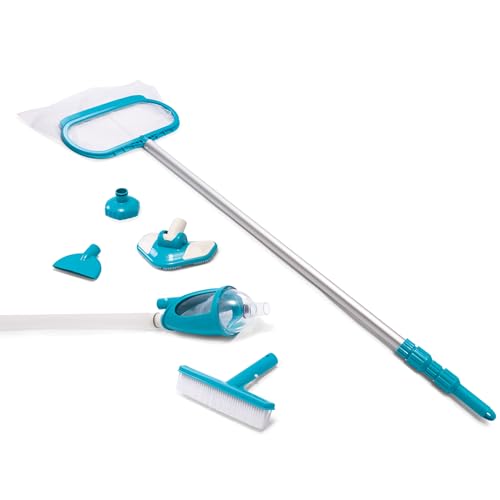
Intex 28003E Deluxe Pool Maintenance Kit — The Complete Tier
The Intex 28003E is the kit this whole category is measured against, because it is built around the way above-ground pools actually get dirty. Leaves land on the surface, algae film creeps across the walls, and grit settles on the floor, and Intex puts a dedicated tool for each layer in one box: a leaf rake for the surface, a curved wall brush shaped to follow the wall-to-floor curve of a frame pool, and a vacuum head that borrows suction from the filter pump you already own. The telescoping aluminium pole stretches to 110 inches, which matters more than it sounds — on an 18-foot round pool you can work the far wall from one side instead of trudging around the deck with a dripping pole.
- Telescoping aluminium pole extends to 110 inches
- 24-foot vacuum hose with connectors included
- Vacuum runs off a filter pump of 800 GPH or more
- Includes leaf rake, curved wall brush, vacuum head with two nozzles and a scrubber vacuum
- Built for above-ground pools of 18 feet and larger
Strengths
- The most complete manual kit in this cluster: surface, wall and floor tools in one box
- Pump-powered vacuum lifts settled debris instead of just stirring it up
- Long pole and hose reach across big frame pools without walking the perimeter
Trade-offs
- Useless for vacuuming if your filter pump flows under 800 GPH
- No water-test gear or chemical dispenser in the box
- Hose priming and pump connections add setup minutes to every session
The vacuum is the centrepiece. It connects to the pump return side with the included 24-foot hose and needs a filter pump rated at 800 GPH or more to pull properly. With a healthy pump the head tracks the floor steadily and the two nozzle options let you trade width for agitation on stubborn patches. The scrubber vacuum adds a second, smaller head for steps and corners. Nothing here is powered, cordless or automatic, and that is precisely the appeal: there is no battery to fade, no robot to rescue from a ladder, and every part is cheap to replace individually if a clip or net eventually gives up.
Ownership is where this kit quietly wins. Because every head clips to standard poles and the hose uses common cuff sizes, a torn net or a worn brush is a small replacement purchase rather than a new kit, and Intex parts circulate widely enough that nothing needs hunting. The routine it enables is also the most forgiving of the pump-powered options: once the hose-priming habit is learned, a full clean of a big pool settles into a predictable half hour, and the kit’s completeness means that routine never waits on a missing tool. Owners stepping up from a starter kit will feel the difference most in the shoulders — the long pole and real suction replace the leaning, reaching and re-passing that make small kits tiring on big water.
The honest limitation is the pump dependency: owners of small cartridge pumps below the 800 GPH threshold get a kit whose headline tool, the vacuum, will barely pull, and no amount of technique fixes a flow-rate shortfall.
Best for: owners whose pool and routine match this kit’s strengths / Not suited for: owners outside the size, pump or storage fit described above

Intex 28002E Cleaning Maintenance Kit — The Starter Tier
The Intex 28002E is the starter kit Intex has sold alongside its Easy Set and frame pools for years, and its design makes one smart trade: instead of borrowing suction from a filter pump, the vacuum head runs off garden-hose water pressure. A venturi jet inside the head creates the pull, and debris collects in a reusable mesh bag clipped behind it. That means the kit works even with the tiny pumps bundled with small pools — or with no pump running at all — which is exactly the situation most first-time pool owners are in.
- 94-inch telescoping aluminium pole
- Garden-hose-powered vacuum head with reusable debris bag
- Surface skimmer net included
- Made for above-ground pools up to 16 feet
- Whole kit weighs about 3.5 pounds
Strengths
- No filter pump needed — a standard garden hose powers the vacuum
- Reusable debris bag empties in seconds and replaces no consumables
- Light enough for kids and smaller adults to handle comfortably
Trade-offs
- Venturi suction is gentle; heavy leaf loads overwhelm the small bag
- No wall brush, so algae film needs a separate tool
- 94-inch pole comes up short on pools wider than 16 feet
You also get a surface skimmer on the same 94-inch telescoping pole, so the weekly routine is simple: skim the surface, swap the head, vacuum the floor, empty the bag, done. The whole kit weighs roughly three and a half pounds, light enough that a careful teenager can run the routine. What you do not get is a wall brush, and that omission shows by mid-season when the waterline starts to feel slick. Pair this kit with any basic brush later and it covers the full job for pools up to 16 feet; expect the pole to feel short beyond that.
In ownership terms, this is the lowest-friction kit in the cluster. There is no pump compatibility to manage, no hose to prime beyond the garden hose itself, and nothing electrical anywhere near the water. The debris bag is the only consumable-adjacent part and it is reusable; when the net eventually tears, the head fitting is standard, so the pole’s working life continues with any replacement head. Its ceiling is set by physics rather than quality — gentle suction, small bag, no brush — and owners who respect that ceiling, cleaning weekly on a small pool, routinely get years of service from a kit that costs less than a single professional visit.
The honest limitation is suction physics: a garden-hose venturi cannot match pump-driven suction, so fine silt often gets blown through the bag mesh and resettles, meaning very dirty floors need repeat passes on separate days.
Best for: owners whose pool and routine match this kit’s strengths / Not suited for: owners outside the size, pump or storage fit described above
When the Answer Flips
Verdicts should come with their reversal conditions. The kit stops being worth it when the pool outgrows manual care — a large, deep, debris-heavy pool where the weekly session stretches past the hour mark and starts being skipped, because a skipped routine has negative value: the kit sits in the shed while the water declines. It stops being worth it when the owner’s constraint is honestly time rather than money, and a cleaning service or an automatic cleaner would actually be used. And it is not worth it as a duplicate: the household that already owns the tools separately gains nothing but a second pole from a bundle.
Notice what those conditions share — none of them is about the kits themselves. Every flip condition is a fact about the household: its pool, its schedule, its shed. That is why this page can be confident in its general verdict and still insist on the matching exercise. The kits are good. The question is only ever whether they are good for the specific water and the specific calendar in front of them.
The Real Cost of Ownership
Beyond the purchase, a manual kit costs three things. Time: roughly twenty to forty minutes weekly in season, which over a summer is the true price and the one to weigh honestly. Soft parts: nets and brush heads wear and are replaced individually — cheap, standard-fitting, and the reason kits with replaceable parts age better than sealed bargains. And attention to the system around the kit: pump-powered vacuums make filter maintenance part of cleaning performance, and every kit assumes the owner also tests and sanitises the water, which carries its own small ongoing costs in strips and chemicals.
Set against that: a single professional cleaning visit typically costs a noticeable fraction of a complete kit, and a season of visits costs several kits over. An automatic cleaner costs several kits at once and still leaves brushing and waterline work to hand tools. The arithmetic is not close for a typical home pool, which is why the verdict below lands where it does — the kit’s costs are real but small, and they buy out much larger ones.
The Alternatives, Judged Fairly
Buying tools separately is the strongest alternative, and for experienced owners it can be the better one: a premium deep net, a wide brush and a quality pole chosen individually out-perform any bundle at their single jobs. Its weakness is the first purchase — fittings, sizes and the missing-tool problem — which is why this guide recommends kits first and separates later, the path the Sepetrel no-pole kit exists to serve. A cleaning service converts money into time completely and suits owners who value the pool but not the hobby; for small above-ground pools its per-visit pricing rarely makes sense. Automatic cleaners remove the floor job and part of the wall job, and still need a brush, a net and a human for the rest — an upgrade to the kit, not a replacement for the category.
The Maths in Plain Terms
Strip the prices away — listings move too much for printed figures to stay honest — and the comparison still resolves clearly, because the ratios are wide. A complete manual kit costs roughly what one or two professional cleaning visits cost. A season of weekly professional visits costs many complete kits. An automatic cleaner costs several complete kits and still leaves the waterline, the steps and the surface partially to hand tools. A kit’s running costs, by contrast, are a replacement net or brush head now and then — the smallest line in the entire pool budget, below chemicals, below electricity for the pump, below the water itself in most regions.
The other side of the ledger is time, and it should be priced honestly rather than waved away. Twenty to forty minutes a week across a season is a real commitment — comparable to mowing a modest lawn — and for an owner who prices their weekend hours highly, the service or the robot can be the rational purchase even at many times the kit’s price. Worth-it verdicts that ignore the time price are advertising. This page’s verdict stands because for the typical home pool the time is modest, the money gap is large, and the work itself is the kind many owners quietly enjoy — outdoors, visible progress, a swim at the end of it.

Sepetrel Deluxe Pool Cleaning Kit with Spa Jet Vacuum — The Small-Water Case
Sepetrel’s spa jet kit is built for the pools that full-size kits serve badly: inflatable pools, small above-ground rings, spas and hot tubs. The vacuum is a venturi jet head that runs off a garden hose, so it needs no filter pump and no power, and the pole tops out at 57.5 inches — short by design, because in a ten-foot pool a nine-foot pole is a liability that bangs the far wall every time you turn. The semi-deep skimmer net splits the difference between a flat skimmer and a deep leaf bag, which suits small water where debris arrives in handfuls rather than drifts.
- Spa jet vacuum powered by garden-hose pressure — no pump or electricity
- Adjustable pole extends to 57.5 inches
- Semi-deep skimmer net for surface debris
- 13.5-inch pool brush included
- Aimed at above-ground and inflatable pools and spas
Strengths
- Works in spas, inflatable pools and stock tanks where pump vacuums cannot
- Short pole is easy to control in small water
- Brush included, which most mini kits leave out
Trade-offs
- 57.5-inch pole is far too short for pools over about 12 feet
- Jet vacuum adds hose water to the pool as it cleans
- Semi-deep net is a compromise between skimmer and leaf rake
The included 13.5-inch brush is the quiet advantage here. Small pools grow algae film fast in warm weather, and most mini kits skip the brush entirely, leaving owners scrubbing with whatever is under the sink. With the brush on the same pole, the small-pool routine becomes skim, brush, vacuum in one lap. The trade-offs are real: hose vacuums add water while they work, the debris bag is small, and the kit simply cannot reach across a big pool. Inside its intended size class, though, it is one of the most sensibly specced kits in this cluster.
Living with the spa jet kit is mostly a story of storage and spontaneity. It lives in a small bag or a deck box, comes out for a ten-minute tidy that bigger kits would make into an event, and goes away again without a hose to coil or a pump to shut down. That low friction is exactly what small water needs, because small volumes show debris immediately and reward little-and-often cleaning. The brush-on-the-same-pole design means the algae film that plagues warm inflatable pools gets dealt with in the same visit as the leaves, which is the combination that keeps small pools clear without chemical heroics.
The honest limitation is reach: this is a small-water kit, and stretching it to a 15- or 18-foot pool means leaning, wading, or missing the middle entirely.
Best for: owners whose pool and routine match this kit’s strengths / Not suited for: owners outside the size, pump or storage fit described above
Three Households, Worked Through
The first household has a 15-foot frame pool, a bundled cartridge pump, two children and a tree overhanging one corner. Their debris is leaves, their film is sunscreen, their time is scarce. A hose-powered kit or the Bestway-class pump kit serves them; the deluxe Intex kit’s threshold is their only trap. Verdict for this household: worth it, clearly, and the kit will be used by whoever draws the Saturday chore.
The second household has an 18-foot pool, a strong pump, and an owner who enjoys the ritual of maintenance the way some people enjoy gardening. For them the complete kit is not merely worth it; it is the hobby’s core equipment, and the per-season cost after the first year is a net and a brush. Verdict: worth it, at the complete tier, with money left for the water-care half.
The third household has a large in-ground pool, two working parents, and a realistic self-assessment: the pool gets used on weekends and nobody is vacuuming it by hand on a weeknight. For them a manual kit alone is not worth it as the primary system — it becomes the supporting toolkit beside an automatic cleaner, and judged in that supporting role, a basic kit is worth it again. The pattern across all three: the verdict follows the routine, not the pool.
What Happens Without One
The counterfactual is worth pricing in kind. Without a kit, owners improvise: a net alone, a household brush, a borrowed vacuum. The surface gets skimmed and the rest quietly accumulates — biofilm on the walls feeding algae blooms that demand shock treatments, grit on the floor grinding into the liner underfoot, debris rotting in corners and consuming sanitiser that then needs replacing. Each individual consequence is small and chemical-shaped, and together they describe the most common way home pools become expensive: not through one failure, but through a season of almost-clean.
That is the deepest sense in which the kit is worth it. It is not really a bundle of tools; it is the removal of every excuse in the sequence. The brush exists, so the walls get brushed. The vacuum fits the pump, so the floor gets vacuumed. The routine becomes the path of least resistance, and pools stay clear on the path of least resistance or not at all.
The Weekly Pool Cleaning Routine That Actually Works
Key Takeaways
- Surface, walls, floor — always in that order, because each stage feeds the next.
- Twenty steady minutes weekly beats a three-hour rescue every month.
- Brush even when the water looks clear; algae film is invisible before it is green.
- Rinse and shade-dry tools after every session and they last seasons longer.
A pool stays clean on a rhythm, not on heroic efforts. The routine below is the one pool professionals teach new owners, scaled to a manual kit. On a small pool it takes about twenty minutes; on a big frame pool, closer to forty.
- Test the water first, while the tools are still dry. Cleaning stirs debris that consumes sanitiser, so knowing the starting point matters.
- Empty the skimmer basket if your pool has one, and check the pump basket.
- Skim the whole surface slowly, working from the far side toward you so the drift comes to meet the net.
- Brush the waterline ring, then the walls top to bottom, then steps and ladder rails with the hand brush.
- Vacuum the floor in lanes as described in the vacuuming section of this guide.
- Top up the floating chlorinator if your setup uses one, and retest after the pump has circulated the water.
- Rinse the kit, shake nets dry, and store everything out of the sun.
Problem: the waterline keeps growing a greasy ring. That is sunscreen and body oil collecting at the surface line; the hand scrub brush in several of these kits exists precisely for it, and a weekly pass stops it hardening into a stain. Problem: the walls feel slippery but the water is clear. That slipperiness is early biofilm, and brushing — not more chemicals — is the correct first response. Problem: debris returns to the floor within a day. Check what is falling in: overhanging trees, nearby decking dust and lawn clippings are sources no kit can outpace, so trim, cover, or clean more often during the worst weeks.
How to Vacuum a Pool with a Manual Kit
Vacuuming with a manual kit is a skill of patience more than strength. The debris you want lives on the floor in a loose layer, and every rushed stroke lifts it back into the water where it resettles behind you. Work through the sequence below and the floor comes up clean in one pass instead of three.
- Skim the surface first. Leaves floating now become floor debris later, and five minutes with the net saves twenty with the vacuum.
- Brush the walls and steps toward the floor. Algae film and dirt on vertical surfaces should be on the bottom before you vacuum, not after.
- Assemble the vacuum: head on the pole, hose on the head, and the far end ready for the pump inlet or skimmer plate, or the garden hose attached for a venturi kit.
- Prime the hose. Push the vacuum head under water and feed the hose down hand over hand so it fills completely; a hose full of air breaks suction the moment it connects.
- Connect and check pull at the head with your palm — you should feel a firm tug before you start moving.
- Move in slow, overlapping lanes, the way you would mow a lawn, keeping the head flat. If the water clouds, slow down further rather than pressing harder.
- Empty bags and check the pump basket partway through a heavy cleanup; a choked bag or basket is the usual reason suction fades mid-job.
- Finish by rinsing every part in fresh water, letting nets and brushes dry in shade, and storing the pole out of direct sun.
Problem: the vacuum loses suction after a few minutes. The fix is almost always a clogged debris bag, a full pump basket, or air that has crept into the hose — check them in that order before assuming the kit is at fault. Problem: debris blows straight through the bag on a hose-powered vacuum. Fine silt can pass a coarse mesh; slow the head down, let the cloud settle, and make a second pass the next day rather than stirring the whole pool at once. Problem: the head keeps flipping or lifting. Keep the pole angle shallow and the head weighted by the water column in the hose; short, flat strokes beat long pushes.
The Ten-Year View
Stretch the horizon and the worth-it case strengthens in a way first-season arithmetic understates. Pools live for years, and the cleaning question is asked every week of every one of them. A kit bought well in year one is still answering in year five, maintained by a net here and a brush there, its cost per session falling toward zero. The alternatives compound in the opposite direction: service fees recur at full price forever, and improvisation recurs as chemistry bills and liner wear. Owners rarely feel the ten-year difference in any single season, which is exactly why it deserves a section — the largest costs and savings in pool ownership are the ones that arrive too gradually to notice.
The ten-year view also reframes the purchase decision itself. At that horizon, the difference between the adequate kit and the right kit dwarfs the difference in their prices: a kit whose fittings fight its owner weekly will be replaced, resented or abandoned long before its parts wear out, while the matched kit becomes invisible infrastructure. Worth it, in the end, is a property of the match sustained over time — which is why this page, like every page in the cluster, keeps returning the reader to the same two checks: the pump, and the pool. Get those right and the decade takes care of itself.
A Word for the Sceptical Reader
Scepticism is the correct starting posture for a page like this, because worth-it verdicts are where buying guides most often become advertising. So note what this page has not done. It has not printed a price, because prices move and a verdict built on one would rot with it. It has not quoted a rating or a review count, for the same reason. It has not claimed hands-on testing it did not perform, and it has named, at length, the households for whom its own verdict reverses. What remains after those refusals is the argument itself — coverage, fit, arithmetic, time — and the argument is offered for inspection rather than belief. A reader who follows it and lands elsewhere has used the page exactly as intended.
That is the standard this cluster holds itself to across its lists and reviews, and it is why the verdict here can be stated strongly without being stated absolutely. Worth it — for the matched pool, the realistic routine and the closed omission — is a conclusion with its working shown. Check the working against your own yard, and buy, or do not, with the reasoning in hand either way.
The Small Print of the Verdict
Every verdict has conditions, and this page has scattered its own through the sections above; gathered, they are four. The kit must match the pump, or its vacuum is furniture. It must match the pool’s size, or its pole is an obstacle. Its known omission must be closed in the same purchase, or the routine has a hole exactly where the pool will find it. And the household must actually supply the weekly minutes, because no purchase in this category cleans anything by itself. Meet the four and the verdict is not close. Fail one and the verdict does not merely weaken — it inverts, because a mismatched or unused kit delivers the costs of ownership with none of the cleaning.
That conditional shape is why this page refuses the one-word answer its title invites. “Worth it” is not a property of the kit; it is a property of the kit in a particular yard, on a particular pump, in a particular household’s week. The good news hidden in the conditions is that all four are checkable in advance, in minutes, with information the owner already has or can read off a pump label. Few purchases of any kind offer a verdict this testable — and fewer still pass the test as often as this one does.
The Kit as the Pool’s First Season Teacher
There is a benefit of the kit that no arithmetic captures and every experienced owner recognises: it is how a household learns its pool. The first season with a manual kit teaches the debris calendar — which tree drops when, which week the pollen arrives, how the water answers a storm — and that knowledge quietly governs every later decision, from when to cover to whether automation would even help. Owners who skip the manual season and start with services or robots often own pools they do not understand, dependent on systems they cannot read. Owners who spend one season with a kit can diagnose a cloudy morning from the doorstep.
Counted that way, even the household that eventually automates got full value from the kit: it was tuition that left tools behind. And the household that never automates discovers the tuition was the smaller part of the return. Either way, the first-season kit is the purchase the rest of the pool’s life is built on, which is the deepest sense in which the answer to this page’s question is yes.
The Objections, Answered in One Place
“My pool is small — surely a net is enough.” For a few weeks, yes; then the walls film over, the floor grits up, and the small pool’s tiny volume turns fastest of all. Small water is the strongest case for a shaped kit, not the weakest. “I will just drain and refill.” Count the water, the time and the rebalancing chemicals across a season of refills, and the kit is cheaper by midsummer — before counting the liner stress of repeated draining. “A robot would be less work.” It would, for the floor, at several times the price, while still leaving the surface, walls and waterline to tools you would then own anyway. “Kits are all the same.” They share a shape, but their thresholds, sizes and omissions differ in ways that decide success completely, as this cluster’s lists document pick by pick.
None of those objections is foolish; each is the right question asked one step too early. Asked after the pump check and the size check, they resolve themselves — which is the most useful thing a worth-it page can teach. The verdict is not “always buy”. It is “buy, having checked”, and the checking takes five minutes.
Final Verdict
A pool cleaning kit is worth it — with the pump-and-size match checked, it is the highest-value purchase in home pool care, the one that turns ownership from a chore list into a routine. Buy the kit that fits your pool from the ranked lists in this cluster, starting with Best Pool Cleaning Kit Under $75 for the complete tier, and judge it after a month of weekly routines rather than after the first weekend.
Frequently Asked Questions
Are pool cleaning kits worth it versus buying tools separately?
For a first purchase, almost always yes: the kit guarantees the heads and pole fit each other, and the bundle typically costs less than the same tools bought one by one. Separate buying makes sense later, when you know which single tool you want to upgrade — a deeper net, a wider brush — or when you already own a good pole and only need replacement heads, which is exactly the gap the Sepetrel no-pole kit fills.
What does a pool cleaning kit actually include?
A typical manual pool cleaning kit bundles the three hand tools of pool care: a skimmer net or leaf rake for surface debris, a brush for walls and the waterline, and a vacuum head for the floor, usually sharing one telescopic pole. Better kits add a vacuum hose, a hand scrub brush or water-care extras such as test strips and a floating chlorinator. Everything in this guide is manual — none of these kits is a robot or an automatic cleaner.
How often should I clean my pool with a manual kit?
A full skim, brush and vacuum once a week suits most home pools in season, with extra skimming after storms or windy days and extra brushing in heatwaves, when algae grows fastest. Spas and small inflatable pools benefit from a quick skim and brush twice a week because their small water volume shows debris and film sooner.
How do I make a pool cleaning kit last longer?
Rinse every part in fresh water after use, because dried chlorine and pool chemicals attack plastics and netting. Let nets and brushes dry fully in the shade — ultraviolet light is the main killer of nets and bristles. Store poles with their locks released, keep hoses loosely coiled rather than kinked, and empty debris bags the same day. Treated that way, the hard parts of a kit last for years and only nets and brush heads eventually need replacing.
Do I need a filter pump to use a pool cleaning kit?
Only for pump-powered vacuum heads. The Intex deluxe kit needs a pump of 800 GPH or more and the Bestway AquaClean needs 530 gal/h or more. Venturi kits such as the Intex 28002E, the Sepetrel spa jet kit and the POOLWHALE T358 run off a garden hose instead and need no pump at all, while skim-and-brush kits need nothing but your arms. Check which type you are buying before assuming compatibility.
How long does a pool cleaning kit last?
The hard parts — poles, vacuum bodies, rake frames — last for years with rinsing and shade storage. The soft parts set the rhythm: nets and brush heads are wear items replaced individually as they tear or smooth out. A kit bought on standard fittings can be maintained almost indefinitely that way, which is a large part of its value against sealed, unrepairable bargains.
Is a kit worth it for a pool that is only up for one summer?
Usually yes, and the case is stronger than it looks. A temporary pool still films, grits and clouds on the same schedule as a permanent one, and the starter kits sized for it are the cheapest in the category. The kit also survives the pool: poles, nets and brushes serve the next pool, the neighbour’s pool or the spa, so a one-summer pool rarely means a one-summer kit. The exception is the household certain the pool is a one-off experiment — for them, the smallest shaped kit, bought without ceremony, is the proportionate answer.
What is the single most common reason a kit disappoints?
A mismatch that was knowable in advance: a pump below the vacuum’s flow minimum, a pole short of the pool’s middle, or a brand ecosystem crossed without the adapter. Genuine product failures exist but are rare in this mature category compared with matching failures, which is why every page in this cluster spends its sternest words on two numbers — the pump rating and the pool size — rather than on the kits themselves.
Does a kit hold any resale or hand-me-down value?
More than most pool gear, because the durable parts — poles, vacuum bodies, rake frames — are standard-fitting and brand-agnostic at the pole. A kit outgrown by a bigger pool passes to a smaller one, a neighbour or a family member with its wear parts refreshed for very little, and the benchmark kits in particular circulate for years. It is a minor point in the worth-it ledger, but a real one: the kit is one of the few pool purchases whose value survives its first owner.
What should I do the day the kit arrives?
Assemble it once, run the pump check if it is a pump-powered kit, and do one full, unhurried clean in the order this page recommends — skim, brush, vacuum, test. That first session is the verdict’s evidence: if the routine feels sustainable, the purchase was right, and every later week is just the same hour, shorter.