Disclosure: As an Amazon Associate, UMT Smart Tool earns from qualifying purchases. This guide is built from product listings and maker specifications, not from our own hands-on testing. Prices are approximate and can change, so check the current price before you buy. Last updated: November 10, 2026.
Hardwood changes the vacuum question completely. On carpet, a stiff spinning brushroll is the tool that does the work. On wood, that same brushroll can scatter crumbs ahead of the machine, trap grit against the finish and, over time, dull or scratch the surface it was supposed to protect. What hardwood actually rewards is a soft roller or a bristle parquet brush that contacts the floor gently, rubber wheels instead of hard plastic ones, and enough suction control to glide rather than grab. This guide is organized around those floor-safety details first and raw power second, across stick, canister and robot formats.
In this guide
Quick Picks
The short version: six vacuums whose cleaner heads, wheels and brushes are built to be kind to wood finishes.
| Pick | Type | Best for |
|---|---|---|
| Dyson V12 Detect Slim Absolute | Cordless stick | Best overall for hardwood-led homes |
| Dreame R20 | Cordless stick | Long runtime at a mid-range tier |
| Miele Classic C1 Pure Suction | Bagged canister | Gentle suction-only cleaning, no brushroll |
| SEBO Airbelt K3 Premium | Bagged canister | Premium pick for wood plus real carpet |
| iRobot Roomba j7+ | Robot vacuum | Hands-off daily upkeep on wood floors |
| Dyson Omni-glide | Cordless stick | Quick cleanups and small hard-floor spaces |
Our Picks
1. Dyson V12 Detect Slim Absolute (394167-01) — Best Overall
The Absolute version of the V12 Detect Slim earns the top spot because its box is built around hard floors. The Fluffy Optic cleaner head uses a soft woven nylon roller with an angled laser that reveals microscopic dust on smooth surfaces, so fine grit gets picked up instead of being pushed around. A piezo sensor counts and sizes the particles drawn in and shows the tally on the LCD screen, and Dyson rates the machine at 150 air watts of suction with up to 60 minutes of run time from the removable battery. Whole-machine HEPA filtration is sealed in, which matters in wood-floored homes where dust has nowhere to hide.
The compromises are size and price. The dust bin holds just 0.35 liters, so larger homes mean frequent emptying, and this is a premium-tier purchase. The second head in the box, the Motorbar, is a bristled carpet tool with hair-removal vanes — use it on rugs and keep the soft Fluffy head on the wood. At about 2.2 kg it is light enough for stairs and above-floor work. For a mostly-hardwood home that wants one cordless machine and proof the floor is actually clean, this is the most complete package here.

2. Dreame R20 — Best Value Stick
The R20 takes a two-head approach that suits mixed homes. Dreame bundles a multi-surface brush head with a soft roller for hard floors alongside a V-shaped bristle brush head for carpet, so the wood gets the gentle roller and the rugs get real agitation. The maker rates it at 190 air watts of suction and up to 90 minutes of run time, and the head carries wide-angle blue LED lights that throw dust and hair into relief on smooth boards — a simpler version of the laser trick above, at a mid-range tier. A dirt-detection sensor adjusts suction automatically as the floor gets dirtier or cleaner.
Be realistic about the headline numbers: the 90-minute figure applies at the lowest setting, and motorized-head run time on carpet will be far shorter. Whole-machine filtration is multi-layer and washable in parts, but Dreame’s service network is thinner than Dyson’s or Miele’s if something fails years in. As a value proposition — two proper heads, dust-revealing lights and a swappable battery at a mid-range price — it is the easiest stick here to justify.

3. Miele Classic C1 Pure Suction (41BAN045USA) — Best Canister
The Classic C1 Pure Suction is the purest hardwood tool in this guide because it has no brushroll at all. Its AllTeQ combination floorhead works by straight suction: a rocker switch drops a ring of bristles for hard floors and retracts them for low-pile rugs, so nothing powered ever spins against your finish. Miele’s 1,200-watt Vortex motor is governed by a six-stage rotary dial on the canister, letting you run full power on entry mats and ease off on delicate boards. The body rides on smooth castors and gives a 29.5-foot operating radius, and three accessories ride along on a VarioClip.
The trade-offs are the cord and the bags. You will plug and replug as you move between rooms, and the HyClean GN bags (4.8-quart capacity, self-sealing when removed) are an ongoing cost — though bagged disposal is the cleanest option for allergy-sensitive households. The standard AirClean exhaust filter is not HEPA; Miele sells a HEPA AirClean filter as a drop-in upgrade. If you distrust batteries and spinning brushes equally, this is the dependable, decades-proven answer.

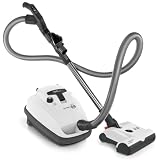
4. SEBO Airbelt K3 Premium (9687AM) — Best Premium for Mixed Floors
The K3 Premium is the choice when the house is half wood, half real carpet and you want one machine that treats both properly. SEBO ships it with two heads: a dedicated Premium Parquet Brush with soft bristles for bare floors, and the ET-1 electric power head — with four manual height settings and a brush on/off switch — for deep-cleaning carpet. Swapping heads means the parquet brush, not a compromised combo tool, is what touches your hardwood. The canister is wrapped in SEBO’s textile Airbelt bumper so the body itself cannot scuff walls or furniture, and it rolls on rubber-coated wheels.
Filtration is S-class in a sealed system, rated to hold 99.97% of particles down to 0.3 microns, which suits allergy households. The operating radius is 37 feet, and SEBO backs the motor with a seven-year warranty — five years on parts and labor for Amazon purchases, per the listing — reflecting its made-in-Germany, buy-it-for-decades positioning. The costs are literal: this is the premium tier, the corded body is heavier than the Miele above, and bags and filters are proprietary.
5. iRobot Roomba j7+ (7550) — Best Robot
A robot is the one format that vacuums hardwood daily without being asked, and the j7+ is specified for it. Instead of a bristle brush, it cleans with dual multi-surface rubber brushes that flex to keep contact with the floor — rubber extractors do not scour finishes and shed wrapped hair far better than bristles. Its PrecisionVision navigation uses a camera to identify and steer around cords, shoes and pet waste, backed by iRobot’s Pet Owner Official Promise, and Imprint Smart Mapping lets you send it to specific rooms on a schedule. Back at the Clean Base it empties itself into an enclosed bag that iRobot rates for up to 60 days of debris.
Set expectations correctly: a robot maintains wood floors beautifully but does not deep-clean like a canister, and it cannot do stairs. The Clean Base bags are a recurring cost, and the j7+ is vacuum-only — there is no mopping function in this model. Run it several times a week and grit never accumulates enough for shoes to grind it into the finish — exactly the long-game protection hardwood needs.

6. Dyson Omni-glide (369455-01) — Best for Quick Cleanups
The Omni-glide was designed for exactly one job: hard floors, cleaned often and quickly. Its omnidirectional Fluffy cleaner head carries two soft rollers spinning in opposite directions on four 360-degree castors, so it moves forwards, backwards and sideways with a flick of the wrist and picks up debris in both directions instead of only on the push. The whole machine weighs under 5 pounds, lies completely flat to slide under low furniture, and converts to a handheld for counters and stairs. Dyson’s Hyperdymium motor spins at up to 105,000rpm behind a small 0.2-liter bin.
The limits are strict and worth stating plainly. Run time is up to 20 minutes, the tiny bin fills fast, and the soft rollers simply will not turn on carpet — this is a hard-floor-only tool, full stop. But in an apartment or a kitchen-and-hallway routine where the alternative is dragging out a full-size vacuum daily, nothing here is faster from cupboard to clean floor, and nothing is gentler on the finish while doing it.

Best Picks by Category
- Cordless stick: Dyson V12 Detect Slim Absolute — laser soft-roller head, particle counting and a separate carpet head in the box.
- Value stick: Dreame R20 — two dedicated heads, dust-revealing LEDs and up to 90 minutes of rated run time at a mid-range tier.
- Canister: Miele Classic C1 Pure Suction — suction-only cleaning with a bristle parquet-style floorhead and no brushroll to fear.
- Premium mixed-floor: SEBO Airbelt K3 Premium — a true parquet brush plus a powered carpet head, sealed S-class filtration and a seven-year motor warranty.
- Robot: iRobot Roomba j7+ — dual rubber brushes that are gentle on finishes, obstacle avoidance and 60-day self-emptying.
- Quick cleanups: Dyson Omni-glide — twin soft rollers that clean in every direction, built purely for hard floors.
Notice the pattern: every pick earns its place through what touches the floor — a soft roller, soft bristles or rubber extractors — not through headline suction numbers.
How to Choose
The cleaner head matters more than suction
On a smooth board, debris sits on the surface waiting to be collected; it does not need to be beaten out of pile. A soft roller seals against the floor and envelops crumbs and fine dust in one pass, while a stiff brushroll tends to flick particles ahead of the machine and can drag trapped grit across the finish. A parquet brush — natural or soft synthetic bristles on a suction-only head — is the canister equivalent. Whichever format you buy, judge the head first and the wattage second.
Wheels, bumpers and the underside
Scratches come from more than brushes. Hard plastic wheels can imprint and scuff softer finishes, especially when a grain of sand sticks to them, so look for rubber or rubber-coated wheels and castors. Canister bodies benefit from a bumper — SEBO’s textile Airbelt is the extreme example. On sticks and robots, check that the head’s soleplate is smooth and that no metal edges sit at floor level. Wipe wheels and soleplates when you empty the bin; embedded grit is the enemy, not the machine itself.
Suction control and brushroll shut-off
Adjustable suction is a hardwood feature, not a luxury. Full power can make a lightweight head stick and judder on smooth boards and can lift the edges of loose-laid flooring or lightweight rugs; a lower setting glides and still collects surface debris completely. If a machine has a powered brushroll, a brush on/off switch — or a swappable hard-floor head — is essential. Variable dials on canisters (Miele’s six stages, SEBO’s controls) are the most precise version of this.
Corded, cordless or robot
Cordless sticks win on convenience and are the right default for daily hardwood upkeep, provided the rated run time covers your floor area on a motorized head — headline figures are always measured at the gentlest setting. Corded canisters give unlimited, undiminishing suction and the best parquet tools, at the cost of the cord. Robots invert the equation: weakest deep-clean, but they run daily, and on hardwood, frequency beats intensity because grit does the damage when it sits and gets walked on.
Filtration and dust disposal
Hard floors release dust into the air more readily than carpet holds it, so sealed filtration matters. Look for whole-machine sealed systems with HEPA-grade exhaust on sticks, S-class or HEPA filtration on canisters, and enclosed disposal. Bagged machines — the Miele, the SEBO and the Roomba’s Clean Base — empty without a dust puff and suit allergy households; bagless sticks cost less to run but need their filters washed or replaced on schedule to keep suction honest.
Keep the gentle head gentle
A soft roller only protects your floor while it is clean. Sand embedded in the roller fabric turns it into a mild abrasive, so pop the roller out and wash or brush it regularly — most soft rollers are designed to be removed and rinsed. Check parquet brush bristles for trapped grit, empty bins before they overfill, and shake out entry mats often: stopping grit at the door is the cheapest hardwood protection there is.
Which vacuum for hardwood floors should you buy?
The best vacuum for hardwood floors is the one whose floor head is gentle on wood and whose format fits your home and your routine. Here is how the six picks map to common needs.
- If your home is mostly wood and you want one cordless do-it-all: choose the Dyson V12 Detect Slim Absolute. It includes a soft-roller head for wood and a separate carpet head.
- If you want two dedicated heads at a lower tier: the Dreame R20 pairs a soft roller for hard floors with a bristle head for carpet.
- If you prefer suction-only cleaning with no brushroll: go for the Miele Classic C1 Pure Suction. Expect a cord and ongoing bag costs.
- If your house is half wood and half real carpet: the SEBO Airbelt K3 Premium ships with a parquet brush and a powered carpet head.
- If you want daily upkeep without lifting a finger: pick the iRobot Roomba j7+, which uses rubber brushes instead of bristles.
- If you only need fast cleanups on hard floors: the Dyson Omni-glide suits a small apartment or a kitchen and hallway routine, but it will not work on carpet.
If you are torn between two, choose the one whose limits you can live with, such as the cord, the small bin or the shorter run time.
What to check before you buy, and who should skip it
Before you buy a vacuum for hardwood floors, check the floor head, the wheels and the practical running costs. These details matter more than a headline suction figure.
- Is the floor head a soft roller, soft bristle brush or rubber extractor rather than a stiff brushroll?
- Are the wheels rubber or rubber-coated, so they will not scuff the finish?
- Can you switch the brushroll off or lower the suction on smooth boards?
- How large is the bin, and how often will you need to empty it?
- Does the run time cover your floor area on the head you will actually use?
- What bags, filters or replacement rollers will you need to keep buying?
- Where will you store it, and does it come with a wall mount or charging dock?
The trade-offs are honest ones. Cordless sticks are convenient, but their rated run time is for the lowest setting and the bins are small. Canisters clean strongly, yet the cord and the bulk make them slower to grab. Robots keep floors tidy day to day but do not deep-clean or handle stairs. Premium models cost more up front, and some need ongoing spending on bags or parts.
Who should skip it: if your current vacuum has a hard-floor mode or a brushroll switch and your floors look fine, you may not need to replace it. Use that setting and keep wheels and heads clean first. A hard-floor-only tool is also a poor fit for anyone with a lot of carpet.
When you are ready, compare the picks above, check the current listing for what is included, then choose the one that fits how you will clean your floors.
Frequently Asked Questions
Can a regular vacuum scratch hardwood floors?
It can. The risks are a stiff brushroll spinning against the finish, hard plastic wheels, and grit trapped under the cleaner head being dragged across the boards. A general-purpose vacuum used with its brushroll switched off — or with a hard-floor head fitted — is usually fine; damage comes from carpet settings and carpet heads used on wood repeatedly.
Is a soft roller or a parquet brush better for wood floors?
Both are genuinely hardwood-safe; they suit different formats. Soft rollers live on cordless sticks and excel at collecting mixed debris — crumbs and fine dust together — in a single pass. Parquet brushes belong to canisters and rely on suction with soft bristles, which is superb for dust and corners but slower over large open areas. Choose by format preference, not by fearing either head.
Are robot vacuums safe for hardwood floors?
Yes, provided the robot uses rubber extractors or soft brushes rather than stiff bristles, and you keep its wheels and brushes free of embedded grit. Models like the Roomba j7+ use dual rubber brushes specifically, which do not scour finishes. The main precaution is maintenance: a stone caught in a robot’s wheel will be dragged around the whole room, so quick weekly checks matter.
Should I turn the brushroll off on hardwood?
If your vacuum offers a brushroll shut-off or a hard-floor mode, use it on wood. A spinning bristle bar adds no benefit on a smooth surface — suction and floor contact do the work — and it is the component most likely to scatter debris or mark a finish. Machines with a dedicated soft-roller or parquet head remove the question entirely, which is one reason every pick in this guide has one.
How often should hardwood floors be vacuumed?
High-traffic areas benefit from two to three passes a week; entryways and kitchens may want a quick daily once-over. The logic is protective, not cosmetic: grit and sand act like sandpaper under shoes, so the goal is removing them before they are ground into the finish.
Can one vacuum handle both hardwood and area rugs?
Yes — most homes need exactly that. The reliable patterns are a stick with two heads (soft roller for wood, bristle head for rugs, as with the Dreame R20 and the V12 Absolute), a canister with a combination or swappable parquet/power heads (Miele and SEBO), or a robot for the wood paired with occasional deep-cleaning of rugs by something stronger. What matters is that the wood always gets the gentle head, not whichever head happens to be attached.
Is a cordless or a corded vacuum better for hardwood floors?
Neither is better for every home. Cordless sticks are easier for quick, frequent cleaning, while corded canisters offer steady power without battery limits. Choose by floor area and how often you clean.
Can I use a steam mop and a vacuum on the same hardwood floor?
Vacuum first to remove grit, then follow the floor maker's guidance on any wet cleaning. Many wood finishes do not tolerate heat or moisture well. Check your flooring manufacturer's instructions before using a steam mop.
How do I stop my vacuum from scratching hardwood?
Use a soft roller, soft bristles or rubber extractors, and keep wheels and heads free of grit. Turn the brushroll off if the vacuum offers that option. Clean the floor head regularly so trapped debris does not drag across the boards.
Do robot vacuums miss dirt along the edges of a hardwood floor?
They can leave some debris in corners and along baseboards. Their path and brush design determine how close they get. A quick pass with a handheld tool now and then covers what the robot misses.
How long should a hardwood floor vacuum last?
It depends on the model, how often you use it and how well you maintain it. Cleaning filters and rollers and replacing worn parts helps. Check the listing for warranty terms, which give a clue about the maker's expectations.
Is a bagged or bagless vacuum better for hard floors?
Bagged models contain dust more cleanly when you dispose of it, which helps allergy-sensitive homes. Bagless models avoid bag costs but release more dust when emptied. Pick based on your tolerance for ongoing bag purchases and emptying.
Bottom Line
Start with the Dyson V12 Detect Slim Absolute: its laser soft-roller head, particle sensing and sealed HEPA filtration make it the most complete wood-first cordless here. The Dreame R20 delivers the same two-head logic for less, the Miele Classic C1 Pure Suction and SEBO Airbelt K3 Premium cover the corded canister ground at two tiers, the Roomba j7+ keeps grit from ever settling, and the Omni-glide is the quick-clean specialist. Whichever you choose, confirm the head type and the current price before you order — on hardwood, the head is the whole ballgame.