Disclosure: As an Amazon Associate, UMT Smart Tool earns from qualifying purchases. This guide is built from product listings and maker specifications, not from our own hands-on testing. Prices are approximate and can change, so check the current price before you buy. Last updated: November 10, 2026.
A down blanket is not a thin comforter, and the difference matters. A comforter or duvet insert is built to be the main event: high loft, baffle boxes and enough fill to carry a bed through winter on its own. A down blanket is a deliberately thin layer of real down in a simple sewn-through shell. It folds flat at the foot of the bed, slips between a sheet and a heavier duvet on cold nights, and on warm nights it replaces the duvet entirely. Because the fill layer is thin, what separates a good down blanket from a disappointing one is not raw warmth but the quality of the down, the down-to-feather ratio, and how honestly the maker labels both. This guide is organized by use case — everyday bed layer, summer weight, oversized coverage, premium fill, couch throw and travel — so you can start with the job you need done.
In this guide
Quick Picks
The short version: six real down blankets we would look at first, one per use case.
| Pick | Type | Best for |
|---|---|---|
| puredown Lightweight Down Blanket | Satin-trim bed blanket | The everyday light layer for most beds |
| Globon Summer Down Blanket | Extra-light summer blanket | Hot sleepers and warm climates |
| DOWNLITE Hypoallergenic Down Blanket with Satin Trim | Oversized hotel-style blanket | Big beds, deep drape and tuck-in length |
| Lincove Satin Trim Down Blanket | Premium duck down blanket | The highest fill power in a bed blanket |
| puredown Feather Down Throw Blanket | Packable couch throw | Sofas, reading chairs and overnight guests |
| Get Out Gear Down Camping Blanket | Packable outdoor blanket | Camping, travel and cold stadium nights |
Our Picks
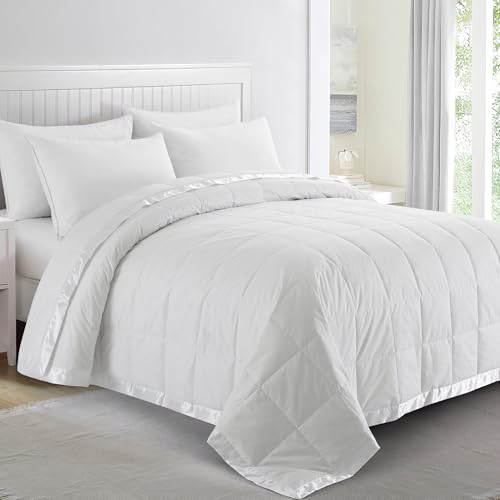
1. puredown Lightweight Down Blanket, Full/Queen, White (90″ x 90″) — Best Overall
The puredown is the reference point for this category: a true bed blanket rather than a slimmed-down duvet. The fill is 75% down and 25% feather — a high down share for the price tier — inside a 100% cotton cover with a satin-trimmed edge, so it looks finished on the bed with no duvet cover over it. The materials carry OEKO-TEX Standard 100 certification, and the blanket comes in twin, full/queen and king sizes and several colors beyond the white shown here. Used alone, it is a spring-to-fall layer for most sleepers; over a sheet in winter it adds noticeable warmth without the bulk of a second comforter.
The honest trade-offs: puredown does not publish a fill power for this blanket, so you are trusting the 75% down content rather than a loft rating, and the sewn-through construction that keeps a blanket flat will never feel plush like a baffle-box comforter. White and ivory versions also show every coffee splash. For most people who want one real down blanket to layer with, though, the combination of a high down ratio, a cotton shell and a finished satin edge is the safest all-round buy here.


2. Globon Summer Down Blanket, Queen (96″ x 88″) — Best for Hot Sleepers
Globon’s summer blanket is the lightest bed-sized pick here: roughly 10 ounces of a 75% down and 25% feather fill spread across a generous 96″ x 88″ queen, which works out to a layer barely heavier than a cotton blanket but with down’s warmth-to-weight advantage. The shell is a soft, noiseless cotton blend (68% cotton, 32% polyester on the listing), box stitching keeps the thin fill from pooling in one corner, and the blanket is pitched squarely at warm weather and air-conditioned bedrooms rather than year-round duty.
That focus is also the limitation. Ten ounces of fill will not rescue a cold room in January, and hot sleepers should still read this as a summer layer to pair with a sheet, not a three-season solution. The blended shell will also feel slightly less crisp than the pure cotton covers elsewhere in this guide. If your problem is a duvet that feels like a weighted vest from May to September, this is the pick that solves it.

3. DOWNLITE Hypoallergenic Down Blanket with Satin Trim, Oversized King, White (113″ x 104″) — Best Oversized
DOWNLITE supplies down bedding to hotels, and this is its classic consumer blanket: 500 fill power duck down in a 230 thread count 100% cotton cover with a satin trim, sewn-through box construction, and genuinely oversized dimensions. The oversized king measures 113″ x 104″ with about 20 ounces of fill, and the oversized queen runs 94″ x 104″ with about 16 ounces — enough extra length to tuck under the mattress and still drape, which standard 90″ x 90″ blankets cannot do on a thick modern mattress. DOWNLITE markets the fill as hypoallergenic, a claim that rests on its cleaning process for the down.
Oversized is also oversized in price: this sits in the premium tier, and the color choice is white or ivory, full stop. The 500 fill power is honest mid-grade down rather than a luxury loft number, so what you are paying for is coverage, an established maker and a blanket-weight fill amount — about double the Globon’s — that works across more of the year. For tall sleepers and deep mattresses, it is the only pick here that truly fits.
4. Lincove Satin Trim Down Blanket, Queen, White — Best Premium Duck Down
Lincove’s blanket is the specification leader among the bed blankets here: 550 fill power white duck down — a loft figure most blanket makers do not publish at all — in a 230 thread count cotton cambric shell with a wide 3-inch satin border on all four sides. The queen is cut oversized at 104″ x 94″ with about 21 ounces of fill, the most in this guide, and the sewn-through box construction keeps that fill evenly spread. Retailer listings describe it as machine washable, which is not a given at this specification level.
Expect a premium-tier price, and note that this is duck down rather than the goose down of luxury comforters — at 550 fill power in a thin blanket, the practical difference is small, but the label matters to some buyers. White and ivory are the only colors. Choose it if you want the blanket itself to be the quality piece in the bedding stack, with published numbers to back the claim.

5. puredown Feather Down Throw Blanket, Throw (50″ x 70″), Beige — Best Couch Throw
Not every down blanket belongs on a bed. This throw-size version from puredown puts a feather-and-down fill into a 50″ x 70″ blanket sized for one person on a sofa: long enough to cover legs and lap properly, light enough to fold over an armrest. The listing is honest about the blend — 30% down and 70% feather fiber — in a wrinkle-resistant microfiber cover with box stitching, and the materials are OEKO-TEX Standard 100 certified. It packs down small, which makes it a good guest and travel layer as well as a couch staple.
Read the ratio before you buy: at 30% down this is a feather blanket with down in it, not the other way around. It lies flatter, feels less cloud-like than the bed blankets above, and feather-rich fills are the ones most likely to let an occasional quill poke through the cover. In exchange you get real natural fill at a budget-friendly tier in a size the bed blankets cannot match for the living room.

6. Get Out Gear Down Camping Blanket (Bouffi) — Best for Travel and Camping
The Bouffi takes the down blanket idea outdoors. It is filled with genuine 650 fill power down — the highest loft rating in this guide — inside a 20-denier ripstop nylon shell with a durable water repellent finish, and the whole 80″ x 54″ blanket (about 77″ x 50″ once lofted) weighs just 1 lb 1 oz in its included stuff sack. Three snaps convert it into a hands-free poncho for camp chairs and cold bleachers, and the maker rates it machine washable in a top-load washer. At home it doubles as an unusually warm throw; outdoors it is a three-season top layer for one camper.
The compromises are the outdoor brief itself: slippery nylon on both sides, a faint rustle the cotton bed blankets do not have, and a one-person footprint that will not dress a bed. It is also a single-width blanket, so couples need two. For travel, car camping and anyone who wants one down layer that works on the sofa and at the campsite, nothing else here comes close on warmth per ounce.
Best Picks by Category
- Everyday bed blanket: puredown Lightweight Down Blanket — 75% down in a cotton, satin-trimmed shell at 90″ x 90″.
- Hot sleepers: Globon Summer Down Blanket — about 10 ounces of fill, the lightest bed-sized layer here.
- Oversized coverage: DOWNLITE Hypoallergenic Down Blanket — up to 113″ x 104″ with tuck-in length to spare.
- Premium fill: Lincove Satin Trim Down Blanket — published 550 fill power duck down and a 3-inch satin border.
- Couch throw: puredown Feather Down Throw Blanket — 50″ x 70″, packable, honest feather-rich blend.
- Travel and camping: Get Out Gear Down Camping Blanket — 650 fill power down at just over a pound, stuff sack included.
Notice the pattern: the right pick is decided by where the blanket will live — nightstand drawer, sofa arm or backpack — because a thin down layer is a specialist tool, and each of these is built for a different job.
How to Choose
Fill weight matters more than fill power in a blanket
Fill power measures how much volume one ounce of down occupies: higher is loftier and warmer per ounce. Comforter makers compete on it; blanket makers often skip it entirely. For a thin layer, the more useful number is fill weight in ounces. Around 10 ounces is a summer blanket, 16 to 21 ounces is a multi-season layer, and anything much beyond that is really a lightweight comforter wearing a blanket’s name. Compare both numbers when they are published, and be suspicious of any blanket that advertises fill power but hides fill weight.
Read the down-to-feather ratio honestly
US labeling lets a product call itself a “down blanket” with far less down than buyers expect. A 75% down fill feels soft, light and quiet. A 30% down, 70% feather blend lies flatter, costs less and is more likely to poke quills through the shell. Also watch for “down fiber” and “feather fiber”: those are processed, chopped material rather than whole down clusters, and they insulate less per ounce. None of this makes feather-rich blankets bad — the throw in this guide is one — but the ratio should set your expectations and the fair price.
Size it for drape, not just mattress dimensions
A standard full/queen blanket is 90″ x 90″, which covers the top of a 60″ x 80″ queen with modest overhang. Thick mattresses eat that overhang quickly, and nothing looks or sleeps worse than a blanket that ends at the mattress edge. If you like to tuck the foot and sides in, look for oversized cuts — 94″ to 113″ widths — and check the length as well as the width, because oversized blankets from hotel suppliers are often longer than they are wide. Throws are a separate sizing world: 50″ x 70″ covers one seated or reclining person.
Shell fabric decides feel, noise and care
Cotton shells breathe best and feel most like traditional bedding; higher thread counts (around 230 and up) are woven tightly enough to slow feather leakage. Microfiber is softer out of the package, wrinkle-resistant and cheaper, but sleeps warmer and can feel clammy. Nylon belongs outdoors: it blocks wind and sheds water, at the cost of rustle and slipperiness. Construction is simpler than in comforters — sewn-through boxes are the norm and are fine at blanket thicknesses, because there is not enough fill to create the cold spots baffle boxes are designed to prevent.
Certifications: what RDS and OEKO-TEX actually tell you
The Responsible Down Standard (RDS) certifies that down was sourced with animal-welfare rules and traceability through the supply chain; it says nothing about warmth or quality. OEKO-TEX Standard 100 certifies that the finished textile’s components were tested for harmful substances; it says nothing about sourcing. A blanket can carry either, both or neither, and the claims apply to specific components, so check which parts of the product the certification number on the listing actually covers.
Care and storage keep down alive
Care labels in this category range from machine washable to dry clean only, and that difference is a real ownership cost — read it before buying, not after the first spill. Washable down blankets want a large-capacity machine, gentle detergent and a full, patient dry on low heat, ideally with dryer balls to break up clumps; damp down stored away will mildew and lose loft. Store any down blanket loose in a breathable cotton bag rather than compressed, and keep outdoor down blankets hung or loosely stuffed between trips for the same reason.
What to check before you buy a down blanket, and who should skip it
Before buying a down blanket, confirm the size, the down share, the care label and the return terms on the exact listing you plan to order. These four details decide whether the blanket suits your bed and your routine.
- Size against your mattress: thick mattresses eat drape, so compare the blanket’s length and width with your bed.
- Down-to-feather ratio and fill weight: read both, and remember that a blanket with a lot of feather lies flatter.
- Shell fabric: cotton breathes, microfiber is soft but can sleep warmer, and nylon suits outdoor use.
- Care label: some blankets are machine washable and some are dry clean only, so check the size and color you are ordering.
- Returns and warranty: read the listing terms before the blanket is opened, in case the loft or size disappoints.
Weigh the objections fairly. A down blanket is a thin layer, so it will not carry a cold bedroom alone. Light colors show stains, and real down needs careful drying. Some people also prefer the feel of a heavier comforter.
You may want to skip down if you avoid animal products, in which case a down alternative is a different product class worth comparing separately. If you share a bed with a partner who sleeps much warmer or colder, a single layer may not please both of you.
Which down blanket should you buy?
The best down blanket is the one built for the job you need it to do, whether that is bed layering, summer cooling, oversized coverage or travel. Here is how the named picks map to common needs.
- If you want one dependable layer for most beds, go for the puredown Lightweight Down Blanket.
- If you sleep hot or live somewhere warm, choose the Globon Summer Down Blanket.
- If you have a deep mattress or like to tuck in, pick the DOWNLITE Hypoallergenic Down Blanket with Satin Trim.
- If you want the highest published fill power among the bed blankets, look at the Lincove Satin Trim Down Blanket.
- If you want something for the sofa or a guest, consider the puredown Feather Down Throw Blanket.
- If you camp, travel or sit in cold stadiums, choose the Get Out Gear Down Camping Blanket.
If you are undecided between two bed blankets, let your room temperature decide. Cooler rooms favor more fill, and warmer rooms favor less.
Compare the picks above, check the current listing for size, fill details and care instructions, then choose the one that fits how you will use it.
Choosing Among These Picks: Layer, Blanket or Throw?
Down blankets fail buyers in one predictable way: the product is fine and the job assigned to it is wrong. The six picks here span full-bed layers, warm-sleeper blankets, an oversized king and a couch throw, so start by naming the job.
The balanced bed blanket versus the hot sleeper’s answer
The puredown Lightweight Down Blanket in the top spot, in Full/Queen and white, is the versatile center of this guide: a true bed blanket with enough down to take the chill off, light enough to layer under a comforter in colder months or stand alone in shoulder seasons. Choose it if you want one down blanket that behaves sensibly across most of the year on a queen or full bed. Its honest limitation is that versatility cuts both ways — the coldest sleeper in a cold house will still want a real comforter over it in deep winter, and the warmest sleeper may find it plenty even in summer, which is a comment on personal warmth rather than the blanket.
The Globon Summer Down Blanket is tuned for the sleeper the puredown might overwhelm. Choose it if you run warm, sleep in a heated or warm-climate home, and want down’s soft, breathable loft without building a winter nest. The discipline here is honesty about your own nights: buying the summer weight and then feeling cool in January is not a product failure. If your bedroom is genuinely cold in winter, buy for winter and add a lighter layer for summer, or accept the puredown as the compromise.
Oversized drape and premium duck down
The DOWNLITE Hypoallergenic Down Blanket with Satin Trim, in its oversized king dimensions, solves the coverage war that plagues couples on large beds: enough width and length that turning over does not steal the blanket from a partner, with generous drape down the sides. Choose it for king beds, tall mattresses, and any bed where standard blankets have felt skimpy. The satin trim gives it a finished, traditional look that sits happily on top of the bed as the visible layer. Its trade-off is handling: an oversized blanket is a bigger wash-day commitment and needs a suitably large machine or a laundry service, as the care guidance in this guide explains.
The Lincove Satin Trim Down Blanket, in queen, is the premium duck down choice for buyers who want that same classic satin-edged presentation in a standard size and are willing to choose the more refined option in the lineup. Choose it when the blanket will be the bed’s top layer and its finish will be seen daily. Skip it if the blanket will live permanently hidden under a duvet cover or comforter, where its trim and presentation earn nothing and the puredown’s versatility is the smarter spend.
The throw and the travel blanket are different tools
The puredown Feather Down Throw Blanket, in a throw size and beige, belongs on the couch, the reading chair and the foot of a bed for extra warmth where a person actually sits. Its feather-rich character gives it a weightier, more substantial drape than a lofty bed blanket, which many people love in a throw. Choose it for living-room warmth and as a guest-ready extra layer. Do not buy it expecting to dress a queen bed; size honesty in the listing is clear, and disappointment here is always a job mismatch, not a quality verdict.
The Get Out Gear Down Camping Blanket takes down outdoors: packable warmth for camping, travel, stadiums and car kits. Choose it if your blanket needs to compress, travel and shrug off being used on the ground at a picnic or around a campfire within sensible care. Its compromises are the reverse of the bed blankets’ — it is not sized or finished to dress a bed elegantly, and outdoor use will age it faster than indoor use. As a travel tool, though, nothing else in this guide does its job at all.
Keeping Down Alive: Loft, Washing and Storage
Loft is the whole product
A down blanket works because its clusters trap still air. Everything in its care comes back to protecting that loft. Shake and air the blanket regularly — a few minutes outdoors on a dry day, or a good shake when you make the bed — to redistribute fill that migrates toward edges and to let any absorbed moisture leave. If one area feels flat, gentle hand-fluffing of that section usually restores it; persistent cold spots usually mean fill has shifted rather than vanished, and patient redistribution through the shell is the first remedy.
Compression is loft’s enemy in storage. Store a down blanket loosely in a large breathable bag or on a shelf, never vacuum-sealed or crushed under heavy items for a season. A blanket stored compressed for months may need extended airing and fluffing to recover, and repeated hard compression shortens its best years. This is doubly true for the camping blanket: unpack it between trips rather than leaving it in its stuff sack all year, and it will greet each trip with its warmth intact.
Washing without regret
When washing at home is appropriate for your pick, use a large-capacity machine, a gentle cycle and a small amount of mild detergent, then dry thoroughly and patiently on low heat, stopping to break up clumps and redistribute fill as it dries. Down that feels dry on the shell can still hold moisture in the clusters, and putting a partly dried blanket away is how musty smells and damaged fill begin. If your home machine is small, a laundromat’s large machines or professional cleaning is not an indulgence for the oversized DOWNLITE in particular; it is the method that actually fits the blanket.
Between washes, a duvet cover or a simple top sheet between sleeper and blanket stretches the interval considerably, because most of what a blanket collects comes from skin contact. Spot-clean small marks promptly rather than washing the whole blanket for a single spill.
Feathers, shells and realistic expectations
An occasional fine quill working through a shell can happen with real down and feather products, especially early in a blanket’s life. Pull it back through from the underside rather than pulling it out, which widens the hole it found. A tightly woven, down-proof shell — a quality this guide explains — minimizes this, and a cover eliminates its annoyance entirely. Judge a blanket by whether leakage is rare and occasional, not by whether it ever happens once.
Decision Checklist Before You Commit
Name the job, then the size, then the warmth. All-purpose queen layering points to the puredown; warm sleeping to the Globon; king coverage to the DOWNLITE; a premium visible queen layer to the Lincove; couch warmth to the puredown throw; travel to the Get Out Gear.
On the listing, confirm the exact dimensions against your mattress or your couch, the fill composition as stated by the maker, and the care method the maker directs. Those three facts, checked before ordering, predict satisfaction with a down blanket better than any other information on the page.
Real Beds, Real Choices: Scenario Walkthroughs
Consider a couple on a king bed who fight the nightly blanket war: one turns, the other wakes cold. Their problem is geometry, and the DOWNLITE oversized king is the only pick here that truly solves it, because no standard queen blanket, however lovely, creates fabric that does not exist. This household should buy the oversize, plan the larger wash it requires, and consider the problem closed. Couples often spend seasons blaming blanket quality for what is simply a size shortage; measuring the bed and the desired drape, as this guide directs, ends the war in one purchase.
Next, a warm sleeper in a mild climate who loves the idea of down — its lightness, its softness, its breathable feel — but has returned heavier bedding before. The Globon summer blanket is this sleeper’s honest match, possibly with the puredown throw at the foot of the bed for the occasional cooler night, where it can be pulled up or kicked off without remaking the bed. Layering a light blanket with a throw gives a warm sleeper adjustable warmth, which is worth more than any single blanket’s rating, because the sleeper’s own temperature varies more across a year than any one product can span.
Third, a household equipping a reading chair, a guest-ready couch and a car for winter travel in the same season. The puredown throw covers the chair and couch with a weight and drape that feels generous, while the Get Out Gear camping blanket lives in the car, ready for breakdowns, bleachers and impromptu picnics. Neither should be asked to dress a bed, and the bed blankets should not be asked to travel. This household illustrates the guide’s opening lesson in its purest form: down products succeed when each is bought for one clear job.
Down and the allergy question, handled carefully
Buyers who react to dust and household allergens often ask whether down is closed to them. The honest answer is individual: reactions commonly blamed on down itself are frequently reactions to what bedding collects over time, which is why washable construction, protective covers and regular airing matter, and why a hypoallergenic-positioned pick like the DOWNLITE exists in this guide. Anyone with a known, specific allergy should follow their own medical guidance rather than a buying guide’s generalities, and a down alternative remains a perfectly respectable choice for those who prefer not to wonder. What this guide can say is that cleanliness practices — covers, airing, proper washing — are the controllable part of the equation, and they are the same practices that keep any down blanket performing at its best.
The five-year view
A down blanket is a multi-year purchase, and its cost makes sense spread across the seasons it will serve. The ownership habits that protect that span are unglamorous: a cover or top sheet to stretch washes, loft-preserving storage, patient complete drying, and prompt attention to small shell snags before they become fill leaks. Owners who adopt those habits routinely describe their blanket in year five as the best bedding they own; owners who store it crushed and damp describe a different product entirely, though it arrived in the same box. Choose the pick that fits your job and climate, then keep it as this guide describes, and down’s reputation for lasting, breathable comfort tends to explain itself.
A Last Reminder Before You Order
Before you order, state the job in one sentence — the layer on a queen bed, the summer cover for a warm sleeper, the end of a couple’s blanket war on a king, the couch throw, the travel companion — and do not let a beautiful listing talk you out of that sentence. Then measure: the mattress width plus the drape you actually want on each side, or the couch and chair the throw must cover, because down blankets are bought in dimensions, not in bed-size labels alone. Check the listing for the fill composition as the maker states it, the exact dimensions, and the care method directed, and picture that care happening in your home with your machines; if the honest picture involves a laundromat trip you will never make, choose the pick whose care you will actually perform. Decide about a cover at the same time, since a duvet cover or a disciplined top sheet changes how often the blanket needs washing and how long its loft stays fresh. When the blanket arrives, air it, let it loft fully before judging its warmth, and give it several nights across your normal layering before concluding anything, because down settles into a bed’s system gradually. Bought for a clear job, sized by measurement and kept with the simple loft-preserving habits this guide describes, a down blanket is among the longest-serving comforts a home can buy.
Frequently Asked Questions
What is the difference between a down blanket and a down comforter?
Thickness and intent. A comforter carries enough fill — often 25 ounces and up in a queen — to be the bed’s primary insulation, with baffle-box construction to hold the loft. A down blanket carries roughly 10 to 21 ounces in a flat, sewn-through shell: it layers over sheets or under a duvet, folds small, and in summer can replace the comforter entirely. If you sleep warm or live in a mild climate, the blanket may be all you need; in a cold bedroom it is a partner layer, not the whole answer.
Are down blankets warm enough for winter?
Alone, only the heaviest picks here, and only in a heated bedroom. Down blankets are designed as one layer in a system: sheet, down blanket, then a duvet or quilt above it traps the blanket’s warmth and feels substantially warmer than either layer alone. That layering flexibility is the point of the category — you adjust the stack night by night instead of owning a summer comforter and a winter comforter.
What fill power should I look for in a down blanket?
Where it is published, 500 to 650 is the realistic blanket range: 500 in hotel-style blankets, 550 in premium duck down, 650 in outdoor blankets where weight matters most. Many bed blankets publish no fill power at all, which is normal for the category — in that case judge by fill weight in ounces and the down percentage, and treat any retailer-invented fill power number with caution if the maker’s own listing omits it.
Can you machine wash a down blanket?
Some, yes — several picks here are listed as machine washable — but some satin-trim blankets are dry clean only, and the label on the specific size and color you buy is the authority. When washing is allowed, use a front-load or large top-load machine, wash gently, and dry thoroughly on low heat; down that goes into storage damp will smell and clump. If you know you will wash a blanket monthly, filter for washable models first.
Down blanket or down alternative blanket?
Real down wins on warmth per ounce, compressibility and lifespan, and good down is cleaned to be hypoallergenic in practice. Down alternative (polyester) wins on price, easy washing and suitability for households avoiding animal products, but it is heavier for the same warmth and flattens sooner with use. One caution from our earlier blanket guides: a down alternative pick is a different product class, so compare like with like — a “down blanket” listing with a polyester fill is mislabeled, whatever the title says.
Why do feathers poke through my down blanket?
Feather quills are stiff and work their way through any weave given time and friction; fills with a high feather share do it most. A tightly woven, down-proof cotton shell (higher thread count) slows it down, as does using the blanket under a duvet cover. Pull a poking feather back through from the underside rather than pulling it out, which drags more fill with it, and expect a few escapees in the first weeks as loose fill from manufacturing works its way out.
How do I wash a down blanket at home?
First read the care label, since not every down blanket is machine washable. If washing is allowed, use a large machine and a gentle detergent, then dry fully on low heat. Dryer balls can help break up clumps.
Can you use a down blanket under a duvet?
Yes, that is one of the main uses. A thin down layer between the sheet and a heavier cover adds warmth without much bulk. In summer you can use the blanket alone.
What does down-proof mean on a blanket?
It usually describes a shell woven tightly enough to keep down and feathers from working through. It lowers leakage but does not remove it entirely. Check the shell description on the listing.
How long does a down blanket last?
Lifespan depends on the quality of the fill and how you care for it. Dry it thoroughly, store it loose in a breathable bag and keep it clean. Well-kept down tends to hold its loft longer than synthetic fill.
Are down blankets good for allergies?
Some people react to down or dust, and some listings use the word hypoallergenic based on how the down is cleaned. That is a maker's claim rather than a guarantee. If you have allergies, talk to your doctor and check the return terms.
Should I get a white or a colored down blanket?
White and ivory look crisp but show stains easily, so they suit a blanket used under a duvet cover. If the blanket sits on top of the bed, a darker shade can be easier to live with. Check which colors the listing offers.
Bottom Line
For most beds, start with the puredown Lightweight Down Blanket: a genuine 75% down fill, a cotton shell and a finished satin edge make it the layer you will use three seasons a year. Hot sleepers should go lighter with the Globon Summer; big beds and tuck-in sleepers should go bigger with the DOWNLITE; and if you want published premium specs, the Lincove’s 550 fill power duck down earns its tier. Keep the puredown throw on the sofa and the Get Out Gear blanket in the car or pack, and you have every room covered. Check the size and current price before you order — and check the care label twice.