Disclosure: As an Amazon Associate, umtsmarttool.com earns from qualifying purchases. Links to Amazon on this page are affiliate links; they cost you nothing extra. Listing details such as price and availability change often, so check the current Amazon listing before you buy.
Anyone shopping for a car battery charger under $50 should expect a maintainer rather than a workshop machine, and for most households that is exactly the right tool. Batteries rarely fail because of one dramatic event. They fade after weeks of short trips, long parking spells and cold nights, and a small automatic charger quietly reverses that slide.
This page is aimed at people with a spare car, a weekend motorcycle, a lawn tractor or a vehicle that sits in the driveway more than it moves. It also suits first-time buyers who want a calm explanation instead of a wall of jargon. Five compact units from familiar makers are compared, each from the angle of how it fits a real garage routine.
At this ceiling you trade speed for gentleness. You will not find high output or rescue features, but you will find reliable upkeep, and the sections below show how to choose among the five.
Quick Comparison
| Product | Best for | Main point | Link |
|---|---|---|---|
| NOCO Genius1 | Mixed battery collections | One amp, lithium listed | Check on Amazon |
| NOCO Genius2 | A second car in storage | Two amps in a flat case | Check on Amazon |
| Battery Tender Junior | Winter storage | Simple float charging | Check on Amazon |
| BLACK+DECKER BM3B | Older and newer vehicles together | Two voltages supported | Check on Amazon |
| DEWALT DXAEC2 | Workshop shelves | Tool-brand build | Check on Amazon |
How These Options Were Chosen
Everything in this guide comes from manufacturer listings and published specifications. We looked at output, supported voltages, accessories and the type of owner each product is aimed at.
We have not used these products ourselves, so nothing here describes how a particular unit performed in a garage. Listings, bundles and revisions change, which is why we keep telling you to confirm voltage, battery types and included clamps on the current page. Where we were unsure of a detail, we left it out.
The Best Car Battery Chargers Under $50
NOCO Genius1 1-Amp Smart Battery Charger and Maintainer GENIUS1
The Genius1 is the smallest charger in a family that most hobbyists have heard of, and it is the one to look at first if you own both a car and something smaller. It delivers one amp, supports 6 volt and 12 volt batteries, and the maker lists compatibility with lead-acid and lithium-ion (LiFePO4) chemistries. A repair mode is listed for sulfated lead-acid batteries, and clamps plus eyelet connectors come in the box.
Think of it as a long-term guardian rather than a quick fix. Left connected to a stored motorcycle or a seldom-used second car, it keeps the battery topped up without fuss. Against the Battery Tender Junior further down, its main advantage is the wider chemistry support, so a mixed collection of batteries is easier to serve.
The drawback is pace. One amp refills a drained car battery slowly, so plan on a long connection. It also will not crank an engine, so keep a booster pack for emergencies. Fit the eyelet lead permanently if the battery is easy to reach, because then each top-up becomes a quick plug-in. Skip it if your battery is large or you need results by tomorrow morning. For a lawn tractor that sleeps through winter, it is a tidy way to avoid a dead battery on the first mowing day.
NOCO Genius2 2-Amp Smart Battery Charger GENIUS2
Doubling the output of its smaller sibling, the Genius2 is the sensible pick when one amp feels too timid. It handles 6 volt and 12 volt batteries, and the maker describes it as suitable for lead-acid and lithium types, with a repair mode and automatic detection of battery condition. Clamps and eyelet connectors are supplied.
Picture a sedan that is driven twice a month. A unit like this can hold the battery steady between drives and shave some time off a recovery after a cold week. The case is slim and light, so hanging it from a hook beside the fuse box or dropping it into a toolbox is easy.
It is still a gentle charger. A seriously flat battery will need a long session, and the listing is where to confirm the battery sizes the maker recommends. Some owners will find that the extra amp is the only difference they notice compared with the Genius1, so if your batteries are small and your patience is large, the smaller model may be enough. Skip this one if you are caring for a truck or a boat with a big battery. Keep the cable away from the fan and belts if you ever connect it with the hood closed on a nearby shelf.
Battery Tender Junior 12V 800mA Battery Charger and Maintainer 021-0123
Few chargers have earned as much trust in cold-weather storage as this one. It is a 12 volt unit with an 800 milliamp output, built around a charge-then-float cycle that holds the battery without pushing it. The maker lists protection against reversed connections and describes the design as spark-proof.
The Junior is for the owner who parks a convertible, motorcycle or classic from autumn to spring. Fit the supplied harness to the battery, route the plug to a convenient spot, and the winter routine becomes a single connection. There are no modes to choose and no screens to read, which is its quiet charm.
That simplicity has limits. It is a 12 volt, lead-acid design, so lithium batteries and 6 volt systems are outside its scope, and the low output makes it a poor tool for reviving a battery that has been drained to nothing. Compared with the NOCO models above, you give up chemistry flexibility and the repair mode in exchange for a very plain operating style. Skip it if you want recovery features or own anything other than a 12 volt lead-acid battery. Its long reputation is mostly about patience, so treat it as a winter habit and not a repair tool.
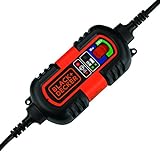
BLACK+DECKER BM3B 6V/12V Battery Charger and Maintainer
The BM3B comes from a brand that sits in most home tool cabinets, and the maker lists it for both 6 volt and 12 volt batteries. That pairing matters to a small group of owners: someone with a vintage tractor or classic car alongside a modern daily vehicle can serve both with one purchase.
Operation is described as automatic, so it moves from charging to maintaining without supervision. Connection is by clamps, and the body is light enough to hang on a wall hook between jobs. For a shed or garage that already holds other BLACK+DECKER gear, it feels like a natural neighbor.
The trade-off is information and features. This is a straightforward design without a chemistry selector, and the exact amperage and supported battery types should be read from the listing before you commit. There is no repair mode to lean on, and it does not replace a booster pack. If your needs include lithium batteries or you like fine control, the NOCO models make a better home. Skip it if you want a charger with switchable programs. Remember to read the listing for the supported battery types, since that is the detail that decides whether it suits your garage.
DEWALT DXAEC2 Professional 2 Amp Automotive Battery Charger and Maintainer
Wearing the familiar yellow and black of a power tool brand, the DXAEC2 is a two amp automotive charger and maintainer positioned for professional-style use. It charges and then maintains automatically, and it is built to survive the knocks of a busy shop better than a flimsy plastic box.
Its natural home is a workbench shelf. A hobbyist who rotates between a pickup, a trailer and a mower can leave the clamps coiled on a hook and grab the unit when a battery needs attention. The tool-brand reputation also gives some buyers extra confidence about long-term durability, although you should check the listing for the warranty terms rather than assume them.
Two amps keeps it in maintainer territory, so do not expect miracles on a battery that has been flat for months. It lacks broad chemistry choices, and the listing is the place to confirm voltage and any extra functions. Against the NOCO Genius2, you are paying for ruggedness and brand feel rather than extra capability. Skip it if lithium support or a recovery mode is on your wish list. A buyer who already owns other yellow tools may enjoy having one more piece that matches the rest of the bench.
Best for Beginners
People who have never connected a charger tend to worry about sparks and wrong clamps. At this ceiling, the Battery Tender Junior is the least intimidating option because it has no modes to choose. You connect it, plug it in, and it handles the rest, which makes the first session feel manageable.
Take ten minutes with the manual before the first use and write the clamp order on a card kept with the unit.
Best for Car Owners
Owners of a single everyday sedan usually want to prevent trouble rather than fix it. The NOCO Genius2 fits that mindset well, because two amps is enough to keep a normal car battery healthy and it still supports a repair mode if the battery gets low after a holiday.
Pair it with a habit of checking the terminals each season for white or green crust.
Best for Daily Driving
A car that runs every day seldom needs charging, but short winter commutes can leave the battery low. The DEWALT DXAEC2 is a sturdy choice for the occasional weekend session, living on a garage shelf and ready when the dashboard seems sluggish.
Connect it overnight on Friday and unplug it on Saturday morning, then see how the engine feels on a cold morning.
Best for Road Trips
Before a long drive, a battery that has sat for a month deserves a check. The NOCO Genius1 is small enough to travel in a trunk bag, so you can top up the battery at a relative’s house before the second leg of a journey.
Keep a booster pack on board as well, because a tiny charger cannot rescue a stranded car in a parking lot.
How to Choose
Shoppers at this limit are really choosing among gentle maintainers, and the useful questions are about your batteries rather than the charger itself.
Begin with voltage
Most modern cars and motorcycles use 12 volt batteries, but vintage cars, some garden tractors and a few older machines use 6 volt ones. Of the five here, the NOCO models and the BLACK+DECKER BM3B list 6 volt support, while the Battery Tender Junior is a 12 volt device. Connecting the wrong voltage is a mistake worth avoiding, so look at the label on your battery first.
Check the chemistry
Lead-acid batteries, including AGM versions, are the norm in cars. Lithium batteries are appearing in motorcycles, boats and some accessories, and they need a charger that says so plainly. If you own one, the Genius1 and Genius2 are the only picks here whose makers list lithium compatibility.
Accept the slow pace
One or two amps means hours or days, not minutes. That is fine for maintenance and unsuitable for emergencies. If you often find yourself needing a car to run in half an hour, this ceiling is the wrong place to look, and a booster pack or the next tier up will serve you better.
Think about the plug-in routine
A charger you must unpack and untangle each time tends to stay in the box. Look at whether a ring terminal harness is included, how long the cord is, and whether the case can hang on a wall. Convenience decides whether the unit is ever used.
A frequent mistake at this level is expecting a one amp unit to behave like a jump pack, or leaving a plain unit without an automatic float mode connected for weeks.
Installation, Safety and Legal Notes
None of these chargers needs installation beyond connecting clamps, but the maker’s instructions come first in every case. Disconnect from mains power before you touch the clamps, and keep sparks and open flames well away from the battery while it charges.
If you want a permanent harness routed under the hood, or a socket added to a wall, a licensed professional should handle any wiring work you are not comfortable doing. Charging in an apartment car park or a rented garage may be restricted by the building, so check local rules and any lease terms. We do not quote specific regulations, because they vary by place.
Care and Troubleshooting
Coil the cable loosely, wipe the clamps after use and store the unit in a dry spot. Small chargers are simple to look after, and a little attention prevents most faults.
| Symptom | First thing to check |
|---|---|
| No lights at all | Wall socket and cord |
| Charger refuses to begin | Clamp contact and a very low battery voltage |
| Battery drains again quickly | Age of battery, or a parasitic draw in the car |
| Very slow progress | Normal for one or two amps on a large battery |
Amps, Battery Size and Charge Time Math
A charger’s amp rating describes how fast it can push current into a battery. A battery’s capacity is usually printed in amp-hours, abbreviated Ah. Dividing the amp-hours you need to put back by the charger’s amps gives a rough floor for charge time, and real sessions run longer because charging slows as the battery fills. As an illustration only, a battery that has lost 20 Ah would need at least 20 hours from a 1 amp unit and at least 10 hours from a 2 amp unit, plus the tapering time at the end.
That arithmetic explains why the units in this guide are maintainers first. A small motorcycle or lawn tractor battery is a modest job for one amp. A full-size car battery is a much bigger tank, and a gentle charger will take a long weekend to refill one that is truly empty. Look for the amp-hour or group size on your battery label, and compare it with whatever battery range the maker lists on the product page.
Do not confuse cold cranking amps with capacity. Cold cranking amps describe how much current a battery can deliver for engine starting in cold weather, not how much energy it stores. A charger rated for small batteries is not meant for large starting batteries just because those batteries are common in cars, so check the size guidance in the manual.
- Find the amp-hour rating or group size printed on the battery case.
- Estimate how much the battery has been drawn down, then divide by the charger’s amps.
- Add generous extra time for the slow finishing stage.
- If the number looks impractical, plan for a higher output charger or a booster pack.
Charger, Maintainer and Jump Starter: Three Different Tools
Shoppers often treat these as interchangeable, and that leads to disappointment. A charger raises the charge level of a battery over hours. A maintainer, sometimes called a trickle or float unit, holds a charged battery at a safe level during storage. A jump starter is a separate battery pack that supplies a burst of current so a stalled engine can turn over. The compact models here lean heavily toward the maintainer role, even where the box also says charger.
The practical consequence is simple. If a car will not start this morning and you must leave in twenty minutes, none of these five is the right tool. If a car will not start because it has sat for six weeks, a patient connection overnight or longer may bring the battery back, provided the battery itself is healthy. Many owners end up wanting both a maintainer for routine upkeep and a small booster pack in the trunk for emergencies.
Another distinction is smart versus basic. A smart unit watches the battery and moves through stages by itself, finishing in a holding mode. A basic unit may keep pushing current without that finishing logic, which is why makers advise against leaving a plain charger attached for weeks. When a listing says automatic or float, that is the feature that lets you leave the clamps on between uses. Verify that wording on the page and in the manual before you rely on it for long storage.
It also helps to know what a charger cannot repair. A battery with a shorted cell, a cracked case or an internal failure will not recover no matter what mode is selected. If a battery refuses to hold charge after a full cycle, have it load tested at a parts store or garage before spending more.
A Seasonal Storage Routine That Protects the Battery
Batteries lose charge on their own, and cold weather makes things worse. A discharged lead-acid battery is more likely to freeze in a harsh winter than a full one, and a frozen case can crack. That is the quiet reason a maintainer earns its place on a seasonal vehicle: it keeps the battery near full all winter.
A sensible routine looks like this. Before storage, drive the vehicle long enough to put some charge back, then clean the terminals with a brush and a damp cloth so corrosion does not interfere with contact. Park the vehicle where it will stay for the season, connect the maintainer according to the manual, and confirm that the indicator lights show it has moved into its holding mode. Check the connection every few weeks, and keep the charger off the ground if the garage floor can get damp.
For motorcycles and tractors, the ring-terminal harness mentioned above is especially helpful because the battery is often tucked behind a panel. Leave the harness attached and routed to an accessible spot, so spring start-up only needs a quick unplug. For cars, make sure the charger cord and clamps are clear of the engine fan, belts and any hot components if you leave anything connected under the hood.
- Fall: top up, clean terminals, connect the maintainer.
- Midwinter: glance at the indicator lights and the cord.
- Spring: unplug, remove the clamps in the order the manual states, and start the engine.
- Any time: replace a battery that has swelled, leaks or smells of sulfur.
Vehicles with heavy electronics can drain a battery even while parked. A modern car may need a connected maintainer after only a few weeks of rest, whereas a simple older machine may sit longer. Let the vehicle’s own behavior guide how often you plug in.
Reading a Charger Listing Before You Order
Listings for small chargers are crowded with icons, so read them against a short checklist. First, find the supported voltages and confirm they match your battery. Second, look for the battery chemistries named, since lithium and some specialty batteries need explicit support. Third, confirm what comes in the box: clamps, eyelet connectors, a cigarette lighter plug or a mounting bracket. Fourth, look for protection features that the maker describes, such as reverse polarity protection and spark resistance, and treat them as maker claims you can verify in the manual.
Pay attention to the cord. Short cords force you to place the charger awkwardly near the battery, and long cords can tangle. If the unit will live in a garage with a single outlet, measure the distance from outlet to battery. An extension cord may be needed, and a heavy-duty one is preferable to a thin one. Also consider the environment. Chargers are usually meant for dry indoor use, so a damp shed or an open driveway may call for a model the maker describes as suitable for those conditions.
Finally, check the warranty text and the return window. Chargers are used infrequently, so a fault can go unnoticed until winter. Test the new unit soon after it arrives by connecting it to a battery and watching the indicator lights progress. If anything looks off, you will still be inside the return period.
These checks take ten minutes and they matter more than any ranking, because the best charger for someone else’s battery can be the wrong one for yours.
Frequently Asked Questions
Is a one amp charger enough for a car?
For maintenance it can be. For recovering a drained battery quickly it is not, so expect a long wait.
Can I leave the Battery Tender Junior on all winter?
The maker designs it for long connection with a float mode, but follow the manual for your exact model.
Which pick works for a 6 volt tractor?
Of these five, the NOCO models and the BLACK+DECKER BM3B list 6 volt support, so begin there and verify on the listing.
Do these chargers repair a dead battery?
A repair mode may help a sulfated battery, but a worn-out battery needs replacing. Treat the mode as a bonus, not a promise.
Do I need a ring terminal harness?
It is optional, though permanent eyelets make regular top-ups faster and tidier.
Is lithium support common at this level?
It is rare. Check the listing wording closely before you connect a lithium battery to any unit.
How long does it take a 2 amp charger to charge a car battery?
It depends on the battery’s size and how drained it is. A deeply discharged car battery can take a day or more on a 2 amp unit, because charging slows near the end. For routine upkeep of a battery that is nearly full, a few hours of connection is often enough.
Can I leave a battery maintainer connected for months?
Many are designed for that, using a float stage that holds the battery without overcharging. Confirm that your exact model is described as automatic or float in its manual. Plain chargers without that function should not stay connected for long periods.
Will a battery charger work if the battery is completely dead?
Sometimes. Many smart chargers need to detect a minimum voltage before they start, so a battery at near zero may be ignored. Repair or recovery modes can help in some cases, but a worn or damaged battery may not accept charge at all.
Should I disconnect the car battery before charging it?
Often not required with an automatic charger, but the manual for your charger and your vehicle decides. Some owners disconnect to protect sensitive electronics or when the maker advises it. Always connect and disconnect clamps with the charger unplugged from the wall.
Bottom Line
At this limit you are buying peace of mind rather than speed. The NOCO Genius1 and Genius2 offer the broadest feature set, the Battery Tender Junior is the simplest, and the DEWALT and BLACK+DECKER models suit a general garage. Pick by voltage and chemistry first, read the listing for the details we could not confirm, and connect it on a schedule you will actually keep.