On a 2×72 belt grinder the wheels set how the belt tracks, how it feels at the work and how the build looks. A drive wheel pulls the belt, a tracking wheel keeps it centered, an idler turns it back, and a contact wheel gives a rounded surface for profiling and blending. Anyone building or upgrading a grinder ends up shopping for these parts.
The six listings below range from a single crowned drive wheel to a full wheel set and two rubber contact wheels. Diameters, bores and materials come from each listing page, and a few listing fields do not match the product, which we flag. We have not used these wheels ourselves, and strength and balance claims are the makers’ own.
As an Amazon Associate we earn from qualifying purchases. Links below are affiliate links, and they do not change the product information we give.
What to Look For
| Feature | Why it matters |
|---|---|
| Wheel role | Drive, tracking, idler and contact wheels each do a different job |
| Bore | 5/8, 7/8 and 1/2 inch bores must match the shaft or bolt |
| Material | Aluminum, Delrin and rubber-covered wheels behave differently |
| Bearings | Pre-fitted bearings save a machining step |
In this guide
Specs at a Glance
| Wheel | Size and bore | Material | Notes |
|---|---|---|---|
| Nylon-Pulley drive wheel | 5 in; 5/8 in bore | 6061 aluminum | Crowned; 2 lb |
| Nylon-Pulley wheel set | 5 in drive; 4 in track; 2 in idler | CNC 6061 aluminum | Bearings fitted; 3 in x 1/2 in mounting bolt not included |
| Nylon-Pulley idlers | 2 in; set of 2 | Aluminum | Model 2702; 6201-1/2 RS bearing code |
| Delrin wheel set | 4 in drive, 7/8 in bore; 3 in track; 2 in idler | Delrin polyacetal | Pre-installed bearings; listing says count of 4 but names 3 wheels |
| 10 in contact wheel | 10 in by 2 in wide; 1/2 in bore | Black rubber on aluminum | Dual 6205RS bearings; 5.8 lb; steel sleeve |
| 6 in contact wheel | 6 in by 2 in wide | Rubber on aluminum hub | 70 Shore; dual 6205 RS bearings; fits a 1/2 in bolt |
The 6 Best 2×72 Belt Grinder Wheels and Wheel Sets
Top pickBest for replacing or adding a drive wheel
1. Nylon-Pulley 5 Inch Crowned Drive Wheel, 2725
A single 5 inch drive wheel in 6061 aluminum with a crowned face for belt tracking and a 5/8 inch bore. The maker describes it as precision machined, and it weighs about 2 pounds.
Suits: replacing or adding a drive wheel. Strengths: a crowned face and a common bore. Weaknesses: one wheel only. Skip it if you need the whole set.
View Nylon-Pulley 5 Inch Crowned Drive Wheel 2725 on Amazon
Best for a full set from one maker
2. Nylon-Pulley 2×72 Wheel Set, 5 Inch Drive, 4 Inch Track, 2 Inch Idler
A CNC-machined set in 6061 aluminum with bearings fitted in the tracking and idler wheels. The listing notes that a 3 inch long, 1/2 inch bolt is required for mounting and is not included. Its detail fields show a 60 medium grit, which does not apply to a wheel.
Suits: a full set from one maker. Strengths: three wheel roles together. Weaknesses: the bolt is extra. Skip it if you want a rubber contact wheel.
View Nylon-Pulley 2×72 Wheel Set 5 4 2 Inch on Amazon
Best for spare or extra idlers
3. Nylon-Pulley 2 Inch Idler Wheels, Set of 2
Two 2 inch idler wheels in aluminum, model 2702, with a 6201-1/2 RS bearing code in the details. The short listing names knife making and 2×72 grinders as the use.
Suits: spare or extra idlers. Strengths: a pair in one listing. Weaknesses: sparse detail. Skip it if you want a complete set.
View Nylon-Pulley 2 Inch Idler Wheels Set of 2 on Amazon

Best for a lighter plastic set
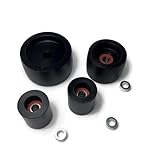
4. Delrin 2×72 Wheel Set, 4 Inch Drive
A set in Delrin polyacetal with a 4 inch drive wheel on a 7/8 inch bore, a 3 inch tracking wheel and a 2 inch idler, with pre-installed bearings. The maker says Delrin is lighter and reduces vibration compared with metal wheels. The unit count reads 4 although three wheels are named.
Suits: a lighter plastic set. Strengths: a 7/8 inch bore drive wheel. Weaknesses: an unclear unit count. Skip it if you want aluminum wheels.
Best for a large radius for blending
5. 10 Inch Rubber Contact Wheel, 2 Inch Wide
A 10 inch rubber contact wheel on an aluminum body, 2 inches wide, weighing 5.8 pounds. It has dual 6205RS bearings and a precision steel sleeve for a 1/2 inch bore, and the maker calls it dynamically balanced.
Suits: a large radius for blending. Strengths: a big diameter and fitted bearings. Weaknesses: the heaviest here. Skip it if you want a compact wheel.
View Generic 10 Inch Rubber Contact Wheel 2 Inch Wide on Amazon
Best for a mid-size contact wheel
6. 6 x 2 Inch Rubber Contact Wheel, 70 Shore
A 6 inch by 2 inch rubber contact wheel on an aluminum hub with dual 6205 RS bearings, listed at 70 Shore hardness. The maker says it fits a standard 1/2 inch bolt without an adapter.
Suits: a mid-size contact wheel. Strengths: a stated hardness. Weaknesses: a generic brand. Skip it if you want a named brand.
View Generic 6 x 2 Inch Rubber Contact Wheel 70 Shore on Amazon
Specs to Check Before Ordering
- Wheel diameter and face width against the grinder frame.
- Bore size and whether a sleeve or bolt is included.
- Material: aluminum, Delrin or rubber-covered.
- Bearing type and whether it is fitted.
- Rubber hardness, where the listing states it.
For assembly and use, follow the maker’s manual.
Mistakes to Avoid
- Ordering a wheel without matching its bore to the shaft.
- Counting the mounting bolt as included.
- Trusting fields, such as grit, that do not apply to a wheel.
- Mixing wheel sizes that do not suit the belt path.
How the Wheels Fit Together in the Belt Path
A 2×72 grinder uses a loop of abrasive belt, two inches wide and seventy-two inches long, and the wheels decide the path that loop travels. The drive wheel connects to the motor and pulls the belt. The tracking wheel sits on an adjustable arm and tilts slightly so the belt stays centered. One or more idlers guide the belt around corners, and a contact wheel gives a curved face at the work area for profiling, blending and hollow grinds.
Before buying, sketch your own grinder layout. Count how many wheel positions the frame has, note which positions are fixed and which are adjustable, and mark the diameter each position was designed for. A wheel that is too large will foul the frame or change belt tension, while one that is too small can leave the belt slack or running at a different speed. If you are building from a kit or a plan, follow the design’s recommended wheel sizes rather than mixing at random.
Keep the whole path in mind, not just a single part. Wheel diameters, widths and crowns all affect how the belt behaves. If you buy a full set, check that the three wheels listed match the roles in your frame. If you buy single wheels, order them in a way that lets you test the path before you finalize the layout. Keep the original parts until the new ones are proven.
Bore, Shaft and Bearing Compatibility Checks
Wheel bores are a common source of mistakes. The bore is the hole through the center, and it must match the shaft, axle or bolt that carries the wheel. Common sizes include 5/8 inch for motor shafts and 1/2 inch for bearings or bolts, but confirm the actual measurement on the listing and on your own hardware. A wheel with the wrong bore will wobble, damage the shaft or need bushings and sleeves to fit.
Bearings change the arrangement. Idlers and tracking wheels usually spin freely on bearings, so they need a bearing seat and an axle of the right diameter. Check whether bearings are pre-installed, the bearing code or size, and whether the wheel needs spacers. If the listing states a bearing code, match it to the bearing you have on hand, in case you need spares.
- Measure the shaft: use calipers on the motor or axle instead of trusting a nominal size.
- Check keyways and set screws: a drive wheel must lock to the shaft so it does not slip.
- Check hardware: some listings state that bolts or washers are not included.
- Check width: the wheel face must accept a two-inch belt without overhang that leaves the edge unsupported.
Do not force a wheel onto a shaft, and do not use a bore adapter you do not trust at grinding speeds.
Aluminum, Delrin and Rubber Wheel Materials
The wheel material shapes weight, noise, vibration and feel. Machined aluminum wheels are rigid and dimensionally stable, and they accept a precise crown. Their weight and rotating mass can help smooth running, but they can also be loud and heavy on a light frame. Aluminum can wear under a steel-sharp belt edge, so check that the belt stays centered.
Delrin, a type of acetal plastic, is lighter and quiet. It resists moisture and machines well, and is often chosen for tracking and idler wheels where weight matters. It is softer than metal, so it can wear or deform under high tension, and it may be less rigid at the drive position. Listings usually describe the polymer and the finish, but you should treat those descriptions as the seller’s claims.
Rubber-covered contact wheels add a cushion between the belt and the workpiece. They are useful for blending, finishing and contouring, and the rubber can have a serrated or smooth face. Hardness affects behavior: softer rubber conforms more but wears faster, while harder rubber stays true and cuts more aggressively. Large contact wheels give a flatter arc and a wider contact patch, and small ones allow tight radii. Choose the material by where the wheel will sit and how much load it will see.
Crowning, Tracking and Alignment Setup
Belts stay on a wheel because of the crown, a slight rise in the center of the wheel face. The belt tends to move toward the highest point, so a crowned wheel helps it stay centered. Flat wheels can be used in some positions, but a crowned tracking or drive wheel gives the belt a better chance of behaving. Do not assume that more crown is better; too much can cause an uneven belt and stress the edges.
Alignment is worth the time. Wheels should run parallel to each other and square to the frame, with the faces in the same plane. Use a straightedge across the wheel faces to check this. Mount each wheel firmly, add spacers if needed, and tighten bolts to the maker’s guidance.
To set tracking, fit a belt, apply light tension, and turn the wheel by hand. Watch which way the belt moves, then adjust the tracking wheel’s tilt in small steps until it settles in the center. Only then switch on the motor, briefly at first, with your body clear of the belt path. Adjust again under power if needed. Check the tracking after changing belts or grits, because belt thickness and splice differences can change behavior. Keep guards in place during testing.
Safety, Maintenance and Signs a Wheel Needs Replacing
A belt grinder is unforgiving, so treat wheel installation as safety-critical. Wear eye protection, hearing protection and a dust mask, and keep loose clothing, jewelry and long hair away from the belt. Check that the guard covers the belt and wheels as much as the design allows. Sparks and abrasive dust are normal, so keep flammables away from the work area and clean up regularly.
Inspect wheels before each session. Look for cracks, chips, rough bearing spin, side-to-side wobble and a worn or flattened crown. Spin each wheel by hand and listen for grinding or roughness, which suggests a failing bearing. Tighten set screws and axle bolts, as vibration can loosen them. Clean off belt residue, metal dust and polish compounds, since buildup can unbalance a wheel and change tracking.
Replace a wheel when the bearing is rough or loose, when the face is gouged or heavily worn, when rubber cracks or peels, or when you cannot make the belt track no matter how you adjust. A bent or damaged wheel cannot be trusted at speed. If a wheel is out of balance, vibration will rise, so address it immediately. Keep spare bearings and fasteners on hand. Check the manual for your grinder and any maker guidance on speed limits, and never exceed the rated speed for a wheel.
Head-to-Head: How the Six Wheel Options Differ in the Shop
This list mixes complete sets, individual wheels and contact wheels, so the first comparison is about role rather than brand. The Nylon-Pulley 2×72 Wheel Set is the one-purchase answer for a grinder build or rebuild: drive, tracking and idler wheels chosen to work together, which removes the compatibility guessing that piecemeal buying involves. Against it, the Delrin 2×72 Wheel Set makes a material argument, offering the same completeness in a polymer that many builders favour for its light weight, smooth running and tolerance of workshop knocks. Choosing between the two sets is mostly a materials and feel decision, and either spares you the most common beginner mistake, which is assembling a belt path from wheels that were never designed to share one.
The individual Nylon-Pulley wheels serve the other kind of buyer: the owner repairing or upgrading an existing machine one wheel at a time. The 5 Inch Crowned Drive Wheel replaces the heart of the drive system, and its crowned profile is central to how the belt tracks, while the 2 Inch Idler Wheels, sold as a pair, refresh the parts of the belt path that spin fastest and wear their bearings soonest. Buying idlers as a matched pair is sound practice, because replacing one worn idler and leaving its tired partner in place usually means opening the machine again within the season.
The two rubber contact wheels, the 10 Inch and the 6 x 2 Inch, are not rivals to the sets at all but additions to them. A contact wheel is where grinding actually happens against a supported belt, and its diameter shapes the hollow or flat character of the work. The larger wheel suits broader, gentler work and bigger blades, while the smaller wheel reaches into tighter curves and smaller work. Owners who add one contact wheel to a flat-platen machine consistently describe it as the upgrade that made the grinder feel like a different, more capable tool, which is why these listings belong in the same conversation as the wheel sets rather than in a separate accessory list.
Replacing one wheel versus renewing the whole set
Replace a single wheel when the failure is single: one noisy bearing, one damaged rim, one wheel that has taken a knock. Renew the set when the machine is new to you, when several wheels show wear together, or when tracking problems have resisted every adjustment, because a belt path is a system and worn components conspire. The cost difference matters less than the diagnostic difference: a fresh, matched set gives you a known-good baseline, and every future problem becomes easier to isolate against that baseline.
Decision Scenarios: Matching Wheels to Your Grinder and Work
The first-time builder assembling a grinder from a kit or plans should start with a complete set and spend their attention on frame alignment and motor mounting, where first builds actually succeed or fail. The knife maker upgrading a basic machine should think in terms of work: profiling and heavy grinding lean on the drive system and a good contact wheel, while finishing and handle work reward smooth, true-running idlers and tracking that stays where it is set. The repairer bringing an older grinder back to life should inspect before ordering, spin every wheel by hand, listen to every bearing, and replace what the evidence condemns rather than reflexively replacing everything.
General workshop users who deburr, sharpen and shape across many materials should value versatility: a sound set of wheels, a contact wheel for supported grinding and a platen for flat work covers nearly everything. In every scenario, one safety principle stands above product choice: wheels, belts and guards are a system, so any wheel change is followed by a slow-speed test run, a tracking check and a careful inspection before full-speed work begins.
Fitting and First Run: A Careful Sequence for New Wheels
Work with the grinder unplugged, belt removed, and the machine clean enough that dropped hardware can be found. Before fitting anything, compare each new wheel with the one it replaces: bore, width and overall diameter should correspond, and any surprise at this stage is far cheaper than the same surprise under power. Fit wheels in belt-path order, drive wheel first, and confirm each spins freely by hand with no wobble, rubbing or gritty feel. A wheel that does not spin true on the bench will not improve at speed.
Refit the belt, check its direction arrow, and run the machine briefly at its lowest setting if it has speed control, watching the belt’s tracking from a safe position to the side rather than directly in line with the belt path. Adjust tracking in small movements, giving the belt time to settle after each one. Only when the belt runs centred and quiet should speed be raised and a piece of scrap steel introduced. That first grinding test tells you the rest: the belt should run without flutter, the wheels without new noise, and the work without the pulsing that betrays a wheel running out of true. Any of those symptoms means stop, unplug and investigate, in that order.
Troubleshooting: Tracking Drift, Noise and Premature Wear
A belt that drifts to one side despite correct tracking adjustment is reporting a geometry problem: a wheel out of alignment, a crown that has worn unevenly, a frame that has flexed, or a belt whose splice is imperfect. Work through the causes in order of likelihood and cost, starting with trying a different belt, because belts are consumables and occasionally dishonest ones reach the shelf. A belt that oscillates side to side as it runs often points to that same splice or to a wheel with runout, which a slow hand-spin with a fixed reference point beside the rim can reveal.
Noise is the bearings’ language. A rumble, click or dry whir from one wheel localises the problem to that wheel’s bearing, and bearings are replaced rather than persuaded. Heat in a wheel hub after a short run carries the same message more urgently. Premature belt wear in one area of its width suggests the belt is riding against a flange, a guard or a misaligned wheel edge, and the wear pattern on the belt is a map: read it before discarding the belt, because the next belt will draw the same map until the cause is fixed. Throughout all troubleshooting, the discipline is identical: power off, belt off, hands on, in that order, every time.
Buying Criteria in Depth: What to Verify Before Ordering Wheels
Compatibility is the whole game, and it is verified with measurements, not optimism. Confirm the bore of each wheel against your shafts, the wheel width against your belt, and the drive wheel’s mounting arrangement against your motor shaft and keyway or set-screw pattern. Listings in this category assume a standard machine pattern that most grinders follow and some do not, so the tape measure and the old wheel in your hand outrank any compatibility claim in a product title. Where a set is offered, confirm that its idlers match the count and positions your frame uses.
Material choice follows the work and the environment. Polymer wheels run light and quiet and forgive knocks; metal wheels carry a reputation for longevity under heavy, hot work; rubber contact wheels are chosen by durometer and diameter for the grinding feel they give. None of these is a hierarchy. They are answers to different questions, and the buyer who can state their question clearly, in terms of the work they do weekly, will choose correctly from this list without needing a winner declared.
Finally, consider the bearing future. Bearings are the consumable inside every wheel, and a wheel whose bearings can be pressed out and replaced will outlive several sets of bearings, while a sealed-for-life design is replaced as a unit. Either approach is legitimate; the mistake is discovering which one you bought at the moment a bearing fails mid-project. Check before ordering, and consider keeping one spare idler on the shelf, since idlers spin fastest and their failure is the one most likely to stop a weekend’s work.
More Questions Buyers Ask Before Choosing
How do I check a used grinder’s wheels before buying parts for it?
Spin each wheel slowly by hand and watch the rim against a fixed reference for wobble, listen for bearing roughness, and check rubber contact wheels for flat spots, cracks or a glazed, hardened surface. Then run the machine briefly without grinding and watch the belt track. That ten-minute inspection separates a grinder needing one idler from a grinder needing a full wheel set, and prices your repair honestly before any money moves.
Does a crowned drive wheel matter if my tracking wheel is adjustable?
Yes, because the two do different jobs. The crown centres the belt continuously as it runs, while the tracking adjustment sets the alignment the crown then maintains. A flat or worn drive wheel makes the tracking control work constantly and often unsuccessfully. Healthy crowning is quiet, invisible competence: you notice it only when it is gone and the belt starts wandering for no apparent reason.
When is a contact wheel the wrong purchase?
When your work is almost entirely flat: profiling against a platen, flattening bevels and sharpening straight edges all live on flat support, and a contact wheel would sit idle. Buy the contact wheel when curved work, hollow grinding or slack-belt-style shaping enters your projects, and buy it in the diameter that matches the curves you actually grind rather than the largest available.
How should spare wheels and belts be stored?
Wheels on a shelf or peg, out of direct sun, with rubber wheels kept away from solvents and heat that harden them. Belts hung in gentle loops rather than folded or crushed under other stock, in the dry rather than the damp. Stored kindly, both wait patiently; stored badly, both present you with a tracking mystery or a perished surface at the exact moment you finally reach for them.
Upgrade Paths: Improving a Grinder in a Sensible Order
Owners of basic grinders often ask what to change first, and the wheel system gives a clear answer when approached in order. Begin with whatever is measurably wrong: a noisy bearing, a wheel with visible runout, a belt that will not track. A machine with a known fault is repaired, not upgraded, and confusing the two spends money without removing the frustration. Once the machine runs true, the next step for most makers is the work surface: adding a contact wheel to a platen-only grinder, or the reverse, opens a whole family of grinding operations that no wheel polish or belt choice can imitate.
After that, gains come from refinement rather than addition: matched idlers that run quietly, a drive wheel whose crown keeps the belt centred without constant attention, and the small discipline of keeping a known-good spare belt and idler in the shop. The final stage of a mature setup is not another wheel but familiarity, the point where the maker knows exactly how the machine behaves with each wheel fitted and chooses setups by the work rather than by habit. That familiarity is worth more than any single component on this list.
Planning a wheel purchase around a build or rebuild
For a build, order the wheel set after the frame dimensions and motor are fixed, because bore and shaft decisions flow from the motor and frame, not the other way round. For a rebuild, strip and inspect first, measure everything, and let the inspection write the shopping list. Both approaches share one rule: the wheels are bought to fit a specific machine that exists in front of you, with its measurements in your notebook, never to fit the machine described in a forum post by someone with a similar-looking grinder.
Common Buying Mistakes With Grinder Wheels
The first mistake is assuming all wheels in this size class share bores and fittings, which they broadly do until the one in your hand does not. Measure first. The second is replacing the most visible wheel when the fault lives elsewhere: tracking complaints are blamed on drive wheels that turn out to be innocent, while the worn idler at the back quietly continues its work of ruining belts. The third is mixing a contact wheel purchase with no thought for the work rest and guarding arrangement around it, since a new wheel position changes where hands and work go, and the setup should be considered whole.
The fourth mistake is judging a polymer wheel by the standards of a metal one, or the reverse. Each material has its place, and a wheel that is excellent in its role can look unimpressive when measured against a role it was never meant to fill. The fifth is forgetting the bearings in the budget and the plan: a wheel set is also a bearing set, and the owner who knows which bearings each wheel carries, and keeps the number recorded in the shop notebook, turns a future failure from a research project into a ten-minute swap.
More Questions Buyers Ask Before Choosing
How do I measure runout without special instruments?
Fix a pointer, a pencil in a clamp or a screwdriver tip braced on the frame, so its tip sits just clear of the wheel’s rim or face. Rotate the wheel slowly by hand and watch the gap open and close. A gap that breathes noticeably as the wheel turns is runout you can act on; a steady gap means the wheel runs true enough for grinding. The method is crude and entirely sufficient for the decisions a wheel buyer actually faces.
Should idler wheels be replaced in pairs even if only one is noisy?
Usually, yes, when the pair is offered as a set, as with the idler listing here. Bearings in matched positions live matched lives, and the quiet one is commonly not far behind its noisy partner. Replacing both restores a known baseline and saves a second strip-down. The exception is a young machine where one bearing failed early and alone, where a single replacement is a fair repair.
One last check before you order
Take the old wheel, or the shaft itself, and measure the bore with whatever honest instrument you own, then write the number down and order against the paper rather than against memory. Confirm the wheel count your frame needs, the belt width your machine runs, and whether the listing in front of you is a set, a pair or a single wheel, because those three confusions account for nearly every returned wheel in this category. Do that, and the parts that arrive will be the parts the machine needs, fitted the same afternoon, with the grinder running true before the weekend. It is a modest standard, measure twice and order once, but wheel buying is one of the places where the old workshop saying applies with complete literalness.
Finally, keep a small notebook page for your grinder: which wheels are fitted, which bearings they carry, when each was installed and what the belt tracking needed afterwards. That unglamorous page turns every future wheel decision into a quick consultation instead of a fresh investigation, and it is the habit that separates owners who fight their machines from owners who simply run them. Wheels are the grinder’s rolling stock, and like all rolling stock they reward records, inspection and timely renewal far more than they reward hope.
Measured, matched and maintained, the right wheels make the whole machine feel honest under your hands every single working day.
Belt Grinder Wheel FAQ
What does each wheel do?
A drive wheel pulls the belt, a tracking wheel keeps it centered, an idler redirects it and a contact wheel gives a rounded work surface.
Which listings include a complete set?
The Nylon-Pulley five-four-two set and the Delrin set each name three wheels.
Why does my belt keep running off the wheel?
The usual causes are misaligned wheels, too little crown on the tracking wheel, a belt with a poor splice, or incorrect tension. Check alignment with a straightedge, then adjust the tracking wheel in small steps.
Can I mix wheels from different makers?
Yes, if the diameters, widths and bores match your frame and the wheels are aligned. Check the listings for bore and bearing details, since mixed parts often need spacers.
Do I need a rubber contact wheel?
Not for every job. A flat platen handles flat grinding, while a contact wheel suits curves, blending and hollow-grind work. Choose a size based on the radii you need.
What is the benefit of a crowned wheel?
The crown helps keep the belt centered by encouraging it to ride toward the highest point of the wheel. Check the listing for whether the wheel is crowned, and whether that suits the position.
How do I know if a bearing is going bad?
A rough, noisy or loose bearing is a warning. Spin the wheel by hand with the belt off, and replace the bearing if it feels gritty or wobbles.
Is a lighter wheel better?
Lighter wheels reduce load on small frames and motors, while heavier ones can run smoothly. It depends on your grinder, so follow the design's recommendations.
Should I remove the belt when changing wheels?
Yes. Unplug the grinder, remove the belt and then work on the wheels. This avoids accidental starts and makes alignment easier.
Matching Wheels to Knife Making, Deburring and General Shop Work
The same grinder behaves very differently depending on the job, and the wheels you pick should follow the work. A person grinding knife blades has different needs from someone deburring steel parts or shaping wood, so decide what you actually do most before ordering.
- Knife making: a large rubber contact wheel helps you grind plunge lines, and flat platen sections handle bevels. Many makers add a small wheel for tight radii, so a set with a small idler helps.
- Deburring and general metal work: a crowned drive wheel with good tracking is the priority, since you move parts rapidly and want a reliable belt.
- Woodworking and shaping: a soft contact wheel gives a forgiving curve, and a larger diameter spreads wear more evenly across the belt.
- Sharpening tools: the contact surface should be flat and consistent, and a small wheel can be useful for inside curves.
If you cannot decide, start with the wheels that match your existing machine and add specialty wheels later, once you know which operations you repeat most.
Before buying anything, write down the dimensions of the current machine: drive wheel diameter, idler diameter, wheel width, bore size and the belt length you run. Those numbers keep you from ordering parts that almost fit. If you plan to run belts of a different width, compare the face width of every wheel as well, because a narrow wheel under a wide belt leaves the edges unsupported.
How Belts and Wheels Work Together
A wheel is only half of the system. The belt you run controls cut rate and finish, and the wheel controls where force goes and how stable the belt runs. Heavy-grit ceramic belts can generate heat and vibration that magnify any flaw in a wheel, including an out-of-round tire or a loose bearing. A smooth finishing belt, on the other hand, rewards a wheel that is true and balanced.
Belt speed also depends on the wheel. At the same motor speed, a larger drive wheel moves the belt faster, because more belt passes each point per rotation. That is why swapping in a different drive wheel can change how aggressively your grinder cuts, and why a variable-speed controller is such a popular upgrade. Check the maximum speed your motor and bearings are rated for before you increase diameter, and never exceed the wheel maker’s limit.
Belt splice quality, belt width and tension also influence tracking. If you change belt brands, expect to retune the tracking, because belts vary in stretch and thickness.
Wheels and belts wear in different ways, and it pays to inspect them regularly. A rubber contact wheel can harden, crack or lose its crown with age and heat, and a worn wheel will make the belt flutter and leave chatter marks. Replace rubber tires that show cracks, and keep rubber away from oil and strong solvents. Metal wheels tend to last far longer, though bearings need replacing eventually.
Dust, Sparks and Workshop Layout
Grinding produces sparks, fine dust and heat, and the arrangement of your shop affects both safety and the life of the equipment. Keep the grinder away from flammable materials, solvents and sawdust. A metal bucket of water nearby is useful for cooling parts, though you should keep it away from electrical connections.
Use eye protection that seals against dust, a respirator suited to metal and abrasive particles, and hearing protection, since the motor and belt are noisy. Tie back hair and avoid loose sleeves. Fine abrasive dust and sparks can settle in bearings, so cover the machine when it is not in use and clean it regularly. If you grind metals such as aluminum, keep that dust separate from steel sparks, and think about dust collection or good ventilation.
Upgrading a Budget Grinder Step by Step
Many builders begin with a budget grinder and then improve it gradually. A sensible sequence keeps costs under control and lets you spot the weak points in order.
- Start by checking that the existing frame is rigid and that the wheels are in line. Misalignment cannot be fixed by new parts.
- Replace the drive wheel with a crowned wheel if tracking is poor, since that single change often solves belt wander.
- Add a contact wheel for curved work once you need it.
- Upgrade idler wheels if bearings feel rough or the belt flutters.
- Consider a variable-frequency drive for speed control last, after you have the mechanical parts working properly.
Change one thing at a time and test afterward, so you can tell which change improved the result.
Keep a notebook of belt types, tracking settings and results. After a few weeks, you will have a record of what works for each job, which makes it easier to decide what to buy next and prevents you from repeating adjustments that you already solved once.
Frequently Asked Questions
What grit belts should I use with these wheels?
It depends on the job. Coarse belts remove material quickly and suit shaping and stock removal, while medium and fine belts refine the surface. Use a coarse belt for heavy work, step up through finer grits, and make sure the wheel is true so the belt tracks well.
Does wheel diameter change belt speed?
Yes. At the same motor speed, a larger drive wheel moves the belt faster, because more belt passes each point per turn. Check the motor, bearing and wheel ratings before changing size, and use a speed controller if you want to adjust cutting speed.
How do I check a grinder wheel for runout?
Spin the wheel by hand with the belt off and watch it against a fixed reference, such as a pencil resting on the frame. A visible wobble or gap that changes as it turns means runout. Check the shaft, the bore and the bearings.
Can a rubber contact wheel be used for heavy stock removal?
It can, but it is not ideal. Rubber flexes and produces a rounded cut, so it suits curves and blending rather than flat, aggressive grinding. For heavy removal, a flat platen or a hard wheel gives a more consistent and controlled cut.
The Short Version
For a single drive wheel, the Nylon-Pulley 2725. For an aluminum set, the Nylon-Pulley 5-4-2. For spare idlers, the Nylon-Pulley pair. For a lighter set, the Delrin. For a large contact wheel, the 10 inch. For a mid-size contact wheel, the 6 inch.