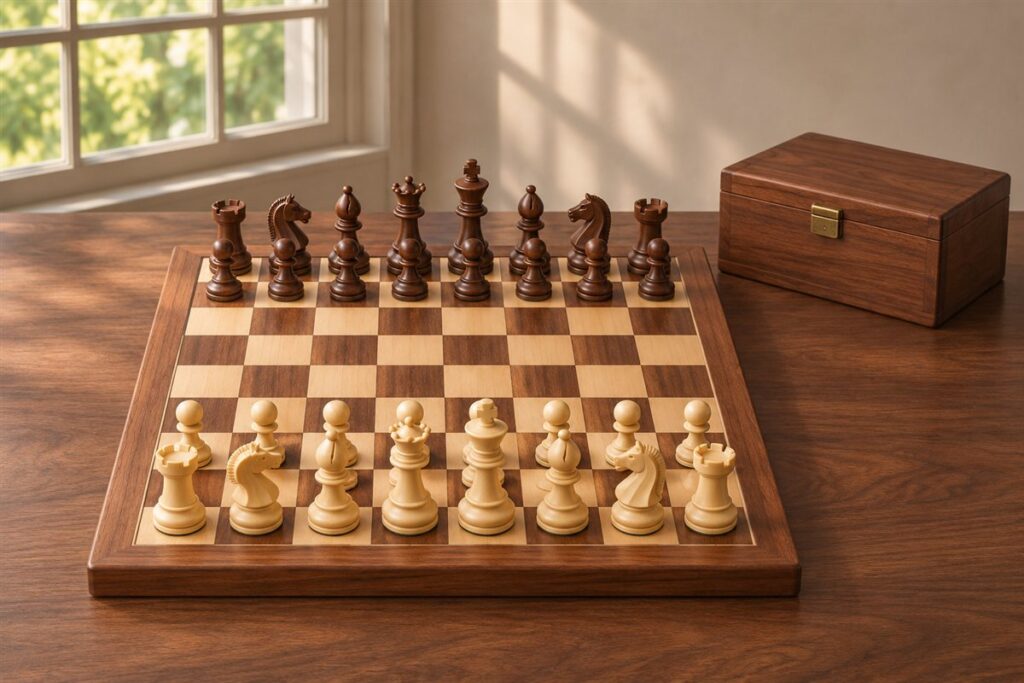
A chess board is the playing surface for a set of pieces. You can find wooden boards, folding boards with storage, roll-up mats and magnetic travel boards, in many sizes.
The right board depends on where you play and what pieces you already own. We have not used these products ourselves; we compare listing information, which is the makers’ own description of size and material.
As an Amazon Associate we earn from qualifying purchases. Links on this site are affiliate links, and they do not change the information we give.
What to Look For
| Factor | Why it matters | What to check |
|---|---|---|
| Square size | Squares must suit the base of the pieces | Compare square size with your piece base width |
| Board size | This sets table space and storage | Check listed dimensions |
| Material | Wood, vinyl and plastic feel and wear differently | Read material and finish details |
| Board type | Folding, roll-up and fixed boards suit different uses | Think about travel versus display |
| Notation | Letters and numbers help with study and clubs | See whether edge labels are printed |
| Surface finish | A matte finish reduces glare | Look at the finish description |
| Storage | Some boards hold pieces inside | Check for compartments or cases |
Setup and Care Tips
- Wipe a wooden board with a dry or lightly damp cloth.
- Store roll-up boards loosely rolled and flat.
- Keep folding boards closed and away from damp.
- Keep a board away from direct sun to protect the finish.
- Match pieces to the square size before play.
Mistakes to Avoid
- Buying a board with squares too small for your pieces.
- Ignoring the edge labels if you study games.
- Choosing a travel board for a permanent display.
- Leaving wood near heat or damp.
- Skipping the listed dimensions.
Board Types Compared: Wood, Roll-Up, Folding and Tournament Styles
Chess boards are not all the same product, and the best choice depends on where and how you play. Solid wood boards look attractive and feel good under the hand, with a quiet sound as pieces are placed. They are often used at home as a display or a family board. Folding boards, which hinge in the middle, store pieces inside or flat and are easy to carry. Roll-up boards made from vinyl, silicone or rubber-like material are light and flexible, and they are a common choice for clubs, schools and travel because they take little space. Tournament-style boards focus on clear contrast and consistent square sizes, and many are designed to be used with standard-size pieces.
Magnetic boards use small magnets in pieces and board so play can continue on the move, in a car or on a train. Wall-mounted or decorative boards are meant for looking at as much as for playing. Think about your primary use first. If you plan to play every week with a friend, a stable, comfortable board matters more than portability. If you teach children, a durable, easy-to-clean surface may be more practical than an elegant but delicate one.
Also think about who will handle the board. Children and casual players are rough on delicate surfaces, so a forgiving material that wipes clean is often a better fit than a prized wooden board kept for display.
Square Color, Contrast and Readability
A board you can read at a glance reduces mistakes and eye strain. Squares with strong contrast between light and dark are easier to see, especially in dim rooms or for younger players and older eyes. Very low-contrast woods or stained finishes can look elegant but may blur together under certain lighting. A matte finish reduces glare from lamps and windows, while high-gloss varnish can bounce light into the player’s eyes.
- Check the listing photos for the actual color and finish, since photos can differ from the real product.
- For learning players, clear rank and file markings (letters and numbers) along the edge help with notation and studying books or videos.
- Avoid patterns or textures so busy that they distract from the pieces.
- Consider the pieces you own. Dark pieces on a dark square, or light pieces on a light square, are hard to read.
If you play in several places, a board with plain, high-contrast squares tends to work in the widest range of lighting conditions.
Lighting changes how a board looks through the day. Try placing it near the spot where you will actually play, and look at it in both daylight and lamp light, because squares that seem clear at noon may blend together in warm evening light. If readability suffers, consider a different tone or a matte finish.
Players with color vision differences may find some wood or stain combinations harder to tell apart, so check that the light and dark squares differ clearly in brightness, not just in hue.
Matching Pieces to the Board
Pieces and board need to fit each other. If the pieces are too large for the squares, they crowd each other and tip over. If they are too small, the board looks empty and the pieces may be hard to see. The usual guideline is that the king’s base should fit comfortably inside a square, with some space left around it. A common recommendation is that the king base is around three-quarters of the width of a square, but check the actual measurements in the product details.
- Measure squares: check the listing for the square size, not just the overall board size.
- Measure the king: compare king height and base diameter against square size.
- Weighted pieces: they feel better on firm boards but can slip on slick surfaces.
- Felt bases: they protect wood and quiet play, but can catch on rough vinyl.
If you buy a board and pieces separately, confirm the dimensions before ordering. Sets sold together are usually designed to match, which removes the guesswork for beginners.
If you are unsure, err slightly toward smaller pieces rather than larger ones. A little extra space around each piece makes moves easier and reduces knocked pieces, while crowded squares make handling awkward, especially for children, beginners and anyone with less steady hands.
Surface, Edge and Build Quality
Look closely at the build rather than just the picture. On wooden boards, the surface should be flat, with squares that line up cleanly and a finish without rough patches. A thin veneer can chip or lift at the edges, while thicker inlay or solid construction is usually more durable. Look at the hinge and closure on folding boards, since weak hinges are a common failing point. For roll-up boards, a flat surface that does not curl at the edges after unrolling is a good sign. Some roll-up boards curl for a while after being stored tightly, which can usually be eased by laying them flat or placing weight on the corners.
Check for smell, too. Some new vinyl or finished surfaces have a strong odor that fades after airing out. Rubbery or glossy surfaces can also leave residue on light-colored furniture, so test them on a cloth or placemat if you are worried.
Read the listing for stated materials, thickness and care instructions. If these are not described, ask the seller before buying, especially for gift purchases.
Edges matter for comfort and durability. Rounded or sealed edges are kinder to forearms and less likely to chip, while sharp, unfinished edges can catch clothing and splinter. Run a hand along the border when the board arrives and return it if the finish feels rough.
Care, Storage and When to Replace
Good care keeps a board looking and playing well. For wooden boards, wipe with a soft, slightly damp cloth, dry immediately, and avoid harsh chemicals. Keep them away from direct sun, heaters and damp areas, which can warp or fade the wood. Occasional polishing with a product safe for the finish can keep it looking fresh, but follow the manufacturer’s advice.
For roll-up and vinyl boards, clean with mild soap and water and let them air dry flat. Store them rolled loosely, not folded, so creases do not form. Folding boards should be closed gently and stored flat. Magnetic boards should stay away from phones, cards and electronics that may be affected by magnets.
- Use coasters or a lid for drinks near the board.
- Do not stack heavy objects on a wooden board.
- Keep pieces in a bag or box so they do not scratch the surface.
Replace a board when the squares are worn or hard to tell apart, the surface is warped so pieces wobble, the hinge fails, or edges are splitting. A small cosmetic mark is usually fine, but anything that affects play or safety is worth fixing or replacing.
Rotate which side faces the light now and then if the board lives on a shelf, so fading is even. If you play often with children, keep a damp cloth nearby, since sticky fingers and drinks are a common cause of marks on any board surface.
FAQ
What size should the squares be?
Squares are usually a little wider than the base of the king, so pieces do not feel crowded. Check both measurements.
Is a roll-up board good for clubs?
It is light and easy to carry, though some players prefer a firm board. It depends on your play space.
What is the best chess board for beginners?
A clear, high-contrast board with matching, appropriately sized pieces is a good start. Rank and file labels help if you plan to follow lessons or books. Durability matters if children will use it.
Do I need a tournament-size board to practice?
Not necessarily, but practicing on a board similar to those used in events helps you get used to the feel. Check event rules if you plan to compete, since requirements can vary.
How do I fix a curled roll-up board?
Lay it flat, vinyl side up, and place light weights on the corners for a day or two. Storing it loosely rolled instead of tightly folded also helps.
Are magnetic boards worth it?
They are useful for travel or play in a moving vehicle because pieces stay put. They are less ideal if you want heavy, weighted pieces, and they should be kept away from sensitive electronics.
Can I use a chess board for checkers?
Yes, a standard 8-by-8 board works for checkers too. Make sure you have appropriate pieces that fit the squares.
How do I keep a wooden board from warping?
Keep it out of damp rooms, direct sun and heat sources. Store it flat and avoid placing heavy items on it.
Should the squares be labeled with letters and numbers?
Labels are helpful for learning and for following games in notation. Experienced players may prefer a clean board without markings.
Questions to Ask Before You Buy
- Will the board be used at home, in a club, or at a tournament?
- Does the square size match the base diameter of my pieces?
- Do I want it to fold, roll, or stay flat?
- Are coordinates printed along the edges, and do I want them?
- What surface will it sit on, and does it need a non-slip underside?
- How will I store it between games?
Compatibility Checks
A good rule is to leave a little breathing room around each piece. If the base of your king takes up most of a square, neighboring pieces may bump into each other when moved. Measure the widest base in your set and compare it with the stated square size, not the overall board size.
Color contrast matters as well. Very glossy surfaces can reflect room lights, and low-contrast squares can be harder to read from a distance. Matte finishes and clear dark and light tones are easier on the eyes over long sessions.
Material Differences
| Material | Strength | Consideration |
|---|---|---|
| Wood | Classic look and feel | Needs dry storage |
| Vinyl | Rolls up for carrying | May keep a curl |
| Silicone | Washable and flexible | Can attract dust |
| Folding case type | Stores pieces inside | Heavier to carry |
Who Should Skip It
If your current board still lies flat, has clear squares and fits your pieces, a replacement may not change your games. Upgrade when size, wear or portability becomes a real limit.
Matching It to Your Club or Home
Clubs often need boards that are easy to wipe, lie flat on varied tables and stack neatly in a cupboard. Home players may care more about appearance and a comfortable feel under the hand. Schools usually want many matching boards so every pair of students has the same setup.
Tournaments can set size rules, so if you intend to compete, read the event guidelines before buying. Standard sizes help everyone, and your own board should match the pieces you plan to bring. Keep a spare roll-up board in your bag in case a venue provides a different layout. Label your board with your name if you play at shared events so it finds its way home.
The Short Version
Pick a board with square size matched to your pieces, then choose the material and format that fits your play space. Folding boards suit storage, rolls suit travel.