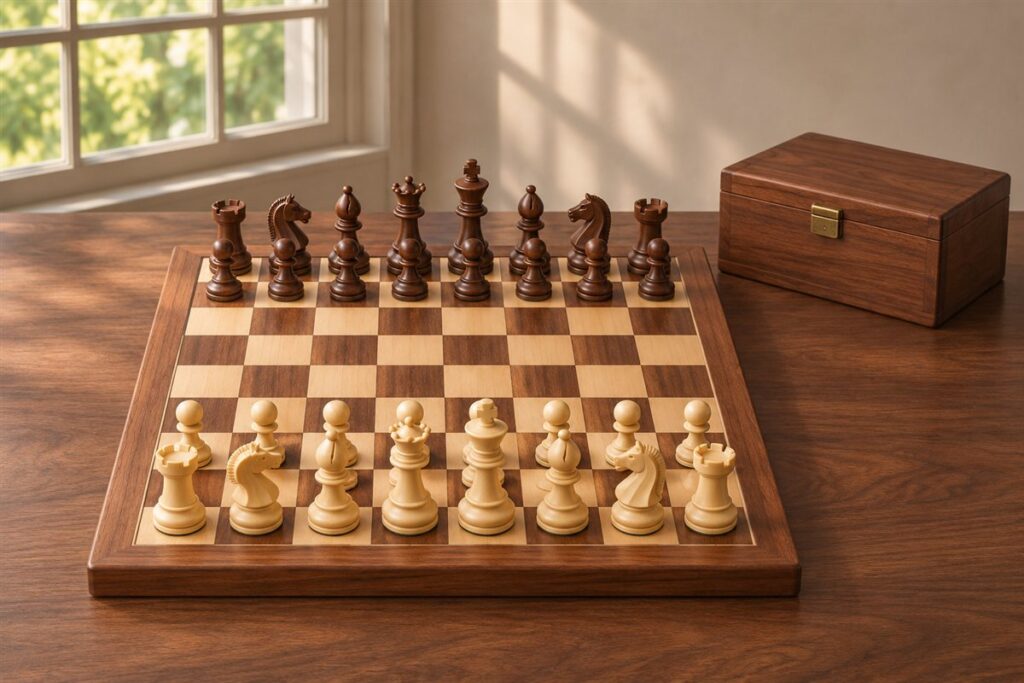
A chess computer is an electronic device that plays chess against you. Some are boards with sensors for real pieces, and others are handheld units or screens with pieces on the display.
They suit beginners who want an opponent at any hour and players who want practice. We have not used these products ourselves; we compare listing information, which is the makers’ own description of levels and features.
As an Amazon Associate we earn from qualifying purchases. Links on this site are affiliate links, and they do not change the information we give.
What to Look For
| Factor | Why it matters | What to check |
|---|---|---|
| Board type | Sensor boards use real pieces and pocket units are compact | Think about where you will play |
| Skill levels | More levels help as you improve | Check the number and range of levels |
| Display | Clear lights or screens make moves easy to follow | Look at the display description |
| Power | Batteries and cords suit different spots | See how it is powered |
| Training features | Hints and takebacks help learning | Check which modes are listed |
| Piece size | Real pieces need matching squares | Compare square size with the pieces |
| Portability | Weight and size affect travel | Check the listed dimensions |
Setup and Care Tips
- Set up on a firm, flat surface.
- Put pieces fully in the centre of their squares on sensor boards.
- Remove batteries if you will not use it for a long time.
- Wipe the board with a dry cloth.
- Switch to the lowest level if you want an easier game.
Mistakes to Avoid
- Choosing a high level before learning the basics.
- Ignoring how it is powered.
- Buying a pocket unit when you want real pieces.
- Not checking the level range.
- Leaving batteries inside during long storage.
Kinds of Chess Computers and How They Differ
The term chess computer covers several different products. Standalone tabletop units have a built-in processor and a physical or touch board; you play against the machine with no phone or internet required. Electronic boards with piece recognition sense your moves and can connect to an app, letting you play online or against software engines. Handheld or pocket units trade board size for portability. Simple trainers and puzzle devices focus on teaching rather than full games.
The main question is whether you want a self-contained machine or a connected board. Self-contained units are simple, durable and free of subscriptions, but their playing strength and features are fixed by the hardware. Connected boards can access a wide range of software, but they rely on the app, your phone or tablet, and sometimes updates. Think about how you will play: casual games at the kitchen table, structured practice, or training before club nights. Check the listing for whether the product includes a board, pieces and power source, and whether any features need an account or app. Choosing the right type first narrows the field far more than comparing small differences between similar models.
Also think about who else will use it. A device shared by a family may need profiles or separate difficulty settings, while a solo learner may care more about simple controls and clear feedback than about advanced extras.
Playing Strength and Difficulty Levels
The best chess computer for you is not necessarily the strongest one. A machine that always wins is frustrating for a beginner, while one that is too weak bores an advanced player. Look for a wide range of difficulty levels with clear descriptions, so you can start easy and step up as you improve. Some units offer adjustable settings such as search depth, time per move or deliberate mistakes, which can make play feel more human.
- Beginners: choose lots of gentle levels, hints and move takebacks.
- Improving players: look for levels that match your rating range, along with analysis tools.
- Advanced players: consider a connected board with access to stronger software.
Be careful with strength claims. Ratings in product descriptions are not always measured in the same way, and the numbers can be hard to compare across brands. Treat them as rough guides rather than guarantees. Check the manual or listing for how the levels are defined, and read feedback from buyers at your level if available. The aim is a computer that stays challenging without being discouraging.
Remember that your own strength changes quickly when you start learning. Choose a unit with generous headroom above your current level so it stays useful for months rather than weeks, and treat the lowest levels as a confidence builder rather than a sign of weakness.
Learning and Training Features
For many buyers, the learning tools matter as much as the opponent. Useful features include hints that suggest a move, warnings when a piece is in danger, move takeback so you can try again, and the ability to review a finished game. Some units can show legal moves with lights or on-screen indicators, which is helpful for new players learning how pieces move.
- Look for puzzle or tutorial modes if you want structured practice.
- Check whether games can be saved and replayed, and how many can be stored.
- Opening books and endgame databases can help study, but their depth varies.
- Coaching style is a personal preference: some players enjoy hints, others find them distracting.
Consider whether features can be turned off. A beginner may want help now but not later. If you plan to use the device with a child, check for simple menus and clear feedback. As always, read the listing carefully to see what is actually included and what requires an additional app or purchase.
If you are teaching a child, look for gentle encouragement and clear, simple move highlighting, and avoid devices that rely on long menus or small text. A feature set that matches the learner’s age keeps practice enjoyable and consistent.
Board, Sensors, Pieces and Build Quality
If the unit has a physical board, its design affects daily use. Sensors that detect pieces need to be reliable. Poor detection leads to missed moves and frustration. Some boards use pressure sensors, others use magnetic or contact sensing, and each has its own quirks, so check the instructions about piece placement and calibration. Pieces should be stable, comfortably sized and easy to see. Check whether they are weighted, as light pieces can slide and heavy ones can stress the sensors.
- Square size should suit the pieces; a cramped board is awkward.
- Screen visibility matters: look for clear, backlit or high-contrast displays.
- Buttons and touch controls should be easy to understand and press.
- Look at how the piece storage works if pieces are lost easily.
A sturdy build is worth the attention. Check hinge, case and surface materials, and be wary of loose or flimsy parts. For children, rounded edges and durable pieces reduce breakage. Replacement parts may not be easy to find, so ask about spare pieces and support before you buy.
Ask whether replacement or spare pieces are sold, and whether the board will still function if a piece goes missing. Small pieces are easy to lose, and a board that depends on a full set can become frustrating after a few months.
Power, Connectivity and Long-Term Upkeep
Power choices influence how and where you can play. Battery-powered units are portable but need fresh batteries, while rechargeable units need a charging routine. Plug-in models are reliable at home but tied to an outlet. Check the listing for the power source, whether batteries are included, and whether you can use an adapter. Remove batteries if you will not use the device for a long time, to avoid leakage.
Connected boards bring more to think about. Confirm which devices and operating systems the app supports, whether it needs an account, and how it connects, for example by Bluetooth or cable. Apps can change over time, so it is sensible to check how updates are handled and whether the board works offline. A product that stops working when an app is discontinued is a risk worth weighing.
- Keep the board clean and dry, and wipe the surface with a soft cloth.
- Store pieces in their holder to prevent loss.
- Protect the unit from drops, heat and spills.
It may be time to replace the unit if the sensors become unreliable, the display fails, or the manufacturer no longer supports the app. Keep the manual, since it often answers calibration and reset questions.
If a unit uses batteries, buy a standard type that is easy to find, and keep the manual so you can reset the device if it behaves oddly after a battery change.
FAQ
Are chess computers good for beginners?
Many have adjustable levels and hints, so they can suit a learner. Check the listed modes.
Do I need an app or internet?
Some models need neither and others link to an app. Read the listing to see what is required.
What is the difference between a chess computer and a chess app?
A chess computer is a dedicated device, often with a physical board, while an app runs on your phone or tablet. Devices are distraction-free and can feel more like real chess, while apps are usually more flexible and easier to update.
Can I play online with a chess computer?
Only some models connect online, usually through an app. Check the listing for connectivity features and any required account.
Will a chess computer help me improve?
It can, particularly if it offers hints, takebacks, adjustable levels and game review. Improvement still depends on how you use it, including thinking before you move and reviewing mistakes.
What should I do if the board misses my moves?
Check piece placement, battery or power level and the calibration steps in the manual. Clean the surface and make sure the pieces are the correct ones for the board.
Are chess computers suitable for children?
Many are, especially those with clear feedback, adjustable difficulty and durable pieces. Look for simple menus and check for small parts if the child is very young.
Do chess computers need batteries?
Some do, some are rechargeable and some plug in. The listing should state the power source and whether batteries or an adapter are included.
How strong are the highest levels?
This varies and is often described in different ways by different makers. Use the stated levels as a rough guide and check the manual for how each is defined.
Questions to Ask Before You Buy
- Do I want a physical board with pieces, or a screen-only handheld?
- Does it offer adjustable difficulty levels that suit my current ability?
- Can it detect moves automatically, or must I press squares?
- How does it run: batteries, a cable, or a rechargeable pack?
- Does it offer hints, take-backs and a way to replay finished games?
- Will it connect to a phone or computer, and is that required?
Feature Trade-offs
| Feature | Benefit | Trade-off |
|---|---|---|
| Sensor board | Natural play with real pieces | Needs careful placement |
| Press-square input | Simple and forgiving | Slower to enter moves |
| Wireless link | Extra modes through an app | Depends on a device |
| Portable size | Easy to travel with | Small squares |
Matching It to Your Level
A learner benefits from gentle opponents, a hint option and a clear display. A club player preparing for matches may want stronger levels, a built-in clock and a record of moves to study later. A parent buying for a child might look for sturdy casing and simple controls.
Where It Will Be Used
Think about lighting, table space and noise. A device with a clear screen and quiet sound suits a shared room. A travel unit with a protective cover fits a bag but trades away board size.
Who Should Skip It
If you prefer playing against people or already use a free app on your phone, a dedicated unit may be unnecessary. It is best for those who want a screen-free, tactile experience.
Compatibility Checks
If a unit offers an app link, look at which phone systems and versions it supports and whether the app is free or sold separately. Check what power source it uses and whether spare cables or batteries are easy to find. For boards that use real pieces, confirm the square size and piece weight the sensors are built for, since mismatched sets can cause missed moves.
Also look at the manual language and update options. Some devices receive new playing levels through an app, while others stay as they were on the day they were made. Decide whether you value a fixed, simple device or one that can grow over time.
The Short Version
Pick the board type you like, look at the range of levels and training modes, and check how it is powered. A simple unit with adjustable levels suits most learners.