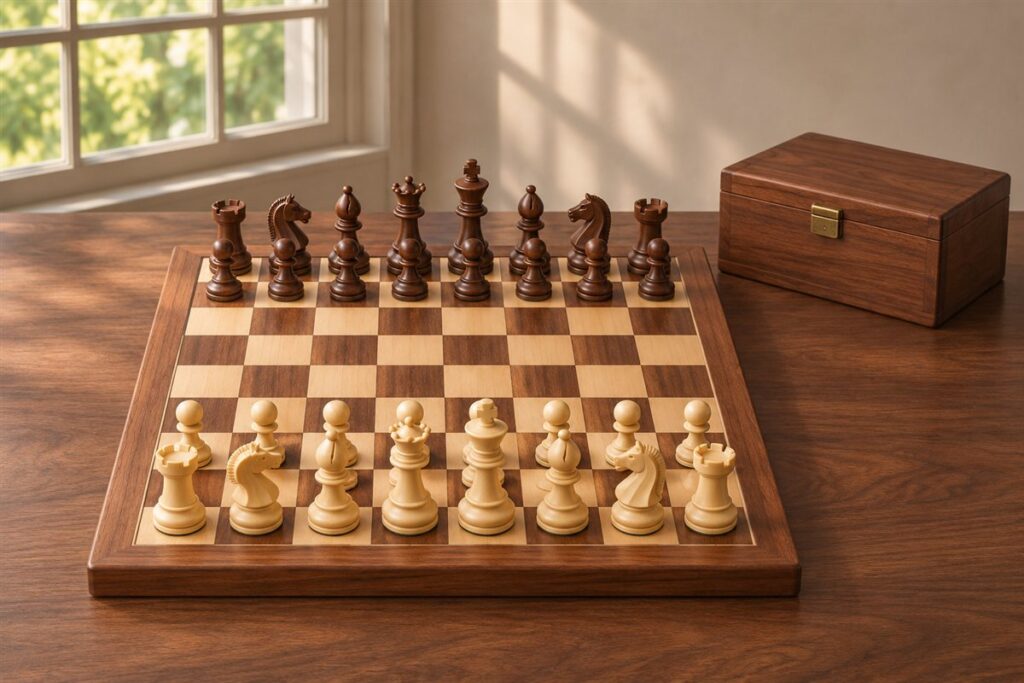
A chess table is a table with a chess board built into the top, sometimes with drawers or a lift for pieces. Some are small side tables, and others are full game tables that fit two chairs.
Size and height decide how comfortable a table feels in use. We have not used these products ourselves; we compare listing information, which is the makers’ own description of materials and dimensions.
As an Amazon Associate we earn from qualifying purchases. Links on this site are affiliate links, and they do not change the information we give.
What to Look For
| Factor | Why it matters | What to check |
|---|---|---|
| Top size | This sets room for pieces and your arms | Check the listed top dimensions |
| Height | It must match your chairs | Compare table height with seat height |
| Square size | Squares must suit the pieces | Compare with your piece base width |
| Material | Wood, veneer and metal differ in feel and weight | Read the material description |
| Storage | Drawers keep pieces nearby | See if drawers or compartments are listed |
| Stability | Wobble spoils a game | Check legs and assembly details |
| Assembly | Some arrive in many parts | Read the assembly notes |
Setup and Care Tips
- Put the table on a level floor, adjusting feet if present.
- Tighten the fixings after the first week.
- Dust the top with a soft cloth.
- Keep it out of direct sun and away from damp.
- Keep pieces in the drawer or a box when not in use.
Mistakes to Avoid
- Not checking that the table height matches your chairs.
- Choosing a top too small for the pieces.
- Forgetting space around the table for chairs.
- Ignoring assembly effort.
- Leaving wood in strong sun.
Table Styles Compared: Dedicated, Inlaid and Convertible
Chess tables come in several styles, and the right one depends on how much room you have and how often you play. A dedicated chess table has a board built into the top, with squares that may be inlaid, painted or printed. Two-player designs usually have a seat on each side. Convertible tables switch between chess and another use, such as a game table with reversible tops for checkers, cards or backgammon, or a coffee table with a hidden board. Folding tables are easier to store and move, while heavier fixed tables are more stable and look more like furniture.
Consider the table in your daily routine. A permanent table in a living room can invite casual games, but it takes space. A foldable or stackable model suits a small apartment, a club hall or a shared classroom. Outdoor chess tables, which are often made of stone-like or weatherproof material, are a different category, so check the listing for indoor or outdoor use. Look for a clear description of the playing surface, the number of seats included and how much assembly the table needs. Choose the style that fits your space first, then compare details like finish and legs.
Ask whether the table can be used for other activities. A board that works as a general game or coffee table earns its floor space even when no one is playing, which matters in a small home.
Playing Surface and Square Size
The playing surface determines how pleasant the table is to use. A flat, smooth top lets pieces stand firmly and slide easily. Inlaid or laminated squares are usually durable, while printed designs can wear with heavy use. Check that the board is clearly visible, with good contrast between the colors, and that the finish is not so glossy that it reflects light into players’ eyes.
Square size matters because it must suit your pieces. If you own a set, compare the base diameter of the king with the stated square size. A rough guide is that the king’s base should fit within a square with a little space around it. If you do not own pieces yet, look for tables sold with a set or a listing that recommends a piece size. Watch for tables with a raised edge or border, which can be handy to rest forearms but may take space from the playing area.
- Check the overall tabletop size so the board does not crowd the edges.
- Look at whether the surface is removable or reversible.
- Consider extra room for a clock, drinks or captured pieces.
Consider storage for pieces too. A table with a drawer or shelf keeps the set close at hand and reduces the chance of lost pieces, but check that the drawer does not hit players’ knees or limit chair placement.
Seating, Legroom and Posture
Chess games can last a long time, so comfort deserves attention. Seats should match the table height so players can sit upright with forearms resting comfortably, without hunching or reaching. Check legroom under the table, since thick aprons, drawers or crossbars can bump knees. If chairs or stools are included, look for stable construction, comfortable seat size and non-marking feet if you have hard floors.
- Chairs that tuck under the table save space in small rooms.
- Padded seats are more comfortable for long games than bare wood.
- Stools are compact, but backless seating can tire some players.
- For children, check whether the height can be adjusted or whether a booster is needed.
If you have your own chairs, measure the seat height and the gap between the seat and the underside of the tabletop, then compare with the table’s listed dimensions. A small mismatch can make a big difference after an hour of play. Anyone with back or mobility concerns may prefer a table with seating that offers back support and easy entry.
Also check how easy the seats are to move. Chairs that slide quietly on your floor and tuck in neatly make a table far more pleasant in a small room, and felt or rubber glides protect wood and tile from scratches.
Stability, Materials and Build Quality
A wobbly table can ruin a game, as bumped pieces can topple. Look at the leg design, since splayed or sturdy legs often resist tipping, and adjustable feet can compensate for uneven floors. Solid wood is durable and can be refinished, while engineered wood is often lighter and cheaper but can chip or swell if it gets wet. Metal frames can be strong and slim, but check that the joints are well attached.
- Press down on each corner after assembly to test stability.
- Check that fasteners are tightened and re-tighten them over time.
- Look for a protective finish on the top to resist spills and scratches.
- Check the weight capacity, especially if children may lean or sit on the table.
Assembly can be easy or time-consuming, so read the listing for details on tools and time, and keep all hardware until you are sure the table is correct. Be realistic about moving it: a heavy table may be hard to shift once in place, so choose its location carefully.
If the tabletop is made of several joined pieces or tiles, run a hand across the seams. Raised edges can make pieces tilt, and a flat, continuous surface is more forgiving, especially for lightweight sets that topple easily.
Care, Placement and Replacement Signs
A chess table lasts longer with simple care. Keep it away from direct sun, which can fade the surface, and from heaters or damp spots that can warp or crack the wood. Use coasters for drinks, wipe spills quickly, and clean with a soft cloth lightly dampened with mild soap if needed. Avoid harsh cleaners that might dull the finish or damage inlaid squares.
- Use felt pads under legs to protect floors.
- Rotate or reposition the table occasionally to even out sunlight exposure.
- Store loose pieces in a box or drawer to prevent scratches.
- Check legs and screws every few months.
Think about placement as well: choose a spot with good lighting, ideally with soft, indirect light to reduce glare, and enough space for players to move chairs back. Replace or repair the table when the top is warped enough that pieces wobble, the legs cannot be made stable, or the surface is so worn that squares are difficult to see. Minor scratches are normal and often add character, but structural wobble is a good reason to act.
When moving the table, lift it rather than dragging it, and loosen or remove legs if the manual allows. Dragging stresses joints and leaves marks on floors, and a little care during moves greatly extends the table’s life.
FAQ
What height should a chess table be?
It should feel comfortable with your chairs so your arms rest naturally. Check the listed height against your seating.
Do chess tables include pieces?
Some do and some do not. Read the listing to see what comes in the box.
How big should a chess table be?
The tabletop should give the board room plus a margin for resting arms and holding a clock. Measure your space and compare it with the stated dimensions, leaving room to move chairs.
Are folding chess tables stable enough for serious play?
Many are fine for casual and club play, but stability varies. Test for wobble after setup, and look for sturdy locks and level feet.
Can I put my own board on a chess table?
If the table has a plain top, yes. If the board is built in, you are limited to its squares, so check that your pieces suit them.
Are outdoor chess tables different from indoor ones?
Yes, they use weather-resistant materials and finishes. Do not leave an indoor table outside, and check the listing for the intended use.
How do I protect a wooden chess table from scratches?
Use felt on the bottom of pieces, wipe spills quickly and avoid dragging items across the top. A protective finish helps, but check the manufacturer's care advice.
Is a chess table a good gift for a child?
It can be, especially if the height and seats suit them. Check small parts, edges and stability, and consider a table that can grow with the child.
What lighting works best for a chess table?
Soft, even light that does not create glare on the surface is best. A matte finish and a lamp positioned to the side can reduce reflections.
Questions to Ask Before You Buy
- Where will the table live: a living room, a club room, a patio, or a classroom?
- Is the playing surface built in, or can it be swapped for another game board?
- Will two seated players have comfortable leg room and elbow space?
- Does the table have storage for pieces, and is it a drawer or a hinged top?
- How much floor space can I give it, and can I move it when I need to?
- Does the square size suit the pieces I plan to use?
Matching It to Your Room or Club
A family room table has to look right beside other furniture, so finish and proportions matter as much as the board. A club or school table sees constant use, so a sturdy frame, edge protection and wipe-clean surface count for more than looks. Outdoor tables need weather-resistant materials and a stable base that will not rock on uneven paving.
Seating and Height
Match the table to the chairs you already own. A low coffee-style table suits floor cushions or a sofa, while a standard dining-height design needs regular chairs. Sit at a friend’s table before you decide if you can, because comfort over a long game is personal.
Feature Trade-offs
| Feature | Benefit | Trade-off |
|---|---|---|
| Built-in drawers | Pieces stay together | Less leg room |
| Folding legs | Easy to store | Can feel less solid |
| Inlaid surface | Fine appearance | Needs gentle care |
| Reversible top | Works for more games | Seam may be felt |
Who Should Skip It
If space is tight, a dedicated table can crowd a room, and a good board on an existing desk or dining table may serve just as well. Skip it too if you play only a few times a year, since a table is a piece of furniture that needs a permanent home. Casual players often find a roll-up board and a tidy box of pieces far easier to store.
Storage Notes
Wood surfaces prefer steady room conditions, so keep the table away from radiators and damp walls. Use a soft cloth for dusting and follow the maker’s care guidance for cleaning. Felt pads under the legs protect floors, and coasters keep drinks from marking the playing surface.
The Short Version
Choose the top size and height for your chairs, check square size against your pieces, and look at storage. A stable table is the real basis of a good game.