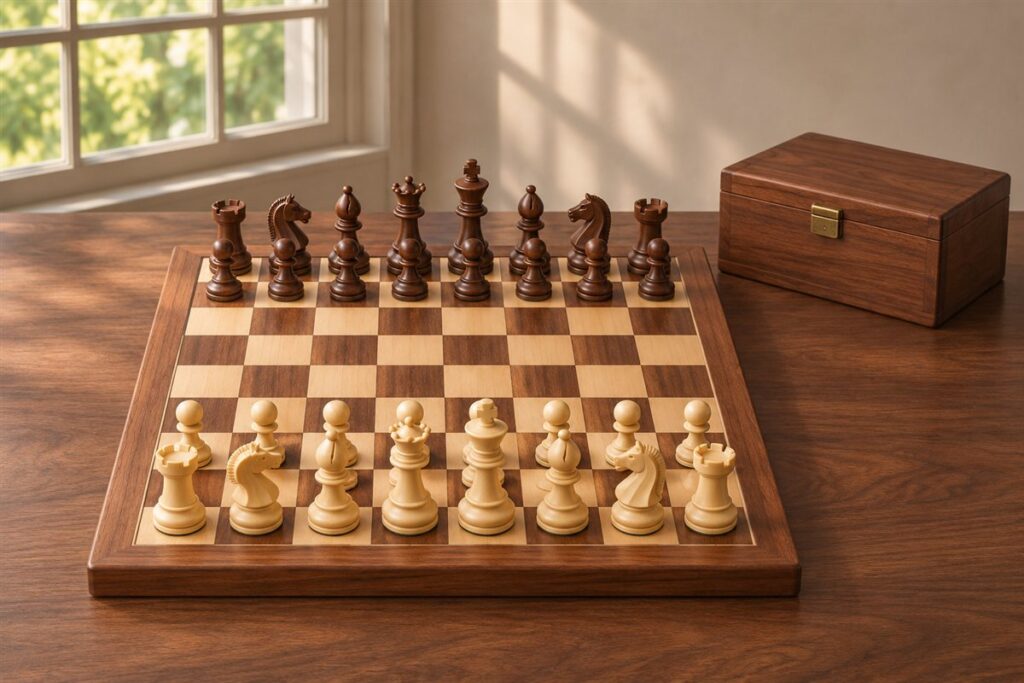
Chess960, also called Fischer Random, shuffles the back-row pieces before each game, so no two openings look alike. Any regular board can host it, but some designs make the constant resetting easier and more enjoyable. Beyond that, a board that lies flat and matches your pieces will serve a casual game or a club night equally well.
We have not used these products ourselves, so this guide does not rank anything. It covers what to look for in a board for shuffled setups, so you can judge any listing yourself and choose what suits your table and your playing group.
As an Amazon Associate we earn from qualifying purchases. Links on this site are affiliate links, and they do not change the information we give.
What to Look For
| Factor | Why it matters | What to check |
|---|---|---|
| Board surface | A flat, even top keeps pieces steady | Check material, thickness and whether it folds flat |
| Square size | Squares must fit your pieces with room to spare | Compare the listed square size with piece base width |
| Coordinates | Printed letters and numbers help you place shuffled rows | Look for clear labels on the edge |
| Piece set | Weight and base shape affect feel and stability | Check the listed piece heights and base material |
| Storage | Resetting is frequent, so quick packing matters | Look for a case, tray or bag for loose pieces |
| Setup aids | Cards, dice or an app can draw the random arrangement | Check what is included and what you must supply |
| Portability | Club and travel play need a lighter board | Compare folded size and listed weight |
Setup and Care Tips
- Draw the back-row arrangement in a way both players can see, such as cards or an app.
- Place the bishops on opposite colors and keep the king between the two rooks.
- Mirror the arrangement for both sides before touching the pawns.
- Keep a small tray beside the board for pieces during setup.
- Wipe the surface with a dry cloth and store pieces in their own compartments.
Mistakes to Avoid
- Buying a board with squares too small for the piece bases.
- Ignoring coordinates, which slows down setup of shuffled rows.
- Forgetting that the arrangement must be mirrored for both players.
- Choosing a set with no storage, then losing pieces after repeated resets.
- Assuming a special board is required when a regular one works fine.
FAQ
Do I need a special board for Chess960?
No. The rules use the same board and pieces as regular chess, only the opening arrangement changes. Extras such as coordinates and storage simply make resetting easier. A small bag of spare pieces or a printed list of legal arrangements can also speed up the routine between games.
How do I choose the random arrangement?
Many players use cards, dice or a free app. Whatever you use, make sure both players can see the result before the pieces are placed. Some players also like a clock or a notation pad nearby, so the whole session stays organized from the first shuffle to the last move.
Questions to Ask Before You Buy
- Will the board live on a table at home, or travel to clubs and events?
- How large are the squares compared with the pieces I plan to use?
- Do I want clear rank and file labels for quick setup of random positions?
- Does the surface suit a clock and a notation pad nearby?
- Will the board roll up, fold, or stay flat?
- Do I want a matte surface that cuts glare under bright lights?
Matching It to How You Play
Casual players who set up a fresh random position each game may prefer a sturdy board with labeled edges, which makes it easier to place pieces correctly from a printed or digital position. Club players often like a roll-up or folding board that travels easily and stores in a bag. Teachers and coaches sometimes pick a large demonstration board, where everyone in the room can see the arrangement.
Because every game opens differently, pieces end up in unusual squares quickly. A board with clear contrast between light and dark squares helps both players read the position, especially in a dim room. Check the size of your pieces against the squares so they sit comfortably without crowding.
Feature Trade-offs
| Choice | Upside | Downside |
|---|---|---|
| Wood board | Solid feel and a classic look | Heavier to carry |
| Vinyl roll-up | Light and easy to pack | Can curl at the corners |
| Folding board | Pieces can be stored inside | Hinge can wear |
| Labeled edges | Faster setup | Some players find it busy |
Who Should Skip It
If you already own a regular board that suits your pieces, you do not need a special model for random opening positions; the same board works for any chess variant. Players who mostly play online can also skip buying one. Add a board only if you want over-the-board games, and match its size to the room where you will use it.
Storage Notes
Keep the board flat or loosely rolled in a dry place, and avoid stacking heavy items on top. Wipe the surface with a dry or slightly damp cloth, and keep drinks away from play. A small card with the file letters and rank numbers can help in setup. If you have a folding model, store it closed so the pieces stay protected.
A Quick Self-Check
Set up three random positions on your current board and time how long each takes. Notice whether labels, contrast or size slow you down. If setup feels quick and the pieces sit well, a new board may not add much. If you squint or knock pieces over, look for clearer markings or larger squares.
The Short Version
Any sound chess board can host Chess960, so focus on a flat surface, matching square and piece size, clear coordinates and easy storage for frequent resets. Add storage and coordinates if you play often, and keep the rest of the decision simple.