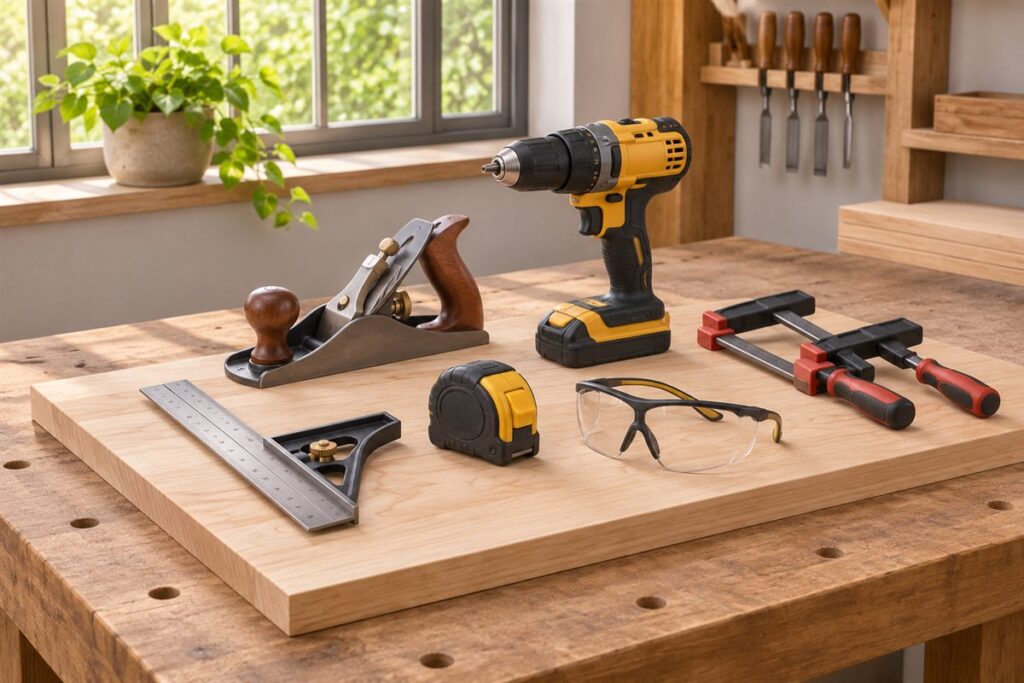
A drill is built for making holes and driving small screws with controlled turning force. An impact driver is built for driving long or stubborn fasteners using quick rotational hammering. Many workshops keep both, but you can often begin with one if you know your main jobs. This guide walks through what each tool does, how to choose, and how to use either one without damaging the work or the fastener.
What a Drill Does Best
A drill holds round-shank bits in an adjustable chuck. It offers a clutch, which lets you set how hard it will turn before slipping, so screws in delicate material do not go too deep.
- Drilling holes in wood, metal and plastic
- Driving small screws with precise depth control
- Using hole saws, sanding drums and mixing paddles
The chuck is the key difference. Because it tightens around a round or hex shank of many sizes, one drill can hold twist bits, spade bits, brad-point bits and driver bits. Many models also have a speed range or a gear switch, so you can run slowly for screws and faster for small holes. Check the maker’s manual for what the gear settings mean on your model.
What an Impact Driver Does Best
An impact driver uses a quick series of rotational taps when resistance builds. This helps drive long screws and bolts with less effort from your wrist. It takes hex-shank bits that snap into a quick-release collar.
- Driving long deck or construction screws
- Removing stuck or rusted fasteners
- Working in tight spots, since most are compact
The tapping action only begins when the fastener resists. Until then the tool turns like a drill. Because the hammering force is delivered in the turning direction, the tool pushes back on your hand far less than a drill would when driving a large screw.
Side-by-Side Differences
| Feature | Drill | Impact driver |
|---|---|---|
| Bit holder | Adjustable chuck | Quick-release hex collar |
| Clutch | Usually yes | Usually no |
| Hole drilling | Strong suit | Possible with hex-shank bits, less control |
| Long fasteners | Can struggle | Strong suit |
| Noise | Moderate | Louder under load |
Who Should Choose Which
- If you mostly drill holes or assemble furniture, choose a drill.
- If you mostly drive long screws, build decks or frame walls, choose an impact driver.
- If you do both regularly, buy both, ideally on the same battery system.
- If you can only buy one for general household use, a drill is the more flexible option.
Always read the maker’s manual. Wear eye and hearing protection, particularly with an impact driver, and keep both hands clear of the bit.
Worked Walkthrough: Driving a Long Screw
Here is a sequence that suits either tool, with the differences noted along the way.
- Read the screw packaging for the recommended pilot hole, if any, and choose a driver bit whose tip matches the recess exactly.
- Clamp the workpiece so it cannot spin or shift. Hold the tool with the battery removed while you fit the bit, if the manual advises it.
- In hardwood or near an edge, drill a pilot hole first with a drill. This is the step where a drill is the better tool.
- With a drill, set the clutch to a low number and the speed to the low setting. With an impact driver, there is no clutch, so use a gentle trigger squeeze as you begin the drive.
- Press the bit firmly into the recess and keep the tool in line with the screw. Tilting is the most common cause of a bit slipping out.
- Drive until the head sits flush. With a drill, raise the clutch number one step at a time if it clicks too early. With an impact driver, ease off the trigger as the head approaches the surface, because there is no clutch to stop it.
- Stop, remove the bit and look at the result. A head that is below the surface can be left, but a split in the wood means the next screw needs a pilot hole.
Common Scenarios
- Assembling flat-pack furniture: a drill with a clutch is usually the safer choice, because chipboard and thin panels are easy to over-drive. Many people finish the last turns by hand.
- Building a raised bed or a deck: the long screws and repeated driving suit an impact driver, with a drill for pilot holes at board ends.
- Removing an old rusted screw: an impact driver can free it where steady turning would only strip the head. Seat the bit fully before pulling the trigger.
- Drilling a hole for a pipe or cable: use a drill with the correct bit for the material. Anything that could be near hidden services should be checked with a qualified professional first.
- Hanging a shelf on a masonry wall: this needs the drilling method and bit type the anchor maker specifies. Not every drill is designed for masonry, so read the manual.
Mistakes to Avoid
- Using a worn or wrong-size bit. A bit that does not fit the recess rides up and rounds the head. Replace worn bits promptly.
- Leaning your whole weight on an impact driver. The impacts supply the extra force, and heavy pressure mainly makes the bit slip.
- Using ordinary bits in an impact driver. Only bits made for impact use are designed to handle the sudden force. Check the bit maker’s guidance.
- Skipping pilot holes in hardwood. The fastener acts like a wedge and can split the board.
- Setting the clutch too high. The clutch exists to stop over-driving, so a very high setting removes the protection.
- Working with loose clothing or long hair near the chuck. A turning chuck can catch both.
Quick Troubleshooting
| Symptom | Likely cause | What to try |
|---|---|---|
| Bit keeps slipping out of the screw | Wrong tip type or size, or a worn bit | Match the tip to the recess and fit a fresh bit |
| Screw head rounds off | Too much speed or poor alignment | Slow down, press in line, and use a bit made for the drive style |
| Wood splits near the end | No pilot hole, or the screw is too thick for the edge | Drill a pilot hole and keep fasteners away from the end grain |
| Chuck will not hold the bit | Chuck not tightened, or a damaged shank | Tighten as the manual describes, or change the bit |
| Tool stops suddenly under load | Low battery or protection circuit | Release the trigger, rest the tool and check the battery charge |
Care and Upkeep
Keep both tools dry and free of dust. Wipe the body with a dry cloth, and clear debris from the vents as the manual allows. Remove the battery before changing bits or doing any cleaning. Store bits in a case so the tips are not chipped by knocking against each other. Keep batteries in a cool, dry place and follow the maker’s charging guidance, and take old batteries to a local collection point. If a tool makes unusual noises, smells hot or has a damaged cord or battery, stop using it and contact the maker or a qualified repairer.
Glossary
- Chuck
- The adjustable jaws at the front of a drill that grip the bit shank.
- Clutch
- A ring that sets the turning force at which the drill slips instead of driving further.
- Hex shank
- A six-sided bit end that fits a quick-release collar.
- Pilot hole
- A small hole drilled ahead of a screw to guide it and reduce splitting.
- Cam-out
- When a bit rides up out of the screw recess under turning force.
- Torque
- The turning force a tool applies to a fastener.
FAQ
Can an impact driver replace a drill?
For driving fasteners, often yes. For precise holes and delicate screws, a drill with a clutch gives more control. If you only drive screws and rarely drill, an impact driver alone can work, but you will miss the clutch on small, delicate jobs.
Can I use normal drill bits in an impact driver?
Only hex-shank bits fit the collar, and bits made for impact use are designed to handle the sudden force. Check the bit maker’s guidance. Standard driver bits may be more brittle and can break under repeated impacts.
Why is my impact driver so loud?
The internal hammering action is noisy when it engages under load. That is normal for the design, so wear hearing protection and be mindful of neighbours and quiet hours.
Do I need a corded model or a cordless one?
That depends on how long you work and where. Cordless tools are convenient for moving around, while corded ones avoid battery limits. Follow the maker’s manual for either type.
Which is better for a first-time buyer?
A drill with a clutch is the more flexible first tool because it makes holes and drives screws. Add an impact driver when you find yourself driving many long fasteners.
The Short Version
Choose a drill for holes and controlled screw driving, and an impact driver for long, stubborn fasteners. If your projects mix both, a pair on one battery system covers nearly everything. Match the bit to the fastener, use pilot holes in hardwood, and read the maker’s manual before you use either tool.