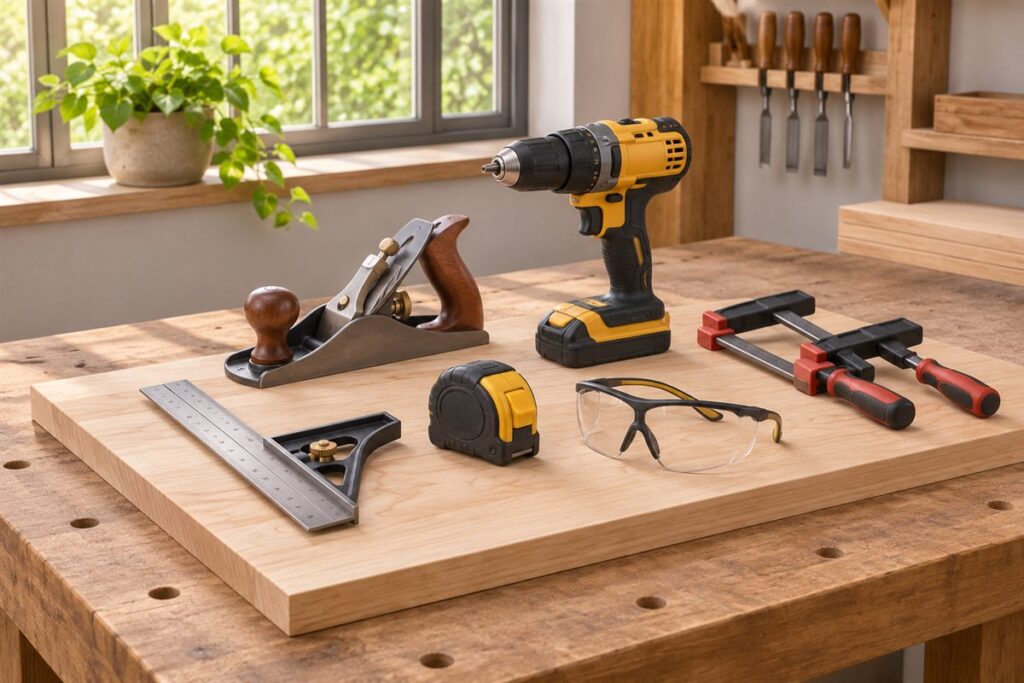
The best tool gift is one the person will use often and does not already own. Before you buy, look at what is in their toolbox, what brand family their battery tools belong to and what projects they talk about. These ideas are grouped by skill level so you can match the gift to the person.
For beginners
- A compact tool bag or case: a place to keep a growing set together.
- A quality tape measure and level: basic tools that improve every project.
- Screwdriver and hex key sets: useful for furniture and household fixes.
- Safety glasses, gloves and ear protection: a good gift that also builds good habits.
- A headlamp or work light: helps in dark corners.
For hobbyists and weekend builders
- Clamps: few makers own enough of them.
- Drill bit and driver bit sets: organized in a case for quick use.
- A good hand plane, chisel or marking gauge: for the woodworker who enjoys hand work.
- A sanding block set or detail sander: for smooth finishes.
- A workshop apron or knee pads: comfort and convenience.
For experienced makers
- Sharpening stones and a honing guide: keep edges keen.
- Precision measuring tools: calipers, a quality square or a digital angle finder.
- Dust collection fittings or an air filter: a health-minded gift for a busy shop.
- Extra batteries or a charger: only if you know the brand and voltage they use.
- A class or workshop session: new skills often beat new objects.
Choosing wisely
| Question | Why it matters |
|---|---|
| What do they already own? | Avoids duplicates |
| Which battery system do they use? | Packs rarely work across makers |
| Do they have room to store it? | Big machines need space |
| What are they building next? | A gift tied to a project gets used |
| Is a gift receipt possible? | Sizes and styles can be exchanged |
If you are unsure, a gift card to a local tool shop lets them choose. A handwritten note naming a project makes any tool feel personal. Wrap sharp tools with their covers on and mention the maker’s safety guidance.
Presentation helps too. A gift packed in a small toolbox or tool roll, with a few useful consumables such as sandpaper, tape and pencils, feels complete. Include the receipt in a separate card so the person can swap sizes or styles.
Gifts by Project Interest
Skill level is only one way to choose. Many DIYers lean toward a particular kind of project, and a gift that fits that interest feels well chosen. Listen for what the person talks about, look at what is half finished in their garage, and think about the next logical tool for that activity.
- Woodworking: marking knives, squares, clamps, a sharpening setup, a good mallet, or storage for chisels and planes. Consumables like sandpaper, glue and finishing supplies also suit this group.
- Home repair and renovation: a stud finder, a stout utility knife, a quality caulking gun, putty knives, a stepladder rated for the person’s weight and a durable work light.
- Furniture assembly and general fixing: a ratcheting screwdriver, a hex key set, a compact cordless driver and a small pouch for fasteners.
- Garden and outdoor projects: gloves, pruning tools, a hand trowel, a tough kneeler and a sturdy bucket or tool tote.
- Electronics and small repairs: precision screwdrivers, tweezers, magnification and a tidy parts organizer. Avoid anything that encourages unsafe mains work.
- Metalwork and mechanics: socket and wrench sets, a good vice or clamp, and safety gear suited to metalwork.
Consider whether the person is deepening an existing hobby or starting a new one. For a new interest, a starter bundle of the essentials with an introductory book or class voucher often works well. For an established hobby, a missing accessory or quality upgrade usually beats another general tool.
Budget Levels and What They Buy
You can give a useful gift at almost any spending level, and a thoughtful small item often beats an expensive wrong one. Think in broad tiers and match the tier to the item.
At a modest level, consumables and small accessories work best: sandpaper assortments, bit sets, quality pencils, marking tools, tape measures, work gloves, a headlamp or a compact tool roll. They are easy to use and unlikely to duplicate something the person owns. Check the quality of the item, since very cheap versions of measuring and cutting tools can frustrate more than help.
At a middle level, you can consider hand tools of good quality, a clamp set, a detail sander, a workbench accessory or a small storage system. These need more knowledge of what the person has. Ask a friend or family member, or look at their workspace if you can.
At a higher level, bigger tools, battery kits, specialist machines or workshop equipment become possible, but the risk of a mismatch grows. Check the battery system, available space, power supply and whether the person has wished for the item. Pooling money with others for one meaningful gift can work well. Whatever the tier, read the product description carefully, check what is included, and avoid items that seem too good to be true. Keep the receipt separate so an exchange is easy.
Battery and Compatibility Checks
Power tool gifts are where mismatches happen most. Most cordless tools are sold in families that share batteries and chargers within a maker’s range, and those batteries usually do not fit other makers’ tools. A new tool that needs its own battery and charger can be a nuisance for someone who already has a drawer full of another system.
If you can, find out which brand and voltage family the person uses by looking at the labels on their tools, or by asking someone close to them. If you cannot find out, choose a gift that does not depend on a battery system, such as a hand tool, a corded work light or an accessory. A bare tool, sold without battery or charger, only makes sense if you know the battery family. A kit that includes battery and charger is complete but may duplicate what they own.
Other compatibility checks matter too. Drill and driver bits must match the chuck type. Sanding accessories must fit the tool’s pad size. Saw blades need the right shank or arbor. Dust fittings must suit the tool’s port and the vacuum hose. When shopping, read product listings carefully to confirm size and fit, and keep the packaging so the item can be returned. If you are unsure, a gift card to a shop that stocks the person’s brand lets them select the right piece.
Gifts That Build Skills
Experiences and learning often last longer than objects. A class, a workshop session, a membership at a community workshop or a good how-to book can open up new projects. Look at local adult education programs, makerspaces, hardware store workshops and craft guilds for classes suited to different levels, and check details such as dates, prerequisites and cancellation terms before buying.
A project kit is another idea. A kit with materials, plans and basic instructions gives someone a complete first project, such as a small shelf, a birdhouse or a stool. Check that the kit is described as including everything, and what tools are required, so the recipient does not need to buy more. Make sure the difficulty matches the person’s skills.
Books and guides can be chosen to fit interest and level. Look for clear photographs, plain explanations and a focus on safe methods. Printed references age better than many online sources, though a mix of both is helpful. A subscription to a magazine or an online course may suit people who learn by watching. Add a small touch, such as a note suggesting a first project, to make it more personal. If the person is nervous about power tools, a short hands-on session with an experienced friend can be the most valuable gift of all.
Common Gifting Mistakes
A few errors turn up repeatedly with tool gifts. Knowing them makes it easier to avoid them.
- Buying a giant set for the number of pieces: many pieces are not useful if the quality is poor or the pieces are ones the person will never use.
- Ignoring storage: a large machine needs space, power and often a stand. Check before buying.
- Choosing a tool the person is not ready for: a powerful saw for a beginner may intimidate. Start with something that builds confidence.
- Overlooking safety: a gift of power tools without suitable protective gear and a note on safe use misses an important point.
- Guessing sizes: gloves, knee pads and aprons need fitting. Include a receipt or choose adjustable types.
- Forgetting left-handed or small-handed users: some tools suit certain users better. Ask when in doubt.
- Buying on brand name alone: read what the specific product does and whether it fits the person’s needs.
When in doubt, simple is good. A reliable measuring tool, a set of good clamps or a thoughtful bundle of consumables is rarely wrong. Add a personal note, and make sure the recipient knows how to return or exchange it if needed.
FAQ
Is a tool set a good gift for a beginner?
It can be, as long as the pieces are the common ones they will use. Check the contents and avoid sets padded with items nobody needs.
What if I know nothing about tools?
Ask a friend or family member who knows their projects, or choose a safety item or a storage case that nearly everyone can use.
What if the person already owns most basic tools?
Consider upgrades, consumables, storage, safety gear or a class. Look for gaps such as measuring accuracy, clamping or sharpening. A gift card to a trusted shop is another good option.
Is it okay to buy used tools as gifts?
It can be, provided they are safe, complete and in good working order. Be honest about their condition and include manuals if possible. Avoid used items with damaged cords or missing guards.
What safety items make good gifts?
Safety glasses, hearing protection, dust masks, work gloves and a first aid kit are all practical. Choose comfortable ones that fit properly. Add a note about where to wear them.
How do I choose a gift for someone with limited space?
Look for compact tools, stackable cases, wall storage or multi-purpose items. Avoid large machines. Consumables and hand tools take little room.
Can I give a tool as a surprise for a child?
Choose age-appropriate tools designed for children, and plan to supervise use. Read the maker's age guidance on the packaging. Do not give powered or sharp tools to children without suitable supervision.
What should I write in a card with a tool gift?
A short note naming a project the person could try, or why you chose the tool, adds a personal touch. You might also mention where to find the manual and any warranty details.
Should I include the receipt?
Yes, in a separate card or envelope so the person can exchange the item if needed. Check the retailer's return policy before buying.
The Short Version
Match the gift to skill level and existing gear. Safe, simple choices include measuring tools, clamps, bit sets and protective gear. When in doubt, ask or choose a gift card.