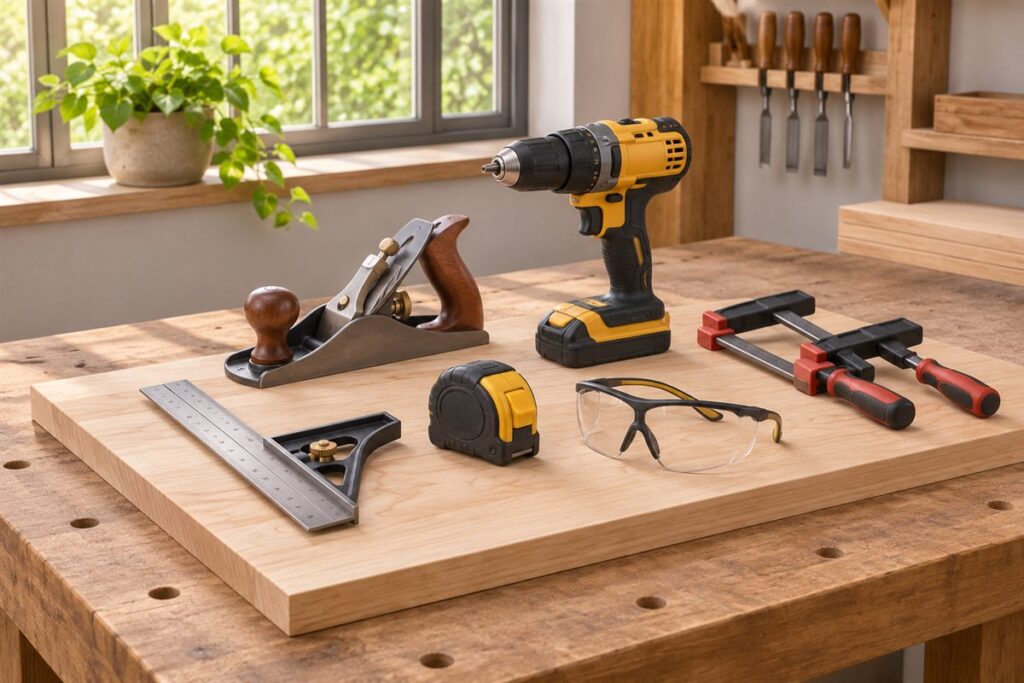
The right wood screw is long enough to grip well, thin enough not to split the board and made of a material that suits where the piece will live. Most choices come down to length, gauge, head and drive type, and coating. A little planning before you reach for the drill saves cracked boards and stripped heads.
Length and Gauge
As a general guide, a screw should pass through the first piece and bite well into the second, so most of its length ends up in the receiving piece. Gauge is the thickness of the screw, and thicker screws hold more but are likelier to split narrow stock. Check the maker’s chart for recommended pilot hole sizes for each gauge and wood type.
Head, Drive and Thread
| Feature | Options | What to check |
|---|---|---|
| Head shape | Flat (countersunk), pan, round, trim | Do you want it flush, raised or hidden? |
| Drive | Square, six-lobe, cross, slotted | Square and six-lobe drives resist slipping |
| Thread | Coarse, fine, partial, full | Coarse suits softwood; fine suits hardwood and sheet material |
| Point | Sharp, self-drilling, blunt | Self-drilling still needs a pilot hole in dense wood |
Matching the driver bit to the screw head exactly matters. A poor fit makes the bit slip and chew the head.
Coatings and Materials
- Plain or zinc-coated steel: usually for dry indoor use.
- Coated exterior screws: made for outdoor timber, with the maker’s notes on where they suit.
- Stainless steel: resists rust and often suits damp locations and some treated lumber, though it is softer, so drive carefully.
- Brass: decorative, soft and best for light-duty fixing, usually after a steel screw has cut the thread.
Some treated timber reacts with certain metals, so read the lumber maker’s advice on suitable fasteners.
Driving Screws Cleanly
- Mark the position and clamp the pieces together.
- Drill a pilot hole sized for the screw core, and a clearance hole in the top piece if you want the boards to pull tight.
- Countersink the opening if the head should sit flush.
- Set the drill to a low clutch setting, push straight along the screw and drive slowly.
- Stop when the head seats. Overdriving can strip the wood or snap the screw.
- Wear eye protection when drilling and driving, and follow your tool manual.
Drill holes at least a short distance away from board ends and edges, and use a little wax or soap on the threads in hard wood.
Screw Types for Different Woodworking Jobs
Woodworking uses several kinds of screws, each designed for a particular purpose, and the name on the box often tells you what it is for. General wood screws have a smooth shank near the head and a threaded section below, which lets the top board slide over the unthreaded part so the joint can be drawn tight. Construction or deck screws are made for fastening framing or outdoor timber and usually have a full thread, a sharp point and a coating suited to outdoor use. Particleboard and chipboard screws have a coarse thread intended for engineered boards. Cabinet screws often feature a wide head that sits flat against hinges and brackets.
Specialty screws solve particular problems. Pocket-hole screws are made for angled joints, with a washer-style head that seats in the stepped hole made by a pocket jig. Trim or finish screws have small heads that are easy to hide. Lag or coach screws are large, heavy fasteners driven with a wrench for structural connections. Confirmat or cabinet assembly screws are designed for flat-pack furniture and some board joints. Always read the box to see what the screw is meant for, and do not substitute without checking.
- General wood screw: furniture, cabinets and small projects.
- Deck and construction screw: framing, outdoor timber and structural work as allowed by local rules.
- Pocket-hole screw: angled joinery with a pocket-hole jig.
- Trim screw: moldings and finish work with minimal marks.
- Lag screw: heavy connections, with pilot and clearance holes sized as the maker states.
When choosing, think about whether you need strength, appearance, resistance to weather or ease of removal. A screw that is excellent for one purpose may be a poor fit for another, so match it to the job.
Hardwood, Softwood and Sheet Materials
The material you are fastening affects the screw you choose and how you prepare the hole. Softwoods such as pine and spruce compress and grip well, and coarse threads bite into them effectively. Hardwoods such as oak and maple are dense and resist the screw, so pilot holes are essential and fine threads can drive more cleanly. Driving a screw into hardwood without a pilot hole can snap the screw or split the board, especially near ends and edges.
Sheet materials need their own approach. Plywood holds screws reasonably well on its face, but the edges can split between layers, so pilot holes help. Medium-density fiberboard and particleboard have weak edge holding, and screws driven into the edges can pull out or split the material; screws designed for these boards and careful drilling make a difference. Edges of these boards are usually better joined with specialized fasteners, dowels, or other methods advised by the board maker. Laminated and coated boards may chip, so a countersink bit and a light touch help.
- In softwood, a pilot hole is often optional but useful near edges.
- In hardwood, drill a pilot hole sized to the screw core every time.
- In plywood, drill pilot holes to reduce splitting, especially near edges.
- In MDF and particleboard, use screws made for those materials and avoid driving into the edges unless advised.
- Check the screw and board makers for specific recommendations.
Test on a scrap of the same material before committing to the real piece. That reveals whether the screw splits, snaps or seats cleanly, and lets you adjust the hole size.
Pilot Holes, Clearance Holes and Countersinking
A pilot hole is a narrow hole drilled to guide the screw and make space for its core. It reduces splitting and lets the screw drive straight. A clearance hole is a wider hole in the top piece, allowing the screw’s thread to pass through without biting, so the screw pulls the two pieces together. Using both is the standard way to make strong, tight joints in hardwood or when attaching one board to another.
Sizing matters. A pilot hole that is too small can split the wood or snap the screw, while one that is too large reduces holding power. The usual approach is to match the pilot hole to the solid core of the screw rather than the thread tips, and to use a slightly larger pilot in hardwood than in softwood. Many screw makers publish charts. Use a piece of scrap, hold the drill bit up to the screw and see whether it covers the core without hiding the threads.
Countersinking cuts a conical recess so that a flat-head screw sits flush or just below the surface. A countersink bit does this in one pass, and combination bits drill the pilot, clearance and countersink together. A counterbore creates a cylindrical recess for hiding the head under a wooden plug, which is common in furniture. Use a depth stop or tape on the bit so that every hole has the same depth.
- Drill the clearance hole in the top piece and the pilot hole in the lower piece.
- Clamp the pieces together to keep them aligned while driving.
- Countersink just enough for the head to sit flush.
- Use a plug or filler if you want to hide the head.
Screws Versus Other Fasteners and Glue
Screws are one of many ways to join wood, and knowing when to use something else can improve your results. Glue creates a strong bond along the grain, and combined with screws provides clamping pressure while the glue sets. For many furniture joints, screws are used to hold the parts until the glue cures, and the glue gives most of the long-term strength. Dowels, biscuits and dominoes align and reinforce joints, and are useful where you do not want visible fasteners.
Nails are faster for light assembly and trim but have less holding power against pulling forces. Bolts and nuts, with washers, create strong, removable connections for heavy or structural parts, though they require larger holes. Brackets and metal connectors are often used where joints cannot be reinforced with wood. For projects that will be taken apart and reassembled, such as a workbench that moves with you, screws and bolts are better than glue.
- Use screws when you need adjustability, removability or clamping force.
- Use glue and screws together where the joint should be permanent and strong.
- Use bolts for heavy loads and for parts that must be tightened repeatedly.
- Use dowels or biscuits to align panel edges.
- Check local building rules and the project’s design for structural joints.
Wood moves with changes in humidity, mostly across the grain. A rigid screw joint across a wide board can crack the board as it swells or shrinks. Slotted holes or other allowances for movement may be needed for tabletops and panels, so consider the design before fastening them down firmly.
Buying Quantities, Budget Tiers and Quality Signs
Screws are cheap individually, but the cost of failure can be high, so it pays to buy suitable ones. Small packs are fine for a single project, but if you build regularly, bulk boxes of the sizes you use most are more economical and reduce trips to the store. Keep them sorted in labeled containers, and keep a few sizes on hand rather than a large assortment you will rarely use. Mixed assortment kits can be handy, but check that the sizes, drives and coatings are the ones you need.
Quality varies. Lower-priced screws may have soft heads that strip, inconsistent threads or thin coatings that wear off. Better screws generally have cleaner threads, harder points and heads with well-formed drive recesses that resist cam-out. Coatings differ in how well they protect against corrosion, and the box should say what environment they suit. Check the packaging and the maker’s notes, and avoid using indoor screws outside.
- Check that the drive recess is clean and deep, without burrs.
- Look at the threads for even spacing and sharp edges.
- Read the packaging for suitable materials, indoor or outdoor use and recommended pilot hole sizes.
- Buy extra of the sizes you use most, in case of breakage.
- Keep screws dry and discard rusted ones.
Signs of a poor choice include screw heads that strip easily, shafts that snap, wood that splits, heads that sit proud or sink too deep, and rust streaks on finished surfaces. If these appear, review the screw type, the pilot hole size, the driver bit and the drill clutch setting. Replace damaged screws rather than driving them again, and consider whether a different fastener would suit the job better.
FAQ
Do I need a pilot hole every time?
Not always in softwood, but it helps near edges and is often needed in hardwood. When in doubt, test on scrap first.
Can I reuse screws?
Often yes, if the head and threads are undamaged. Replace any with worn drives or bent shanks.
What is the difference between a wood screw and a deck screw?
A wood screw usually has a smooth shank section and suits furniture and indoor work. A deck screw is designed for outdoor timber and typically has a full thread and a weather-resistant coating.
How do I choose the right pilot hole size?
Match the pilot to the screw's core, not the thread tips, and go slightly larger in hardwood. Check the screw maker's chart and test on scrap.
Why does the wood split near the end of a board?
Screws wedge fibers apart, and ends and edges have little material to resist. Drill pilot holes, keep screws back from the end and consider a thinner screw.
Can I drive screws into the edge of MDF or particleboard?
Edge holding is weak and the material can split. Use screws and methods the board maker recommends, or choose a different joint.
Should I use glue as well as screws?
For permanent furniture joints, glue adds strength along the grain and screws provide clamping while it sets. For parts that must come apart, use screws alone.
What does cam-out mean?
It is when the driver bit slips out of the screw head under pressure and damages the recess. Use a well-fitting bit, firm in-line pressure and drive types that resist slipping.
Are stainless screws always better outdoors?
They resist rust well and suit many damp locations, but they are softer and need careful driving. Check the packaging and the timber maker's advice.
The Short Version
Choose a screw whose length, gauge, drive and coating suit the wood and the setting. Drill pilot holes, drive slowly and follow the screw maker’s guidance.