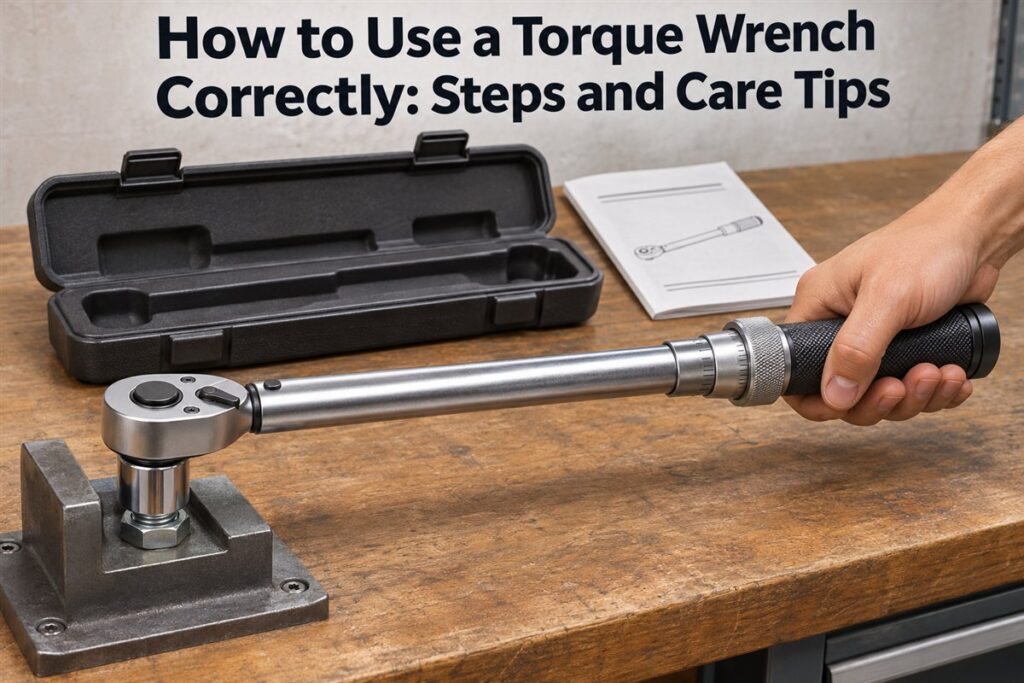
A torque wrench lets you tighten a fastener to a target value rather than guessing, which matters for wheels, engine parts, bicycle components and other jobs where a maker sets a figure. Find the specified torque in the item’s own manual, set the wrench to that value and pull smoothly until it signals. Always follow the manual for the part you are working on.
Know the Parts and Types
| Type | How it works | Notes |
|---|---|---|
| Click type | Clicks or releases at the set value | Common; store at the lowest setting if the maker says so |
| Beam type | Pointer shows the value on a scale | Simple; read it straight on |
| Dial type | Gauge shows torque as you pull | Easy to read; handle gently |
| Digital type | Screen and alert | Check batteries and calibration notes |
Many wrenches show values in newton metres or foot-pounds. Make sure the units on the wrench match the units in your specification, or convert them correctly.
Using a Click-Type Wrench
- Look up the specified torque and any tightening order or stages in the maker’s guide.
- Clean the threads and make sure they are dry or lubricated as the maker states, because oil can change the result.
- Thread the fastener by hand first so it does not cross-thread.
- Unlock the handle, turn the grip to the target value on the scale, and lock it again.
- Fit the correct socket fully onto the fastener, with the wrench square to it.
- Hold the handle at the grip point, not by the end, and pull smoothly. Do not jerk.
- Stop as soon as you feel or hear the click. Do not keep pulling.
- For several fasteners, such as wheel studs, follow a criss-cross pattern and repeat in stages as the manual describes.
Brace yourself and keep your body clear in case the socket slips. Keep the wrench on a flat surface when changing settings.
Looking After the Tool
- A torque wrench measures tightening, so do not use it to loosen stuck fasteners. Use a breaker bar.
- Do not drop it or use it as a hammer, since impacts can upset its accuracy.
- After use, follow the maker’s storage advice, which often says to return a click type to the lowest setting, but not below its stated minimum.
- Keep it in its case, away from damp and dirt.
- Have it checked or reset by a service centre as the maker suggests, especially after heavy use or a drop.
FAQ
Can I use a torque wrench with an extension?
Short straight extensions generally have little effect, but some adapters and crowfoot attachments change the result. Check the maker’s guide for any correction.
What happens if I over-tighten?
Fasteners can stretch, strip or break, and parts can warp. If you go past the value, loosen and retighten as the manual advises.
The Short Version
Find the correct torque value, set the wrench, pull smoothly until the click and stop. Keep the tool clean, store it as the maker says and follow the manual of the part you are fastening.