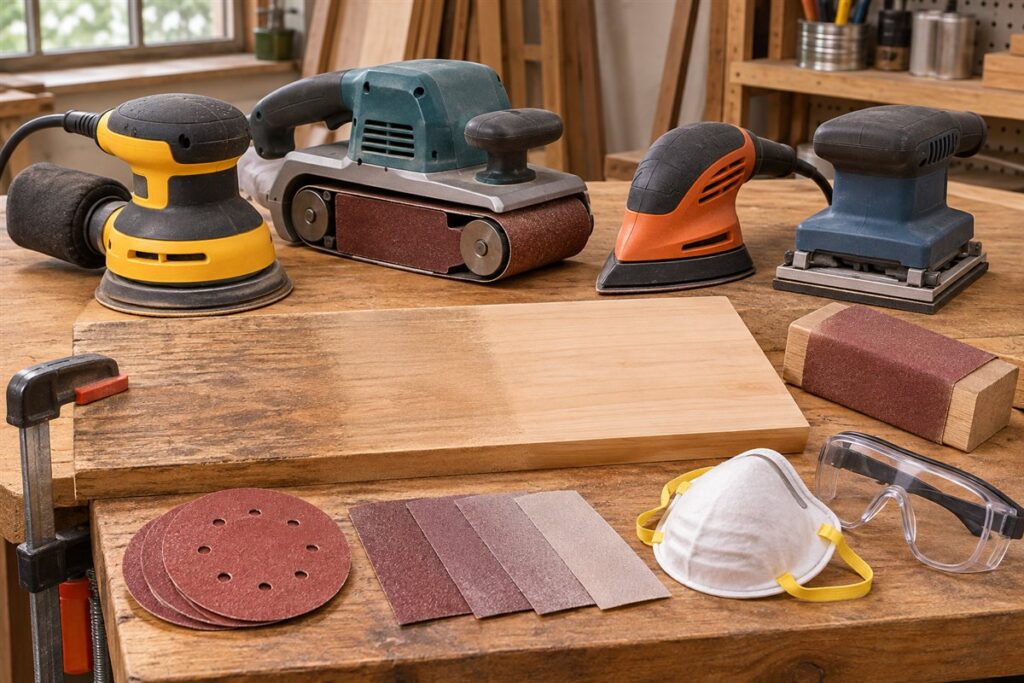
A sander smooths wood, removes old finish and prepares surfaces for new coatings. Random orbital sanders suit most general work, belt sanders remove material quickly, and detail sanders reach corners. Choosing the right type saves time and avoids scratches.
Random Orbital Sanders
The sanding disc spins and moves in small ovals at the same time, so it leaves fewer visible swirl marks. It is the usual first power sander for beginners because it is forgiving and works on flat panels, furniture and doors. Discs attach with hook-and-loop backing and are changed quickly.
Belt Sanders
A loop of abrasive runs around two rollers. Belt sanders cut fast, so they are useful for levelling rough boards or shaping, but they can gouge the surface if held in one place. Keep the sander moving, and take light passes along the grain.
Detail and Sheet Sanders
- Detail (mouse) sanders: a small triangular pad for corners and tight spots.
- Palm or sheet sanders: a quarter-sheet of paper clamped on a pad that shakes quickly, good for light finishing.
- Spindle and drum sanders: shop tools for curved edges.
- Hand sanding blocks: still the best way to control edges and curves, and quiet. Wrap paper around a flat block of wood or cork for even pressure.
Comparing the Main Types
| Sander | Strength | Watch out for |
|---|---|---|
| Random orbital | Smooth, versatile | Slower on heavy removal |
| Belt | Fast stock removal | Gouging if held still |
| Detail | Corners and small areas | Small pad, slow on large areas |
| Sheet | Light finishing | Can leave straight-line marks |
Grit and Dust
Abrasive grit numbers run from coarse (low numbers) to fine (high numbers). A common path works through several grits, moving up without skipping too many steps. Check the maker’s guide for suitable grits. Dust is a real concern: wear a dust mask suited to fine particles, use dust extraction if the sander supports it, and keep the area ventilated. Some old finishes may contain hazardous materials, so get advice before sanding them.
Basic Technique
- Clamp or hold the work firmly.
- Choose a coarser grit only if you must remove marks, then move to finer grits.
- Let the weight of the sander do the work, without pressing hard.
- Move steadily along the grain.
- Wipe away dust between grits and check the surface in side light.
Paper and Pad Care
Change abrasive as soon as it feels smooth, since worn paper only polishes the surface and heats it. Check the pad for wear and dust build-up, and empty any dust bag before it is full.
FAQ
Which sander should I buy first?
A random orbital sander covers most general jobs and is easier to control than a belt sander.
Can I sand without a power tool?
Yes. A sanding block and patience work well, especially on edges and small pieces.
The Short Version
Choose a random orbital for general smoothing, a belt sander for heavy removal, and a detail sander for tight spots. Work through grits, protect your lungs and follow the maker’s safety instructions.