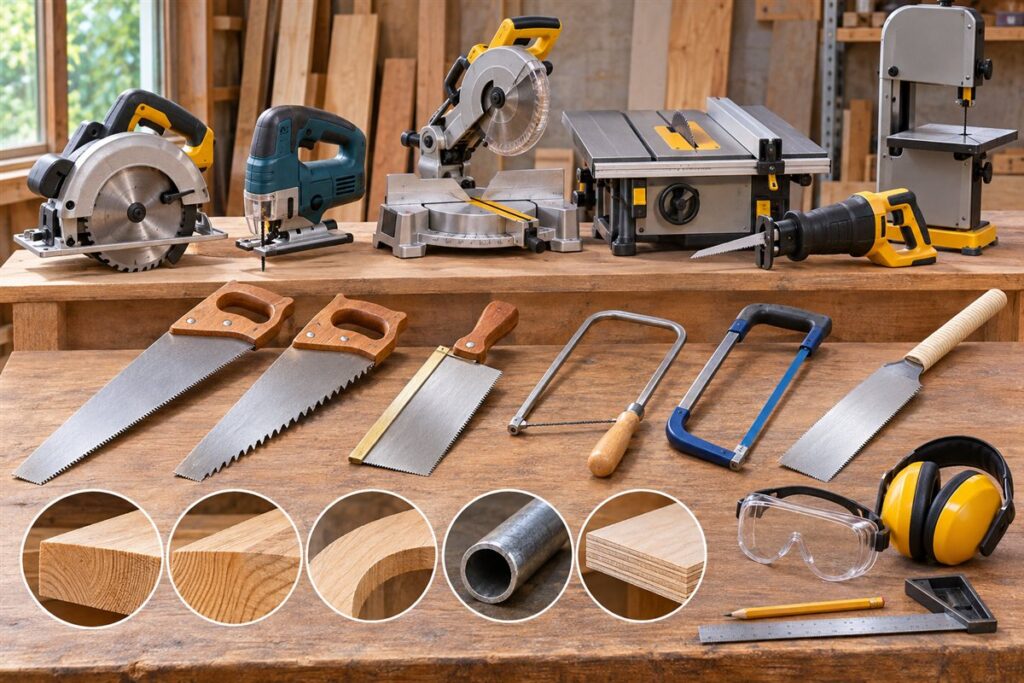
Saws are grouped by what they cut and how they cut it. Some are built for straight cuts along the grain, some for crosscuts, some for curves and some for metal. Once you know the main families, choosing the right saw for a job becomes much easier.
Hand Saws
Hand saws need no power, produce little dust and give you plenty of control while you learn.
- Crosscut saw: teeth shaped to cut across the wood grain.
- Rip saw: teeth shaped to cut along the grain.
- Tenon or back saw: a thin blade with a stiffened spine for neat joint cuts.
- Coping saw: a thin blade held in a frame for tight curves.
- Hacksaw: a fine-toothed blade for metal and plastic pipe.
- Pull saw: cuts on the pull stroke, giving a thin cut and good control.
Power Saws
Power saws cut faster but demand more respect. Read the maker’s manual before first use, and use the guards and any dust extraction provided.
- Circular saw: a hand-held round blade for long straight cuts in boards and sheets.
- Jig saw: a narrow reciprocating blade for curves and cut-outs.
- Mitre saw: a blade on a pivoting arm for repeatable angled crosscuts.
- Table saw: a blade rising through a table, suited to ripping and sheet work, and one that needs proper training.
- Reciprocating saw: a push-pull blade for rough cutting and demolition.
- Band saw: a looped blade for curves and resawing.
Matching Saw to Job
| Job | Common choice |
|---|---|
| Trimming a board to length | Crosscut hand saw or mitre saw |
| Cutting a curve | Coping saw or jig saw |
| Cutting a sheet of plywood | Circular saw with a guide |
| Cutting metal rod or pipe | Hacksaw with a suitable blade |
| Rough demolition | Reciprocating saw |
Blade Basics
The blade often matters as much as the saw. More teeth per inch usually give a smoother, slower cut, while fewer teeth cut faster and rougher. Blades are made for particular materials, so use one that matches wood, metal or plastic, and check the maker’s guide for compatible sizes.
Habits That Help
- Mark the cut line clearly before you touch the saw.
- Hold the workpiece firmly with a clamp or vice.
- Let the saw do the work without forcing it.
- Keep your free hand clear of the line of the blade.
- Wear eye protection, and hearing protection with power saws.
FAQ
Which saw should a beginner buy first?
A general-purpose hand saw and a coping or pull saw cover many small jobs and teach good habits. Add a jig saw or circular saw when you need more speed.
Can one saw do everything?
No. Each saw has a purpose, and using the wrong one gives rough results and makes the work harder. A few well-chosen saws are better than one that does everything poorly.
The Short Version
Hand saws offer control and quiet, power saws offer speed, and the blade should match the material. Choose by the cut you need, hold the work firmly, and follow the maker’s safety instructions with every power tool.