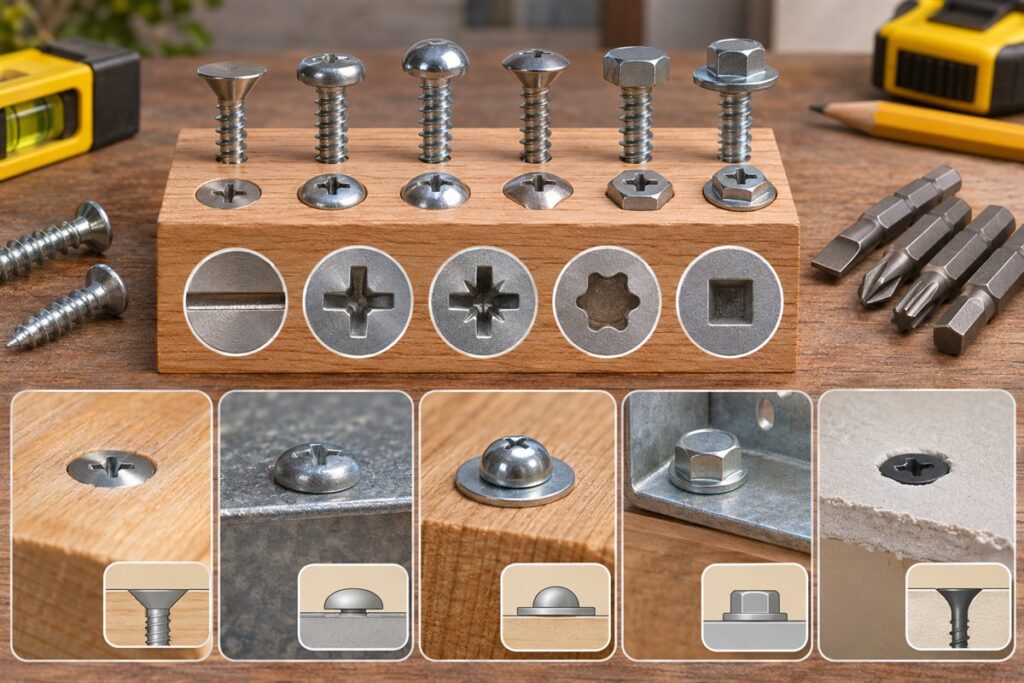
A screw head has two features: its outside shape and its drive recess. The shape decides how the head sits against the work, and the recess decides which driver fits. Getting both right gives a neat, firm result.
Head Shapes
- Flat (countersunk): sits level with or below the surface when the hole is countersunk. Common in woodwork and cabinetry.
- Pan: a low rounded top with a flat bearing surface, suited to sheet material and general fixing.
- Round: a domed head that stays visible, often used with washers.
- Oval: a countersunk screw with a slightly raised dome, used for decorative fittings.
- Hex and hex washer: driven by a socket or spanner, giving high turning force.
- Trim or bugle: a small head that sinks neatly into softer material like plasterboard.
Drive Recesses
The recess is the shape cut in the head. Slotted, Phillips, Pozidriv, Torx and square (Robertson) are the usual choices. Torx and square resist the driver slipping out, while slotted heads can slide off the screw. Match the driver exactly. A driver that is slightly too small will round off the recess.
Head and Use Compared
| Head | Sits | Where it is used |
|---|---|---|
| Flat | Flush with surface | Wood, hinges, cabinets |
| Pan | On top, low profile | Metal sheet, brackets |
| Round | On top, domed | Light fixings with washers |
| Hex | On top | Heavy fixings and machinery |
| Bugle | Slightly sunk | Plasterboard |
Choosing for Your Project
- Decide whether the head should sit flush or on top of the surface.
- Choose the length so the screw bites well into the base material but does not poke through the far side.
- Drill a pilot hole in hardwoods to avoid splitting.
- Countersink for flat heads so they sit properly.
- Match the driver to the recess and press in firmly as you turn.
Material and Finish
Screws come in steel, stainless steel, brass and coated finishes. Outdoor or damp locations call for corrosion-resistant types, and the maker of the screw lists what suits which environment. Brass screws are soft, so drive them gently, often after a steel screw has cut the thread.
For fixings that carry loads, such as heavy shelves, mounted equipment or anything structural, follow the maker’s instructions for the fixing and ask a qualified professional if you are unsure what the wall or frame can take.
Drive Styles and How They Grip
The recess in a screw head decides how well a driver can transfer force. Slotted drives are simple but allow the driver to slip sideways, so they need care. Phillips drives are designed so the bit can lift out under high load, which protects the screw but can chew up the recess if you push too hard. Pozidriv recesses have extra contact points for a firmer grip. Torx, with its six lobes, spreads force over a larger area and resists slipping, and square drives hold the bit firmly.
Each style suits different use. For quick household jobs with a hand screwdriver, Phillips and slotted are everywhere. For power driving, Torx and square drives tend to stay seated and work well with higher speed tools. Security drives with unusual shapes or pins exist to resist tampering, and they need matching bits.
The key rule is a close fit. A bit that is slightly too small, worn or of the wrong style will wobble in the recess and round it out. Push the bit firmly into the head before turning, and keep it aligned with the screw.
- Check the style and the size number of the recess.
- Keep spare bits in the sizes you use most.
- Replace worn bits when the tip becomes rounded.
Matching the Head to the Material
Different materials behave differently around screw heads. In softwood, a flat head will pull itself below the surface if you drive it hard, while in hardwood it may sit proud unless you countersink. Chipboard and similar boards have weak surfaces that can crumble under a head, so screws made for these boards, often with a particular head and thread, hold better.
In thin sheet metal, pan or similar heads sit on top with a wide bearing surface, while a flat head would need a countersunk hole. For plasterboard, bugle heads sink slightly without tearing the paper face. Check that the screw is made for the board you use, as plasterboard screws are designed with that purpose.
For plastics, be careful about overtightening and cracking. A broad head or washer spreads the load. For decking and other outdoor timber, the head is often designed to sink cleanly and resist stripping, and the finish needs to cope with moisture.
If you plan to cover the screw heads with filler or paint, choose a head that can sit below the surface. If they will remain visible, pick a head that looks tidy and consistent in color and style.
Driver Bit Fit and Technique
Good technique reduces damage far more than buying expensive screws. Choose the bit that matches both the style and the size. Insert it fully into the recess, and hold the driver in line with the screw. Press firmly as you turn, since pressure keeps the bit seated.
Use a drill with a clutch where possible and begin at a low setting. Increase it until the screw sits where you want it. Power tools can overdrive screws, stripping the recess or the wood. In delicate materials, finish the last turns by hand for control.
If a screw resists, stop and check for causes. It may need a pilot hole, the wood may be dense, or the screw may be crooked. Back the screw out and fix the cause rather than forcing it. For stuck screws, a firm push and slow turning often work better than speed.
Long bits and extensions can wobble. Use a bit holder or guide sleeve to keep alignment on long runs. Keep bits clean and free of debris, as dirt in the recess prevents proper seating.
- Use the right bit size, not one close to it.
- Drive straight and press firmly.
- Use the clutch to avoid overdriving.
Dealing With Damaged or Stuck Screws
Sooner or later a screw head gets damaged. First, try a bit one size larger or a different style that may grip the damaged recess. Pressing hard while turning slowly helps. A wide rubber band placed between the bit and the head sometimes adds grip, though results vary.
Screw extractors are bits designed to bite into a damaged recess and turn the screw out. Follow the instructions, drill carefully and use the correct size. They can break if forced, leaving a worse problem. For stuck screws, penetrating oil may help in some cases, but check that it is safe for the material and the surrounding finish.
If the head is flat and exposed, you might file a new slot with a small hand tool or use pliers to grip the head and turn it. For screws with a protruding head, locking pliers can grip and turn it out. Take care to avoid damaging the surrounding surface.
When removal threatens to ruin the piece, consider the options. You might cut the screw off, drill out the head, or leave a hidden screw in place if it is not causing problems. Prevention is easier: use the right bit and a pilot hole, and avoid overtightening.
Buying Screws and Keeping Them Organized
When buying screws, read the package for the head style, drive type, length, gauge, material and intended use. Packs that list the intended material and whether the screw has a self-drilling or self-tapping tip help you choose. Avoid mixing screw types in one project, because different heads need different bits and look inconsistent.
Buy a little more than you need, because losing or damaging a few is common. Boxed assortments are convenient for odd jobs but may include sizes you never use. Buying specific packs for your common tasks may serve better. Check the finish for the environment, as indoor and outdoor uses differ.
Organize your stock. Small divided boxes or labeled jars keep head styles and sizes separate and save time hunting. Keep the matching bits with the screws, such as a bit in the same box lid, so you always have the right driver.
Finally, avoid reusing screws that have damaged heads or threads. A fresh screw costs little compared with a failed fixing. For critical applications, follow the guidance for the project and use fasteners that are suited to the load.
FAQ
Why does my flat-head screw stand proud?
The hole probably needs countersinking so the cone shape can sink in. A countersink bit solves this.
Can I reuse screws?
If the recess and thread are undamaged, yes, but replace any with a worn or rounded head.
What is the difference between Phillips and Pozidriv?
They look similar, but Pozidriv has extra marks and a different profile. Using a Phillips bit in a Pozidriv screw fits poorly and can damage the recess.
Why do some screws need a pilot hole?
A pilot hole guides the screw and reduces splitting, especially in hardwood or near edges. Some self-drilling screws do not need one, but check the packaging.
Are Torx screws better than Phillips?
Torx drives resist slipping and handle more driving force, which many users prefer with power tools. Phillips remains common and fine for light work.
What does screw gauge mean?
Gauge describes the thickness of the screw shaft, and the numbering system varies by region. Check the packaging, and match it with the hole or fitting you use.
Can I use any screw for decking?
Use screws made for outdoor timber, with suitable coatings and heads. Check the timber and fastener guidance for compatibility.
What if my screw head sits below the surface?
It may have been overdriven. Use the clutch setting or drive by hand at the end, and consider a washer if the material is soft.
How do I remove a security screw?
You need the matching security bit. If you do not have it, check where the fitting came from or ask a hardware supplier for the right driver.
The Short Version
Choose head shape for how the screw should sit, drive type for grip, and length for hold. Match the driver, drill pilot holes in hard material, and follow the maker’s guidance for load-bearing fixings.