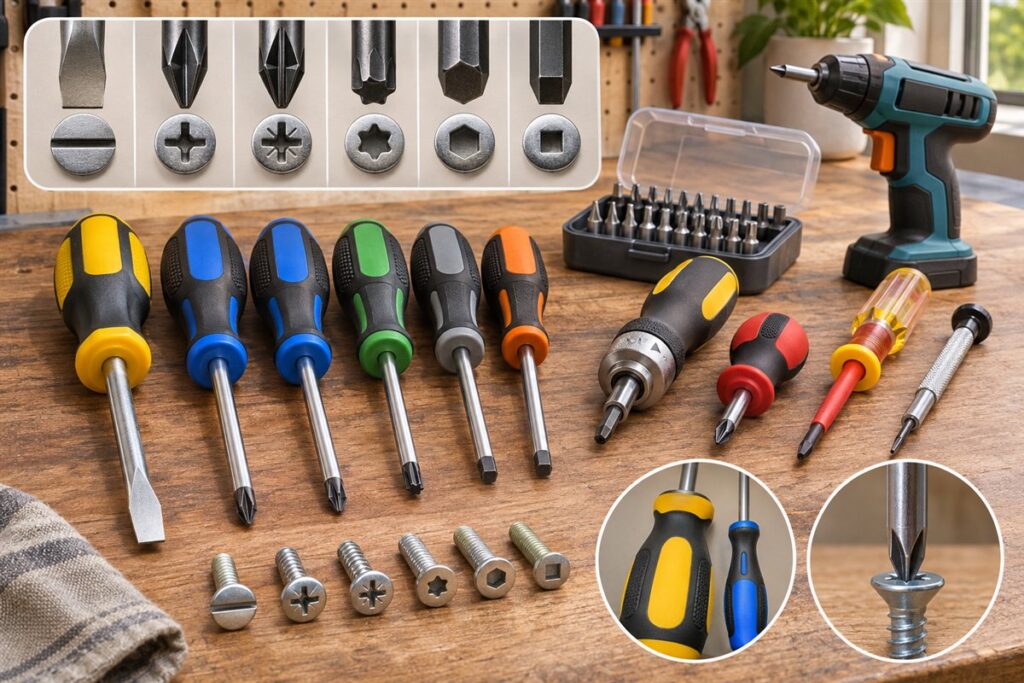
A screwdriver only works well when its tip matches the screw head. Slotted, Phillips, Pozidriv, Torx and hex are the main tip shapes, and each fits a different recess. Using the right one prevents slipping and damaged screw heads.
Common Tip Shapes
- Slotted (flat): a single blade for a single slot. It tends to slip sideways, so keep it centred.
- Phillips: a cross shape with a tapered tip, common on household items. It is designed to let the driver cam out under heavy force.
- Pozidriv: looks like Phillips with extra small marks between the arms. It grips better but a Phillips driver fits poorly.
- Torx (six-lobed): six rounded lobes that hold well and resist slipping.
- Hex: a six-sided key, common in furniture and bicycles.
- Square (Robertson): a square recess that grips firmly.
Sizes and Handles
Within each shape there are sizes, such as PH1, PH2 and PH3 for Phillips. The tip should fill the recess without wobbling. Handles come in plastic and rubber grips, and wider handles give more turning force while slimmer ones give finer control.
Special-Purpose Drivers
Precision (jeweller’s) screwdrivers handle tiny screws in glasses and small devices. Stubby drivers fit cramped spaces. Ratcheting and bit drivers hold interchangeable bits, so one handle covers many tips. Insulated screwdrivers have coatings for electrical trades, but they do not make live work something a householder should attempt; follow the maker’s guidance and local codes, and use a qualified electrician for mains wiring.
Matching Tip to Screw
| Screw recess | Matching driver | Common use |
|---|---|---|
| Single slot | Slotted | Older hardware, cover plates |
| Cross | Phillips | General household items |
| Cross with marks | Pozidriv | Cabinet and building screws |
| Six lobes | Torx | Decking, appliances, devices |
Driving a Screw Cleanly
- Choose the tip that fills the recess and fits snugly with no wobble.
- Keep the driver in line with the screw.
- Press firmly into the recess while you turn.
- Turn slowly to avoid stripping the head.
- Stop when the screw is snug against the surface rather than forcing it.
Care for Your Drivers
Worn or chipped tips are the main cause of slipping. Keep drivers dry, store them in a rack or roll, and replace a tip when the edges have rounded off. Never use a screwdriver as a chisel or pry bar, because the blade can chip or bend. Look at the tip now and then, and keep a few spare bits close by.
Building a Basic Screwdriver Kit
A small number of drivers handle most household work. A medium Phillips and a medium slotted cover many common fixings, a smaller pair suits electronics, light fittings and appliances, and a Torx and hex set cover furniture, bicycles and many modern products. A single handle with interchangeable bits is a space-saving way to cover many sizes.
Think about reach and space. A stubby driver works in cramped places, while a long-shaft driver reaches into recessed screws. A precision set serves glasses and small gadgets. Add specialty items only when a task calls for them.
Buying a set can be a good value when it matches your needs, but check what it includes. A set with many tips you do not use may be less helpful than a smaller set with good tools in the sizes you need. Look at how the tips are stored and whether there is room to keep everything together.
Compare the options by asking how often you will use the tool, which screws you meet most, and where you work. A person who assembles flat-pack furniture needs different tools from a person repairing small electronics.
- Household basics: Phillips and slotted in a couple of sizes.
- Furniture and cycles: hex and Torx.
- Small devices: a precision set.
- Flexible kit: handle with a range of bits.
Bit Quality and Tip Finish
The tip is the working part, and its quality shows in how it holds the screw. Well-made tips have accurate shapes and hardened surfaces that resist wear. Poorly shaped tips may round off or wobble. Look for clean machining with no rough edges. A tip that fits snugly in the recess is a good sign.
Some tips are coated or textured to grip the screw. Rough or dark finishes may bite into the recess better than polished ones, though preferences differ. Check the listing for what the finish is intended to do. Magnetic tips hold the screw in place, which helps in awkward spots.
Shaft material and strength matter for heavy work. A shaft that bends or twists under load is frustrating and may snap. Check the stated use, and do not use a screwdriver as a pry bar or chisel. If a tool is not rated for striking, do not hit the end of the handle with a hammer.
Bits for power tools differ from hand screwdriver tips. Impact-rated bits are made for the higher shock of an impact driver, and ordinary bits may break. Make sure the bit type fits the tool you use.
Handle Comfort and Ergonomics
Handle shape affects comfort and control. A handle that fits the palm well spreads pressure and reduces fatigue during long jobs. Soft grips cushion the hand, while harder handles may give a clearer feel. Some people prefer a tapered handle for fine control and others prefer a thick handle for torque.
Think about grip when your hands are wet or oily. Textured or rubberized surfaces help, and flat sides stop the driver rolling off a table. Look for a handle that is firmly attached to the shaft. A loose handle is annoying and a sign of poor build.
Shaft length and handle size should suit the task. For tight spaces, a short handle gives access, but at the cost of leverage. For deep recesses, a long shaft helps. Ratcheting handles let you keep your grip without releasing, which is useful for long runs of screws.
Try tools in the shop if you can. Hold the handle, turn it in the air and feel how it sits. For regular use, comfort pays off more than any single feature.
- Choose a handle size that suits your hand.
- Prefer grips that stay secure when hands are damp.
- Check that the shaft is firmly fixed to the handle.
Power Assist and Manual Drivers
Electric and battery screwdrivers speed up repetitive work. Small cordless screwdrivers handle assembly and light fixings, while drill-drivers cover heavier tasks. They bring speed and reduce wrist strain, but they can overdrive screws and strip recesses. A clutch or torque setting helps control this.
Manual drivers have advantages. They give better feel for tight or delicate screws, work without batteries and are less likely to damage soft materials. For tasks like fitting hinges or switch plates, many people finish by hand even when they start with a power tool.
Consider the tool’s size and weight. A compact powered driver may fit small spaces, but a larger one may be awkward. Check the bit holder type and make sure it accepts the bits you own. Battery life and charging should suit your usage.
Powered tools also need safety care. Keep fingers away from the bit, secure the work, and wear eye protection if there is a risk of the bit slipping or breaking. Follow the maker’s instructions.
A common pattern is to keep both: a set of good manual drivers for precision and a power driver for volume. Decide which suits your work most, and let that guide your first purchase.
Misuse to Avoid and Signs of Wear
Screwdrivers are often misused as pry bars, scrapers and chisels. This bends the shaft, chips the tip and can cause injuries. Use the right tool for these tasks. Do not use a screwdriver to test electrical circuits, and do not rely on insulated drivers for live work.
Check tips regularly. A worn tip that rounds off or has chipped corners no longer fits the screw and will damage heads. Replace worn bits or drivers rather than forcing them. A slotted tip can sometimes be reshaped, but results depend on the tool and your skill, and replacement is often simpler.
Inspect handles for cracks and shafts for bends. A bent shaft makes accurate work hard and could fail. For insulated drivers, check for cuts or damage in the coating. If the insulation is damaged, do not rely on it for protection.
Keep drivers clean and dry, and store them in a rack, roll or drawer where tips are protected. Wipe off oil or dirt after use, and avoid leaving them in damp places. With basic care, good drivers last for many years.
FAQ
Why do screw heads strip?
Usually the driver is the wrong shape or size, or not pressed in firmly. Matching the tip and pressing in as you turn reduces the problem.
Is a magnetic tip useful?
Many people find it convenient for holding small screws. Check the maker’s guide if you are working near sensitive equipment.
What does PH2 mean?
It refers to a Phillips tip of size number 2. The size numbers help you match the driver to the screw, and the packaging or screw information shows which one is needed.
Can I use a screwdriver to open paint tins?
It is a common habit, but it can bend or chip the tip. A proper tin opener or flat tool is a better choice.
Are magnetic screwdrivers safe to use near electronics?
Magnets can affect some sensitive items, so check the maker's guidance for the device. For delicate electronics, many people prefer non-magnetic tools.
Do I need an impact-rated bit?
If you use an impact driver, impact-rated bits are designed for the shock. Ordinary bits may break under that kind of load.
How do I choose between a ratcheting and a standard driver?
Ratcheting handles save time on repeated turns, while standard drivers give a simpler feel. Choose the one that suits the task and your comfort.
Why does my screwdriver wobble in the screw?
The tip may be the wrong size or style, or it may be worn. Try a better fitting bit and check the recess for damage.
Can I sharpen a slotted screwdriver?
A lightly worn tip can sometimes be reshaped with a file, but accuracy matters. If you are unsure, replacement is simple and safe.
The Short Version
Match the tip shape and size to the screw, press in firmly and turn steadily. Bit drivers save space, and electrical work should be left to a qualified professional.