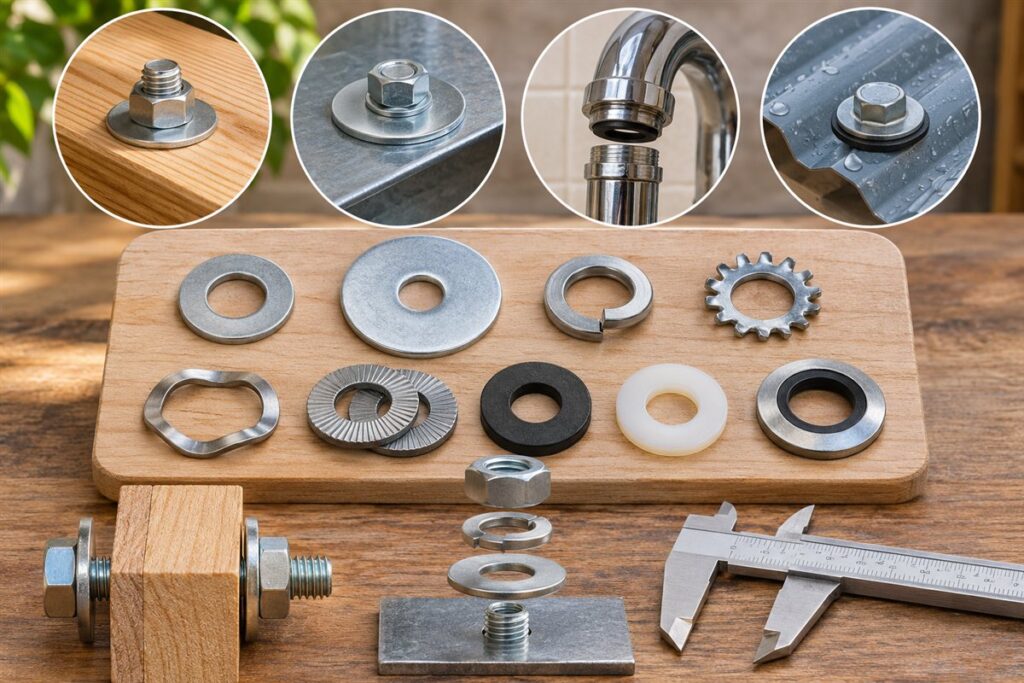
A washer is a thin disc with a hole that sits under a bolt head or nut. Its main jobs are spreading the load, protecting the surface and, in some designs, helping the fastener resist loosening. Choosing the right kind makes a joint last longer.
Flat Washers
The plain flat washer is the most common type. It spreads the clamping force over a wider area so the nut or screw head does not dig into the surface. It also gives a smooth face to turn against. Wood especially benefits, because a bare bolt head can crush the fibres.
Fender Washers
A fender washer has a small hole and a very wide outer diameter. It is used where you need extra spread across thin sheet metal, plastic or soft board, or where the hole is a little oversized.
Washers That Resist Loosening
- Split lock (spring) washers: a split ring that presses back against the nut. Often used with a flat washer.
- Toothed (external-tooth) washers: serrations bite into the surface. They suit metal parts, and the teeth can mark finishes.
- Wave washers: a gently curved ring that provides light spring pressure.
- Nord-lock style washers: paired wedge-faced discs made for high-vibration joints, used according to the maker’s directions.
Sealing and Protective Washers
Rubber and neoprene washers cushion and seal, and are commonly used on taps, hoses and roofing fixings. Nylon washers insulate and resist corrosion. Bonded sealing washers combine a metal ring and rubber layer to keep out water. For taps, plumbing connections and gas or water supply fittings, check the maker’s manual and local codes, and call a qualified professional when you are unsure.
Which Washer Where
| Washer | Main job | Typical place |
|---|---|---|
| Flat | Spread load | Under nuts and bolt heads |
| Fender | Spread across thin material | Sheet metal, soft board |
| Split lock | Resist loosening | Machinery, metal frames |
| Rubber | Seal or cushion | Taps, hoses, gutters |
Fitting Washers Correctly
- Match the washer’s hole to the bolt diameter, with only a small gap.
- Place a flat washer against the surface, then any lock washer between it and the nut.
- Use a washer under both the head and the nut when you are bolting through wood.
- Tighten until firm, but do not crush soft washers or the material beneath.
- Replace rubber washers that have hardened, cracked or flattened.
Sizing and Measuring Washers
Washers are described by a few dimensions, and matching them to the fastener is what makes them work. The inner diameter must clear the bolt or screw shank without a large gap, the outer diameter determines how widely the load is spread, and the thickness affects stiffness and stack height. Packaging usually lists these, sometimes with the bolt size the washer is intended for.
To measure, use calipers or a ruler with fine graduations. Measure the inside hole, the outside edge and the thickness, and compare with the product listing. Remember that a washer for a given bolt may be called by the bolt size or by its own hole size, and these are not the same number. Metric and imperial sizes can look similar but do not match exactly, so keep them separate and check the standard stated on the packaging.
Some washers are labelled as standard or wide series, meaning the outer diameter differs. A wider washer spreads force further, which suits soft material, while a standard one is fine for general use. If the hole is too large, the bolt head can pull through, and if it is too small, the washer will not fit over the shank. Bring the fastener to the shop when you are unsure, and test the fit. Store washers in labelled compartments or small bins by size and type, so you do not mix them. For critical structural or load-bearing joints, follow the plan or the maker’s specifications and ask a qualified professional.
Materials and Finishes
Washers are made from several materials, each suited to different conditions. Plain steel is common and inexpensive, but it can rust if left bare. Zinc-plated and other coated steels resist corrosion better for indoor or lightly exposed use. Stainless steel is more resistant to rust and is often chosen for outdoor, damp or marine settings, though it is not suitable for every joint, and it can behave differently when paired with other metals.
Mixing metals matters. When two different metals touch in the presence of moisture, one can corrode faster than the other, a process called galvanic corrosion. Aluminium, steel and copper alloys are examples of metals that can interact. Check compatibility charts or the fastener maker’s guidance when joining dissimilar metals outdoors or in damp places, and use insulating washers or sleeves when recommended.
- Brass and bronze: resist corrosion and are used in plumbing and decorative work, but are softer than steel.
- Nylon and plastic: insulate, resist corrosion and protect surfaces, though they have limits on heat and load.
- Rubber and neoprene: seal and cushion, with limits on temperature and chemicals.
- Fibre and composite: used for light sealing and spacing.
Choose materials that suit the environment, load and temperature, and read the product description. For exterior projects, use fasteners and washers designed for outdoor exposure. Replace washers that show rust, cracks or flattening.
Matching Washers to Common Jobs
Knowing what each job asks for makes choosing easier. In timber, a flat washer under the nut and bolt head stops the metal from crushing fibres, and a wider fender-type washer helps in softer boards. When bolting through thin metal or plastic sheet, a wide washer spreads force and helps prevent the fastener tearing through. On sheet metal screws used on thin panels, a washer-head screw or a separate washer can do the same.
For furniture and flat-pack assemblies, a small flat or spring washer under the bolt can help keep joints snug through repeated use. For machinery and equipment that vibrates, locking designs may be used, but the maker’s instructions come first. In plumbing and taps, rubber or fibre washers seal the joint, and the correct size and material are essential; follow the manual and local codes, and use a qualified plumber for fittings you are unsure about.
Roofing and gutter fixings often use bonded or sealing washers, which combine metal and rubber to keep water out. Check that the sealing layer is intact and suited to the fastener. Electrical connections may use specific washers or hardware, and in these cases follow the equipment instructions and use a qualified electrician. For car and bike parts, use only the washer specified by the maker, as some are designed to crush or deform once and must be replaced. Avoid guessing on safety-critical parts.
Installation Mistakes to Avoid
Washers are simple, but they are easy to use wrongly. Learn the common pitfalls to keep joints secure.
- Wrong order: place the flat washer against the surface, with any locking washer between it and the nut. Reversing them can reduce the effect.
- Over-tightening: crushing soft washers or the material beneath can weaken the joint. Tighten as the plan or maker directs.
- Under-tightening: a loose joint can wear, rattle and loosen further. Check after the first period of use.
- Reusing damaged washers: flattened, cracked or corroded washers lose their function. Replace them.
- Using one washer type for everything: a plain flat washer does not provide the sealing or locking action that other types give.
- Mixing sizes: an oversized hole lets a bolt pull through, and an undersized one will not seat.
- Ignoring burrs: sharp edges or rough faces on washers can mark surfaces or sit unevenly. Use the smooth side against finished surfaces if the washer has one.
Use the right tools, such as a correctly sized spanner or socket, and avoid forcing parts. If a joint keeps loosening, review the design instead of simply adding more washers. Consider whether a locking nut, thread-locking product, or a different fastener suits the job, following product instructions.
Inspecting and Replacing Washers
Washers are inexpensive and small, but when they fail, joints can loosen or leak. Make a habit of looking at them whenever you service something. Signs of wear include flattening or thinning, cracks, corrosion, deep scoring from the fastener, deformed shapes and hardened rubber. Spring washers that no longer spring back are spent. Toothed washers with flattened teeth do little.
When you take a joint apart, check the washer and the surface it pressed against. Pitting or deformation on the surface may mean the load was not spread well, and a larger washer may help. Keep a mixed supply of the sizes you use most, so that replacement is simple. Label bins by size and material.
Some washers are single-use, such as those designed to crush or deform to form a seal, and these should be replaced every time. Check the maker’s manual to see which parts need replacing. For plumbing joints, a worn rubber washer is a common cause of drips, and replacing it is usually the simplest first fix. For outdoor structures, check washers and fasteners after the first season and then at regular intervals. If a joint carries a load where failure could cause injury, such as swings, ladders or overhead fixtures, follow the maker’s schedule, use the specified parts and consult a qualified professional when in doubt. Dispose of old washers with scrap metal where local rules allow.
FAQ
Do I always need a washer?
Not always, but it is wise with wood, soft materials, oversized holes and any joint likely to move. Some fasteners come with a washer face built in.
Can I stack several washers to fill a gap?
For light spacing jobs, sometimes, but a proper spacer or sleeve is neater and stronger. Follow the maker’s guidance for load-bearing parts.
What is the difference between a washer and a spacer?
A washer spreads load or provides locking or sealing under a fastener, while a spacer holds parts apart at a set distance. Some pieces serve both roles, so check the description.
Should washers go under the bolt head, the nut or both?
Often both, especially when bolting through wood or soft material. Check the plan or maker's instructions. Under only one side, put it where the part turns against the surface.
Do locking washers work on their own?
They help resist loosening in some joints, but they are not a cure-all. Their performance depends on the joint and the maker's design. Check the instructions and consider other locking methods for critical joints.
Can I reuse washers?
Plain flat washers in good condition can often be reused, but damaged, flattened or corroded ones should be replaced. Single-use types, such as crush washers, must be replaced every time.
Are stainless washers always better?
They resist rust well, but they may not suit every joint, particularly with dissimilar metals. Match the material to the environment and the fastener, and check guidance on compatibility.
How do I choose a washer for a plastic part?
Use a wider washer to spread the load and avoid cracking. Do not over-tighten, and consider a nylon or rubber washer if the maker suggests it. Test on a spare piece where possible.
Why does my bolt keep loosening even with a washer?
Vibration, wrong size, insufficient tightening, worn parts or a joint that moves can all cause loosening. Check each of these, and consult the maker's guidance on locking methods.
The Short Version
Flat washers spread load, fender washers cover big areas, lock washers resist loosening and rubber washers seal. Match the size, place them in the right order and leave plumbing, gas and structural work to qualified professionals where required.