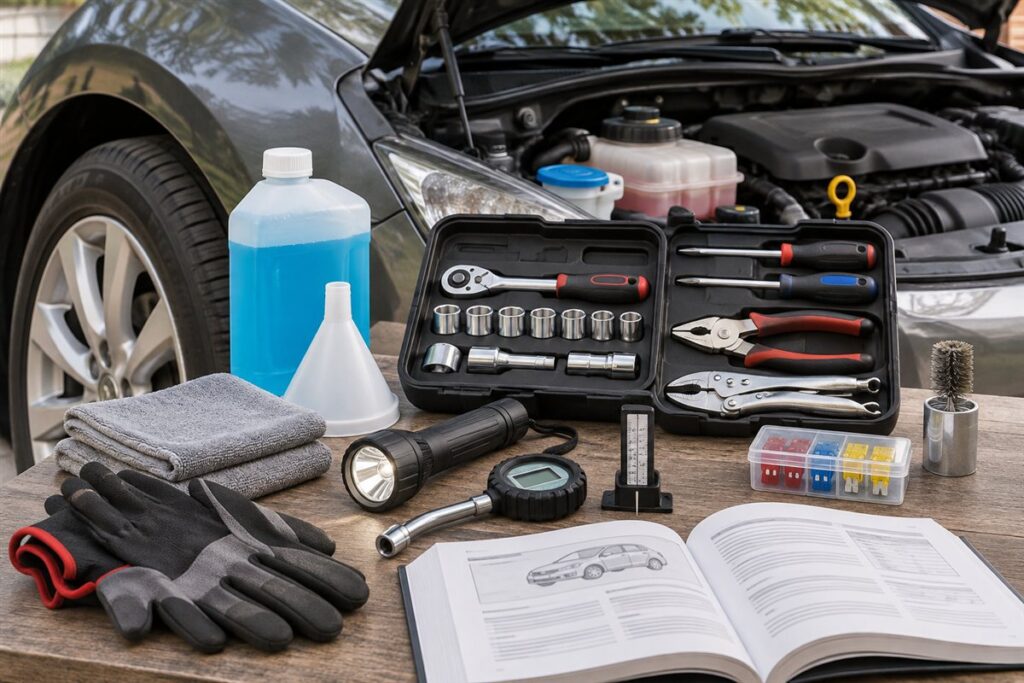
Basic car care needs only a short list of tools: a tyre pressure gauge, a torch, gloves, rags and a few hand tools. Your vehicle’s manual is the main reference for what you can do yourself, and a qualified mechanic should handle brakes, steering, fuel and electrical faults. This guide sets out the kit, the routine checks it supports, and the points where it is wiser to stop.
Checks You Can Do With Simple Items
Many routine checks need little more than your eyes and a clean cloth.
- A tyre pressure gauge and a small pump or access to an air line.
- A tread depth gauge, or the method your area recommends.
- A torch or headlamp for looking under the bonnet.
- Lint-free rags and paper towels for checking dipsticks.
- Washer fluid and a funnel.
Look up the correct tyre pressures and fluid types in the manual. Do not rely on memory or on the figure for another vehicle.
A Small Hand Tool Set
- Screwdrivers for trim and clips.
- A socket and ratchet set in the sizes your car uses.
- Pliers and a pair of locking pliers.
- A battery terminal brush, if the manual covers terminal care.
- A set of spare fuses, as listed by the vehicle maker.
Always follow the vehicle maker’s instructions, particularly for anything on the electrical system. Hybrid and electric vehicles have special high-voltage parts that should only be handled by trained professionals.
Working Habits
Park on level ground, apply the parking brake, and let the engine cool before opening hot components. Wear gloves and eye protection when handling fluids. Never work under a car supported only by a jack, and follow the jack and stand maker’s instructions. If a job requires lifting the vehicle and you are unsure, ask a qualified professional.
Used oil, coolant, filters and batteries are hazardous waste in many places. Follow local collection rules for each.
Simple Reference Table
| Task | Tool | Check in |
|---|---|---|
| Tyre pressure | Gauge | Manual or door placard |
| Fluid levels | Rag, torch | Manual |
| Bulb change | Screwdriver | Manual |
Worked Walkthrough: A Monthly Under-Bonnet Check
A short routine, done on the same day each month, is the most useful habit a car owner can build. Adapt it to your manual, which shows where each item sits.
- Park on level ground with the engine off and cool, apply the parking brake and open the bonnet. Support it as the manual describes.
- Use the torch to look for obvious damage, such as loose connectors, damp patches or chewed wiring. Note anything unusual for a mechanic instead of trying to fix it.
- Locate the oil dipstick as shown in the manual. Pull it out, wipe it with a clean rag, push it fully back in and pull it out again to read the level against the marks.
- Check the coolant and washer reservoirs by eye against their marked levels. Never open a hot coolant system, because it can be under pressure.
- Top up only with the fluid type the manual names, using the funnel, and wipe away any spills.
- Check each tyre pressure with the gauge when the tyres are cold, using the figures on the placard or in the manual, and include the spare if you carry one.
- Walk around the car and look at the lights, wipers and tyre sidewalls. Write the date and any notes in your log.
Common Scenarios
- A tyre pressure warning appears: check all four tyres with a gauge, inflate to the placard figure and look for nails or damage. If one tyre keeps losing air, have it inspected.
- A headlight bulb is out: the manual shows how to reach the holder and which bulb type to use. Some vehicles make this easy and others need a workshop, so follow the maker’s guidance.
- A fluid level looks low: top up with the specified fluid, then watch whether it falls again. A repeated drop suggests a leak that a qualified mechanic should find.
- A dead battery on a cold morning: the manual describes the correct way to connect jump leads, if your vehicle allows it, and some modern vehicles need special procedures. Roadside help is a fair option if you are unsure.
- Wipers smearing: clean the blades and windscreen with a damp rag before deciding to replace the blades.
Mistakes to Avoid
- Using the wrong fluid. Oils, coolants and washer fluids differ, and the wrong one can harm components. The manual names what your car needs.
- Checking tyre pressure after a long drive. Warm tyres give a higher reading, so measure them cold for a figure that matches the placard.
- Relying on a jack alone. Jacks can slip or fail, so use stands made for the job and follow their instructions.
- Overtightening bolts. Too much force can strip threads or crack parts. Look up the torque figure in the manual when one is given.
- Ignoring a warning light. Learn what each symbol means from the manual and act on it.
Quick Troubleshooting
| Symptom | Likely cause | What to try |
|---|---|---|
| Gauge reading seems to change each time | Poor seal on the valve or a faulty gauge | Press on firmly and square, and compare with a second gauge |
| Dipstick reads unclear | Oil smeared on the stick | Wipe it, reinsert fully and read it again |
| Fuse keeps blowing | An electrical fault | Stop replacing fuses and ask a qualified mechanic |
| Socket slips on a nut | Wrong size or a rounded fastener | Match the size carefully, or ask a garage if the fastener is damaged |
Care and Upkeep Over Time
Keep the hand tools in a lidded box so they stay dry, and wipe off oil and grime after use. Replace worn gauges, since a damaged one gives misleading numbers. Check the in-car kit twice a year, and rotate gloves, rags and any consumables. Keep a simple log in the glovebox or on your phone with dates of checks, tyre pressures and any fluids you topped up. It makes patterns easier to spot, such as a level that keeps dropping, which is a good reason to book a visit with a qualified mechanic.
Glossary
- Placard
- A label, often on the door frame, listing recommended tyre pressures.
- Dipstick
- A marked rod that shows the engine oil level.
- Tread depth
- How much pattern remains on a tyre; some areas set a minimum.
- Torque
- The tightening force on a fastener, given in the manual for some parts.
- Jack stand
- A support designed to hold a raised vehicle while a jack only lifts it.
- Terminal
- The metal post on a battery where cables attach.
FAQ
Can I change my own oil?
Some owners do, but it needs the right equipment, correct oil, support stands and a plan for used oil. If unsure, a garage can do it. Check the manual for the oil type and fill amount.
Which tools should I keep in the car?
Items the manual recommends, such as the jack, wheel brace and warning triangle, plus a torch and gloves. Check regularly that the jack and brace are present and in working order.
How often should I check tyre pressure?
Many makers suggest checking regularly and before long trips. Your manual gives the interval it recommends, and the pressure should be measured when the tyres are cold.
Do I need a torque wrench?
If you remove wheels or work on parts with set tightening values, a torque wrench helps you follow the manual. If you only do checks, it is not needed.
When should I stop and call a mechanic?
Call for brakes, steering, fuel, airbags, high-voltage parts or anything that repeats after you fix it. Warning lights you do not understand deserve the same caution.
The Short Version
Get a gauge, torch, rags and a basic hand tool set, and rely on the manual. Build a monthly check habit and keep a short log. Leave safety-critical or high-voltage work to qualified mechanics.