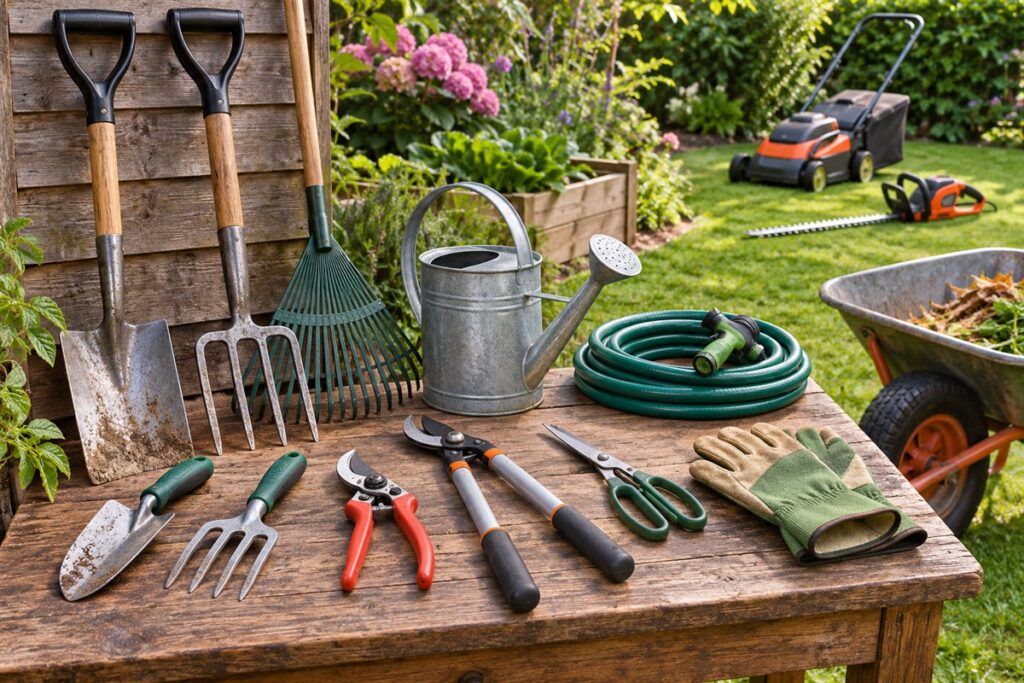
A beginner gardener can do most jobs with six or seven hand tools: a spade, a fork, a trowel, pruning shears, a rake, gloves and a watering can or hose. Choose tools that feel comfortable in your hands, and add power tools only if your garden is large enough to justify them. This guide covers what each tool does, a worked planting routine, and the care that keeps tools useful for years.
Digging and Planting
- A spade for edging beds and turning soil.
- A garden fork for loosening compacted ground.
- A hand trowel for planting small plants and bulbs.
- A hand fork for weeding between plants.
Look at handle length and grip. A tool that is too long or heavy for you will tire your back and wrists quickly. Try holding a few if you can before you commit.
Cutting and Tidying
- Pruning shears (secateurs) for stems and small branches.
- Long-handled loppers for thicker growth.
- Garden scissors or shears for soft growth and edges.
- A leaf rake and a stiff rake for soil and gravel.
- A wheelbarrow or sturdy bag for carrying waste.
Keep cutting tools clean and sharp, and wipe them after use to reduce the spread of plant disease. Follow the maker’s care instructions.
Power Tools in the Garden
Hedge trimmers, string trimmers and mowers can save effort, but they have moving parts and sharp blades. Read the maker’s manual, wear eye protection, ear protection and sturdy footwear, and keep children and pets away. For tree work, working at height or anything near overhead power lines, call a qualified professional. Follow local rules about noise hours and garden waste.
Match Tool to Task
| Task | Hand tool | Power option |
|---|---|---|
| Cutting grass | Shears | Mower or trimmer |
| Trimming hedges | Hand shears | Hedge trimmer |
| Clearing leaves | Rake | Blower |
Worked Walkthrough: Preparing a Small Bed and Planting
This routine suits a small flower or vegetable bed. Local soil and plant needs vary, so use it as a framework and follow the plant label for spacing and depth.
- Mark the outline of the bed with a string line or a hose laid on the ground, and adjust until the shape looks right from where you will see it most.
- Cut the edge with the spade, pushing it straight down along the line. Remove grass and weeds including their roots, and set them aside for your garden waste route.
- Push the garden fork into the ground and rock it gently to loosen the soil. Work in rows across the bed, taking care on wet soil, which can compact when walked on.
- Pull out stones and old roots by hand, wearing gloves, and break up large clumps with the back of the rake.
- Level the surface with the rake, pulling soil from high spots into low ones.
- Dig a hole with the trowel to the depth and width the plant label states, place the plant, firm the soil around it with your hands and water it well.
- Clean the tools before you put them away, and tidy the edges with shears.
Common Scenarios
- Overgrown shrubs: use secateurs for stems up to a hand-friendly thickness and loppers for thicker growth. Large branches or work at height should go to a qualified tree professional.
- Compacted lawn or hard soil: a garden fork helps loosen the ground. Do the work when the soil is damp but not waterlogged, as it is easier to dig.
- Autumn leaf clearing: a leaf rake and a sturdy bag are enough for a small yard. Check local rules for leaf disposal.
- A patio or balcony garden: a trowel, hand fork, small shears and a watering can cover most container work.
- Weeding between rows: a hand fork or hoe removes small weeds. Pull them before they set seed, and dispose of them following local waste rules.
Mistakes to Avoid
- Using a spade like a lever. Prying with the blade can bend or snap it. Use a fork or bar for stubborn roots.
- Digging when the soil is soaked. It clumps and compacts, which makes the ground harder for plants.
- Cutting with dull blades. A blunt edge crushes stems instead of cutting cleanly, and you need more force.
- Leaving tools out in the rain. Moisture rusts metal and weathers wooden handles.
- Working without gloves around thorns or soil. Scratches and splinters are easier to avoid than to treat. Ask a health professional about tetanus protection if you are unsure of your status.
Quick Troubleshooting
| Symptom | Likely cause | What to try |
|---|---|---|
| Shears crush stems | Dull or loose blades | Clean, sharpen as the maker describes and adjust the pivot bolt |
| Soil sticks to the spade | Wet, clay-heavy ground | Wait for drier conditions and wipe the blade clean |
| Wooden handle splinters | Age or weathering | Sand lightly and rub in a suitable oil, or replace the handle |
| Wrists ache after digging | Tool too heavy or long for you | Try a lighter tool, take breaks and change your grip |
Looking After Your Tools
Garden tools last longer with a little care. After use, knock off soil with a brush, rinse if needed and dry them before storage. A light wipe with an oily rag on metal parts can reduce rust, and wooden handles benefit from an occasional rub with a suitable oil, following the maker guidance. Sharpen cutting edges with a file or stone, always moving away from your body and wearing gloves.
At the end of the season, check handles for cracks and replace any that look weak. Store tools off the floor, in a dry shed or garage, with blades covered. Keep chemicals, fuel and cleaning products in their original containers and well away from children, and follow local rules for disposing of old fuel, oil and batteries.
Glossary
- Secateurs
- Hand-held pruning shears for cutting stems and small branches.
- Loppers
- Long-handled cutters for thicker growth.
- Hoe
- A long-handled tool with a flat blade for cutting weeds at the surface.
- Mulch
- A layer of material spread on soil to hold moisture and limit weeds.
- Compaction
- Soil packed so tightly that air and water move through it poorly.
- Pivot bolt
- The bolt that joins the two halves of shears and sets how tightly the blades meet.
FAQ
How should I store garden tools?
Clean off soil, dry them, and hang or stand them in a dry place. Store blades with guards if they come with them. Keep them away from children.
Do I need gloves?
They are a good idea for digging and pruning. Choose a snug pair that still lets you feel what you are holding. Thorny work may call for thicker gloves.
Which tool should I buy first?
That depends on your garden. For a small planting bed, a trowel, hand fork and shears are a sensible first set, and a spade follows once you dig larger areas.
Are power tools worth it for a small yard?
Often not at first. Hand tools are quiet, take little space and need no charging. Consider a power tool when repeated tasks, such as hedge cutting or lawn mowing, take too long by hand.
How do I clean tools between plants?
Wipe cutting blades with a clean cloth, and if you are working with diseased plants, follow guidance from a local gardening service or the tool maker on suitable cleaning products.
The Short Version
Begin with a spade, fork, trowel, shears and a rake. Keep them clean and sharp, add power tools only when needed, and use professionals for tree and height work. Choose tools that suit your hands and your space.