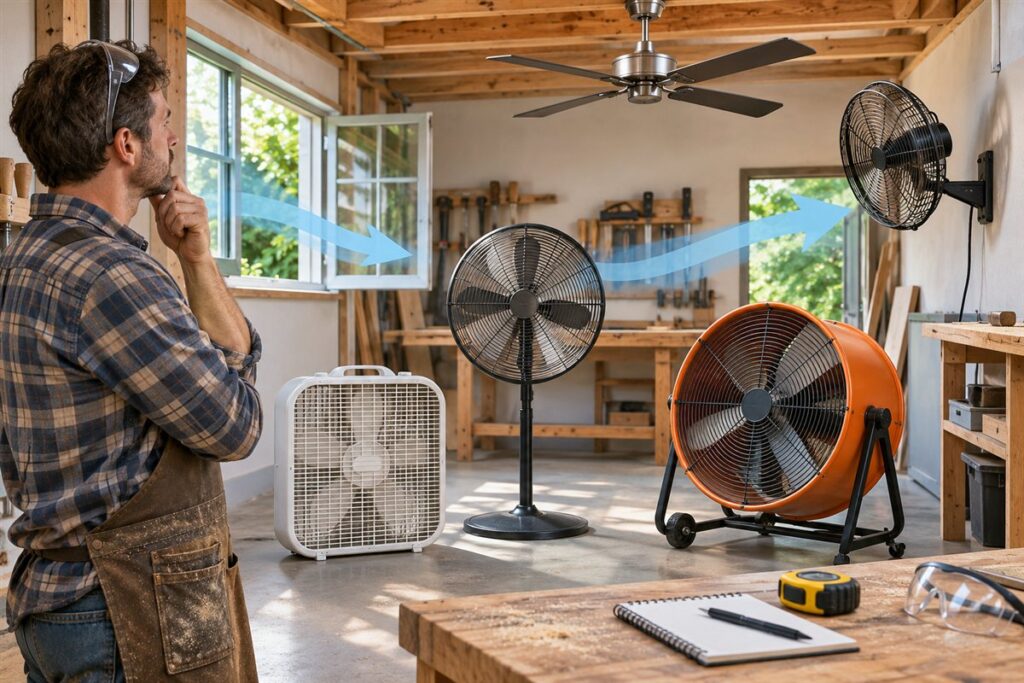
A workshop fan moves air so a hot or stuffy space feels more comfortable, and the right one depends on the size of the room, the dust in it and where you can place it. A fan is not a substitute for proper ventilation or fume extraction.
Fan Types for Workshops
- Box fans: light, simple and easy to store. They suit windows and small spaces.
- Pedestal fans: adjustable height and tilt, with sweeping motion that spreads air.
- Drum or barrel fans: sturdy, higher-volume fans for larger garages and shops.
- Wall-mounted fans: free up floor space, but they depend on wall fixing.
- Ceiling fans: move air across the whole room, with installation that may involve wiring and ladder work.
What Makes a Fan Suitable
Look for a sturdy guard, a stable base and a motor intended for the conditions. Workshops produce dust and sometimes damp, which can clog small fans. Some fans have totally enclosed motors or are designed for harsh environments; check the maker’s guide. Variable speeds let you reduce noise and avoid blowing papers and light materials about.
Planning Table
| Factor | Why it matters | What to check |
|---|---|---|
| Room size | Bigger rooms need more air movement | Airflow figure in the maker’s guide |
| Dust level | Dust can clog motors | Enclosed motor or cleaning access |
| Guard design | Protects fingers from blades | Narrow guard spacing |
| Noise | Loud fans tire you out | Speed settings |
| Placement | Position changes how air moves | Stable, level spot |
Placing and Using Your Fan
- Set the fan on a stable, level surface away from walkways.
- Keep cords out of the way and do not run them under rugs or through doorways where they can be damaged.
- Aim airflow so it does not push sawdust or fumes toward you.
- Keep the fan away from finishing work, since moving air can carry dust onto wet surfaces.
- Unplug it before cleaning the guard and blades.
Never use a fan to push flammable vapors around, and do not run one in a space where solvents or fuels are in use unless the maker designed it for that. Fume-producing jobs need proper ventilation as described by the product label and local rules. Ceiling or wall fan installation involves wiring and working at height, so use a qualified electrician.
Clean the guard and blades every so often, because dust coats them and cuts airflow. A quick wipe with the plug removed keeps the fan quieter and helps the motor run cooler.
Reading Airflow and Speed Claims
Fan listings often include a figure for air movement, commonly in cubic feet per minute or cubic metres per hour. This number tells you roughly how much air the fan moves at its top setting, and it is a better guide than blade diameter alone. A larger fan is not automatically stronger, since motor design, blade shape and speed all play a part. When you compare two fans, look for the same unit and the same measurement conditions, and treat very large claims with caution if the listing does not say how they were measured.
Speed settings matter in practice. A fan with several settings lets you choose a gentle breeze for light work or a strong flow when the shop heats up. A single-speed fan can be too much for light tasks, such as finishing, and too little for a hot day. Variable speed is useful but check how smoothly it adjusts, as some controls produce humming at low settings.
Match the airflow to your space. A small single-bay garage does not need the same fan as a large multi-bay shop. Consider the ceiling height too. A fan that works well in a low room may feel weak in a tall one. If you want to move air through a space, place one fan to push air in and another to pull it out, which tends to work better than a single fan fighting stale air.
- Check the listing for the airflow figure and the settings at which it was measured.
- Think about the sort of work: sanding, welding and finishing each affect where you want air to go.
Guards, Cords, Switches and Power Safety
A workshop fan runs in a place with dust, debris and moving people, so the safety features deserve close attention. Check the guard first. The wires or slots should be close enough to prevent fingers, cords and offcuts from reaching the blades. A guard that is firmly clipped or bolted on is better than one that rattles or opens easily. Look for a stable base that resists tipping, particularly if the fan will be used near walkways or children.
Examine the cord and plug. A short cord invites extension cord use, which adds a risk if the cord is too thin or too long. Read the manual for guidance on extension cords, and use one rated for the fan’s power draw if needed. Route cords where they cannot be tripped over, crushed under a door or pinched under equipment. Do not run cords under rugs. If the cord or plug becomes hot, frayed or damaged, stop using the fan.
Switches should be easy to reach and firm in action. A switch buried in dust is more likely to fail. Consider whether the fan has a tilt-over protection or other safety features, and what the manual says about continuous running.
- Never operate a fan with a damaged guard or loose blades.
- Unplug before cleaning, moving or adjusting.
- Keep the fan away from water and wet floors unless it is made for damp locations.
Placement for Cross-Ventilation and Heat
Where you put a fan can matter more than which fan you buy. In a hot shop, the aim is usually to bring in cooler outside air and push hot air out. Place one fan in a window or open door facing outward to exhaust warm air, and open another opening elsewhere so fresh air can flow in. This creates a path across the room. Placing a fan in the middle of a closed room just stirs the same warm air around, which can feel cooler on skin but does not lower the temperature.
For dust-producing tasks, think about where the dust goes. Position yourself so the airflow carries dust away from you, not past your face. Do not place a fan in a way that blows dust across a clean or freshly finished surface. When finishing, turn fans off or direct them away until the surface has set, as the maker of the finish advises.
Fans can help with fume dilution in some conditions, but they are not a substitute for proper ventilation, extraction or respiratory protection. If you work with solvents, fuels, welding or strong chemicals, read the labels and follow safety guidance. Never use a standard fan where flammable vapours may be present, since the motor can create sparks.
- Try different positions and check how the air feels at your bench.
- Keep paths clear so airflow can move across the room.
- Reconsider placement when doors or windows are opened or closed.
Noise, Vibration and Day-Long Comfort
A fan you can stand to have on for hours will be used more than one that drones. Noise comes from the motor, the blade design and any rattling parts. A well-balanced fan with a firm base generally hums more quietly than a light one that vibrates on its stand. Larger blades turning slowly often produce a lower, less irritating sound than small blades spinning fast, though this varies. Listen to a fan at several speeds if you can before buying.
Vibration can loosen fasteners and shift the fan across the floor over time. Check that the base is stable and that rubber feet or pads are fitted, and consider placing the fan on a mat to reduce noise on a hard floor. A fan on a wall bracket transmits vibration to the wall, so check the mounting and use fasteners suited to the wall type.
Comfort also depends on how the airflow feels. A direct blast on one spot becomes tiring, while a gentle sweep or oscillation spreads air more evenly. Oscillation is useful when you move around the shop, but the oscillating mechanism is a part that can wear out. Think too about cold-weather use: moving air makes you feel cooler, so in winter you may prefer to use the fan only at low speed or turn it off.
- Check how adjustable the head and height are.
- Look for easy-to-clean guards, since cleaning will be a regular task.
Cleaning, Wear and Replacement Signs
Dust coats fan blades and guards quickly in a workshop, which reduces airflow and adds load to the motor. Unplug the fan and wipe the blades and guard with a damp cloth, taking care not to let water enter the motor. If the guard comes apart, follow the manual to remove it, clean both sides of the blades and reassemble it securely. A vacuum with a brush attachment helps with the vents. Avoid compressed air if it pushes fine dust into the motor housing, and follow the maker’s advice.
Look at the fan during cleaning. Check that the blades are not cracked, bent or loose on the shaft. Inspect the guard for dents and check the stand or base for loose bolts. Check the cord along its length and at both ends, and replace the fan if the insulation is damaged.
Signs it is time to replace the fan include grinding, squealing or clicking noises, a burning smell, blades that wobble, a motor that is hot to the touch or stops intermittently, a damaged cord, and a switch that does not work reliably. A fan that has been exposed to fire, water or heavy impact should be retired. Fans are inexpensive compared with the risk of an electrical fault in a dusty room, so replace rather than repair when in doubt.
Store a seasonal fan clean and dry, covered to keep dust out, in a place where the cord is not under strain. Check it again before the next hot season.
FAQ
Does a fan clear dust from the air?
No. A fan moves air, and may stir dust up. Use dust collection and a proper filter for dust control.
Can I leave a fan running all day?
Follow the manual. Many fans are not meant for continuous use, and dust buildup can affect them.
Should I use a fan while sanding or cutting?
Be careful. A fan can stir fine dust and blow it around the shop. It can help if it moves dust away from you toward an open exit, but it is not a replacement for dust collection and a mask.
Can a fan cool a workshop?
A fan moves air and can make you feel cooler, but it does not lower the room temperature by itself. Used with open windows or doors for cross-ventilation, it can help replace hot air with cooler air.
Do I need a special fan for a dusty shop?
Look for a fan with accessible cleaning and a motor design suited to the conditions, as described in the manual. Regular cleaning is important in any case. Ask the maker if you are unsure.
Is a wall-mounted fan safer than a floor fan?
It keeps the floor clear and avoids tipping, but it depends on secure mounting. A floor fan is flexible but takes up space and has a cord on the floor. Choose based on layout and the quality of the mounting.
How high should a fan be placed?
Position it so the airflow reaches where you work without hitting you straight on all day. A height near chest level is common for a pedestal fan, but adjust to the job. Keep it away from the work surface to avoid blowing dust onto it.
Can I use an outdoor extension cord with a fan?
If an extension is needed, use one rated for the load and the conditions, as the fan manual advises. Keep the run as short as practical, and do not coil a cord while it is in use.
How often should I clean the fan?
In a dusty shop, a quick wipe every few weeks is common, with a deeper clean each season. Clean sooner if airflow drops or you can see dust building up on the blades.
The Short Version
Choose a fan by room size, durability and placement, and treat it as a comfort aid only. Use proper ventilation and a qualified electrician for anything fixed.