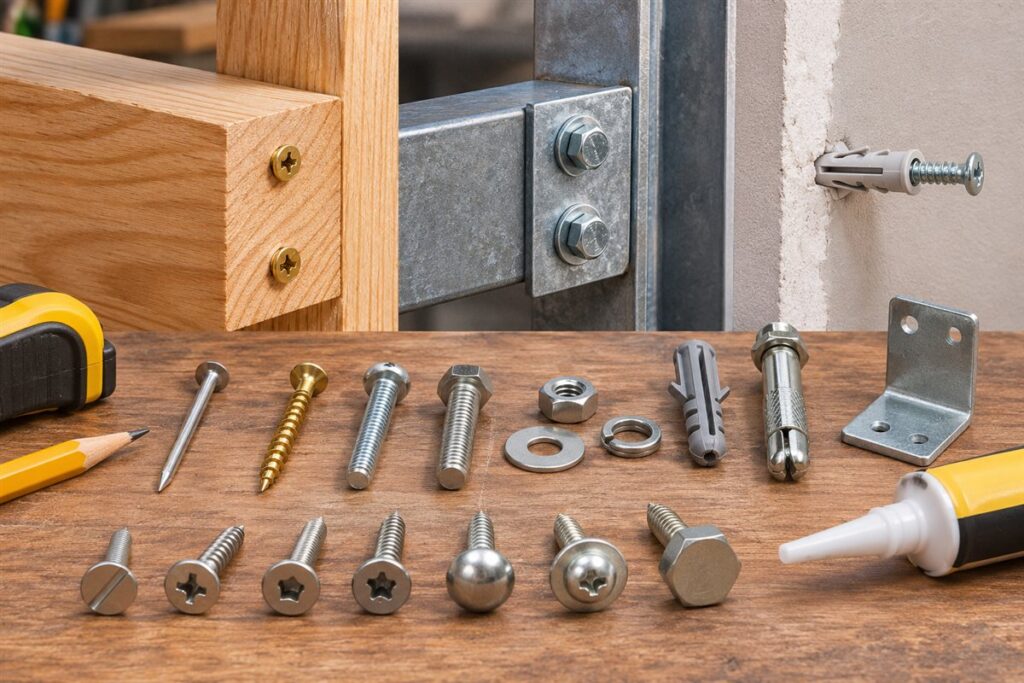
The right fastener depends on the materials you join, the load it will carry, its length and the environment it will sit in. Match the fastener type to those four things, follow the maker’s guidance, and ask a qualified professional about anything structural.
The Main Fastener Families
- Nails: quick for light timber work, but they hold in one direction and can loosen.
- Wood screws: grip well and can be removed, useful for furniture and framing.
- Machine screws and bolts: used with nuts or threaded holes in metal and thick timber.
- Wall plugs and anchors: spread the load in masonry or plasterboard.
- Adhesives and brackets: often used alongside mechanical fasteners.
Decision Criteria
| Factor | Why it matters | What to check |
|---|---|---|
| Materials joined | Wood, metal and masonry need different threads and anchors | Packaging and maker’s guide |
| Load | Heavier loads need stronger fixings | Maker’s stated limits and wall type |
| Length | Too short holds poorly, too long can break through | Penetration into the second piece |
| Diameter | Thicker fasteners hold more but may split timber | Pilot hole size |
| Environment | Damp and outdoor use cause corrosion | Coating or material suited to outdoors |
| Head and drive type | Affects looks and tool fit | Matching bit |
Sizing and Drilling
- Choose a fastener long enough to go through the first piece and bite well into the second, as the maker advises.
- Drill a pilot hole when working near edges or in hard timber, to limit splitting.
- Use a clearance hole in the top piece so the screw pulls the pieces together.
- Match the driver bit exactly to the head, and keep the tool straight.
- Stop tightening when the pieces are snug. Overtightening can strip threads or crush material.
Walls and Hidden Services
Know your wall type before choosing an anchor, and look for hidden pipes and cables before drilling. If you are unsure about the wall, the load, or anything that carries people, such as railings or shelving above a bed, ask a qualified professional. Never rely on a single fastener for a load whose failure could cause harm, and follow local building rules.
When in doubt, read the packaging. Most fasteners list suitable materials, sizes and sometimes recommended uses, and the maker guide often shows pilot hole sizes. Keep leftover fasteners in labelled containers so you can match them next time, and avoid mixing different types in one box, because it makes later repairs harder.
Head Styles and Drive Types
The head decides how a fastener sits and how you turn it. A flat or countersunk head fits into a recess so that it ends flush with the surface, which suits cabinets, decking and trim. A pan or round head sits proud and gives a wide bearing surface, which suits sheet metal and brackets. A truss or washer head spreads load over a wider area, useful for thin or soft material. A hex head is turned with a socket or wrench and can take high torque, which is why it is common for structural and mechanical work.
The drive is the recess or shape that accepts the tool. Slotted heads are simple but easily slip. Phillips-type heads are common but can cam out under load, which damages the head. Square and star-shaped recesses grip the bit more positively and are easier to drive without slipping. Whatever the drive, choose a bit that matches exactly. A worn or wrong-size bit strips the recess and makes the screw hard to remove later.
- Visible finish work: choose a head that sits flush and a drive that resists slipping.
- Thin sheet material: a wide head spreads the clamping force.
- Repeated removal: a positive drive avoids stripped heads.
Keep a few driver bits in the sizes you use most and replace them when the tips round off. Using the right bit and pressing firmly while turning slowly prevents most stripped heads.
Materials, Coatings and Corrosion
Fasteners fail in damp conditions more often from corrosion than from loads. Plain steel is strong and inexpensive but rusts quickly outdoors or in damp rooms. Zinc plating gives some protection for indoor and sheltered use. Hot-dip galvanizing gives a thicker coat and is a common choice outdoors, though the coating can be damaged when driving. Stainless steel resists corrosion well and suits wet environments, coastal areas and treated lumber if the maker confirms compatibility, but it is typically softer than hardened steel and can strip or snap if overdriven. Brass and bronze resist corrosion and look attractive on furniture and marine fittings, but they are softer.
Mixing metals can cause trouble. When two different metals touch in the presence of moisture, one can corrode faster than the other. Check the maker’s guidance for the combination you plan to use, such as fasteners with treated timber or aluminum. Some treatments in timber attack certain coatings, so use fasteners the timber maker names as compatible.
Consider the appearance too. Rust streaks can stain pale wood, stone and cladding. For exterior projects, choose fasteners rated for outdoor use, and check the packaging for the intended exposure. For indoor dry work, simpler coatings are usually enough.
- Inspect coatings on the pack and avoid fasteners with flaking plating.
- Do not reuse badly rusted fasteners in structural positions.
Washers, Nuts and Preventing Loosening
A bolted joint is more than a bolt. A flat washer spreads the load under the head or nut, preventing it from digging into soft materials such as wood or thin metal. Oversize washers are used in timber to stop the head pulling through. Spring washers and toothed washers resist loosening under vibration, though their effectiveness varies, and the maker of the equipment may recommend something specific. Lock nuts with a nylon insert or a deformed thread grip the bolt and resist turning. Castle nuts and split pins serve in places where a failure would matter.
Threaded joints in vibrating machinery, such as lawn equipment or vehicles, can loosen over time. Thread-locking compounds are applied to the threads in a thin layer and come in strengths intended for removable or permanent joints. Read the label to choose the right grade and follow cure times. For safety-critical joints, such as brakes or steering, follow the vehicle maker’s instructions and ask a qualified professional.
Tighten correctly. Under-tightening leaves the joint loose, while over-tightening stretches the bolt or crushes material. Where the maker gives a torque figure, use a torque wrench set to it. Otherwise, tighten until snug and add a small final turn as the manual suggests.
- Match the nut thread to the bolt exactly in size and pitch.
- Use a washer under the part that turns.
- Check bolts after the first period of use for loosening.
Thread Types and Choosing the Hole
Threads are shaped for the material they enter. Wood screws have a coarse thread and often a smooth shank, which pulls the pieces together. Coarse threads also work well in softwood and particleboard. Fine threads are used in metal and hardwood where the hole is tapped or pre-drilled. Self-tapping screws cut their own thread into thin metal or plastic, and self-drilling versions also drill their own pilot. Machine screws and bolts have uniform threads and need a nut or a tapped hole. Always match the thread to the hole or nut in size and pitch, since a mismatch can strip the threads.
The hole you drill matters as much as the fastener. A pilot hole that is too small can split wood or snap the screw, while one that is too large gives a weak hold. Packaging or the maker’s chart usually lists a suitable drill size for each fastener and material. In hardwood, the pilot hole is usually larger than in softwood. Test on a scrap piece of the same material to refine the size.
When driving screws into engineered boards, such as particleboard or MDF, take care near edges, because these materials can crumble or split. Special screws are made for them. For plasterboard, use fasteners made for it and do not overdrive, as the paper face can tear and lose hold. When in doubt, read the packaging and follow the material maker’s instructions.
Storage, Removal and Replacement
Keeping an assortment of fasteners helps, but a jumble of mixed screws wastes time. Store them by type and size in small bins with lids or in a divided organizer, and label each compartment. Keep outdoor-rated fasteners separate from indoor ones so you do not mix them by accident. Store them in a dry place, since damp can rust even coated products. A few silica gel packs in an enclosed box help in humid spaces.
Take care when removing fasteners. Use a bit that fits exactly, press firmly and turn slowly. If a head is stripped, a rubber band or a piece of wide elastic placed between the bit and the head can add grip. Screw extractors are made for damaged heads, and following the maker’s directions matters. Penetrating oil can help with rusted bolts, but allow time for it to work and follow safety guidance on flammability and ventilation.
Know when to replace fasteners rather than reuse them. Replace any that are bent, rusted, stripped, corroded or have damaged threads. Self-locking nuts and some specialized fasteners are designed for single use, and the maker’s instructions will say so. When repairing something that has failed, ask why it failed: the load may have exceeded the fastener, the fastener may have corroded or the joint may have been poorly designed. Fixing the cause avoids repeated failures. For structural, load-bearing or safety-related work, ask a qualified professional to check the choice and installation.
FAQ
Can I use any screw outdoors?
No. Choose fasteners made for outdoor use, and check the maker’s guide for compatible timber treatments.
Are nails or screws better?
Screws hold better and can be removed. Nails are fast for light work. Choose by the job.
What is the difference between a screw and a bolt?
A screw threads into the material it fastens, either into a pre-made hole or by cutting its own thread. A bolt passes through a clear hole and is secured with a nut. The terms overlap in everyday use, so check the packaging.
Do I always need a pilot hole?
Not always. In soft material away from edges, many screws drive fine without one. In hardwood, near edges or with long screws, a pilot hole helps prevent splitting and snapped screws. Test on scrap.
Can I mix metric and imperial fasteners?
Not for threaded fasteners that must engage each other, since their threads differ. Check the size markings on the bolt and nut or tapped hole. Forcing a mismatched thread damages both.
What length screw should I use?
It should go through the first piece and bite well into the second, as the maker's guidance suggests. Too long a screw can break through the back, and too short gives a weak hold. Check the thickness of both pieces.
Why do screws keep stripping?
Causes include the wrong bit size, a worn bit, too much speed or pressure that is not in line with the screw. Match the bit, press firmly and use a slower speed. Use a drive type that grips better if the problem persists.
Are drywall screws suitable for woodwork?
They are designed for fastening plasterboard and can be brittle, so they may snap under side loads. For structural wood joints, use screws labeled for wood or structural use.
How do I fasten into a hollow wall?
Use an anchor made for hollow walls, rated for the load, and follow its instructions for the hole size and installation. Heavy items should be fixed into solid structure. If unsure, ask a qualified professional.
The Short Version
Match fastener type to material, load, length and environment, and drill pilot holes where needed. For heavy, overhead or structural loads, follow the maker’s guide and ask a qualified professional.