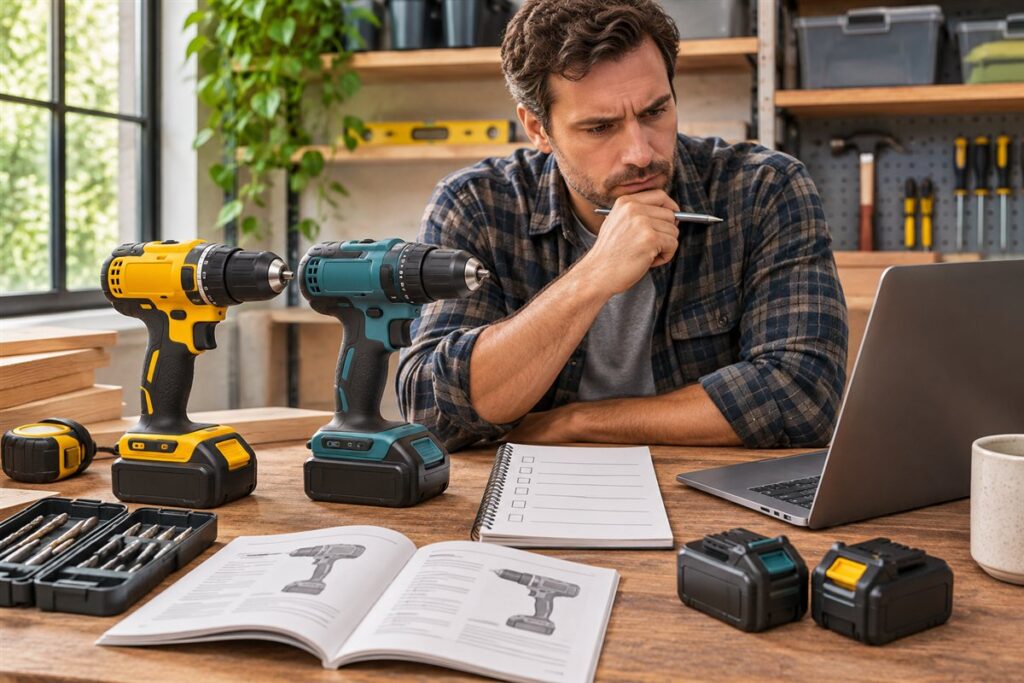
To compare tool brands fairly, decide what you need first, compare similar tools side by side on the same points, and look at what surrounds the tool, such as batteries, service and parts. Loyalty and marketing language are poor guides.
Define the Job Before the Name
Write down what you will actually do: occasional home repairs, regular building projects or daily trade work. Needs differ, and a tool built for heavy daily use may be more than a weekend user requires. Without a clear job, every comparison drifts toward whichever name sounds familiar.
Compare Like With Like
- Choose the tool category and size, such as a mid-size cordless drill.
- Put the makers’ published details side by side from their own guides.
- Compare the same points for each: power source, weight, speed ranges, included accessories and what the manual says about intended use.
- Note what is missing from one guide that another gives, and ask the maker if it matters.
- Hold the tools in a shop if you can, to compare balance and grip.
Look Beyond the Tool Itself
- Battery platform: whether one pack fits many tools in the range, and whether the range includes the tools you want later.
- Service and parts: whether brushes, chucks, blades and guards can be replaced, and who does repairs.
- Manual quality: clear instructions are a sign of a maker who expects users to read them.
- Local support: nearby service centers or clear contact details.
- Maker coverage terms: read what they actually say rather than relying on slogans.
A Fair Comparison Grid
| Factor | Why it matters | What to check |
|---|---|---|
| Fit for your work | Over- or under-sized tools frustrate | Your own job list |
| Ergonomics | Comfort affects control | Weight and grip in your hand |
| Battery system | Shared packs cut clutter | Range of tools using the same pack |
| Serviceability | Repairs extend life | Parts and service access |
| Documentation | Good manuals help safe use | Clarity of the maker’s guide |
Traps to Avoid
Be wary of single-number claims, since figures can be measured in different ways. Take online opinions as personal experiences, not facts about every tool. Avoid assuming one maker is best at everything, because most have strong and weak areas. If a tool will do electrical, structural or height work, rely on the manual and a qualified professional, not on a name.
Reading Specifications Critically
Spec sheets are useful, but they are written to be compared carefully, not skimmed. Start by checking that you are comparing the same measure. Power may be quoted in volts, watts, amps or torque, and the figures are not interchangeable. A voltage figure on a battery tool, for example, describes the battery system and not how much work the tool does. Torque, speed and impact rates should be viewed together, since a tool strong in one area might be weaker in another. A single impressive figure rarely tells the whole story.
Check the conditions behind a claim. Runtime figures depend on battery size, load and the task. Speed figures usually describe running with no load, which differs from real use. If a listing gives a number without explaining how it was measured, treat it with caution and look for a basis you can compare. If two makers do not measure in the same way, a direct comparison may not be possible.
Look for what is missing. A spec sheet that omits weight, cord length, included accessories or warranty terms may be hiding a weak point or may simply be brief. Ask questions or check the manual, which often has more detail than the product page. Pay attention to the language. Words such as professional grade or heavy duty have no fixed meaning and are not a substitute for stated figures. Note down what each source says, and write the same fields for each tool so gaps stand out.
- Convert units to the same system before comparing.
- Compare weight with and without battery.
- Check whether included items such as a case or charger are part of the price comparison.
Judging Reviews and Opinions
Reviews can help, but only if you read them with care. Individual reviewers use tools for different jobs and with different expectations, so a complaint about a tool used beyond its intended purpose may not apply to you. Look for patterns, not single comments. If many reviewers mention the same fault or the same strength, that carries more weight than a one-off report. Pay attention to reviews that describe the work performed and the length of use, since those give context.
Be aware of the limits of ratings. A high average may reflect a small number of reviewers, or may hide a split between happy and unhappy users. Check the distribution if it is shown. Reviews written right after purchase cannot tell you about durability, while later ones can. Be careful about reviews that read as promotional, repeat the same phrases or praise without any detail. Equally, a few angry comments should not outweigh a broad record of satisfied use, but they do deserve a check against the manual.
Forums and community groups can offer practical advice, such as how to fit accessories, which parts wear out and how to service the tool. Treat them as anecdotes rather than data, and note when people have tied their choice to a single brand. Loyalty is not a bad thing, but it can color judgment. Ask yourself what the person was doing with the tool, and whether your use is similar. Combine multiple sources, and weigh them against your own requirements.
- Look for reviews from people who do similar work.
- Note recurring complaints and check whether the maker responds to them.
Cost of Ownership Over Time
The price on the tag is only the start. Over several years, you will spend on batteries, chargers, blades, bits, filters, belts and repairs. A tool that costs less at first but needs frequent replacement of expensive parts can be less economical than a more costly tool with longer-lasting components. On the other hand, paying more does not guarantee lower running costs. Estimate what you will need to buy over the tool’s life.
Batteries are often the largest recurring cost for cordless tools. Check how many tools in the range use the same battery, whether replacement batteries are available in different capacities and how the maker describes battery care. If you already own tools from one platform, adding another platform means a second set of batteries and chargers. Consider whether the range offers the other tools you may need later, so you can share batteries.
Consumables matter too. Check whether blades, discs and accessories are common sizes available from different makers, or whether you are locked into a particular type. Consider the cost and availability of replacement parts, such as brushes, switches, guards and cords. Ask whether the maker offers repair services and how long parts are generally supplied. These details are usually in the manual or on the support pages.
- Add up the likely extra purchases for the first few years.
- Compare the tool and battery separately to see where the money goes.
Warranty, Service and Support
Warranty terms differ widely, and the headline period seldom tells the full story. Read what the warranty covers and excludes. Some cover manufacturing defects only, while others include certain wear parts, batteries or labor. Check whether registration is required, whether the warranty applies to professional or commercial use and what proof of purchase is needed. A long warranty with many exclusions may be less valuable than a shorter one with clear terms.
Service access is as important as the written terms. Find out where repairs are handled, how you would send the tool in and how long the process usually takes. A nearby service center can save time, but a mail-in process may be fine if it is well run. Check whether the maker provides parts diagrams, manuals and contact details online. If you rely on a tool for income, consider how long you could be without it and whether a loan or replacement is offered.
Support can be assessed before buying. Look at the maker’s website to see whether manuals are available, whether parts are listed and whether questions are answered. Send a pre-purchase question and see how quickly and clearly you get a response. Local suppliers may also provide advice and repairs. Keep your receipts, manuals and serial numbers, as these are generally needed for any claim.
- Read the exact wording of the warranty before relying on it.
- Ask whether batteries and chargers are covered the same way as the tool.
Trying Before Committing
The best comparison is often hands-on. Visit a store to hold similar tools side by side, if possible. Check the balance, weight, grip and switch position. Operate controls, change a bit or blade, insert and remove a battery and look at how the guard or depth settings adjust. Tools that feel awkward in the shop will probably feel worse after an hour of use. Bring work gloves if you wear them, since they change the feel of grips and triggers.
If you cannot try tools, rely on return policies. Check how long you have to return an item, what condition it must be in and whether any restocking charges apply. Test a new tool soon after purchase on a few typical tasks, so problems show up while returns are still possible. Note anything that bothers you, and compare it with what you expected.
Consider starting small. Buy one tool or a bare tool to try the platform before building a collection. Borrowing from a friend or renting a tool can reveal how a brand’s ergonomics, controls and quality suit you. Many makers publish manuals online so you can read the setup, maintenance and safety instructions before you buy. If a manual is confusing or incomplete, that tells you something about the product.
Finally, accept that no brand is best at everything. Mixing makers for specific tasks is a reasonable choice, provided you accept separate batteries or chargers. Make a short list based on your needs, test the finalists and choose the one that fits your work, budget and support expectations.
FAQ
Should I stay with one brand?
It can simplify battery and charger sharing, but it is not required. Mixing makers is fine if you accept extra packs and chargers.
Is a bigger name always better?
Not automatically. Judge each tool on how well it suits your work and how well it is supported.
Are professional-line tools always better for home use?
Not always. Professional-line tools are often built for heavy daily use, which can mean more weight and cost than a home user needs. Match the tool to how often and how hard you will use it.
How do I compare battery tools from different makers?
Compare voltage class, battery capacity, charger type, weight and the range of tools that share the battery. Remember that voltage alone does not tell you how well a tool performs. Check the maker's guide for details.
Should I buy a kit or a bare tool?
A kit includes the battery and charger, which suits a first purchase. A bare tool makes sense when you already own compatible batteries. Check that the battery fits before buying.
Does a longer warranty mean a better tool?
Not necessarily. It shows what the maker is willing to cover, but terms and exclusions vary. Read the details, including what is excluded and what you must do to make a claim.
Is it worth paying for a well-known name?
Sometimes the name reflects good support and broad accessory availability, but it is not a guarantee. Judge the specific tool and the maker's service rather than the name alone.
How do I check parts availability?
Look at the maker's website or manual for parts lists and diagrams, or ask the maker or a local service center. Common wear parts, such as brushes and guards, should be easy to identify.
What if two brands seem equal?
Choose on the details that matter to you, such as comfort, existing batteries, service access and the clarity of the manual. A trial in a store or a good return policy can settle a close decision.
The Short Version
Define your needs, compare equal tools on the same points and weigh batteries, service and manuals. Decide on fit and support rather than on the name.