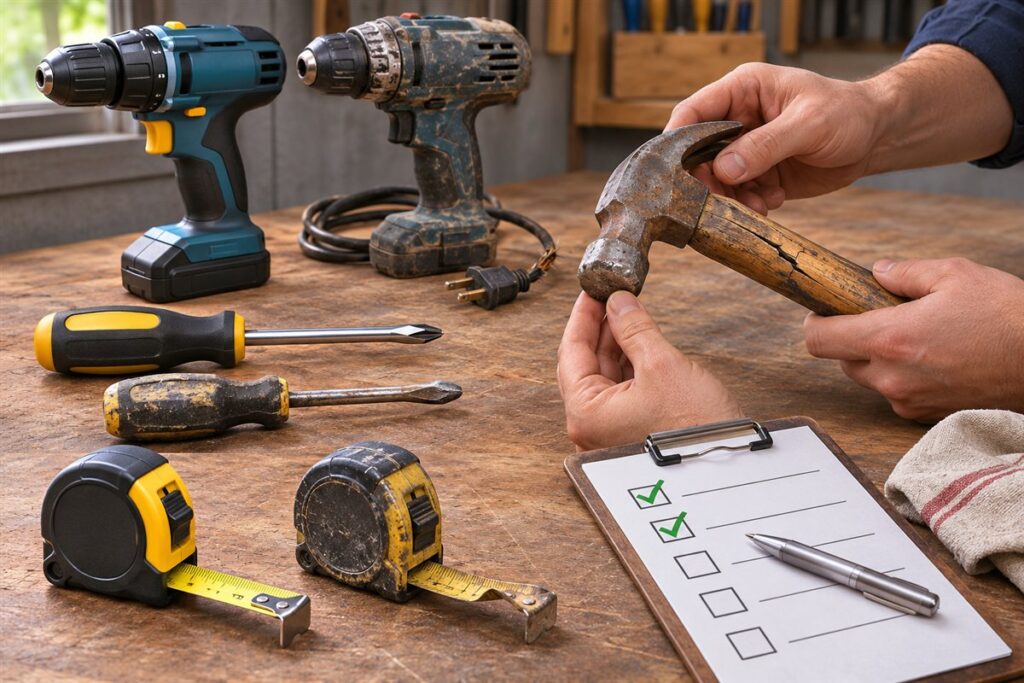
A worn-out tool usually shows signs: it works harder than before, behaves oddly or looks damaged. Check tools regularly for these clues, and retire anything you do not trust.
Signs in Hand Tools
- Loose or cracked handles, or heads that wobble.
- Chipped, mushroomed or rounded striking and cutting surfaces.
- Bent shafts, twisted blades or jaws that no longer meet squarely.
- Worn tips on screwdrivers that slip out of the screw head.
- Heavy rust, pitting or stiff moving parts.
A hammer with a damaged head or an unsound handle can fail in use, and a screwdriver with a rounded tip can slip and damage both the screw and your hand. Replace such tools rather than hoping they last.
Signs in Power Tools
- Sparks, a burning smell, smoke or unusual heat that is not normal for that tool.
- New grinding, squealing or rattling noises.
- Switches that stick, trigger problems or random stops.
- Damaged or frayed cords, loose plugs or cracked housings.
- Guards that no longer move or fit properly.
- Reduced power or runtime that persists after the blade or battery is changed.
If a power tool sparks, smokes or smells hot, stop using it, disconnect the power and consult the manual or a qualified service center.
A Quick Inspection Routine
- Disconnect the power or remove the battery.
- Look over the whole tool in good light, including cord, plug, housing and guard.
- Test moving parts by hand, listening for roughness or play.
- Check cutting edges, bits and accessories for wear.
- Decide whether to clean, adjust, repair, replace or retire it.
Repair or Replace
| Finding | Common response | Note |
|---|---|---|
| Dull blade or bit | Replace or sharpen | Often the simplest fix |
| Loose handle | Replace the handle or tool | Follow the maker’s guidance |
| Frayed cord | Stop use; qualified repair | Do not tape and continue |
| Cracked housing | Retire or have it assessed | Internal parts may be exposed |
| Worn battery | Replace per the maker | Recycle by local rules |
Keep notes on anything that seems different, even if small. A tool that feels slightly rougher this month may be much worse next season. A brief note in a maintenance log, with the date, helps you decide when to act and gives a qualified service center useful information.
Also pay attention to accessories. Worn bits, dull blades and stretched belts can make a good tool seem faulty, so change the accessory first before deciding that the tool itself is at fault.
Cutting Tools and Edges
Edges wear gradually, which makes dullness easy to miss until a job becomes hard work. Chisels, plane irons, knives and saw teeth all cut by concentrating force along a thin line. As that line rounds over, more pressure is needed, and more pressure means less control. The tool slips, tears the surface or follows the grain instead of your line.
Look for clues. A sharp chisel leaves a clean, shiny cut, while a dull one crushes fibres and leaves a fuzzy surface. A dull knife drags instead of slicing, and a dull handsaw wanders and needs shoving. A bright, reflective line along an edge under good light often means the edge is rounded. Run a fingertip across the edge, never along it, to detect rounding or nicks, and be careful when doing so.
Chips and bent teeth need attention as well. A chipped plane iron leaves ridges in every pass, and a saw with missing teeth cuts unevenly. Many edges can be restored by honing or sharpening with the right equipment, and a sharpening service can handle saws and blades that are awkward to do at home. If the metal is cracked, badly pitted or has lost its hardness so it dulls within minutes, replacing the tool is wiser than repeated repair.
Measuring and Marking Tools That Drift
Measuring tools can wear out in less obvious ways. A tape measure with a bent or loose hook may read short or long, and a damaged blade can make every measurement doubtful. Squares can be knocked out of true, and levels can lose their accuracy if dropped. Because errors in measurement carry through to the finished work, it is worth testing these tools from time to time.
- Tape measures: check the hook moves freely and compare two tapes against each other. Look for kinks, faded markings and a blade that no longer retracts smoothly.
- Squares: draw a line along the edge against a straight board, flip the square and draw again. If the lines do not coincide, the square is out of true.
- Levels: place the level on a flat surface, note the bubble, then turn it end for end. The reading should be the same. Cracked vials or loose housings are also warning signs.
- Straightedges and rules: sight along the edge and check for bends or nicks.
Some squares and levels can be adjusted by following the maker’s guide, but others cannot. If a measuring tool cannot be trusted and cannot be corrected, replace it. Keep one reliable reference tool at home to compare others against, and handle all of them gently, since a drop or knock is the most common cause of error.
Clamping and Gripping Tools That Lose Their Hold
Clamps, vises, pliers and wrenches work by holding parts firmly, and wear shows up as slipping, play or reduced grip. A wrench with worn jaws can round off a nut, and pliers with loose pivots can twist the work instead of holding it. Clamps with bent bars, stripped screws or damaged pads may not apply even pressure, which spoils glue-ups and risks the work slipping loose.
Check the moving parts. Open and close each tool and feel for rough spots or sideways wobble. Look at jaw faces for rounding, chips or polished areas where teeth have worn flat. For adjustable wrenches, jaws should close parallel and stay put under load. For locking pliers, the locking action should hold firmly without creeping.
Light cleaning and a drop of suitable lubricant can fix stiff movement caused by dirt, but worn teeth, bent frames and stripped threads usually mean replacement. Do not use cheater bars or hammers to extend a tool’s reach beyond the maker’s rating, because that is a common cause of damage and injury. Replace pads on clamps if they harden or crumble, and keep threads clean. When a gripping tool begins to slip, retire it before it damages fasteners or injures your hand.
Power Tool Wear You Can Hear and Feel
Power tools tell you about their condition through sound, vibration and behavior. Get to know how each of yours normally feels so changes stand out. A drill that used to run smoothly and now wobbles, a saw that vibrates more than before, or a sander that feels rough in the hand can signal worn bearings, a damaged accessory or loose fittings.
Listen for changes in pitch. Grinding or squealing often points to bearings or gears, while rattling can mean loose parts. A motor that hums but struggles to start, or that slows under light loads, may have electrical or mechanical trouble. Notice if the tool gets hotter than usual, or if the case feels warm in places it did not before.
Observe how it behaves under normal use. If a chuck no longer grips bits tightly, bits slip and the chuck may need cleaning or replacement. If a trigger sticks, speed control becomes erratic or the tool shuts off, stop using it. Rule out simple causes first: replace the accessory, check the battery and clean the vents. If the symptom persists, seek a qualified service center. Keep notes of when changes began, as this helps a technician diagnose faults and helps you decide whether repair is sensible.
Making the Repair or Retire Decision
Once you spot wear, you need to decide what to do. Think about safety first. If the fault could cause injury, such as a cracked handle, damaged insulation, missing guard or electric shock risk, stop using the tool until it has been properly repaired or replaced. Safety issues are not worth taking a chance on to save time.
Next, consider value and availability. Is a replacement part available, such as a handle, blade, cord or battery? Is the fix within your ability, or does it require a qualified technician? How does the cost of repair compare with replacement? A good-quality tool with a replaceable part may deserve repair, while a low-use tool with major internal damage may not. Think about how often you use it, too; a tool you use every week deserves more investment than one that sits in a drawer.
When you retire a tool, remove it from your working set at once so no one picks it up by mistake. Recycle or dispose of it by local rules, and treat batteries separately. Do not pass on or sell a tool you consider unsafe. If you replace it, learn from the failure: ask whether it was overloaded, misused or poorly stored, and adjust your habits so the new tool lasts longer.
FAQ
How often should I inspect tools?
A quick look before each use, and a closer check every few months, is a reasonable habit. Your manuals may give more specific advice.
Is a worn tool always unsound?
Not always, since some wear is normal. The question is whether it still works as the maker intended. If you are unsure, ask a qualified professional.
Can I sharpen a worn tool myself?
Many edge tools can be sharpened at home with the right stones, files or guides. Follow the maker's advice and take care with sharp edges. For saw blades and specialist cutters, a sharpening service may be more practical.
How do I know whether a cracked handle can be repaired?
Cracks in a load-bearing handle are a safety risk, and glue or tape is rarely a lasting fix. Replacement handles are available for many hammers and axes, but the head must be fitted correctly. If you are unsure, replace the tool.
Does rust always mean a tool is finished?
Light surface rust can often be cleaned off and the tool protected with oil. Deep pitting on cutting edges, springs or load-bearing parts may weaken the tool. Judge by function and safety.
Why does my cordless tool run for a shorter time than it did?
Battery packs lose capacity with age and use, so shorter run time is common. Try a different, charged pack and check the contacts for dirt. If the tool still struggles with a good pack, the tool itself may be the problem.
Is a wobbly chuck dangerous?
It can be, because a loose bit may slip or break. Clean the chuck, check that it tightens fully and seek service if the wobble remains. Do not continue using a tool with a worn or damaged chuck.
Should I keep old tools as backups?
Only if they are safe and work properly. A worn tool kept as a spare can end up being used by mistake. Keep backups clearly separate and inspect them before use.
What records help when judging tool wear?
Notes of purchase dates, repairs, battery replacements and unusual symptoms help you see patterns. A short log or photos of the tool when new and now can make changes clearer.
The Short Version
Look, listen and feel for damage, heat, play and poor performance. Retire or repair what you cannot trust, and recycle by local rules.