Where to buy
Check the latest price, availability and delivery on Amazon. Orders are placed on Amazon. We may earn a commission from qualifying purchases.
- Best overall: Zinus Joseph 10 Inch Metal Platforma Bed Frame, Queen — Check on Amazon
- Yaheetech Victorian Queen Metal Platform Bed Frame with Headboard — Check on Amazon
- Zinus Piper Upholstered Platform Bed Frame, Queen — Check on Amazon
- Mellow Naturalista Classic 12 Inch Solid Wood Platform Bed, Queen — Check on Amazon
See 2 more Amazon options
- Zinus Kai Bamboo and Metal Platform Bed Frame, Queen — Check on Amazon
- Novilla 14 Inch Metal Platform Bed Frame, Queen — Check on Amazon
Read the full guide ↓
Disclosure: As an Amazon Associate, umtsmarttool.com earns from qualifying purchases. Links to Amazon on this page are affiliate links; they cost you nothing extra. Listing details such as price and availability change often, so check the current Amazon listing before you buy.
Side sleepers shopping for a platform frame usually arrive with a hope this guide has to correct first: that the right frame will soften the bed. It will not. A platform is a rigid deck. It cannot compress under a shoulder or give under a hip the way a mattress’s comfort layers — or the pocketed coils inside a hybrid — can. That local give is the mattress’s job, and it happens in the top few inches of the bed, not underneath it. What a frame can do is narrower and genuinely valuable: hold the mattress flat and even, so the surface that is supposed to give does so uniformly instead of dipping into a hammock under the two narrow bands — shoulder and hip — where a side sleeper’s weight lands.
So this guide re-judges the six queen platform frames we verified under $200 through that one lens. The questions change. Slat spacing stops being an abstract warranty detail and becomes the side sleeper’s central specification, because a hip settling into a wide, unsupported gap between slats feels it within the hour. Deck evenness matters more than headline capacity; bed height matters at the edge of the bed. And noise matters more than it does for back sleepers, because a side sleeper shifts weight across the deck repeatedly through the night, working every joint the frame has. One finding survives the re-judging intact and becomes stronger: exactly one maker in this market publishes the slat-spacing figure, and that frame still leads. The honest exit, stated now and repeated at the end: if your mattress is too firm, too soft or worn out, no frame at any price fixes that. A frame protects your mattress’s warranty and its evenness — nothing more.
In this guide
Quick Picks
| Frame | Best for | Price | Headboard |
|---|---|---|---|
| Zinus Joseph 10 Inch Metal Platforma Bed Frame, Queen | Best for side sleepers — the only maker-published slat spacing | Check price on Amazon | No |
| Yaheetech Victorian Queen Metal Platform Bed Frame | Best complete bed — headboard included at the lower end of this tier | Check price on Amazon | Included |
| Zinus Piper Upholstered Platform Bed Frame, Queen | Best padded headboard — and a construction detail aimed at slat noise | Check price on Amazon | Included |
| Mellow Naturalista Classic 12 Inch Solid Wood Platform Bed, Queen | Best solid-wood deck | Check price on Amazon | No |
| Zinus Kai Bamboo and Metal Platform Bed Frame, Queen | Best bamboo-and-steel design | Check price on Amazon | Included |
| Novilla 14 Inch Metal Platform Bed Frame, Queen | Best plain platform — the value answer | Check price on Amazon | No |
How These Picks Were Chosen
Every pick had to clear the same four tests as our under-$200 platform guide, in this order. First, identity: the listing had to resolve to the queen variant specifically — an ASIN pinned to the queen size, a model number, or a listing record for the queen — never a parent listing whose price might belong to a twin. Second, price: the queen had to sit at or under $200 in this tier; a product whose queen price could not be confirmed for this tier is named in this guide without a link. Third, documentation: any figure printed here — slat spacing, capacity, clearance, dimensions — had to come from the maker’s own listing copy, manual, or spec block for that model. Figures are never borrowed across models, not even within one brand’s line, and where sources conflict we print the conflict rather than quietly resolving it. Fourth, safety: we re-ran the recall check against the CPSC record for platform beds before finalizing the list; the landscape is covered in its own section below, and no pick is a recalled model.
On top of those four tests, this guide applies the side-sleeper discipline, and it is mostly a discipline of refusal. We do not convert slat counts into slat spacings — a count of twelve slats says nothing about the gaps between them, and the gaps are what a hip feels. We do not repeat listing language about silence as fact; noise is judged from construction and assembly care. And we do not credit any frame with pressure relief, alignment correction or pain benefits, because a rigid deck provides none of those directly — it provides a flat, even foundation, and the comfort claims in this guide stop there.
Three carry-overs from the under-$100 list were re-judged rather than assumed. The Yaheetech Victorian stays and is promoted. The Novilla stays unchanged — nothing at $200 makes a plain platform obsolete. The Fluest, EMODA, Zinus Rumi and VASAGLE leave the list, each for a documented reason: their headboard and tall-frame slots are now held by more strongly verified frames, and the plain-metal brand slot is taken by the Joseph, which adds the one thing the Rumi never published — a slat-spacing figure. All four remain verified picks at their own prices in the under-$100 guide; leaving this list is a statement about what $200 makes possible, not a demotion on quality. Evidence quality is mixed at this tier, and each review notes where its documentation is strongest and where it is thinner.
One more discipline: per-size pricing. A frame’s twin and queen variants can differ substantially on the same listing, and the gap widens in the upper part of this tier. Two candidates were cut during this research because the only prices that could be confirmed belonged to smaller sizes. Every figure that survived is the queen’s own.
The 6 Best Platform Bed Frames for Side Sleepers Under $200
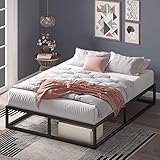
Zinus Joseph 10 Inch Metal Platforma Bed Frame, Queen
Who it suits: the side sleeper who wants the deck under their hip verified rather than assumed — anyone who has ever asked a frame maker “how far apart are the slats?” and been met with silence.
The Zinus Joseph queen leads this guide for the same reason it leads our general under-$200 guide, and for a side sleeper the reason doubles in weight. Zinus publishes the number: the maker’s listing copy states that the plywood slats are spaced 3 to 3.4 inches apart — inside the roughly 3-inch guidance most foam mattress warranties work to, and stated by the maker, not measured by a reviewer or guessed from a photograph. Think about what that figure means in a side sleeper’s night. Your weight does not spread across the deck the way a back sleeper’s does; it concentrates at the shoulder and again at the hip, and wherever a wide gap between slats coincides with one of those bands, the mattress dips into the gap instead of resting on support. A published spacing of 3 to 3.4 inches is the only evidence available anywhere in this market that the dips, if they happen at all, are small and evenly distributed — the deck stays even, and the mattress’s own surface does the giving it was designed to do. The frame itself is the line’s 10-inch low-profile steel platform: a sturdy steel structure with wood slat support, no box spring needed, sized 80 by 60 inches for a queen mattress, with a maker-stated capacity of 700 pounds for the queen (the twin is rated 350) and a 5-year limited warranty. One identity note matters at checkout: the listing to buy is the 10-inch queen, model OLB-MBBF-10Q — a manual for a different Joseph variant circulates under a different listing, and matching the model number is how you know the page in front of you is this frame.
- Only frame in this guide — and the only one in this market segment — with a maker-published slat spacing: 3 to 3.4 inches
- Maker-stated queen capacity of 700 lb, from the listing copy rather than a roundup
- 5-year limited warranty, the documentation standard this brand’s support infrastructure sets
Honest limitation: availability on this listing has passed through stretches with no featured offer showing. Treat the Joseph’s Amazon page as a verify-then-buy: confirm the queen size is selected, that a featured offer is live, and check the current price on Amazon to confirm it sits at or under $200 before ordering. If the offer is empty on the day you shop, the Yaheetech below is the standing alternative, not a compromise.
Choose it if: your mattress warranty cares about slat spacing, you want the support question answered by the maker instead of by hope, or you prefer a low-profile frame under a thick mattress.
Skip it if: you want a headboard included, you need tall under-bed storage — a 10-inch frame is not a storage frame, and Zinus publishes no separate clearance figure we could verify — or you want a listing with steadier availability.
Yaheetech Victorian Queen Metal Platform Bed Frame with Headboard
Who it suits: the side sleeper who wants a complete, finished-looking bed — headboard included — well within a $200 budget, and is comfortable judging the deck by construction rather than by a published spacing figure.
The Yaheetech Victorian queen is the rare pick that gets simpler as the budget grows. In the under-$100 guide it was a conditional hero, held to a strict buy-only rule at that tighter cap. At this tier that caution retires: positioned at the lower end of this tier, it is an ordinary pick here — check price on Amazon to confirm the queen in your finish still sits comfortably within this tier. What you get is a complete metal bed: a Victorian-style headboard integrated into the frame, 12 metal slats, a footprint of 83 by 62 inches, and 12.6 inches of listed under-bed storage height — the tallest verified clearance figure in this guide, from the listing itself. For a side sleeper, the headboard earns a mention beyond looks: it keeps pillows from escaping off the head of the bed during the position changes side sleepers make all night.
- Complete bed with integrated headboard at the lower end of this tier
- Graduates to an ordinary pick at this tier, without the tighter cap’s buy-only rule
- 12.6 inches of listed under-bed storage, the best verified clearance here
Honest limitation: two figures remain unpublished for this frame, and this guide prints neither. Yaheetech does not publish a slat-spacing figure we could pin — the 12 metal slats are a count, not a spacing — and we could not pin a maker capacity for the queen: a large round number circulates for this style of frame, but it could not be verified against the maker’s own materials, so it does not appear here. A side sleeper whose mattress warranty names a maximum slat gap cannot verify this deck against it; that verification is the Joseph’s alone. The pick described here is the black finish; other finishes on the Victorian’s listing should be checked on Amazon before assuming they match it in price or availability.
Choose it if: you want the finished-bed look with the headboard solved in the same box, you value under-bed storage, or you would rather spend less here and put the rest of the budget toward the mattress.
Skip it if: you need a published slat spacing for a warranty-sensitive foam mattress — that is the Joseph — or you want upholstery or wood rather than black metal.

Zinus Piper Upholstered Platform Bed Frame, Queen
Who it suits: the side sleeper who also reads, watches and props up in bed — anyone who leans against the headboard nightly and found every metal frame in the earlier tiers visually cold.
Upholstery was the first of the under-$100 guide’s three impossibilities, and the Zinus Piper queen is the frame that ends that. In Dark Grey, the queen (model ZU-FPPOP3OC-12Q) sits in the middle of this tier — check the current price on Amazon, as the price can vary by finish and seller, which is worth knowing about, not a disqualification. The construction is a steel platform wrapped in polyester fabric upholstery with a paneled headboard, at 82.3 inches long; the listing’s spec block states a maximum weight capacity of 700 pounds for the queen. A construction detail deserves naming: foam-padded tape on the slats, which the maker fits as a feature bearing on slat noise; we print it as exactly that — a construction feature — not as a promise of silence, because no listing adjective is evidence and a side sleeper’s repeated weight shifts will test any deck’s joints over time. A 5-year limited warranty is listed for the model. The padded headboard is the side sleeper’s secondary argument here: a comfortable surface to sit up against before sleep, and a soft stop that keeps pillows in place. It changes nothing about the deck — which is the honest way to value it.
- The upholstered queen that verifies within this tier — check price on Amazon
- Listing-stated 700 lb queen capacity
- Foam-padded slat tape — a maker construction feature bearing on slat noise, not a silence guarantee
- Paneled fabric headboard gives the finished, primary-bedroom look metal cannot
Honest limitation: an upholstered platform is a low platform. Under-bed clearance is limited and storage is not this frame’s purpose — if bins under the bed are the plan, the Yaheetech or the Novilla serves it better. Fabric asks more of you than powder-coated steel: it shows dust and holds pet hair. Zinus publishes no slat-spacing figure we could pin for this model, so the deck-verification argument belongs to the Joseph alone. The price can also vary by finish and seller, so check the current price on Amazon and confirm the queen in your finish is at or under $200 on the day.
Choose it if: the bed’s look matters as much as its support, you lean against the headboard to read, or metal frames read as dorm furniture to you.
Skip it if: under-bed storage is a requirement, the room is a high-traffic rental or kids’ room where fabric will suffer, or you want a published slat spacing.

Mellow Naturalista Classic 12 Inch Solid Wood Platform Bed, Queen
Who it suits: the side sleeper who wants real wood — a solid pine frame with wooden slats — and is willing to let the finish choice do the budget work.
The Mellow Naturalista Classic queen is the second impossibility from the under-$100 guide resolved: solid wood, verified. The frame is solid pine construction with a 3.5-inch-thick frame, wooden slats with non-slip tape, and the tightest footprint in this guide — 79.5 by 59.5 inches, barely larger than the 80-by-60 mattress it carries, which makes it the small-room pick as much as the wood pick. The non-slip tape earns its mention here: slats that stay where they were laid keep the deck’s support pattern — and its evenness — where the maker put it. On capacity, this guide documents a conflict rather than resolving it: the listing’s own feature block claims a maximum weight recommendation of 1,000 pounds, while a retailer spec table reads 400 pounds. Both are claims rather than test results, we could not reconcile them, and the comparison table prints the listing’s figure attributed to the listing — the conflict itself is the honest information. Pricing demands attention, because the finish can move the price more than the frame changes: the linked pick is the Cherry queen, while Espresso and Pine sit lower in the tier — check price on Amazon for each finish. Every finish described here was verified within this tier, but the spread between finishes can be meaningful, so if the budget is tight the finish should be chosen by price first and color second.
- Genuine solid pine construction — the material step the earlier tiers could not verify
- Every finish described here verified within this tier, with Cherry at the top end and Pine and Espresso lower — check price on Amazon
- Smallest footprint in the guide (79.5 × 59.5 in) — a true queen deck in a near-mattress-sized frame
- Non-slip tape on the wooden slats, and a listing-claimed 1,000 lb maximum weight recommendation (a retailer table reads 400 lb — unresolved, see review)
Honest limitation: the Cherry finish sits near the top of this guide’s cap, and this listing has at times sat above $200. Buy the finish whose current price sits comfortably within the tier, and treat a Cherry price over $200 as a walk-away, not a stretch. There is no headboard, and Mellow does not publish a slat-spacing figure we could pin for this model, so the documentation crown stays with the Joseph.
Wood ownership is the quieter argument for this pick. A scuff in solid pine can be sanded and re-finished at a kitchen table, while a chip in powder-coated steel is permanent; wooden slats can be replaced individually from any lumber rack if one ever cracks — a repair that matters to a side sleeper, because one cracked slat under the hip is a dip you feel every night — and the simple joinery can be disassembled, moved and rebuilt without a parts diagram. None of that appears in a spec block, but over a ten-year horizon it is the difference between furniture and equipment.
Choose it if: you want wood’s look, warmth and repairability, your room is tight, or you are happy to take Espresso or Pine and bank the difference.
Skip it if: only the Cherry finish will do and it is sitting above $200 when you check, you need a headboard included, or a published slat spacing is your deciding factor.

Zinus Kai Bamboo and Metal Platform Bed Frame, Queen
Who it suits: the design-led side sleeper — anyone who wants a headboard with actual visual character, in natural material, without leaving the verified zone.
The Zinus Kai queen pairs a steel platform frame with bamboo slats and a slatted bamboo headboard, and it sits comfortably in the middle of this tier — check price on Amazon — rather than at its edge. The frame runs 81.6 inches long, the extra length belonging to the headboard design. Where the Piper buys softness, the Kai buys texture: the bamboo headboard reads as furniture rather than equipment, and the material pairing is one no other pick here offers. For a side sleeper the judgment is the same as throughout this guide: the headboard is a genuine nightly convenience for pillow management, the deck’s support figures are simply not published, and the pick stands on its position in the tier and its design rather than on any documentation claim.
- Positioned in the middle of this tier — the queen ordinarily sits well under this cap; check price on Amazon
- Bamboo slatted headboard included; a genuine design object, not a dressed-up rail
- Steel structure with bamboo slats — the material pairing is unique in this guide
Honest limitation: the Kai is a design step, not a documentation step. We could not pin a maker-published slat-spacing figure or a maker capacity for the queen from the listing record, so neither is printed — the Joseph remains the answer when the specification matters more than the silhouette, which for a side sleeper it usually does. This frame has touched the cap’s edge in the past; its position in the middle of the tier is what carries it here, so check the current price on Amazon before ordering.
Choose it if: you want the headboard to be the room’s design statement, you prefer natural materials without the Naturalista’s finish lottery, or you want a pick that sits mid-tier rather than at the line.
Skip it if: you need published specifications, maximum under-bed storage, or the absolute lowest price — the Novilla below sits lower in the tier.

Novilla 14 Inch Metal Platform Bed Frame, Queen
Who it suits: the pragmatist — any side sleeper whose actual requirement is a queen mattress held flat and high enough to store bins under, at the lowest verified price, with the savings left for the mattress itself.
The Novilla 14-inch queen has now been the plain-platform answer at $75, at $100 and at $200, unchanged, because nothing about a bigger budget improves what it does. Check price on Amazon — it sits at the low end of this tier — and its documentation comes from the maker’s own manual for model N-F10013-Q-BK: roughly 12 inches of under-bed clearance and a 1,200-pound maker capacity claim. That clearance is the practical heart of the pick — standard storage bins slide under a 14-inch frame whose deck leaves about a foot of usable height, which neither the 10-inch Joseph nor the upholstered Piper attempts. In a side-sleeper guide its role sharpens rather than changes: it is the frame for the buyer who has decided, correctly, that comfort will be decided by the mattress, and wants the deck simple, documented in a manual, and cheap enough that the mattress budget keeps the difference. It carries no headboard, no upholstery, no wood and no published slat spacing; it is a steel rectangle that does one job, and its presence in a $200 guide is the guide’s honesty made visible.
- At the low end of this tier for the queen — check price on Amazon
- Maker’s manual documents roughly 12 inches of under-bed clearance and a 1,200 lb capacity claim
- 14-inch height turns the under-bed zone into real storage
Honest limitation: it is a plain frame and looks like one. There is no headboard and no attachment story worth printing, no published slat spacing for a warranty-sensitive foam mattress, and the finish is basic black steel. At 14 inches it also makes the tallest bed in this guide once a thick mattress goes on top — a real consideration for shorter side sleepers getting in and out, covered in the height section below.
Choose it if: storage clearance and price are the whole brief, the frame will be hidden by bedding anyway, or you are furnishing a guest room or rental properly without overspending.
Skip it if: you want a headboard, a material with character, or a maker-published slat spacing.

Comparison Table
| Frame | Price | Headboard | Slat spacing, maker-published | Capacity (maker claim) | Under-bed clearance |
|---|---|---|---|---|---|
| Zinus Joseph 10 Inch, Queen | Check price on Amazon | No | Yes — 3 to 3.4 in | 700 lb | Not published |
| Yaheetech Victorian, Queen | Check price on Amazon | Included | Not published | Not pinned | 12.6 in (listed) |
| Zinus Piper Upholstered, Queen | Check price on Amazon | Included | Not published | 700 lb (listing) | Limited; not published |
| Mellow Naturalista Classic 12 Inch, Queen | Check price on Amazon | No | Not published | 1,000 lb (listing claim; a retailer table reads 400 lb) | Not published |
| Zinus Kai Bamboo and Metal, Queen | Check price on Amazon | Included | Not published | Not pinned | Not published |
| Novilla 14 Inch, Queen | Check price on Amazon | No | Not published | 1,200 lb (manual claim) | About 12 in (manual) |
Read the capacity column the way it deserves: every figure in it is a maker’s claim, not a test result, and the two frames marked “not pinned” are not weaker for it — their makers simply did not publish a figure we could verify. For a side sleeper, the slat-spacing column is the table’s real story: one “yes” in six, and that one frame leads the guide, because spacing is the only column that describes what the deck does under a hip.
How to Choose a Platform Bed Frame Under $200 — the Side Sleeper’s Version
Start with the mattress, not the frame. If your mattress is foam and its warranty names a maximum slat gap — many do, commonly around 3 inches — the Joseph’s published 3 to 3.4 inches is the only figure in this guide you can check against that warranty before buying. For innerspring and hybrid mattresses, spacing matters less and the field opens up. Then be honest about which problem you are solving: a frame can deliver an even deck, a chosen height and a quiet structure. It cannot deliver softness, pressure relief or a different feel — those live in the mattress, and if they are what you lack, the correct output is a frame cheap enough to leave the budget where the problem is.
Decide what the bed must look like. Three of these six include a headboard: the Yaheetech’s black metal Victorian styling, the Piper’s padded fabric panel, and the Kai’s bamboo slats. For a side sleeper the headboard has a practical edge — it keeps pillows on the bed through a night of position changes — but it stays secondary to the deck. If you already own a headboard you love, the frame-only picks — Joseph, Naturalista, Novilla — are your list; confirm on the listing how, or whether, your headboard attaches before ordering.
Measure storage honestly. A frame’s height is not its clearance: rails, legs and center supports all subtract. The two verified clearance figures here are the Yaheetech’s 12.6 listed inches and the Novilla’s roughly 12 manual inches; for the other four, no maker figure could be pinned, so measure the assembled frame before buying bins, and never convert a “14-inch frame” into “14 inches of storage.” Use the finish as a price lever on the Naturalista. The same solid-wood frame sits at the top of the tier in Cherry and lower in Espresso and Pine; if the color is negotiable, check price on Amazon for each finish before choosing. Check the size selector twice. Every pick in this guide is the queen; listings default to whatever variant the link lands on, and headline prices elsewhere on the page may belong to a twin.
Plan the assembly hour, and the quiet after it. Every frame here arrives flat-packed and assembles with hand tools; the realistic differences are in the details — the Piper stores its parts in the headboard so nothing is missing at minute one, and the Naturalista’s solid pine rails are the heaviest single pieces in the guide. Budget an unhurried hour, build on the floor the bed will occupy, and leave final tightening until the frame is square. Then, two to four weeks later, go around the fasteners once more: platform joints settle under load, and the squeaks owners blame on cheap steel are more often loose bolts announcing themselves. A side sleeper works those joints harder than most — every roll from one side to the other crosses the deck’s center — so the re-tightening habit is worth twice as much here as in a general guide. Felt pads under legs protect hard floors.
What a Platform Frame Can and Cannot Do for a Side Sleeper
It is worth stating the mechanics plainly, because most frame marketing blurs them. When you lie on your side, your body’s contact with the bed narrows to two load bands: the shoulder and the hip. Everything a sleeper means by comfort in that position — the shoulder sinking in far enough, the hip carried without a hard point — is decided by how the mattress’s surface responds at those two bands. A pocketed-coil mattress can respond locally, coil by coil. A foam mattress responds across its comfort layers. A platform frame, underneath both, responds not at all: it is rigid by design, and that rigidity is its virtue. Its whole contribution is to be flat and to stay flat, so that whatever give the mattress offers arrives evenly, at the shoulder, at the hip and everywhere between.
The failure mode is the mirror image. A deck that sags — slats spaced too widely, a slat cracked, a center support gone soft — does not sag uniformly. It sags most where the load is, which for a side sleeper means exactly under the hip, and the result is a hammock: the hip drops, the shoulder stays nearer the surface, and the sleeper spends the night being slowly folded by their own bed. No comfort layer can compensate for a foundation that is lower in one place than another, because the layer is only as level as what holds it. That is why this guide spends its length on spacing and deck construction rather than the language of softness: for a side sleeper, evenness is not a proxy for comfort — it is the precondition for it.
And then the honest boundary, which this guide will not soften. If your mattress is the wrong firmness for your build, or its comfort layers have taken a permanent set where you sleep, or it was simply never a side sleeper’s mattress, a new frame — this Joseph, or any frame at any price — will not make it one. The frame protects the mattress’s warranty and its evenness, nothing more; it cannot add give the mattress does not have. Judge your situation before spending: if the bed feels wrong in the same way after rotating the mattress end for end, the problem is on top of the deck, not under it. Buy the frame that keeps a good mattress good, and spend the real money where the give actually lives.
Slat Spacing at $200: One Published Number in Six
It is worth pausing on how strange the spacing situation remains. Slat spacing decides whether a platform supports a foam mattress evenly or lets it sag between slats, and it is the figure mattress warranties actually cite — yet across six verified queens under $200, exactly one maker publishes it. The Joseph’s 3 to 3.4 inches comes from Zinus’s own listing copy, and it is the reason that frame leads this guide. The other five publish slat counts (the Yaheetech’s 12 metal slats), materials (the Naturalista’s taped wooden slats, the Kai’s bamboo slats), or nothing at all. A count is not a spacing: twelve slats across an 80-inch deck with wide end gaps can leave larger unsupported spans than the number suggests, and without the deck layout the arithmetic cannot be done honestly — so this guide does not do it.
For a side sleeper this is not pedantry. The unsupported spans are where the mattress dips, and the dips land under load bands. A back sleeper distributes weight across enough of the deck that a wide gap is a minor event; a side sleeper’s hip can sit directly over one. That asymmetry is why the one published figure in this market carries the weight it does in this guide’s ranking, and why the five unpublished decks are described by what is actually known about them — construction, materials and position in the tier — rather than by a spacing estimate dressed up as knowledge. The practical rule stands: if spacing is your deciding specification, buy the frame that publishes it.
Height, Noise and the Recall Record: The Night-Time Variables
Height. A side sleeper meets the bed’s height twice a night at minimum — sitting on the edge to get in, and lowering down to get out — and the relevant number is frame height plus mattress thickness. The three picks with verified frame heights span the range: the Joseph at 10 inches, the Naturalista at 12, the Novilla at 14. On a thick mattress, the Joseph’s low profile lands the surface at a height most people can sit on with feet flat — the position a side sleeper rolls into place from, hips level while settling. The Novilla’s 14 inches under the same mattress makes a noticeably taller bed: wonderful for storage, more of a climb and a drop for shorter sleepers. The Piper is a low platform by construction, with no height figure we could pin. None of this is a health claim — it is furniture geometry, argued qualitatively from the verified heights rather than prescribed as a number.
Noise. Side sleepers change position against the deck repeatedly through the night, and every change is a load shift across slats and joints. Frame noise, when it comes, comes from those interfaces: a slat moving in its seat, a bolt a quarter-turn loose, a joint flexing under a shifting hip. So this guide judges noise from construction and assembly care, not listing adjectives — several listings in this category describe themselves with words like silent or noise-free, and we decline to repeat any of them as fact, because no maker’s adjective is a measurement. What can honestly be said: the Piper’s foam-padded slat tape is a construction feature fitted at exactly the slat interface where movement noise starts; the Naturalista’s non-slip slat tape addresses the same interface from the migration side; and for every frame here, the decisive variable is in the buyer’s hands — full tightening at assembly, then a re-tightening pass a few weeks later once the joints have settled under load.
The recall record. We re-checked the US recall landscape for platform beds in November 2026, and it is unchanged from our earlier tiers — itself the finding worth printing, because the two standing recalls involve exactly the failure mode a side sleeper can least afford. Home Design’s upholstered platform beds were recalled on January 18, 2024 — roughly 527,177 units, with 128 reports of beds breaking, sagging or collapsing and 36 injuries. Lucid’s platform beds followed on September 19, 2024 — roughly 137,000 units, 245 reports and 18 injuries. A deck that sags or collapses is, for a sleeper lying across two load bands, the hammock failure at its worst. The other bed recalls of 2025 and 2026 concern canopy frames, Murphy beds and wall beds, not platforms. No recall names Zinus, Mellow, Yaheetech or Novilla, and none of the six picks is a recalled model. The lesson is structural rather than brand-specific: platforms fail at slats, rails and leg joints under load, which is why this guide weighs published documentation and multi-year sales records more heavily than headline capacity claims.
Common Buying Mistakes
Expecting the frame to soften the bed. The most common side-sleeper mistake of all. A platform is rigid; the give lives in the mattress. If the mattress is the problem, a frame purchase postpones the fix and spends the budget that would have made it. Reading a slat count as a slat spacing. Twelve slats is a count. The gaps between them are the specification, only one maker in this guide publishes it, and no arithmetic converts one into the other honestly. Believing the word “silent.” Listing adjectives are not measurements. Judge noise from construction — padded or taped slat interfaces, sound joinery — and from your own re-tightening habit. Quoting the twin price. The headline price on a listing or in a roundup table often belongs to the smallest size. Every figure in this guide is the queen, checked as the queen; do the same at checkout. Buying the finish before the price. On the Naturalista, the finish can be a meaningful price decision. Check all finishes on Amazon before falling for one photograph. Assuming a past price is a promise. Past prices describe history, not today’s offer; check the current price on Amazon — particularly on the Joseph, where availability can vary, and on the Naturalista in Cherry, which lives near the top of the cap. Treating height as clearance. A 14-inch frame does not store 14-inch bins; rails and legs take their share, and four of these six frames publish no clearance figure at all. Reading a capacity claim as a test result. The 700, 1,000 and 1,200 pound figures in this guide are makers’ claims — in the Naturalista’s case a conflicted one — useful for comparing a maker’s own models and nothing more. Skipping the recall check on a no-name alternative. If you leave this list for an unbranded frame at a suspicious price, the two standing platform recalls are the reason to check its maker against the CPSC record first.
Final Recommendation
For most side sleepers buying a queen platform under $200, the Zinus Joseph is the frame to buy first — not because it promises comfort it cannot deliver, but because it is the only frame here, and the only one at any tier we have researched, whose maker publishes the slat spacing that decides whether the deck under your hip is verifiably even: 3 to 3.4 inches — check price on Amazon for the queen, with the verify-the-offer check its review describes. If you want a complete bed with a headboard for the least money, the Yaheetech Victorian, at the lower end of this tier, is now an unconditional recommendation, and the Piper’s upholstery and the Kai’s bamboo, both mid-tier, are the look-led alternatives. The Naturalista is the wood buyer’s frame, bought in Espresso or Pine unless Cherry is sitting comfortably under the cap. And if your honest diagnosis is that the mattress itself is the problem, the Novilla, at the low end of the tier, is the correct purchase — holding a new mattress flat while leaving the budget for the surface that will decide your nights. If discomfort persists on a sound bed, or you wake with numbness, that is a question for a clinician, not for another frame.
Frequently Asked Questions
Can a platform bed frame actually help a side sleeper?
It can help in one specific way: by holding the mattress flat and even, so the mattress’s own comfort layers give uniformly at the shoulder and the hip instead of dipping into a sagging deck. It cannot add softness or give of its own — a platform is rigid by design. If your current frame sags, an even deck is a real improvement; if the frame is sound and the mattress feels wrong, the mattress is the purchase.
Does slat spacing really matter for side sleepers?
Yes, more than for back sleepers. A side sleeper’s weight concentrates at the shoulder and hip, so an unsupported gap between slats under one of those bands becomes a dip the sleeper feels directly. Spacing is also the figure foam mattress warranties cite. In this guide only the Zinus Joseph publishes it — 3 to 3.4 inches, from the maker’s own listing copy.
Is a slat count the same as slat spacing?
No. A count — the Yaheetech’s 12 metal slats, for example — says how many slats there are, not how wide the gaps between them run, and the gaps are what support the mattress. Wide end gaps can leave large unsupported spans behind an impressive count. This guide never converts a count into a spacing.
Which frame height suits a side sleeper?
There is no universal number, because the sleeping surface is frame plus mattress. The verified frame heights here run from the Joseph’s 10 inches to the Novilla’s 14. Aim for a finished bed you can sit on at the edge with feet flat — the position you get in and out from, hips level as you settle onto your side. A tall frame under a thick mattress is a climb; a low frame under a thin one is a squat.
Will one of these frames fix shoulder or hip discomfort from my current mattress?
No — and any guide that promises otherwise is selling you something. A frame cannot change a mattress’s firmness or restore worn comfort layers. What it can do is remove a sagging foundation from the equation and protect a new mattress’s warranty and evenness. If discomfort persists on a sound, even bed, or you notice numbness, talk to a clinician rather than buying another frame.
Are platform frames noisy for restless side sleepers?
They can be, and the noise comes from interfaces — slats shifting in their seats, bolts settling loose — rather than from the materials themselves. Construction helps: the Piper’s foam-padded slat tape and the Naturalista’s non-slip slat tape both address the slat interface. Assembly care helps more: tighten fully, then re-tighten a few weeks later. We do not repeat any listing’s “silent” language as fact — an adjective is not a measurement.
Are any of these frames recalled?
No. The standing US platform-bed recalls — Home Design upholstered platforms (January 2024) and Lucid platforms (September 2024) — do not name any maker in this guide, and our November 2026 re-check found no new platform-bed recall. The recall section above covers the landscape in full.
Related guides: Best Platform Bed Frame Under $100 · Best Platform Bed Frame Under $400 · Best Storage Bed Frame Under $200 · Best Platform Bed Frame Under $200