Where to buy
Check the latest price, availability and delivery on Amazon. Orders are placed on Amazon. We may earn a commission from qualifying purchases.
- Best overall: KD Frames Nomad Platform Bed, Queen — Check on Amazon
- ZINUS Suzanne 44 Inch Bamboo and Metal Platform Bed Frame, Queen — Check on Amazon
- Zinus Joseph 10 Inch Metal Platforma Bed Frame, Queen — Check on Amazon
- Zinus Shalini Upholstered Platform Bed Frame with Headboard, Queen — Check on Amazon
See 2 more Amazon options
- Allewie Queen Size Storage Bed Frame with 4 Underbed Drawers — Check on Amazon
- Mellow Naturalista Classic 12 Inch Solid Wood Platform Bed, Queen — Check on Amazon
Read the full guide ↓
Disclosure: As an Amazon Associate, umtsmarttool.com earns from qualifying purchases. Links to Amazon on this page are affiliate links; they cost you nothing extra. Listing details such as price and availability change often, so check the current Amazon listing before you buy.
A side sleeper loads a bed at two points — the shoulder and the hip — and asks the mattress surface to give at both. That giving is the mattress’s job, and it is worth being precise about whose job it is not. A platform frame cannot give locally the way a pocketed-coil mattress can: a deck has no zones and no softer panel waiting under your shoulder. What a frame can do — the whole of its job for this reader — is hold the mattress flat and even, so whatever give the mattress has is delivered uniformly instead of being distorted by a sagging rail or by foam dipping between wide-spaced slats. And the honest exit belongs at the top of this guide, not buried in it: if your mattress itself is wrong for your shoulder, no frame at any price fixes that. A frame protects your mattress’s warranty and its evenness. Nothing more.
This guide also answers what the step from $400 to $700 adds, because we re-ran every check fresh for this tier — the six verified picks from our under-$400 research, plus every premium candidate the extra $300 was supposed to unlock. The answer is the strangest result in this family’s research so far: the $400-to-$700 band adds no new verifiable queen platform bed on Amazon at all. The joinery class sells direct and above the cap — the Thuma Classic queen, Floyd’s queen, Avocado’s wood frames and Silk & Snow’s wooden queen are all positioned above this tier in the brands’ own stores. The premium names that do list on Amazon sit there without a buyable offer to pin: the Bme acacia queens, the Softa Mikor rubberwood queen and the FLEXISPOT Hako G2 all show “No featured offers available.” KD Frames’ own Charleston and Lexington document as well as our hero does, but their Amazon queens cannot be verified as buyable in this tier, so they are named in this guide without links. So the verified $700 slate is the $400 slate, re-judged — and for a side sleeper the consequence is specific: the extra $300 buys no additional evenness evidence whatsoever. The same three maker-published slat spacings — 2.8 inches, 2.95 inches, and 3 to 3.4 inches — are the whole of the verifiable evenness record at $700, exactly as at $400. What the headroom buys is patience: every verified pick sits well under the cap, so you can check the current price on Amazon and buy when the listing suits you instead of rushing.
Below: a quick picks table, detailed notes on each of the six frames, a comparison table, a buying checklist, three sections on what a frame can and cannot do for a side sleeper, the common mistakes, and the questions that come up again and again. Every pick below is the queen size, checked as the queen, because the twin in a headline is still the oldest trick on the page.
In this guide
Quick Picks
| Frame | Best for | Price | Slat spacing, maker-published |
|---|---|---|---|
| KD Frames Nomad Platform Bed, Queen | Best overall — the tightest published spacing under your shoulder | Check price on Amazon | Yes — 2.8 in |
| ZINUS Suzanne 44 Inch Bamboo and Metal Platform Bed Frame, Queen | Best documented frame with a headboard | Check price on Amazon | Yes — 2.95 in |
| Zinus Joseph 10 Inch Metal Platforma Bed Frame, Queen | Best documentation value — a published spacing in the lowest part of the tier | Check price on Amazon | Yes — 3 to 3.4 in |
| Zinus Shalini Upholstered Platform Bed Frame with Headboard, Queen | Best upholstered frame — the dressed, hotel look | Check price on Amazon | Not published |
| Allewie Queen Size Storage Bed Frame with 4 Underbed Drawers | Best with drawers — storage that verifies | Check price on Amazon | Not published — 12 slats is a count |
| Mellow Naturalista Classic 12 Inch Solid Wood Platform Bed, Queen | Best finished wood — no finishing work required | Check price on Amazon | Not published |
How These Picks Were Chosen
Every pick had to clear the same four tests, in this order — the same tests our earlier tiers applied, re-run fresh for this one. First, identity: the listing had to resolve to the queen variant specifically — an ASIN pinned to the queen size, a model number, or a listing record for the queen — never a parent listing whose price might belong to a twin. Second, price: the queen had to be buyable at or under $700 on Amazon, with the current price there to check on the listing; a product whose queen could not be verified as buyable in this tier is named in this guide without a link. Third, documentation: any figure printed here — slat spacing, capacity, dimensions — had to come from the maker’s own listing copy, manual, or spec block for that model. Figures are never borrowed across models, not even within one brand’s line, and where sources conflict we print the conflict rather than harmonize it. Fourth, safety: we re-ran the recall check against the CPSC record for platform beds in November 2026 before finalizing the list. The standing landscape is two recalls — Home Design’s upholstered platform beds (January 2024) and Lucid’s platform beds (September 2024) — and no pick in this guide is a recalled model.
At this tier the second test did the decisive work. The six under-$400 picks were re-judged rather than assumed, and all six cleared the bar again — none was displaced, because nothing verifiable arrived to displace it. The candidates that failed did so in three distinct ways: direct-only brands priced above the cap (Thuma, Floyd, Avocado, Silk & Snow); Amazon listings with no featured offer showing across repeated checks, so no buyable queen offer exists to verify (the Bme line, Softa, FLEXISPOT); and listings whose current availability could not be verified (Plank+Beam, and KD Frames’ Charleston and Lexington). Exclusion here is a statement about evidence, not about furniture: several of the excluded beds may be excellent, and the sources file records a swap-in note for each.
One more filter belongs to this guide specifically: evenness evidence, the only thing a side sleeper can verify before buying. A deck’s flatness cannot be tested from a listing photo, so the pre-purchase evidence is documentary — a maker-published slat spacing, stated for that exact model. Three of these six picks publish one. Two publish materials or a slat count instead, and a count is not a spacing: twelve slats across an 80-inch deck can still leave wide unsupported spans at the ends, and without the deck layout the arithmetic cannot be done honestly, so this guide does not do it. One pick publishes neither a spacing nor a capacity, and its review says so at full strength. Where a figure could not be verified, this guide leaves the gap visible rather than filling it with a borrowed number.
The 6 Best Platform Bed Frames for Side Sleepers Under $700
KD Frames Nomad Platform Bed, Queen
Who it suits: the side sleeper with a foam mattress whose warranty names a maximum slat gap — anyone who asked “how far apart are the slats?” and wants the answer in writing, from the maker, for this exact bed.
The KD Frames Nomad queen leads this guide for the same reason it led at $400, and the side-sleeper lens sharpens rather than changes the reasoning: it is still the best-documented hardwood platform we can verify on Amazon at any price under $700. The frame is solid kiln-dried tulip poplar — a genuine hardwood, not pine — and the maker’s copy is explicit that every piece is solid poplar, with no plywood, MDF or particleboard in the frame. KD Frames builds it in Athens, Georgia, from poplar grown in Virginia. The maker’s listing copy and the model’s manual both state a slat spacing of 2.8 inches, with the slats sitting flush with the tops of the rails — the tightest maker-published spacing we have verified, and the first that sits inside the roughly 3-inch guidance most foam mattress warranties work to, rather than straddling it. For a side sleeper that is not an abstract specification: it means the foam under your shoulder is supported evenly along its whole length instead of dipping between slats, so the give you feel is the mattress’s own. The platform stands 15 inches high — the tallest deck in this guide — the maker states a capacity of 600 pounds, and a 5-year warranty backs the model. Check the current price on Amazon for the queen. The Nomad sits in the lower part of this tier, well under the $700 cap, and this guide’s honest advice is to value it that way: the Nomad’s documentation, not a higher spend, is what the money was for.
- The tightest maker-published slat spacing we have verified: 2.8 inches, in the listing copy and the manual
- Solid kiln-dried tulip poplar hardwood — no plywood, MDF or particleboard in the frame
- Made in Athens, Georgia, USA, by a maker building frames since 1987
- Maker-stated 600 lb capacity and a 5-year warranty
Honest limitation: the Nomad arrives unfinished. The poplar is bare — no stain, no sealant — so you either finish it yourself (a weekend of sanding and sealing, and the cost of the finish) or live with raw wood whose slats can vary in color. There is no headboard. Its maker-stated 600 lb capacity is the lowest figure in this guide. And this listing has passed through stretches with no featured offer showing, so treat it as a verify-then-buy: confirm the queen is selected, a live offer exists, and check the current price on Amazon to confirm it is at or under the cap before ordering. If the offer is empty on the day you shop, the Joseph below is the documented alternative, not a compromise.
Choose it if: your mattress warranty cares about slat spacing, you want hardwood rather than pine, or you are happy to finish the wood yourself and make it yours.
Skip it if: you want a finished bed out of the box, a headboard included, or a stated capacity above 600 lb.

ZINUS Suzanne 44 Inch Bamboo and Metal Platform Bed Frame, Queen
Who it suits: the side sleeper who wants the bed to be the room’s furniture statement — headboard and footboard both — without leaving the documented zone.
The Zinus Suzanne queen sits second at this tier, on its documentation. The design is a genuine bamboo headboard and footboard over a bold steel frame in a grey wash finish, at 82 by 59.2 by 44 inches — and unusually for a design-led bed, its listing copy does the specification work too: Zinus states that each size comes with 12 to 13 slats measuring 2.8 inches wide and spaced 2.95 inches apart, that all sizes above twin support up to 700 pounds, and a 5-year limited warranty is included. That 2.95-inch figure makes the Suzanne one of only three picks in this guide with a maker-published slat spacing, sitting inside the roughly 3-inch warranty guidance — so the deck’s evenness can be checked on paper before the box is opened. What the higher cap changes is the buying strategy. Check the current price on Amazon for the queen before you buy. The Suzanne sits in the middle part of this tier, well under the $700 cap, so at this budget there is room to be patient and check the listing rather than buying in a hurry. Be plain about what the premium buys, though: the footboard and the bamboo. As pure support, the Nomad documents a tighter spacing and sits lower in the tier, and this guide will not pretend the extra money buys extra strength or extra evenness — it buys the room’s look, with documentation good enough that the look costs the deck nothing.
- Maker-published slat spacing of 2.95 inches in the listing copy — one of three documented decks in this guide
- Genuine bamboo headboard and footboard over a steel frame; the design summit of the verified set
- Listing-stated 700 lb capacity for the queen and a 5-year limited warranty
- Sits well under the $700 cap — check the current price on Amazon for the queen
Honest limitation: this listing’s price can move, so do not treat any single check as a going rate. Check the current price on Amazon before you buy, and if the queen is sitting unusually high for this tier, waiting is the sensible move. A footboard also eats floor space and can crowd a small room, and the 44-inch figure in its name is the bed’s total height, headboard included — it tells you nothing about the deck height your mattress will sit on.
Choose it if: the bed is the room’s design statement, you want a footboard, and you want design that still publishes its specifications.
Skip it if: you need to buy on a fixed date without time to check the current price on Amazon, or documented support above all else is the whole brief — that is the Nomad or the Joseph.

Zinus Joseph 10 Inch Metal Platforma Bed Frame, Queen
Who it suits: the foam-mattress side sleeper who wants a maker-published slat spacing in the lowest part of the tier — and prefers a low-profile steel deck under a thick mattress.
The Zinus Joseph queen earned its place in this family’s research at $200, where it was the only frame in the market whose maker published the number: Zinus’s listing copy states that the plywood slats are spaced 3 to 3.4 inches apart. Two tiers later its role has settled. The Nomad publishes a tighter figure (2.8 inches) that sits inside the roughly 3-inch warranty guidance the Joseph’s range straddles, and the Suzanne publishes 2.95 inches with a headboard attached. What the Joseph still owns, outright, is accessibility — check the current price on Amazon for the queen, and it remains the most accessible verified route to a published spacing in the lowest part of this tier, in a 10-inch low-profile steel frame with a maker-stated queen capacity of 700 pounds and a 5-year limited warranty. For a side sleeper the low profile is a genuine feature rather than a compromise: pair a 12- or 14-inch mattress with a 10-inch frame and the sleeping surface lands at a normal sitting height, where the same mattress on a 15-inch deck becomes a climb — and getting in and out of bed is a hip-and-shoulder movement performed twice a day. At a $700 cap the Joseph is also the guide’s standing rebuke to overspending: the documentation most buyers actually need sits at the low end of the tier, and stepping higher buys materials, looks and drawers, not more certainty.
- Maker-published slat spacing of 3 to 3.4 inches — still the most accessible published figure in the market
- Maker-stated queen capacity of 700 lb, from the listing copy rather than a roundup
- 10-inch low profile pairs well with thick mattresses
- 5-year limited warranty, with the deepest manual and support record in this guide
Honest limitation: check the current price on Amazon before ordering — this listing has passed through stretches with no featured offer showing. Treat it as a verify-then-buy: confirm the queen size is selected, that a featured offer is live, and that the current price is at or under the cap before ordering. Its spacing range also straddles the 3-inch guidance rather than sitting inside it — if your warranty states a hard 3-inch maximum, the Nomad’s published 2.8 inches is the safer document. One warning carried from our earlier research at full strength: a manuals site hosts a manual record under a different ASIN for a different Joseph variant, so never follow a link that re-points this frame away from the 10-inch queen listing linked here.
Choose it if: you want the published-spacing answer in the lowest part of the tier — check the current price on Amazon — a low profile under a thick mattress, or steel rather than wood.
Skip it if: your warranty demands a spacing at or under 3 inches in writing — that is the Nomad — or you want a headboard or tall under-bed storage; Zinus publishes no separate clearance figure for this frame that we could verify.
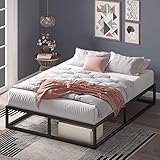
Zinus Shalini Upholstered Platform Bed Frame with Headboard, Queen
Who it suits: the buyer who wants the dressed, hotel-look bed — button tufting, a real headboard to lean on — and who does not need a published specification to be comfortable.
The Zinus Shalini queen holds the upholstery slot at this tier, as it did at $400. Check the current price on Amazon for the current WonderBox-version queen, and the bed it describes is the classic button-tufted headboard in dark grey over an interior steel and wood framework, with wooden slat support, dense foam padding, and the Zinus party trick: every part, including the hardware, stores inside the headboard, and the whole bed ships in one compact box. A 5-year limited warranty is listed for the model. For a side sleeper, though, this review has to carry one charge at full strength: the Shalini buys its evenness on faith. The current listing publishes neither a slat spacing nor a weight capacity that we could pin — a November 2026 spec read agrees the capacity figure is not stated, and no spacing could be pinned either. That absence cannot be waved away as an industry habit, because the same maker publishes a spacing on the Joseph and on the Suzanne in this very guide; here the figure simply is not offered, and this guide prints neither number rather than borrowing them from other Zinus models. None of that makes the Shalini a bad bed — it is buyable in this tier, its warranty is listed, and the upholstered look is a legitimate reason to buy a frame. It means a side sleeper choosing it is choosing the look with their eyes open: the deck under your shoulder will be whatever it is, and no document says otherwise beforehand. At $700 the Shalini is also the guide’s clearest case of the band buying nothing: the upholstered queens above it in price are the unverifiable ones, so the verified upholstery ladder stops here, well under the cap, with much of the budget unspent.
- Button-tufted upholstered queen in this tier — check the current price on Amazon
- All parts and hardware stored inside the headboard; ships in one compact WonderBox
- Wooden slat support over a steel and wood framework — no box spring needed
- 5-year limited warranty
Honest limitation: the documentation gap follows this frame up the tiers, unchanged at $700: no capacity and no slat spacing could be pinned from the current listing, so a warranty-sensitive foam mattress cannot be checked against this deck before buying. Under-bed clearance is likewise not stated, so do not plan storage around it. And fabric asks more of you than powder-coated steel: it shows dust, holds pet hair, and wants a fabric cleaner rather than a damp cloth.
Choose it if: the bed’s look leads, you lean against the headboard to read, and you do not need a published capacity or spacing to be comfortable.
Skip it if: a documented capacity or slat spacing is a deciding factor — that is the Nomad, the Joseph or the Suzanne — or under-bed storage is a requirement.

Allewie Queen Size Storage Bed Frame with 4 Underbed Drawers
Who it suits: the buyer whose bedroom has no room for a dresser — anyone who needs the under-bed zone to work as drawers, not as a cave for bins.
The Allewie queen remains the only bed with built-in drawers to verify as a platform pick anywhere in this family’s research, and the $700 pass re-checked the obvious question: does the higher drawer budget at this tier change the answer? It does not — the drawer queens our storage-bed research can price above this one carry thinner verification, not better — so the Allewie holds its place judged as a platform first. The deck is 12 sturdy wooden slats over a reinforced metal structure. Read that the way this guide insists on reading it: 12 is a count, not a spacing, and a count cannot tell a side sleeper how evenly the deck supports the foam at the shoulder — twelve slats with wide end gaps can leave larger unsupported spans than the number suggests. The listing states a maximum capacity of 900 pounds, a maker’s claim printed here as one. It sits in the lower part of this tier — check the current price on Amazon for the queen before you buy. On top of the deck you get four under-bed drawers, a diamond button-tufted faux-leather headboard whose height adjusts between two settings for different mattress thicknesses, and a footprint of 83 by 62.2 inches. Readers choosing purely on storage volume should also read our storage bed frame guides, where drawer beds are compared on storage merits alone.
- Four real drawers built in — still the only drawer bed to verify as a platform pick in this family
- Queen sits well under the $700 cap — check the current price on Amazon
- Listing-stated 900 lb maximum capacity (maker claim) over 12 wooden slats
- Height-adjustable tufted headboard suits mattresses of different thicknesses
Honest limitation: judged strictly as a platform, it documents less than the frames above it: Allewie publishes a slat count, not a spacing, so a warranty-sensitive foam mattress cannot be checked against this deck the way it can against the Nomad, Joseph or Suzanne. The drawers also mean the under-bed is spoken for — there is no open clearance for bins — and an offer can carry a shipping charge on top of the item price, so compare the delivered total, not the headline. Faux leather is not leather: it is a wipe-clean surface that will not age like hide.
Choose it if: drawers solve a real problem in your room, you want one purchase to be both bed and dresser, or you want a pick that sits comfortably in the lower part of this tier — check the current price on Amazon.
Skip it if: you need a published slat spacing, open under-bed clearance, or genuine leather and fabric rather than faux leather.

Mellow Naturalista Classic 12 Inch Solid Wood Platform Bed, Queen
Who it suits: the buyer who wants real wood with a finish already on it — anyone who likes the Nomad’s idea but not its weekend of sanding and sealing.
The Mellow Naturalista Classic queen carries over again, and at this tier its job description is the finished-wood pick, unchanged and unchallenged: nothing that verifies above it in price offers finished solid wood either — the premium wood beds are direct-only or offer-less, as the band research documents. The frame is solid pine construction with a 3.5-inch-thick frame, wooden slats with non-slip tape, and the tightest footprint in this guide — 79.5 by 59.5 inches, barely larger than the 80-by-60 mattress it carries, which makes it the small-room pick as much as the wood pick. Its 12-inch height sits between the Joseph’s low profile and the Nomad’s tall deck in the height arithmetic a side sleeper does with their mattress thickness. The listing’s own feature block claims a maximum weight recommendation of 1,000 pounds; that is a maker claim, printed here as one, and a retailer spec table reads 400 lb for the same model — the conflict is documented in our sources and not harmonized, here as at every earlier tier. Finishes: the linked queen is Cherry, with Espresso and Pine as sibling finishes named here without separate links — check the current price on Amazon for the finish you choose. Every finish sits in the lower part of this tier, well under the cap. On documentation, be plain: Mellow does not publish a slat-spacing figure we could pin for this model, so a side sleeper who needs the deck’s evenness in writing should look at the three documented picks — this frame’s case is finish, footprint and repairability, not paperwork.
- Genuine solid pine, finished — the wood pick with no finishing project attached
- Every finish sits well under the cap — check the current price on Amazon for Cherry, Espresso or Pine
- Smallest footprint in the guide (79.5 × 59.5 in) — a true queen deck in a near-mattress-sized frame
- Non-slip tape on the wooden slats, and a listing-claimed 1,000 lb maximum weight recommendation
Honest limitation: pine is a softwood, and the Nomad’s tulip poplar is the harder, more durable material — that is the honest trade this pick makes for arriving finished. There is no headboard. And the capacity conflict stands as documented: the listing claims 1,000 lb, a retailer table reads 400 lb, and this guide will not average two disagreeing sources into a third number nobody published.
Wood ownership is the quieter argument for this pick, as it was at $200 and $400. Pine scuffs where powder-coated steel chips, but a scuff in solid wood can be sanded and re-finished at a kitchen table, while a chipped coating is permanent; wooden slats can be replaced individually if one ever cracks, and the simple joinery can be disassembled, moved and rebuilt without a parts diagram. None of that appears in a spec block, but over a ten-year horizon it is the difference between furniture and equipment.
Choose it if: you want wood’s look, warmth and repairability without a finishing project, your room is tight, or you are happy to take Espresso or Pine instead of Cherry.
Skip it if: you want hardwood rather than pine — that is the Nomad — a published slat spacing, or a headboard included.

Comparison Table
| Frame | Price | Headboard | Slat spacing, maker-published | Capacity (maker claim) | Under-bed clearance |
|---|---|---|---|---|---|
| KD Frames Nomad, Queen | Check price on Amazon | No | Yes — 2.8 in | 600 lb | Not published |
| ZINUS Suzanne 44 Inch, Queen | Check price on Amazon | Included, plus footboard | Yes — 2.95 in | 700 lb (listing) | Not published |
| Zinus Joseph 10 Inch, Queen | Check price on Amazon | No | Yes — 3 to 3.4 in | 700 lb | Not published |
| Zinus Shalini Upholstered, Queen | Check price on Amazon | Included | Not pinned | Not pinned | Not published |
| Allewie 4-Drawer Storage, Queen | Check price on Amazon | Included | Not published | 900 lb (listing) | Drawers, not open clearance |
| Mellow Naturalista Classic 12 Inch, Queen | Check price on Amazon | No | Not published | 1,000 lb (listing claim) | Not published |
Read the capacity column the way it deserves: every figure in it is a maker’s claim, not a test result — no capacity in this band comes from a named independent test. The frames marked “not pinned” are not weaker for it; their makers simply did not publish a figure we could verify, and this guide would rather leave a cell honest than fill it with a borrowed number. For a side sleeper, the spacing column is the table’s real story, and at $700 it is the same story as at $400: three “yes” answers in six.
How to Choose a Platform Bed Frame Under $700
Start with the mattress, not the frame. If your mattress is foam and its warranty names a maximum slat gap — many do, commonly around 3 inches — three frames in this guide can be checked against that warranty before buying: the Nomad at 2.8 inches and the Suzanne at 2.95 inches sit inside the guidance, and the Joseph’s 3 to 3.4 inches straddles it. For innerspring and hybrid mattresses, spacing matters less and the field opens up. Never convert a count into a spacing. A slat count tells you how many boards there are, not how far apart they sit; the Allewie’s 12 slats and the Suzanne’s 12 to 13 are counts, and only the Suzanne’s listing goes on to publish the gap itself. If a listing gives you a count and no gap, the gap is unpublished — decide accordingly. Decide what the bed must look like. Three of these six include a headboard: the Shalini’s button-tufted fabric, the Allewie’s tufted faux leather, and the Suzanne’s bamboo with a matching footboard. If you already own a headboard, the frame-only picks — Nomad, Joseph, Naturalista — are your list; confirm on the listing how, or whether, yours attaches before ordering.
Do the height sum before you buy. The number that decides how a bed feels to get into is not the frame’s height or the mattress’s thickness but the two added together. The verified deck heights in this guide are the Joseph’s 10 inches, the Naturalista’s 12 inches and the Nomad’s 15 inches — argued here qualitatively, because that is all the evidence supports: a thick mattress on the tall Nomad makes a high surface to climb into, while the same mattress on the low Joseph lands near an ordinary chair height, which is the easier movement for hips and shoulders that start the day stiff. Total heights that include a headboard — the Suzanne’s 44 inches — are not deck heights and cannot be used in this sum. Decide whether you are finishing wood or buying it finished. That is the real Nomad-versus-Naturalista question: the Nomad is the harder wood and the better document, but it arrives bare; the Naturalista arrives finished in three colors but is pine. Use the headroom as a timing tool. Because every verified pick sits well under the cap, you never have to buy in a hurry: check the current price on Amazon, and if a listing is sitting high for its tier, patience is the sensible move. Measure storage honestly. Not one of these six publishes a separate under-bed clearance figure we could pin, and a frame’s height is not its clearance. If open storage matters, measure the assembled frame before buying bins; if enclosed storage matters, that is exactly the Allewie’s four drawers. Check the size selector twice. Every pick in this guide is the queen; confirm “Queen” is the selected size and check the current price on Amazon to confirm it still sits under the cap before checkout.
Plan the assembly hour, and the quiet after it. Every frame here arrives flat-packed and assembles with hand tools; the realistic differences are in the details — the Shalini stores its parts in the headboard so nothing is missing at minute one, the Nomad’s solid poplar rails are the heaviest pieces in the guide, and the Allewie adds a drawer assembly the others do not have. Budget an unhurried hour (longer for the Allewie), build on the floor the bed will occupy, and leave final tightening until the frame is square. Then, two to four weeks later, go around the fasteners once more: platform joints settle under load, and the squeaks owners blame on cheap steel are more often loose bolts announcing themselves. A side sleeper loads and unloads those joints with every position change, all night, so this habit matters more to you than to any other reader of this guide.
Evenness Is the Specification: Three Published Numbers and Three Silences
Why these numbers carry the guide is the mechanism stated at the top: a deck cannot give at the shoulder, so evenness is the only comfort-relevant property a side sleeper can verify before buying. Our under-$200 research found exactly one maker in this market willing to publish a slat spacing; the $400 pass raised that to three. The $700 pass asked whether money raises it further, and the answer is no, with one footnote that proves the rule. The three published figures stand exactly as they were: the Nomad at 2.8 inches, the Suzanne at 2.95 inches, and the Joseph at 3 to 3.4 inches — the first two inside the roughly 3-inch maximum most foam mattress warranties cite, the third straddling it. For a side sleeper these are not trivia. They are the only pre-purchase evidence in existence about how evenly the deck under your shoulder is supported, because everything else a listing offers on the subject — photographs of slats, adjectives about sturdiness — cannot be checked.
The footnote is KD Frames’ Lexington: its manual publishes the same 2.8 inches as the Nomad, which would make a fourth documented deck — but its Amazon queen cannot be verified as buyable in this tier, so it stands in this guide as a named exhibit rather than a pick. Documentation without a buyable listing is a brochure, not a recommendation. The other three picks publish slat counts (the Allewie’s 12), materials (the Naturalista’s taped wooden slats), or nothing we could pin (the Shalini). A count is still not a spacing, for a geometric reason worth stating once: what matters is the largest unsupported span, and layouts tend to open up at the ends of the deck, near the head and foot. Without the deck layout, a count cannot be converted into a maximum gap, so this guide does not convert it. The rule for this reader is the rule at every tier: if evenness is your deciding specification, buy a frame that publishes it — and no amount of money up to $700 buys you a fourth verified choice.
One related piece of label-reading belongs here, because $700 is where it appears. The only named laboratory in this band’s marketing is SGS, and on the listings where it appears — the Softa and FLEXISPOT beds this guide could not verify — the certification attaches to low-emission coatings and materials, not to any load test of a bed. No capacity figure in this guide comes from a named test either: 600, 700, 900 and 1,000 lb are all makers’ claims. Treat them as claims, and treat “certified” as a word whose object you should always ask for.
Height and Noise: The Two Things a Side Sleeper Feels Every Night
Specifications are checked once; height and noise are experienced nightly. Height first, argued qualitatively because the verified record supports nothing stronger. The sum that matters is deck height plus mattress thickness, and the verified deck heights here span five inches: the Joseph at 10 inches, the Naturalista at 12, the Nomad at 15. On the same mattress, that is the difference between a surface you sit down onto and one you climb up to. For a side sleeper the movement at the edge is a hip-and-shoulder movement — sit, swing the legs up, roll onto the shoulder — and it is easier from a surface near chair height than from one you haul yourself onto or drop down from in the dark. Neither extreme is wrong: a tall bed suits tall sleepers, a low bed suits thick mattresses and shorter sleepers. What is wrong is choosing the height by accident, from a listing photograph, without doing the two-number sum — or mistaking a bed’s total height, headboard and all, for the height of the surface you will sleep on.
Noise is the second nightly fact, and it is widely misattributed. A platform frame has no mechanism to be silent or loud by design; the sounds owners report — creaks, ticks, the occasional groan on a position change — come from joints: fasteners never fully tightened, joints settled under the first weeks of load, slats shifting in their seats. A side sleeper is the reader most exposed to this, because side sleeping is restless by nature — the body unloads one shoulder and loads the other dozens of times a night, working every joint in the deck with each change. So this guide argues noise from construction and assembly care only, and declines every listing’s “silent” or “noise-free” claim as fact: no maker can warrant your floor, your fasteners or your assembly. What you control is the build — assemble where the bed will stand, tighten fully once the frame is square, and re-tighten after two to four weeks. Done that way, any frame in this guide can be quiet for years; skipped, the best-documented deck in the set will eventually announce itself.
Common Buying Mistakes
Expecting a frame to fix a mattress problem. The most expensive mistake in this category. A frame cannot give at your shoulder; it can only hold the mattress flat and even while the mattress gives. If the mattress is wrong for you, the honest purchase is a mattress — the frame’s job is the warranty and the evenness, nothing more. Converting a slat count into a spacing. Twelve slats is a count. Without the deck layout, the largest unsupported span is unknown, and inventing a gap from a count is inventing the one number a side sleeper most needs to be real. Assuming a bigger budget must mean a different list. At this tier it does not — the verified set is the $400 set. Buy the pick that fits — check the current price on Amazon — rather than spending up to the cap for its own sake. Assuming one model’s documentation covers its brandmates. Zinus publishes a spacing on the Joseph and the Suzanne and does not, verifiably, on the Shalini’s current listing. Check the specific listing of the specific model, every time. Chasing the premium names onto Amazon anyway. The Bme, Softa and FLEXISPOT queens sit on Amazon without featured offers; buying through an unfeatured third-party offer that cannot be verified is exactly the transaction this guide’s rules exist to prevent. If you want one of those beds, buy it from the brand’s own store, where the listing and warranty are the brand’s own. Reading a certification as a load test. The band’s “SGS Certified” language certifies coatings and emissions, not strength; no capacity here comes from a named independent test. Quoting the twin size. Headlines often belong to the smallest size; every pick in this guide is the queen, checked as the queen — do the same at checkout. Treating height as clearance. A 15-inch platform and a 44-inch bed say nothing about under-bed space; none of these six publishes a clearance figure, so measure before buying bins. Buying the Nomad and skipping the finish. Unsealed poplar will take marks and moisture. Budget the finish and the weekend, or buy the Naturalista finished. Skipping the re-tightening, then blaming the frame for squeaks. Joints settle and a side sleeper works them nightly; one pass with the wrench at week three is the cheapest silence in this guide.
Final Recommendation
For most side sleepers buying a queen platform under $700, the KD Frames Nomad is the frame to buy first: solid tulip poplar hardwood made in the USA, the tightest maker-published slat spacing we have verified at 2.8 inches, inside the guidance most foam warranties work to. Check the current price on Amazon, do the verify-the-offer check its review describes, and count the finishing weekend honestly in the decision. If you want to stay in the lowest part of the tier, the Joseph remains the documentation answer — check the current price on Amazon — and the Shalini is the upholstered bed to buy when the look leads and a published specification does not. The Allewie is the one-purchase answer when the room also needs a dresser — check the current price on Amazon. The Naturalista is the finished-wood buy, in Espresso or Pine unless Cherry suits the room. The Zinus Suzanne is the design buy — and at this cap, buy it patiently: check the current price on Amazon and do not rush if the listing is sitting high for its tier. And the exit from the introduction stands at the end as it did at the start: if your mattress itself is wrong for your shoulder, none of these frames fixes that, at $700 or any other budget — the frame protects the mattress’s warranty and its evenness, and a side sleeper who needs more give needs it from the mattress. The $700 budget’s real gift is not a better bed; it is the freedom to buy the right bed in this tier and leave the rest for the component that actually gives.
Frequently Asked Questions
Can a platform bed frame help a side sleeper’s shoulder?
Only indirectly, and this guide will not claim more. A frame cannot give locally the way a pocketed-coil mattress can, and it has no softer zone for your shoulder. What it does is hold the mattress flat and even, so the give the mattress has is delivered uniformly — and it keeps a foam mattress inside its warranty’s support conditions, slat gap included. If your shoulder problem is the mattress itself, a frame is not the fix; persistent pain or numbness is a question for a clinician.
What slat spacing should a side sleeper look for?
A published one. Most foam mattress warranties work to a maximum gap of roughly 3 inches, so a maker-stated spacing at or under that figure — the Nomad’s 2.8 inches, the Suzanne’s 2.95 inches — is the verifiable answer, and the Joseph’s 3 to 3.4 inches straddles the line. A slat count is not a spacing and cannot be converted into one honestly. If a listing publishes neither, you are buying the deck’s evenness on faith, which is a legitimate choice only when made knowingly.
Why is the under-$700 list the same as the under-$400 list?
Because verification, not effort, produced it. The joinery brands (Thuma, Floyd, Avocado, Silk & Snow) sell direct with their queens positioned above this tier; the premium brands that list on Amazon (Bme, Softa, FLEXISPOT) show no featured offer on their queen listings, so no buyable queen can be verified; and KD Frames’ Charleston and Lexington document well but cannot be verified as buyable on Amazon in this tier. A pick has to be buyable as a queen in this tier to be linked, and nothing new cleared that bar. For a side sleeper, the band adds no new evenness evidence either: the same three published spacings are the whole of it.
Is a taller or lower platform better for a side sleeper?
Neither, in itself — what matters is the sum of deck height and mattress thickness, because that sets the height of the surface you sit on, swing your legs over and roll onto your shoulder from. The verified deck heights here are 10 inches (Joseph), 12 inches (Naturalista) and 15 inches (Nomad). A thick mattress on the tall deck becomes a climb; the same mattress on the low deck lands near chair height. Do the two-number sum for your own mattress and your own legs, and ignore total heights that include a headboard — they are not deck heights.
Will a platform frame make my bed quieter?
No frame can promise that, and this guide declines every listing’s “silent” claim as fact. Platform noise comes from joints — fasteners left less than fully tight, joints settling under the first weeks of load — and a side sleeper works those joints with every position change. What actually produces a quiet bed is assembly care: build the frame square where it will stand, tighten fully at the end, and re-tighten once after two to four weeks. That habit, not a feature badge, is the difference between a quiet frame and a talkative one.
Are any of these frames recalled?
No. The standing US platform-bed recalls — Home Design upholstered platforms (January 2024) and Lucid platforms (September 2024) — do not name any maker in this guide, and our November 2026 re-check found no new platform-bed recall.
Related guides: Best Platform Bed Frame Under $400 · Best Platform Bed Frame Under $1000 · Best Platform Bed Frame For Side Sleepers Under $400 · Best Storage Bed Frame Under $700 · Best Platform Bed Frame Under $700