Where to buy: Every pick in this guide is sold on Amazon, and for every pick you should check price on Amazon for the exact size and count — a pair counts as a pair, never halved to sneak under the cap. In a small bedroom, start with the size question before the material question: this budget’s one upper-band product is a king pillow, and a king pillow is the wrong proportion for a full or twin bed. Start with the standard-size picks further down if your bed is a full or a twin; start with the Purple Harmony Pillow in king only if your small room’s bed is a queen or a king and one pillow is the purchase.
Disclosure: umtsmarttool.com is reader-supported. When you buy through links on our site, we may earn an affiliate commission from Amazon at no additional cost to you. Prices change frequently — check price on Amazon; the price on the listing at checkout is the one that counts.
A small bedroom changes what a pillow budget should buy, and at $400 it changes it in one direction: width. Pillow sizes are fixed classes — a standard pillow is a 26-inch class, a queen a 30-inch class, a king a 36-inch class. Two queen pillows side by side span 60 inches: wider than a full bed (54 inches), and exactly the full width of a queen bed, edge to edge, with nothing left for the sleepers. Two standards span 52 inches: they fit a full bed with two inches to spare, and on a queen they leave eight inches of open mattress. In a small bedroom, where every inch of the bed is slept on, the pillow’s footprint is not a detail. It is the first specification — and at this budget it collides head-on with the tier’s strangest fact.
That fact, from our base $400 guide’s research, is this: exactly one verified product transacts on Amazon in the upper band between $200 and $400 — the Purple Harmony in king size, a premium pick whose loft listings sit in that band (check price on Amazon). Above that band the shelf is empty; the luxury names that appear to live up there could not be pinned to a single verifiable Amazon listing in our research, so they are named in this guide, honestly, and not linked. For a small bedroom, the one band product being a king cuts both ways. If your small room holds a queen or king bed, the ceiling construction in this series is finally buyable, as a one-pillow purchase. If it holds a full or a twin — the more common small-room beds — a 36-inch-class pillow is simply the wrong object: on a twin it spans nearly the whole bed, on a full two-thirds of it. The right $400 answer for those rooms is further down the list, in the standard-size picks, bought as an allocation of two.
What $400 genuinely adds, re-judged for small rooms, is three things. The Harmony king fits the budget now, for the rooms whose beds fit it. Saatva’s latex pillow — brand-direct throughout this series — is now available on Amazon for the first time — check price on Amazon —, in a standard/queen measuring 28 by 18 inches, narrower than the conventional queen class and quietly well-proportioned for a small bed. And the standard-size picks our base guide promoted — Casper’s phase-change Hybrid Snow and the down-rich Continental Serenity 700 — are, in this guide, not the consolation sizes: they are the honest fit for a full or twin bed, and two of them together are what $400 honestly buys a small room. Nothing here treats neck pain, apnea, or insomnia — a pillow is a comfort purchase, and persistent pain, numbness, or pauses in breathing are a conversation for a clinician, not a product page.
In this guide
Quick Picks: The 6 Best Sleep Pillows for Small Bedrooms Under $400
| Pick | Best for | Fill | Size & count | Price |
|---|---|---|---|---|
| Purple Harmony Pillow | Best overall — the ceiling, in king, for queen/king beds only | GelFlex Grid over Talalay latex core | King, single | Check price on Amazon |
| Saatva Latex Pillow | Best premium latex — narrower than a conventional queen | Shredded natural latex core, microdenier fiber outer | Standard/Queen, single | Check price on Amazon |
| Casper Hybrid Pillow with Snow Technology | Best cooling foam hybrid — the full/twin fit | Foam layers + fiber core, phase-change bands | Standard, single | Check price on Amazon |
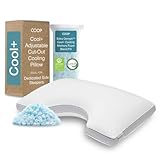
| Coop Home Goods Eden Cool+ Cut-Out Pillow | Best for side sleepers — shaped and adjustable | Gel-infused memory foam + microfiber, adjustable | Queen, single | Check price on Amazon |
| Continental Bedding Serenity 700 Down Pillow | Best genuine down — down-rich, at the right width | 80% goose down / 20% feather, 700 fill power | Standard, single | Check price on Amazon |
| Coop Home Goods Eden Pillow | Best value flagship — one pillow serving the bed | Gel-infused memory foam + microfiber, adjustable | Queen, single | Check price on Amazon |
Read the size column first — in a small bedroom it matters more than anywhere else. One pick here is a king, two are queens, and three are standards or standard/queens: at this tier the sizes have to be matched to a small bed deliberately. Where a pick’s larger size sits above the budget or does not exist, the review says so.
How These Picks Were Chosen
Every pick had to pass the same test as our $30, $75, $100, and $200 guides. Each pick had to be available at or under $400 for the exact size and count printed, verified on its Amazon listing. Pairs count as pairs. Where availability belongs to a particular size or loft, that variant is the one named — and where a variant could not be verified on Amazon, the product is named without a link, whatever its reputation. On top of that shared test, this guide applied the small-bedroom test: each pick was re-judged on the width it occupies, the storage it demands, and whether its size fits the beds small rooms actually hold — fulls at 54 inches wide, queens at 60, twins at 38.
Three research questions shaped the lineup, all inherited from our base $400 guide. First: does anything actually transact in the upper part of this budget, between $200 and $400? Yes — exactly one product line: the Purple Harmony king, a premium pick (check price on Amazon), with its loft listings sitting in that upper band. Above it, the upper stretch of this budget produced no verifiable transaction at all. Second: do the down-rich queens and pairs finally verify? No — the Serenity queen two-pack has no current verifiable Amazon listing to check, and a discontinued record is not a recommendation. Third: do the organic latex flagships finally appear on Amazon? Half of them. Saatva’s is now available on Amazon (check price on Amazon); Avocado’s still is not, so it remains a ceiling marker rather than a pick. Two exclusions from the earlier guides were re-checked a fourth time and stand: a well-known feather pair and a respected shredded-latex pillow still have no verifiable Amazon listing to link.
Every width figure in this guide comes from the standard size chart — standard pillows a 26-inch class, queen pillows a 30-inch class, king pillows a 36-inch class; a twin bed 38 inches wide, a full 54, a queen 60, a king 76 — not from any single listing’s marketing dimensions. Where a pick’s verified listing dimension differs from its class, the review prints it and says so: the Saatva’s 28 by 18 inches is the one example here. The Coop Eden’s width is charged only at its queen size class, 30 inches, because this series’ sources conflict on its listing dimensions and print neither. Certifications are printed as what they are — brand and maker claims — and “hypoallergenic” appears only as an attributed maker label, never as our claim. Comfort claims only, throughout. A pillow does not treat anything.
The 6 Best Sleep Pillows for Small Bedrooms Under $400, Reviewed
1. Purple Harmony Pillow, King — The Ceiling, Charged for Its Width
At $200, the Purple Harmony standard was the ceiling pick, and its king sat outside that budget. At $400 the king is the hero — and in a small-bedroom guide it arrives with the sharpest size charge in the series, so here it is first: a king pillow is a 36-inch-class object. On a twin bed (38 inches wide) one spans nearly the entire bed. On a full bed (54 inches) one takes two-thirds of the width, and two cannot be laid side by side at all — 72 inches of pillow against 54 inches of bed. On a queen bed one spans 36 of the 60 inches and a pair still does not fit; only on a king bed (76 inches) does a pair sit inside the mattress with room to spare. So this hero’s place here is precise: the buy for the small room whose bed is a queen or a king, bought singly. For a full or twin bed, skip to the standard picks below — the same construction in standard size from our $200 guide, and it is the proportionate version of this pillow.
For the rooms it fits, the construction is the one our earlier guides described, scaled up: a ventilated Talalay latex core wrapped in a honeycomb layer of Purple’s GelFlex Grid, a hyper-elastic polymer with thousands of open air channels, inside a stretch-knit cover the brand describes as moisture-wicking. The king keeps the family’s 17-inch depth — shallower than the conventional 20-inch depth, quietly returning three inches of bed length — and weighs about six pounds. Check price on Amazon for the tall-loft king via the link above — this guide’s verified listing. The three lofts (5.5, 6.5, and 7.5 inches) are separate premium listings whose prices move independently, so confirm the loft on the listing before buying.
The cooling claim survives this series’ usual translation better than most, and in a small room — which runs warm, because sleeper and pillow share a smaller volume of air — the distinction matters. The grid is not a gel infusion that saturates in minutes; it is an open structure, and air genuinely moves through it all night. Combined with the latex core’s airflow, this remains the coolest-running construction we have been able to link at any budget — a comfort claim about airflow, not a treatment for night sweats, which no pillow is. The feel is bouncy, buoyant, instantly responsive — the opposite of memory foam’s slow sink. Purple’s trial on this pillow is now 30 nights through the brand, with a one-year warranty — brand terms, so check the Amazon listing’s own return terms before buying.
Who it suits: Sleepers whose small room holds a queen or king bed and who want one premium pillow rather than a pair; warm side and combination sleepers who want buoyant support with real airflow.
Pros: The most genuinely breathable construction in the series; three lofts across listings; latex-core durability; a 17-inch depth that returns bed length; premium positioning in this guide’s upper band; the only verified product in the $200 to $400 band.
Honest limitation: The width is the limitation, and it is disqualifying for the most common small-room beds: a king pillow is the wrong proportion on a full or a twin, and a pair fits only a king bed — and a pair sits above this budget. The grid feel is polarizing, the core and grid are spot-clean only, and the loft listings price independently, so check price on Amazon for the exact loft.
Choose it if: Your small room’s bed is a queen or a king, one pillow is the purchase, you sleep warm, and you have been waiting for this pillow’s big size to fit a guide’s budget honestly.
Skip it if: Your bed is a full or a twin — the standard Harmony is the same pillow in your proportion — or you want a moldable, sink-in feel.
2. Saatva Latex Pillow — The Flagship That Finally Pins, at a Small-Room Width
For three guides, the Saatva Latex Pillow was this series’ definition of brand-direct through the maker’s own store, with no verifiable Amazon transaction, named in ceiling sections and never linked. That era is over. The queen is now available on Amazon as a premium pick — in stock, fulfilled by Amazon (check price on Amazon) — with the king also listed there. The organic-latex shelf has opened a marketplace channel.
The size fact comes first here, because it is a small-room virtue hiding inside a caveat other guides print as a warning: Saatva’s standard/queen measures 28 by 18 inches on its listing — two inches narrower than the 30-inch queen class. Two of them span 56 inches: inside a queen bed’s 60 inches with four inches to spare, where a pair of conventional queens consumes every inch — and still two inches over a full bed’s 54, so on a full it remains a one-pillow purchase. It will sit loose in a standard queen case; in a small room, that looseness is the price of the only premium queen here that leaves any bed width to the sleepers.
The construction is a pillow inside a pillow: a removable core of shredded natural latex — described by the brand as GOLS-certified — wrapped in an outer layer of down-like microdenier fiber, inside a machine-washable organic cotton cover the listing describes as Fair Trade Certified and GOTS-certified. Fill honesty matters here, so here it is plainly: by weight, the fiber wrap is the majority of the fill — one independent breakdown put it at roughly 59 percent polyester fiber to 41 percent latex — so “latex pillow” names the core, not the whole pillow. The feel is plush at contact and buoyant underneath. Two lofts are chosen at purchase (standard at about 4 to 5 inches, high at about 6 to 7); the link above is the high-loft queen, and the standard-loft queen is on its sibling listing — check price on Amazon.
Terms discipline matters as much as size discipline. Saatva advertises a 45-night trial and a one-year warranty on its own store; those are brand terms, not credited here to Amazon purchases — an Amazon order carries the listing’s return terms. Owner reports on the listing include back sleepers who found the standard loft softer than expected: side and combination sleepers are this pillow’s home crowd.
Who it suits: Combination and side sleepers who want natural latex’s bounce with a plush, down-like first touch; couples on a queen bed in a small room, where this is the one premium pair that fits with width to spare.
Pros: Genuine shredded natural latex core with a washable organic cotton cover; 28-inch width is the proportionate premium queen for a small bed; a premium pick also sold through the brand store; two lofts.
Honest limitation: The fill is majority fiber by weight — the latex is a core, not the whole pillow. At 28 by 18 inches it sits loose in conventional queen cases. The loft is chosen at purchase, not tuned at home, and the brand’s 45-night trial does not automatically travel with an Amazon purchase.
Choose it if: You want the premium latex flagship, in the queen width a small bed can actually pair, from the store you already use — knowing exactly how much of it is latex.
Skip it if: You need a conventional 30-inch queen footprint to fill your cases, you want to tune fill at home (either Coop), or a fully natural fill with no synthetic wrap is the point — that pillow is named in this guide’s ceiling discussion, still unlinked.
3. Casper Hybrid Pillow with Snow Technology — The Standard That Fits the Bed
Our $200 guide linked the standard Casper Hybrid and named its cooling sibling in the text. At $400, the Casper Hybrid Pillow with Snow Technology is promoted to a full pick as a premium option on Amazon — check price on Amazon — and it is also sold through the brand store. In this guide it carries a second distinction: it is the premium pick sized the way a small bed is sized. A standard pillow is a 26-inch class; two span 52 inches and fit a full bed with two inches to spare, and on a queen they leave eight inches of the bed to the sleepers. For the small room whose bed is a full or a twin — the rooms the hero above cannot serve — this is the honest premium fit, bought singly or as a true pair inside this budget.
The architecture is the Hybrid’s — foam layers wrapped around a fiber core, plush on contact and supportive underneath, with nothing to fluff or tune — with Casper’s Snow technology added: phase-change cooling bands designed to absorb the heat pulse of a head landing on the pillow and keep absorbing across the first part of the night. The cooling claim gets this series’ standard translation, and the Snow survives it in the middle rank. Phase-change material is a stronger first-contact system than a gel infusion: it pulls a real quantity of heat out of the surface before it saturates. But saturate it does — phase-change absorbs heat; it does not move air. Once the bands have taken up their charge, the rest of the night is decided by the foam-and-fiber construction underneath, a middling airflow story. Buy the Snow for a cooler landing and a slower warm-up, not all-night climate; that job belongs to the grid above and the latex beside it.
Channel and size discipline, as always with Casper. The brand store sells the Snow in standard and king sizes; the verified pick here is the standard on Amazon — check price on Amazon — and the king did not verify on Amazon in our research — in a small bedroom the king is beside the point anyway. The fixed loft is Casper’s choice, positioned for side and combination sleepers; stomach sleepers will find it more pillow than they want. What it asks of a small room is nothing: no fill bag to store, no tuning sessions — it arrives, it goes on the bed, and the room owes it nothing.
Who it suits: Side and combination sleepers on full, twin, or tight queen beds who fall asleep hot and want the strongest cool-landing foam pillow that verifies, with zero maintenance or storage overhead.
Pros: Phase-change cooling stronger than gel infusion; plush-then-supportive feel with zero fluffing or tuning; standard width fits small beds in true pairs; check price on Amazon; nothing to store.
Honest limitation: The cooling is a heat-absorption effect, not airflow — it fades as the bands saturate. No adjustability. The verified pick is the standard size; the king did not verify on Amazon in our research.
Choose it if: Your bed is a full or a twin, your complaint is the first hot hour of the night, and you want Casper’s hybrid feel with the cooling upgrade already in it.
Skip it if: You sleep hot all night (the Harmony’s grid or the Saatva’s latex core), or you need to tune loft.

4. Coop Home Goods Eden Cool+ Cut-Out Pillow — The Shaped Adjustable, Bought Singly
At $200 this pillow was our first swap-in: verified, recommended, and held out of the linked six only because its sibling the Eden held the Coop cooling slot. At $400, the Coop Home Goods Eden Cool+ Cut-Out takes its own slot. The queen is a mid-range pick on Amazon — check price on Amazon. What it adds over the Eden is shape: Coop’s gel-infused adjustable fill in a cut-out profile, with a notch engineered for a side sleeper’s shoulder, so the loft goes to the head and neck while the shoulder gets room instead of a ramp.
The small-bedroom framing is the one this guide applies to every queen here: it is sold as a queen, so it is charged at the queen size class — 30 inches wide — and bought the way a small bed wants queens bought, one at a time. One Cool+ spans half of a queen bed or more than half of a full; a pair spans 60 inches, the whole width of a queen bed and six inches more than a full bed has. For a single side sleeper, that arithmetic is fine; as a default pair for a small bed, it is not. The adjustable architecture is the Eden family’s: cross-cut gel-infused memory foam and microfiber behind a zippered liner, tuned by the handful over the first few nights, under the brand’s cooler-touch Cool+ cover. The gel infusion earns the series’ standing translation — a cooler first contact that absorbs heat until it reaches skin temperature, which takes minutes — so the honest reason to buy this pillow is the geometry, not the gel. A shoulder notch changes where a side sleeper’s weight lands in a way no amount of fill tuning in a rectangle fully replicates. The tuning has one small-room cost, covered in the storage section below: fill you remove has to live somewhere, and both Coop picks in this guide generate a bag of it.
One channel fact from the Eden review below applies to the whole Coop line: Coop’s advertised trial and warranty are brand terms, and the return terms on the Amazon listing are the ones guaranteed to apply to an Amazon purchase. Buy the shape because the shape fits your sleep; read the listing’s terms before checkout.
Who it suits: Committed side sleepers in small rooms who have tuned rectangular adjustables and still wake with their shoulder riding up the pillow; a single sleeper on a queen or full bed, where one shaped pillow is the whole purchase.
Pros: A genuine shoulder cut-out in an adjustable fill — the only shaped pick in the guide; check price on Amazon.
Honest limitation: Queen-class width: buy one for a small bed, not a pair. The shape is a commitment — back and stomach sleepers will find the notch pointless or worse. The gel is a first-contact effect, not all-night cooling, and the removed fill needs storage.
Choose it if: You sleep on your side, one pillow serves your bed, and the shoulder geometry is the feature you have been missing.
Skip it if: You change positions all night (the Eden or the Saatva), your bed needs a matched pair (the standard picks), or you want natural fill.
5. Continental Bedding Serenity 700 — Down-Rich, at the Width a Small Bed Wants
The down pick from our $200 guide carries into this one unchanged, because nothing in November 2026 research displaced it: the Continental Bedding Serenity 700 remains the only down-rich pillow this series has ever been able to link. The fill is 80 percent goose down and 20 percent goose feather — down the majority, by a wide margin — at a stated 700 fill power, in Hungarian white goose down, inside a 400-thread-count cotton shell. The maker describes the down as RDS-certified and the pillow as made in the USA, and it is sold in low, medium, and high loft versions: loft choice at purchase is the down buyer’s substitute for adjustability. The standard size is sold singly as a mid-range pick — check price on Amazon and confirm the listing live before checkout, as availability for this pick has been the least stable among these six.
For a small bedroom, the standard size is not the consolation prize it is in a king-bed guide — it is the fit, and at $400 it becomes a pair. At 26 inches wide, two Serenity 700s span 52 inches: they sit inside a full bed’s 54 inches with room to spare, and on a queen they leave eight inches of the bed to the sleepers. Two singles count as a pair — the only down-rich pair this budget honestly funds, assembled from singles because the maker’s own queen two-pack cannot be recommended: it has no current verifiable Amazon listing to check, so there is no pick to make. Down-rich on Amazon, verifiably, is a standard-size purchase — which, in this guide, is precisely the point.
The feel remains the genuine article: light, weightless loft that molds around the head and relofts with a shake, warmer than feather because down traps more air per ounce. The honest costs carry too: down compresses over a night more than latex or foam, wants daily fluffing, and long-term owner reports on this model describe loft loss inside the first year for some sleepers. It is the wrong fill entirely for anyone sensitive to natural down.
Who it suits: Back sleepers and down devotees in small rooms who want the real ratio, in the size that fits their bed singly or as a pair; side sleepers in the high-loft version who like a moldable, scrunchable pillow.
Pros: A true 80/20 down-rich fill with a stated 700 fill power — still the only one in this series; loft options at purchase; standard width is the proportionate fit for full and twin beds, in singles or pairs; maker’s RDS and made-in-USA claims printed on the listing.
Honest limitation: Verified at standard size only — the queen pair has no current verifiable listing. Down compresses, needs fluffing, and can lose loft within a year; the soft versions will under-support broad-shouldered side sleepers.
Choose it if: Down-rich is the thing you actually want, your bed is a full, twin, or tight queen, and you will fluff it daily.
Skip it if: You need a queen size, you are sensitive to down, or you want a pillow that holds a fixed shape without maintenance.

6. Coop Home Goods Eden Pillow — Carried, Charged at Its Size Class
The hero of our $200 guide does not need re-arguing at $400; it needs re-framing for a small room, and the re-framing starts with its width. The Coop Home Goods Eden is sold as a queen, so this guide charges it at the queen size class — 30 inches wide — and prints no narrower listing dimension, because this series’ sources conflict on the Eden’s dimensions and print neither. At class width: one Eden spans exactly half of a queen bed and more than half of a full; two span 60 inches, wider than a full bed and every inch of a queen. So the honest way to buy it for a small bedroom is as one pillow serving the bed — a single sleeper’s pillow, or the one adjustable pillow a couple tunes and shares the bed around — not as a matched pair bought on autopilot. Bought that way, it remains what it was: the flagship adjustable, gel-infused cross-cut memory foam and microfiber fill you add or remove through a zippered liner, extra fill bag in the box, a mid-range pick — check price on Amazon.
What carries over from its $200 review: the gel infusion is a first-contact effect — cooler when your head lands, at skin temperature within minutes — while the durable virtues are the softer, more down-like hand than the Original, the washable construction, and the brand’s stated CertiPUR-US and GREENGUARD Gold certifications. What also carries over is the channel fact, the mirror image of the Saatva’s parity: Coop’s own store also lists the Eden queen, so compare the two channels and check price on Amazon for the marketplace’s delivery and returns machinery. Coop’s advertised 100-night trial and 5-year warranty are brand terms; the listing’s return terms govern an Amazon purchase. And the small-room ledger has one more line, shared with the Cool+ above: the extra fill bag, and the fill you remove while tuning, both need a home — a real, if modest, storage allocation, covered in the storage section below. The counterweight is budget room: as a mid-range pick, the Eden leaves much of this budget unspent — enough to add a Serenity standard beside it.
Who it suits: A single sleeper on a queen bed who wants one adjustable pillow with a cooler first touch; anyone furnishing a small room on a total budget, where the unspent budget room is the point.
Pros: Fully adjustable loft with extra fill included; gel-infused fill and a plusher hand than the Original; machine washable; brand-stated certifications; check price on Amazon.
Honest limitation: Queen-class width — buy one for a small bed, not a pair. The cooling is a first-contact effect, not all-night temperature control. Check price on Amazon and compare it with the brand’s own store price for the same queen. The spare and removed fill needs storage. Expect a faint new-foam smell on opening and periodic re-fluffing.
Choose it if: Your bed is a queen, one pillow serves it, and you want the most capable rectangular adjustable in this series.
Skip it if: Your bed is a full and two sleepers need pillows (the standard picks fit the width), the shoulder cut-out above is the geometry you need, or you sleep genuinely hot and need structural airflow.

Comparison Table
| Product | Fill | Adjustable? | Size & count | Width on the bed | Price | Watch out for |
|---|---|---|---|---|---|---|
| Purple Harmony, King | GelFlex Grid over Talalay latex | No — loft chosen at purchase | King, single | 36-in class — two-thirds of a full bed; a pair fits only a king bed | Check price on Amazon | Wrong proportion for full/twin beds; loft listings price independently — check the exact loft |
| Saatva Latex | Shredded latex core, microdenier fiber outer | No — loft chosen at purchase | Standard/Queen 28×18, single | 28 in — a pair spans 56 in, inside a queen bed | Check price on Amazon | Fill is majority fiber by weight; sits loose in conventional queen cases |
| Casper Hybrid Snow | Foam layers + fiber core, phase-change bands | No | Standard, single | 26-in class — a pair fits a full bed | Check price on Amazon | Cooling saturates; king not verified on Amazon |
| Coop Eden Cool+ Cut-Out | Gel-infused memory foam + microfiber | Yes — add/remove fill | Queen, single | 30-in class — buy one for a small bed, not a pair | Check price on Amazon | Shape suits side sleepers only; spare fill needs storage |
| Continental Serenity 700 | 80% goose down / 20% feather, 700 FP | No — loft chosen at purchase | Standard, single | 26-in class — a pair fits a full bed | Check price on Amazon | Least stable availability in the guide; queen pair has no current listing |
| Coop Eden | Gel-infused memory foam + microfiber | Yes — add/remove fill | Queen, single | 30-in class — half a queen bed; a pair overhangs a full | Check price on Amazon | Compare Amazon with the brand’s own store; spare fill needs storage |
How to Choose a Sleep Pillow for a Small Bedroom Under $400
Do the width arithmetic first — before fill, before brand. A full bed is 54 inches wide: two standards (26-inch class) span 52 inches and fit; two queens (30-inch class) span 60 inches and overhang by six. A queen bed is 60 inches wide: two standards leave eight inches of open width, two queens consume every inch, and one king pillow takes 36 of the 60. A twin is 38 inches wide: one standard fits, one king nearly spans it. If two people sleep in the bed, the standard picks are the proportionate default; a queen pillow is a deliberate one-pillow purchase; a king pillow is for a queen or king bed only.
Choose the fill by feel, honestly named — and match loft to position. Down-rich feels weightless, moldable, and warm, and asks for daily fluffing. Shredded memory foam feels dense and tunable. A foam-and-fiber hybrid feels plush, then supportive, and asks for nothing. Latex feels springy and pushes back — but read the construction: this tier’s latex pick is a latex core inside a fiber wrap that is the majority of the fill by weight. The grid feels like nothing else on this list. If a listing’s name says “down” but the fill line gives no ratio, assume feather-dominant until proven otherwise. Side sleepers generally need the most loft, back sleepers a medium, stomach sleepers the least — and notice where the guess happens: the adjustable fills (both Coops) forgive a wrong guess at home, while the fixed picks move the guess to checkout.
Spend $400 as an allocation of right-sized pillows, not one wrong-sized one. No single verified pillow honestly eats this whole budget — and in a small room that is good news, because two sleepers need two pillows. The pairings count as pairs in the allocation section below.
Count the storage, not just the price. In a small room every accessory is rent. An adjustable pillow ships with an extra bag of fill and generates a bag of removed fill; both need a home roughly the size of a small cushion. A fixed pillow — the Harmony, the Saatva, the Casper, the Continental — stores nothing but itself, and asks only for a protector, which in a small room doubles as the washable hygiene layer. Neither column is wrong; choose the column knowingly.
Cool honestly in a warm, small room. Gel infusions and cool-touch covers saturate within minutes; phase-change bands saturate across the first part of the night. Only an open structure moves air all night — here, the Harmony’s grid and the Saatva’s latex core. If you wake hot at 3 a.m., buy airflow. And check the transaction, not the advertisement: the Saatva, the Eden, and the Casper Snow each sell both on Amazon and through their brand stores, so check price on Amazon and compare channels — and the band’s luxury names have no verifiable transaction at all. A listing you cannot verify is not a pick.
Treat trials and warranties as listing terms, not brand promises. Saatva’s 45-night trial, Purple’s 30-night trial, and Coop’s 100-night trial are brand terms. The return window on the Amazon listing is the only recourse guaranteed to apply to your purchase. Read those terms before checkout and keep the packaging until the second week.
The $400 Allocation: One Resident, an Empty Shelf, and Two Right-Sized Pillows
The research question this budget asks is simple: what actually sells up here? The answer, from our research across Amazon listings, is one product line. The Purple Harmony king is a premium band resident on Amazon — check price on Amazon for its tall-loft listing and its low- and medium-loft listings. Everything else here sits in the budget to mid-range tiers, and in the upper stretch of this budget, across four research passes at four budgets, this series has never pinned another Amazon pillow transaction. That upper stretch is not expensive. It is empty.
The names that seem to contradict that are worth naming precisely, because each fails differently. Continental Bedding’s own 100-percent-down line appears in down-pillow roundups as a premium line, but it could not be tied to a verifiable Amazon listing for a specific product, so the line is named here and not linked. The Queen Anne luxury down pillow shows third-party marketplace reads that conflict with each other and with review coverage — a third-party-only, internally inconsistent record is not a verification. The airweave pillow, a premium brand-store product, is reported sold through the brand’s Amazon storefront, but no verifiable Amazon listing could be established — and the brand sells accessories as final sale, a terms caution before chasing it through any channel. Avocado’s organic pillows remain the ceiling that stayed direct: real products sold brand-direct, with no Amazon transaction to grade.
So the honest way to spend $400 is as an allocation, not a single purchase — and in a small bedroom the allocation is not a compromise but the correct shape of the purchase, because two sleepers need two pillows and the room needs them sized to the bed. The pairings, counted as pairs and never halved: two Continental Serenity standards — down-rich, on a full bed, with budget room left over. Two Casper Snow standards — the cool-landing pair. Two Saatva queens — the premium pair that fits a queen bed with four inches to spare. Two Harmony standards — the $200 guide’s ceiling pick — as two singles: the most breathable pillow in the series, in the proportion a small bed wants. And a king Harmony plus a queen Eden furnishes two different beds inside this budget. The $400 pillow, singular, barely exists. The $400 pillow budget, spent across the verified shelf at the sizes a small room holds, is the most capable one in this series.
Storage and the Washable Layer: The Costs Nobody Prints
A pillow is only in use half its life. The other half it sits on the bed, which in a small bedroom is also the sofa, the desk chair, and the laundry-folding surface. The discipline is simple: one pillow per sleeper, bought well, beats a pile bought cheaply — every extra pillow in a small room gets moved twice a day, stored on the floor, or stuffed onto the one shelf. All six picks here are singles, counted as singles; a second pillow for reading is furniture, not bedding, and it will be moved like furniture.
The hidden storage cost in this guide belongs to the adjustable picks, printed in their reviews rather than discovered after checkout. Both Coops ship with an extra bag of fill, and tuning removes fill that has to be kept — loft preferences change with mattresses and seasons, and the removed handfuls are the pillow’s future adjustments. Bagged, the spare fill is roughly the size of a small cushion: trivial in a house, a genuine allocation in a studio closet. The fixed picks — the Harmony, the Saatva, the Casper, the Continental — store nothing but themselves. Neither column is wrong, but choose knowingly: adjustability is paid for partly in storage, and in a small room storage is the currency that runs out first.
The hygiene layer deserves the same plain treatment, because a small room concentrates it: the pillow sits closer to the room’s cooking, humidity, and dust than in a house with doors to close, and the laundry may be a shared room down the hall. The practical answer is the protector — a washable, zippered layer that takes the washing the pillow itself cannot, so the pillow’s own wash cycle stretches from weekly to occasional. On care, the picks split honestly: the Saatva’s organic cotton cover is machine washable, and both Coops are washable constructions — the forgiving options for a shared-laundry household. The Harmony’s grid and latex core are spot-clean only, so its protector is not optional equipment; it is the wash plan. The Continental’s down wants to be kept dry and fluffed daily. It is the running cost of the purchase, printed here before checkout rather than learned in the first laundry week.
Common Buying Mistakes
Buying queen pillows in pairs for a full bed. Two queen pillows span 60 inches; a full bed is 54 inches wide. The pair overhangs before it is ever slept on. Size the pillows to the bed: standards in pairs, queens one at a time.
Buying the king because it is the hero. The Harmony king is this guide’s ceiling pick and its most size-restricted one. On a full or twin bed it is the wrong proportion at any price; the standard Harmony is the same construction in your size.
Trusting the product name over the fill line. This tier’s latex pick is majority fiber by weight; its down pick prints 80/20 because its maker does. The construction in the specification is the truth; the name is the hope.
Forgetting the spare fill. An adjustable pillow’s removed fill needs a home roughly the size of a small cushion. In a room with no closet to spare, that is a real cost — choose it knowingly or choose a fixed pick.
Paying for phase-change and expecting climate. Phase-change bands absorb a heat pulse and then they are done. All-night temperature behavior comes from airflow — the grid, or latex.
Expecting a pillow to treat a symptom. A better-fitting pillow can feel more comfortable. Persistent pain, numbness, loud snoring, or pauses in breathing need a clinician, not a checkout — at any budget.
Final Recommendation
Start with your bed’s width, because in a small bedroom it decides more than the fill or the price does. Two queen pillows span 60 inches — wider than a full bed’s 54 — so if two sleepers share a full or a tight queen, the standard picks are the proportionate shortlist, and $400 honestly buys two of them: the Continental Serenity 700 pair for down devotees; the Casper Hybrid Snow pair for set-and-forget buyers who fall asleep hot. If your bed is a queen and a premium pair is the purchase, the Saatva Latex Pillow is the one flagship pair that fits with width to spare — 28 inches at a time — with its fill construction printed plainly in its review. If one pillow serves your bed — a single sleeper, or the one premium pillow on a queen or king bed — the Purple Harmony in king is the buy this budget exists for: the series’ most breathable construction, in the size locked out of every lower guide. Side sleepers who want shape should take the Coop Cool+ Cut-Out, singly; readers who want the best verified adjustable should take the Coop Eden — check price on Amazon — and spend the remaining budget anywhere else in the room. What no small-room reader should do is put a king pillow on a full or twin bed, or chase the luxury names in the upper stretch of this budget: on Amazon, verifiably, nothing else lives there.
Frequently Asked Questions
Standard, queen, or king pillows for a small bedroom?
Let the bed decide, with the arithmetic in front of you. Standards are a 26-inch class: two span 52 inches and fit a full bed (54 inches) or a queen (60 inches) with width left for the sleepers. Queens are a 30-inch class: two span 60 inches — wider than a full bed, and exactly a queen bed’s width with nothing left over. Kings are a 36-inch class: one takes two-thirds of a full bed and nearly all of a twin. In a small room, standards are the pair size, a queen pillow is a one-pillow purchase, and a king pillow belongs on a queen or king bed, bought singly.
Is the king-size Harmony a mistake for a small bedroom?
It depends entirely on the bed, and this guide charges it both ways on purpose. On a queen or king bed, bought as one pillow, it is the best purchase in the guide — the only verified product in the $200 to $400 band, with the most breathable construction in the series. On a full or twin bed it is the wrong proportion at any price: a 36-inch-class pillow on a 54-inch bed crowds out the sleeper, and on a 38-inch twin it is effectively the whole bed. The same pillow in standard size — check price on Amazon — is the version those rooms should buy.
Can I finally buy a real down pillow — in queen, or as a pair — for $400?
A down-rich standard single, yes: the Continental Serenity 700 — check price on Amazon — with a stated 80 percent down fill and 700 fill power — and two singles are the honest pair for a small bed. A down-rich queen or a maker’s pair, still no: the maker’s queen two-pack has no current verifiable Amazon listing, and a product with no current listing cannot be recommended at any budget. Availability for the standard single has also been the least stable in this guide — confirm it live on Amazon before checkout.
Can the right pillow fix my neck pain or snoring?
A pillow that fits your sleep position can feel more comfortable, and comfort is a legitimate reason to buy one. It is not a treatment. Ongoing pain, numbness, loud snoring, or pauses in breathing warrant a clinician’s evaluation rather than a product upgrade — at $400 exactly as at $30.
Keep Reading
Best Sleep Pillow For Small Bedrooms Under $200 · Best Sleep Pillow Under $400 · Best Sleep Pillow For Small Bedrooms Under $700 · Best Memory Foam Pillow For Small Bedrooms Under $400 · Best Platform Bed Frame For Small Bedrooms Under $400