Where to buy
Check the latest price, availability and delivery on Amazon. Orders are placed on Amazon. We may earn a commission from qualifying purchases.
- Best overall: Magicteam Sound Machine with 20 Non-Looping Sounds (SN-A1, Black) — Check on Amazon
- Dreamegg D11 Max Portable Noise Machine — Check on Amazon
- HoMedics SoundSpa Sound Machine (SS-2000, Silver) — Check on Amazon
- Yogasleep Rohm Portable White Noise Machine — Check on Amazon
See 2 more Amazon options
- Yogasleep Hushh Portable White Noise Machine for Baby — Check on Amazon
- Big Red Rooster Sound Machine, 6 Sleep Sounds (Black) — Check on Amazon
Read the full guide ↓
Disclosure: As an Amazon Associate, umtsmarttool.com earns from qualifying purchases. Links to Amazon on this page are affiliate links; they cost you nothing extra. Listing details such as price and availability change often, so check the current Amazon listing before you buy.
Apartment noise arrives from every direction at once: the neighbor’s television through a shared wall, doors and voices in the hallway, traffic on the street below, footsteps from the floor above. A white noise machine is the renter’s answer to that problem for one simple reason — it asks nothing of the building. No installation, no screws, no landlord permission, nothing to patch or repaint when the lease ends. But this guide starts with the honest limit, because it decides whether the purchase works at all: masking works on the listener’s side of the wall. A machine on your nightstand covers the neighbor’s television for you, in your room, at your ears. It does nothing for the neighbor, it does not quiet anything at its source, and it will not stop your own sounds carrying out. A shopper who understands that buys a genuinely useful tool; a shopper who expects soundproofing buys a disappointment.
Here is the second honest finding: every machine that genuinely verifies in this under $30 budget on Amazon is a small speaker playing stored digital sounds. There is no real fan inside any of them — the famous fan-based machine, Yogasleep’s Dohm, sits in a higher tier above this budget. There is no app control, no Bluetooth speaker mode, and — worth knowing before you shop — not one of the six listings below advertises a headphone jack. What $30 genuinely buys is masking: a steady, even sound that covers up the noises that would otherwise stand out against a quiet room, the way a running shower covers a conversation in the next room. Masking is a physical trick, not a treatment, and it is the whole of what these machines do. Within that limit, the field splits into plug-in bedside boxes that never need charging and rechargeable pucks that suit rooms with no spare outlet — and in lease terms the money is small either way, since every pick sits within this budget. Two of the six picks are sold as baby machines, and we label them as such rather than dress them up. Below you will find a quick picks table, detailed notes on each of the six machines, a comparison table, a buying checklist, the mistakes apartment shoppers make most at this price, and answers to the questions that come up again and again.
In this guide
Quick Picks
Short on time, or comparing several options at once? Each row below names a buyer type and the machine that suits it, with a link to the listing.
| Buyer type | Pick | Why it stands out | Link |
|---|---|---|---|
| Best overall | Magicteam Sound Machine, 20 Sounds (SN-A1) | Big sound library, 32 volume levels, plug-in reliability | Check on Amazon |
| Best rechargeable | Dreamegg D11 Max Portable Noise Machine | 21 sounds and a big 1,800 mAh battery, no cord and no outlet needed | Check on Amazon |
| Best simple bedside classic | HoMedics SoundSpa (SS-2000) | Six sounds, a volume knob, wall power or AA batteries | Check on Amazon |
| Best for travel and moving | Yogasleep Rohm Portable | 3.8-ounce rechargeable puck from the Dohm’s maker | Check on Amazon |
| Best for babies and nurseries | Yogasleep Hushh Portable | Baby machine with clip, night light and lock | Check on Amazon |
| Best old-school budget buy | Big Red Rooster Sound Machine (BRRC107B) | Six sounds, dual power, a long record in this budget tier | Check on Amazon |
How These Picks Were Chosen
The first filter was the budget itself, applied honestly. Every machine below is a real Amazon US listing that we could pin to an exact ASIN, a listing that fits this guide’s under $30 budget, and a live offer — using the listing itself and current offer listings. Machines whose listings we could see but whose exact listing we could not pin are named without links at the end of this section, however good they may be. Anything we could not verify as a current listing in this budget was left out.
We did not use these machines ourselves. We read the maker listings and specification pages, and compared the things that actually differ at this price: how many sounds are stored and of what kind, whether the sounds are recordings that repeat or — as some makers claim — non-looping, how the volume is controlled and how finely, what the timer offers, and how the machine is powered. For this apartment edition we weighted the same facts the way a renter feels them: whether the machine needs an outlet in a room that may not have a spare one, whether it can sit by the bed without any fixing or fitting, and whether its timer matches the two distinct jobs in a shared-wall building — masking while you fall asleep, or masking all night. Two disciplines ran through every check. First, maker claims are printed as maker claims: when a listing says its sounds do not loop, or its battery lasts a stated number of hours, we attribute that to the maker rather than assert it as something we tested. Second, decibel figures appear only where a listing states them — and at this price, listings almost never do, so this guide prints none and treats third-party volume measurements as the reviewers’ own numbers, not specifications.
One thing we looked at closely was the word “canceling,” because nearly every listing title at this price uses it. None of these machines cancels noise in the headphone sense — there is no microphone, no anti-noise waveform, no active electronics of that kind at $30. They mask: they raise the room’s background sound level evenly so that irregular noises — a door, a voice, a dog’s tags — have less contrast to stand out against. That is a genuinely useful trick and it is why people buy these machines, but a shopper who expects cancellation will be disappointed, and the buying checklist below starts there.
Named without links, because each failed one of the tests above: the myBaby SoundSpa Portable by HoMedics, a well-known baby machine whose current Amazon listing we could not pin cleanly in this pass; the Momcozy sound machine and the Yogasleep Hushh 2, both seen in this budget range in offer listings but not pinned to a verified ASIN here; the Dreamegg D1, a liked bedside model that sits above this budget tier; and the Douni 27-sound machine — just over this budget, and notable because its listing does advertise the 3.5 mm headphone jack that none of our six picks offers.
The 6 Best White Noise Machines for Apartments Under $30
Magicteam Sound Machine with 20 Non-Looping Sounds (SN-A1, Black)
Who it suits: Anyone who wants one machine for the nightstand and the widest choice of sounds this budget offers — the default buy for a first white noise machine, and the natural bedside fixture in a rented bedroom.
This little black cube is the category’s benchmark at this price: a solid-state plug-in machine, about 3 by 3 by 1.8 inches by the listing’s own specification block, holding 20 sounds. Magicteam describes those sounds as non-looping, and the named ones cover the useful ground — white, brown, pink and blue noise, a fan, a brook, rain, ocean, birds and a bonfire among them. Volume adjusts across 32 levels, which is finer control than most machines at any price offer, and the timer can be set for 1, 2, 3 or 4 hours or left on continuous play. A memory function restores your last sound and volume when you switch it back on, so the nightly routine is one button press. For current pricing, check price on Amazon for the Magicteam SN-A1 — check the current price on Amazon before you buy.
The design choice that defines it is the plug, and in an apartment that choice cuts in the renter’s favor more often than not. There is no battery: the machine runs from the included AC adaptor or any USB port, and the listing says plainly that it needs to be plugged in for use. For a nightstand machine that is arguably the right trade — no charging routine, no battery to age, the same output on night one thousand as on night one — and it is exactly what a fixed bedroom in a lease needs: set it by the bed, where masking does its best work, and forget it exists. The honest cost is the outlet itself. Older rentals run short of sockets near the bed, and a plug-in machine competes with the lamp and the phone charger; a buyer whose nightstand outlet is already full should look at the rechargeable picks below instead.
In daily use, the details that matter are the boring ones, and they are mostly right. Cycling through 20 sounds with a button means your sound is at most 19 presses away and occasionally several presses past where you wanted to stop, which is the tax every one-button library charges; the memory function means you pay it once, at setup, rather than nightly. The 32-step volume ladder is the feature owners end up valuing most, and in a shared-wall building it matters twice over: masking lives in a narrow band — loud enough to cover the hallway, quiet enough to forget, and no louder than it needs to be for the people on the other side of the wall — and coarse volume controls hop straight over that band. Set it once, on the sound and level you chose, and the machine’s whole job from then on is to be forgotten by breakfast.
- 20 sounds, described by the maker as non-looping, spanning four noise colors, fan and nature recordings.
- 32 volume levels — unusually fine control for masking without overpowering a room or a shared wall.
- Timers at 1, 2, 3 or 4 hours plus continuous play, and a memory function for one-press nights.
Honest limitation: It must stay plugged in — there is no battery — and the listing does not list a headphone jack, so private listening is not on the menu.
Choose it if the machine will live by the bed, you have an outlet to give it, and you want the most sounds and the finest volume control under $30. Skip it if you need cordless use, your nightstand outlets are all taken, or you need a headphone jack.
Dreamegg D11 Max Portable Noise Machine (HFD-D11 Max, Classic White)
Who it suits: Renters whose bedroom has no spare outlet, travelers, parents, and anyone who wants the machine to move — crib side, stroller, hotel nightstand — without a cord.
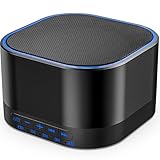
The D11 Max is Dreamegg’s rechargeable puck, about 4 by 3.7 by 1.8 inches, and it packs the longest feature list in this guide: 21 soothing sounds spanning white noise, nature sounds and baby lullabies, a timer at 30, 60 or 90 minutes or continuous play, a memory function, and a child lock that stops small hands from reprogramming the nap. Its party piece is the battery — a built-in 1,800 mAh cell, charged over the included USB-C cord, which Dreamegg says lasts through the night and into daytime naps on a single charge; spec tables put the maker’s claim at 15 to 40 hours depending on volume. Treat both as maker claims rather than test results, but even the low end covers a night with room to spare. A lanyard and loop let it hang from a stroller, car seat or suitcase handle — or, in the apartment this edition is written for, from a bedpost or a door handle in a room where every outlet is already spoken for. For current pricing, check price on Amazon for the Dreamegg D11 Max — check the current price on Amazon before you buy.
Honesty requires one label: this is a baby-first machine. It is sold in Amazon’s nursery category, its listing leads with babies, and some of its 21 sounds are lullabies an adult sleeper will never select. None of that stops it working perfectly well as an adult apartment or travel machine — the white noise and nature sounds are the same job done by the same kind of speaker — but a buyer who wants an adult-only bedside box with no lullabies in the rotation should take the Magicteam above and give it the outlet.
- 21 sounds with a 30, 60 or 90 minute timer, memory function and child lock.
- Built-in 1,800 mAh rechargeable battery with USB-C charging — no cord and no outlet needed at the bedside.
- Lanyard and loop for strollers, car seats, luggage and bedposts; compact 4-inch body.
Honest limitation: There is no built-in night light, and the lullaby-heavy sound list reflects its nursery-first design.
Choose it if you want cordless sound that travels between rooms, rentals and trips. Skip it if you want a night light in the same box or a plug-in machine you never have to charge.
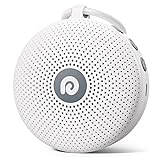
HoMedics SoundSpa Sound Machine (SS-2000, Silver)
Who it suits: Buyers who want the simplest possible bedside machine from a long-established brand — six sounds, a knob, no menus and no charging.
The SoundSpa is the elder of this guide: a small silver disc from HoMedics, a brand that has sold sound machines for decades, with six digitally recorded sounds — White Noise, Thunder, Ocean, Rain, Summer Night and Brook. Volume is a knob you turn rather than a ladder of button presses, the auto-off timer offers 15, 30 or 60 minutes, and power is genuinely flexible: the included AC adapter for the nightstand, or 4 AA batteries (not included) for a trip, a bathroom shelf or a power cut. Check price on Amazon for the current price on Amazon before you buy. Where the Magicteam competes on library size, the SoundSpa competes on having almost nothing to learn: one control for sound choice, one for volume, one for the timer.
Two apartment-specific notes belong with this pick. First, its timer tops out at 60 minutes, which frames it as a fall-asleep machine: if your problem is street noise at 3 a.m. rather than hallway noise at 11 p.m., you will run it continuously on the adapter instead, which it does happily. Second, the trade for its simplicity is variety and polish. Six sounds is the smallest library in this guide, there is no memory function to speak of beyond leaving the dials where you left them, and reviewers who have measured and listened closely note that its white noise track repeats in a loop that attentive listeners can pick out — the exact thing the Magicteam’s non-looping claim is aimed at. For many sleepers a repeating loop is inaudible in practice; for light sleepers who fixate on patterns, it is the reason to choose the Magicteam instead.
- Six classic sounds with a proper volume knob — the simplest controls in this guide.
- Dual power: AC adapter included, or 4 AA batteries for cordless use anywhere.
- Auto-off timer at 15, 30 or 60 minutes, from a brand with a long track record.
Honest limitation: Only six sounds, the timer runs to 60 minutes at most, and reviewers note the white noise loops audibly; the listing does not list a headphone jack.
Choose it if you want a knob, a known brand and battery backup in one small disc. Skip it if you want a big sound library, a long timer, or pattern-free noise.

Yogasleep Rohm Portable White Noise Machine
Who it suits: Renters who move — between apartments, between rooms, between home and the road — and light sleepers who want a proven brand’s smallest machine: three good sounds, a real volume dial, nothing else.
The Rohm is Yogasleep’s travel puck: 3.5 inches across, 3.8 ounces, from the company that has made the fan-based Dohm since 1962. It plays three sounds — bright white noise, deep white noise and gentle surf — through a volume control with real range, runs on a USB-rechargeable battery (a 3-foot micro-USB cord is included), and comes with a lanyard for hanging it from a hook, a door handle or a bag. Yogasleep says it operates all night long on a single charge — check price on Amazon for the current price on Amazon before you buy. It is the minimalist’s machine: no timer, no night light, no lullabies, no app — just the three sounds its maker has spent decades tuning. For the renter specifically, its virtues compound: it needs no outlet, leaves no mark, packs in a coat pocket on moving day, and works identically in the next apartment, a guest room or a hotel.
That minimalism cuts both ways, and one maker instruction deserves printing plainly: Yogasleep intends the Rohm for portable use and instructs owners to turn it off and unplug it every 14 days, using only the included cable — a small ritual that home-only users may find odd, and a sign this battery is managed for travel duty rather than permanent plug-in life. One buying note from our checks: older crawls of this listing have shown stretches with no featured offer available, while recent checks found a live offer — confirm the offer on the listing before you rely on it. Buyers who want a set-and-forget bedside machine should take the plug-in picks; buyers who want the smallest trustworthy thing in a carry-on should take this.
- Three sounds only — bright white noise, deep white noise, gentle surf — done by the Dohm’s maker.
- USB-rechargeable at 3.8 ounces, with lanyard included; the lightest pick in this guide.
- Simple volume dial and one-button sound choice; nothing to configure, nothing to install.
Honest limitation: No auto-off timer and no night light, and the maker instructs a switch-off and unplug every 14 days.
Choose it if travel weight, moving-day simplicity and brand trust matter more than features. Skip it if you want a timer, more sounds, or a machine that lives plugged in.

Yogasleep Hushh Portable White Noise Machine for Baby
Who it suits: Parents first — this is a baby machine and is labeled as one — plus adults who want its clip, night light and lock in a travel puck.
The Hushh is the nursery sibling of the Rohm above: the same 3.5-inch, 3.8-ounce puck shape and the same three sounds (bright white noise, deep white noise, gentle surf), rebuilt around a baby’s day. It adds a flexible baby-safe clip for a stroller, car seat or crib rail, a small amber night light for night feeds, and a lock so the settings survive small hands and bag zippers. The battery is USB-rechargeable; Yogasleep’s listing copy claims up to 24 hours on one charge while other brand copy says 6-plus hours, and we print both as the maker claims they are — expect a full night, not a week, and charge it like a phone. Check price on Amazon — check the current price on Amazon on the live listing before you buy.
For a nursery, the safety habits matter more than the features, and they are habits rather than specifications: pediatric guidance commonly cited for infant sound machines is to place the machine well away from the crib — about 7 feet is the usual figure — and to run it on the lower half of the volume dial rather than at maximum next to the baby’s head. The Hushh’s clip makes it tempting to hang the machine on the crib itself; the guidance says hang it across the room instead, which in most apartment nurseries simply means the far wall or the dresser. Adults buying it for travel get the same machine minus the worry: a proven puck with a light the Rohm lacks.
- Baby-first design: stroller and crib clip, amber night light, and a settings lock.
- Three sounds and a wide-range volume control in a 3.8-ounce rechargeable puck.
- Same maker and sound set as the Rohm, with the nursery extras added.
Honest limitation: No auto-off timer, and the maker’s own battery figures disagree with each other (up to 24 hours in listing copy, 6-plus hours elsewhere) — both are claims, not tests.
Choose it if it is going in a nursery or on a stroller, or you want the Rohm with a night light. Skip it if you need a timer or dislike baby-product styling and sound naming.

Big Red Rooster Sound Machine, 6 Sleep Sounds (BRRC107B, Black)
Who it suits: The bargain hunter who wants a simple six-sound machine with dual power and a long record of selling for around twenty dollars.
Big Red Rooster’s sound machine is the other old-school design in this guide: a compact box with six sounds — Rain, Brook, Ocean, Thunder, White Noise and Summer Night — an auto-off timer at 15, 30 or 60 minutes, and dual power from an AC adapter or 3 AA batteries, so it works on the nightstand and in a suitcase or a tent. The black version we pin here sits at the lower end of this budget tier — check price on Amazon for the current price on Amazon before you buy.
Against the HoMedics it trades the famous brand for a simpler budget positioning; against the Magicteam it trades fourteen sounds, the fine volume ladder and the memory function for battery operation. The sounds are recordings that repeat, the build is basic plastic, and the listing does not list a headphone jack. None of that matters to the buyer it suits: someone who wants one of six familiar sounds, at a sensible volume, in any room of the apartment or out of it, without stretching this budget.
- Six familiar sounds with a 15, 30 or 60 minute auto-off timer.
- Dual power — AC adapter or 3 AA batteries — for home and travel alike.
- A long-running design in this budget tier, with dual power for home and travel.
Honest limitation: Basic build and looping recordings, a small sound library, a timer that stops at 60 minutes, and no headphone jack listed.
Choose it if you want dual power and a simple budget buy in this tier. Skip it if you want non-looping claims, fine volume steps or a memory function.

Comparison Table
| Product | Sounds | Power source | Auto-off timer | Price | Link |
|---|---|---|---|---|---|
| Magicteam Sound Machine (SN-A1) | 20, maker-described as non-looping | AC adapter or USB — plug-in only | 1, 2, 3 or 4 hours, or continuous | Check price on Amazon | Check on Amazon |
| Dreamegg D11 Max | 21, including lullabies | Built-in 1,800 mAh battery, USB-C | 30, 60 or 90 minutes, or continuous | Check price on Amazon | Check on Amazon |
| HoMedics SoundSpa (SS-2000) | 6 | AC adapter or 4 AA batteries | 15, 30 or 60 minutes | Check price on Amazon | Check on Amazon |
| Yogasleep Rohm | 3 | USB-rechargeable battery | None | Check price on Amazon | Check on Amazon |
| Yogasleep Hushh | 3, baby machine | USB-rechargeable battery | None | Check price on Amazon | Check on Amazon |
| Big Red Rooster (BRRC107B) | 6 | AC adapter or 3 AA batteries | 15, 30 or 60 minutes | Check price on Amazon | Check on Amazon |
How to Choose a White Noise Machine for an Apartment Under $30
- Start with the job: masking, not canceling — and on your side of the wall. Every machine here works by covering irregular noise with steady sound for the people in the room with it. It will not silence the neighbor’s television at its source, stop your own music carrying out, or soundproof anything. If your problem is a snoring partner in the same bed or voices through a thin wall at close range, no $30 speaker erases that — manage expectations before you manage products.
- Place it between you and the noise, near the bed. A machine by the door or under the window, close to the listener, masks more at lower volume than a louder machine across the room. Do not press it against the shared wall and turn it up: that wastes its best work and pushes your masking sound toward the neighbor, which is how a solution becomes somebody else’s problem.
- Decide plug-in or battery by your outlets, not by habit. Rentals are famously short of sockets near the bed. Plug-in machines (Magicteam) never need charging and suit a fixed nightstand with a free outlet; rechargeable pucks (Dreamegg, Yogasleep) go where no outlet exists and survive power cuts, but need a charging habit.
- Match the timer to the noise’s schedule. Hallway and neighbor noise that peaks in the evening is a fall-asleep problem — a 30 to 90 minute timer covers it. Street noise, early traffic and thin-wall mornings are all-night problems — you need continuous play, which all six here offer, though the two Yogasleep pucks have no timer at all and the two AA classics stop theirs at 60 minutes.
- Check the volume control style. Fine digital steps (the Magicteam’s 32 levels) suit light sleepers who need the level just so — and shared walls reward that precision. A knob or dial (HoMedics, Yogasleep) is faster in the dark and easier for children and grandparents.
- Count sounds last, not first. Most sleepers settle on one or two sounds — usually plain white or brown noise — and never touch the rest. A 21-sound library is nice; a sound you actually like, at a volume you can set precisely, is the thing that matters.
- Ask about the headphone jack before you buy. None of the six listings in this guide advertises one. If private listening matters — a roommate on a different schedule, a partner who reads while you sleep — that single feature may push you to a different model or a phone app instead.
- For a nursery, plan placement, not just purchase. Common pediatric guidance is to keep the machine roughly 7 feet from the crib and the volume in the lower half of its range. A clip is for the stroller and the diaper bag, not for hanging the machine at the baby’s head.
- Read battery claims as claims. Makers quote hours at unstated volumes, and one of our picks carries two different figures in its own brand copy. Buy for “lasts the night,” and treat anything beyond that as a bonus.
- Check the current price on Amazon, not a headline. Prices and offers change often, so check price on Amazon on the listing itself before you compare picks in this budget.
Masking Works on Your Side of the Wall: The Apartment Truth
Read the titles in this category and you will see “noise canceling” everywhere. It is worth being precise, because the two technologies share no parts. Noise-canceling headphones sample the room with a microphone and generate an opposing waveform that subtracts sound before it reaches your ear. A white noise machine does the opposite: it adds sound — a steady, even wash with no pattern to follow — so that the sounds you do not want become harder to pick out. A door closing against silence is an event your brain flags; the same door closing against a steady wash of fan-like noise is a small ripple in an already-moving pond, and your brain lets it pass. That is masking, and it is a real, physical, well-understood effect — it is also the whole of the effect. These machines do not treat any medical condition, and this guide makes no claim that they improve health; people buy them because a room with even sound in it is a more comfortable room to sleep, work and keep a private conversation in.
In an apartment, that physics has a direction, and honest shopping starts there. The machine works in the room it is in, for the ears in that room. It covers the neighbor’s television for you; it does not turn the neighbor’s television down, and it does nothing at all for the neighbor. The same limit runs the other way: your machine will not keep your own voice, music or television from carrying through the wall to them, because masking is not a barrier — nothing about it blocks, absorbs or seals sound. Renters sometimes buy one of these machines hoping to be a better neighbor, and the kind truth is that the only setting that helps the people next door is a modest one: a machine run at the lowest volume that works, near your bed, adds little to the building; a machine run loud against a shared wall can become the noise the next unit complains about. What these machines genuinely offer a renter is sovereignty over one room’s sound floor — yours — bought without touching the building.
Placement and Volume Discipline in a Building With Shared Walls
Two practical consequences follow from how masking works, and both matter more in an apartment than the choice between any two machines in this guide. First, placement beats power: a machine between you and the noise source — near the door for hallway noise, under the window for street noise, by the bed for anything — masks more at lower volume than a louder machine across the room, which is why small pucks work at all. Second, the sound itself matters more than the sound count. Noise colors are simply different balances of high and low frequency: white noise is hiss-heavy, pink is softer, brown is a low rumble that many people find easier under traffic and bass-heavy sounds through walls. The right one is the one whose character disappears for you — which is why a three-sound machine with the right three sounds can beat a thirty-sound machine you scroll through nightly.
The third discipline is the timer, because apartment noise runs on a schedule and the two masking jobs are different. Sleep-onset masking covers the building’s busy hours — doors, voices, televisions winding down — and then stops: that is the 15 to 60 minute timers on the two AA classics, the 30 to 90 minutes on the Dreamegg, and the 1 to 4 hours on the Magicteam. All-night masking covers the building’s quiet hours, when a single irregular sound stands out against near-silence and the street starts moving before you do: that job needs continuous play, which all six machines offer, and it favors the plug-in Magicteam, which never presents a flat battery at 3 a.m. Choose by your building’s rhythm, not by feature count — and whatever you choose, run the lowest volume that does the job. In a shared-wall building, volume restraint is not just politeness; a machine set just loud enough is also the one you can sleep through, which is the point.
The Renter’s Case: One Small Machine, Zero Installation
Most apartment noise fixes are closed to renters. Sealed doors, added mass, fitted panels and replaced windows all belong to the landlord, and the deposit rules them out even where goodwill allows them. A sound machine is the exception: it sits on a nightstand or hangs from a hook, plugs into a socket or runs on a battery, and on moving day it goes in the same box as the kettle — no holes to fill, no permission ever sought, nothing to undo. That is worth stating plainly because it reframes the cost. All of the machines in this guide sit within this under $30 budget — check price on Amazon for the current price on each listing — and the outlay is small next to the rent on the wall the noise comes through.
The same approach scales gracefully to how renters actually live. One machine usually serves the bedroom, which is where masking earns its keep; a second, different kind covers the rest of the pattern — the plug-in Magicteam stays by the bed while a rechargeable Rohm travels to the living room, the guest room and the suitcase — and because nothing is fitted to the unit, the whole arrangement moves with you when the lease ends.
Common Buying Mistakes
- Believing the title: expecting headphone-style noise cancellation from a speaker that masks, then returning a working machine for doing the only thing it ever could.
- Buying it for the neighbor. A machine masks noise for the room it sits in; it will not quiet your television for the unit next door, and running it loud against the shared wall can make you the noise problem.
- Placing it wrong — across the room at high volume instead of near the bed or by the door at low volume, then concluding that masking does not work.
- Buying on sound count — paying for 40 sounds when you will use white noise and rain, while ignoring the volume control you will touch every night.
- Choosing a plug-in machine for a bedroom with no spare outlet, or a rechargeable puck for a permanent nightstand and never building the charging habit, then blaming the machine for its family’s known weakness.
- Mismatching the timer to the building: a 60-minute maximum timer bought for all-night street noise, or an always-on machine bought for a hallway that goes quiet by eleven.
- Trusting a headline price instead of checking the listing. Check the current price on Amazon before you compare picks in this budget.
- Running a nursery machine at full volume on the crib rail. Distance and restraint — about 7 feet away, lower half of the dial — are the commonly cited pediatric guidance.
- Treating maker battery figures as measurements. They are claims, sometimes two different claims from the same brand; plan around a night per charge.
- Forgetting the headphone question until the machine arrives. None of these six listings advertises a jack; check before ordering if it matters.
Final Recommendation
- Most buyers: Magicteam Sound Machine (SN-A1).
- No spare outlet, or cordless and travel use: Dreamegg D11 Max Portable Noise Machine.
- Simple controls and a known brand: HoMedics SoundSpa (SS-2000).
- Lightest travel puck, and the mover’s pick: Yogasleep Rohm Portable.
- Nurseries and strollers: Yogasleep Hushh Portable.
- Simple budget buy with dual power: Big Red Rooster Sound Machine (BRRC107B).
Our top two are the Magicteam for anyone whose machine will live by the bed — the biggest verified sound library, the finest volume control and no battery to think about — and the Dreamegg D11 Max for anyone whose machine will move, because its battery, timer and child lock make it the most complete puck under $30. The two Yogasleeps are the brand-trust buys, one for travelers and movers and one, honestly labeled, for babies. The HoMedics and the Big Red Rooster are the simple classics, separated mostly by whether you prefer a famous name or a simpler budget design. None of these machines cancels noise, soundproofs a wall, treats a condition or replaces a fan you can hear breathing in the room — they mask, steadily and cheaply, on your side of the wall, and within this budget that is a fair and useful trade. Check the live price on the listing, confirm the power style matches your outlets and your life, place it near the bed rather than against the wall, and order the one that fits.
Frequently Asked Questions
Will a white noise machine stop my neighbors hearing me?
No, and any guide that implies otherwise is selling you something. Masking works on the listener’s side of the wall: the machine raises the background sound in your room so incoming noises stand out less for you. It does not block, absorb or seal sound, so your voice, music and television carry through the wall exactly as before. If being heard is your concern, the honest tools are volume, distance from the shared wall and soft furnishings — not a sound machine.
Can it block out a neighbor’s TV or street noise?
It masks rather than blocks. A steady sound raises the room’s background level so irregular noises stand out less, and many people find that enough for hallway voices, doors, dogs, a television through a wall and distant traffic. The hardest cases are close, loud and irregular — a television against your exact wall at high volume, or a snoring partner in the same bed — and no machine in this guide will erase those. Placement helps: the machine does its best work positioned between you and the noise, near your bed, at the lowest volume that does the job.
Where should I put a white noise machine in an apartment?
Near the listener, and between the listener and the noise: by the bed for general use, near the door for hallway noise, under the window for street noise. Avoid pressing it against the shared wall and turning it up — that sends your masking sound toward the neighbor while doing less for you. For a nursery, the commonly cited guidance is about 7 feet from the crib with the volume in the lower half of its range.
Should I use the timer or run it all night?
It depends on your building’s schedule. If the noise that bothers you is the evening peak — doors, voices, televisions — a timer that covers the first hour or two is enough, and every timed pick here offers one, from 15 minutes to 4 hours depending on the model. If your problem is the quiet hours and early traffic, run it continuously; all six machines do, though the two Yogasleep pucks have no timer at all, and a plug-in machine is the set-and-forget way to mask all night.
What is the difference between white, pink and brown noise?
They are balances of the same ingredients. White noise carries equal energy across frequencies and sounds like television static or a hiss. Pink noise tilts energy toward the low end and sounds softer, closer to steady rain. Brown noise tilts further still, into a low rumble like a distant waterfall or strong wind — often the most comfortable choice under traffic and low sounds through walls. Listings state which colors a machine includes; which one you sleep best under is personal, and it is the main reason a small library with all three colors can beat a large library of nature recordings.
Do these machines have headphone jacks?
None of the six listings in this guide advertises one — we checked, because it is one of the most common reasons buyers at this price are disappointed, and in a shared apartment it decides purchases: if a roommate or partner keeps different hours and private listening is the point, shop for the jack first and the machine second. Headphone jacks do exist in the wider market (one 27-sound model just over this budget lists a 3.5 mm jack), and a phone with a sleep-sounds app covers the need for free.
Can I leave a white noise machine on all night, every night, in a rental?
Yes — every machine in this guide runs continuously as well as on its timer, and the plug-in picks are built for exactly that duty; nothing is installed, mounted or altered, so there is nothing for a landlord to object to and nothing to undo at move-out. Two habits are worth keeping: run the lowest volume that masks your room rather than the highest available, and follow maker instructions for the rechargeable pucks, one of which (the Rohm) asks to be switched off and unplugged every 14 days.
- Best White Noise Machines Under $30
- Best White Noise Machine Under $75
- Best Weighted Blanket Under $30
- Best Sleep Pillow Under $75
- Best Wardrobe Under $30