Where to buy
Check the latest price, availability and delivery on Amazon. Orders are placed on Amazon. We may earn a commission from qualifying purchases.
- Best overall: SNOOZ Original Smart White Noise Machine (Charcoal) — Check on Amazon
- Hatch Rest Baby Sound Machine, Night Light, 2nd Gen (Wi-Fi) — Check on Amazon
- Yogasleep Dohm (White/Gray) — The Original White Noise Machine — Check on Amazon
- LectroFan EVO White Noise Machine — Check on Amazon
See 2 more Amazon options
- LectroFan Micro2 Portable White Noise Machine & Bluetooth Speaker (White) — Check on Amazon
- Magicteam Sound Machine with 20 Non-Looping Sounds (SN-A1, Black) — Check on Amazon
Read the full guide ↓
Disclosure: As an Amazon Associate, umtsmarttool.com earns from qualifying purchases. Links to Amazon on this page are affiliate links; they cost you nothing extra. Listing details such as price and availability change often, so check the current Amazon listing before you buy.
The best white noise machines for a guest room under $100 have to pass a test no other room sets: the person using the machine is not the person who bought it. Your guest arrives tired, in an unfamiliar room, and meets the machine at midnight — half asleep, in the dark, with no manual and no intention of downloading your app. So this guide judges the under-$100 field the way a guest experiences it. What can a stranger run without instructions? What can you, the host, set up before they arrive so there is nothing left to figure out? And what quietly disqualifies an otherwise good machine — a pairing step, a subscription prompt, a cord that reaches no outlet?
Underneath that test sits the honest finding of our November 2026 checks, intact. At this budget, the smart tier finally verifies with full pins: app control, schedules and Wi-Fi routines are real, buyable features, and a rechargeable machine joins the slate. What the money still does not buy is better masking. Masking — raising a room’s background sound evenly so irregular noises stand out less — depends on sound character, volume and placement, and none of those improved at $100: the hero of our under-$30 guide, the Magicteam cube — the lowest-priced pick in this guide; check price on Amazon — survives into this guide unchanged, because by the door it masks a hallway exactly as well as the most expensive machine here does. The priciest pick below makes its sound with the same physics as the mid-band Dohm — a real fan — plus a phone app. In a guest room that split matters more, not less: the app is the host’s tool, useful before arrival; the masking is the guest’s experience, and it was already complete at the value end of this slate.
So read the six picks below in two layers. The host layer is control: the SNOOZ’s schedules and fade, set once from your phone; the Hatch Rest’s stored routines — with the plain label that the Hatch is a nursery machine, earning its guest-room place only in the specific cases its review names; timers and memory functions that let a machine start, run and stop without the guest touching a setting. The guest layer is simplicity: the Dohm’s single switch, the Magicteam’s one-button return to your pre-set sound, the Micro2 charged on the nightstand with no cord to hunt for. Most hosts should start with the SNOOZ, strong on both layers; hosts whose guests are usually grandparents or the simply exhausted should start with the Dohm. Below you will find a quick picks table, detailed notes on each machine, a comparison table, a buying checklist, the mistakes hosts make most in this band, and answers to common questions.
In this guide
Quick Picks
Short on time, or comparing several options at once? Each row below names a guest-room job and the machine that does it, with a link to the listing.
| Buyer type | Pick | Why it stands out | Link |
|---|---|---|---|
| Best overall for a guest room | SNOOZ Original (Charcoal) | A real fan the host schedules by app; the guest just uses three buttons | Check on Amazon |
| Best for guests with a baby | Hatch Rest, 2nd Gen | A nursery machine — Wi-Fi routines and a color light the host runs | Check on Amazon |
| Simplest for any guest | Yogasleep Dohm (White/Gray) | One switch, two speeds, a twist — nothing to configure wrong | Check on Amazon |
| Best timer and private listening | LectroFan EVO | An 8-hour timer, 22 generated sounds and a headphone jack | Check on Amazon |
| Best where no outlet reaches | LectroFan Micro2 (White) | Rechargeable — charge it before arrival, place it anywhere | Check on Amazon |
| Best value, pre-set and forget | Magicteam Sound Machine (SN-A1) | The under-$30 hero — its memory function restores your pre-set sound | Check on Amazon |
How These Picks Were Chosen
This guide inherits its evidence from our under-$100 base guide, whose November 2026 checks pinned every machine below to an exact ASIN and a live offer on Amazon US within this guide’s budget, using current offer listings and listing mirrors, with the details recorded in our notes. Machines we could see elsewhere but whose exact listing we could not pin are named without links at the end of this section. Three of the six picks carry over from our under-$75 guide unchanged, and three from that guide are honestly displaced at this tier, not disgraced: the Yogasleep Duet, whose Bluetooth-without-an-app is outclassed here by real app control; the Dreamegg D1; and the Douni, whose cheap headphone jack the EVO covers with a deeper library and a longer timer. All three remain the recommendations of our under-$75 guide.
On top of that inherited record, this guide applies one filter of its own: the midnight test. We re-read each pick asking what a guest who has never seen the machine can do with it in a dark room — start it, change the volume, make it stop — and what the host must do in advance so the guest never meets a setup screen, a pairing request or a dead battery. Machines are not re-scored on sound quality here; the base guide’s comparisons stand. They are re-argued on operability, and where a machine’s smart features belong to the host rather than the guest, the review says so plainly.
We did not use these machines ourselves. We read the maker listings, manuals and specification pages. The base guide’s disciplines run unchanged. Maker claims are printed as maker claims: when a listing says its sounds are non-looping, or an app promises a healthier routine, we attribute it to the maker — app-store language about deeper, healthier sleep is marketing, printed here as such. Decibel figures appear only where a listing states them — and these listings almost never do, so this guide prints none. And where a listing contradicts itself — on dimensions, a cord’s length, a battery’s rating — we print the contradiction rather than picking the friendlier figure.
One word still needs its warning: “canceling.” Listing titles in this band use it, including the fan machines’, and none of these machines cancels noise in the headphone sense — there is no anti-noise waveform in any of them, at any price in this guide. They mask: they raise the room’s background sound level evenly so that irregular noises — your hallway, your plumbing, the dog’s tags — have less contrast to stand out against. That is a genuinely useful, physical effect, and it is also the whole of the effect; these machines do not treat any medical condition.
Named without links, because each failed a test above: the Yogasleep Dohm Connect, the Dohm’s app-controlled sibling — a real fan with app power, volume and schedules, sold by the brand and at other major retailers, but we could not pin its Amazon US listing to an exact ASIN, for the third guide running; the Yogasleep Dohm Nova, the fan-plus-light model sold at other retailers, which failed the same test for a second pass; the Hatch Rest+ 2nd Gen, whose availability reads conflict and which one current source reports discontinued; the Hatch Rest Go, which does pin to an exact listing but is a baby-only travel machine whose job the Micro2 below covers for general buyers; the SNOOZ Pro — over this guide’s budget; the LectroFan Classic, still displaced by its EVO sibling; and, still unpinned, the myBaby SoundSpa Portable, the Momcozy sound machine and the Yogasleep Hushh 2. Above this guide entirely sit Hatch’s Restore sunrise clocks — a clock with a light that imitates dawn, in a higher price band altogether.
The 6 Best White Noise Machines for Guest Rooms Under $100
SNOOZ Original Smart White Noise Machine (Charcoal)
Who it suits: Hosts who want to do the thinking before the guest arrives — set the schedule once, and let the machine greet the guest already running.
The SNOOZ is the smart tier with the guest-room division of labor done right. Inside its fabric-covered dome — 5.6 by 5.6 by 3.2 inches, about 1.1 pounds — there is a real fan and no speaker at all: the listing is explicit that there are no digital sounds and no recordings, just one fan sound, shaped two ways. For the guest, the machine is deliberately simple: a three-button design for power, tone and volume, an outer shell that twists to change the tone, and ten volume levels — all runnable by touch, in the dark, by someone who has never seen it. Stated plainly, a guest should never need the app. For the host, a free app — the listing says the machine connects over Bluetooth — acts as a remote from anywhere in the room and, more importantly, a scheduler: set automatic on and off times by day, and the listing describes a fade as the machine winds down. Set it on Friday afternoon and the room is already masked at bedtime; the listing family also advertises a small built-in night light the app can toggle. Check the current price on Amazon for the SNOOZ Original in Charcoal — it sits at the top of this guide’s budget band, so confirm the live price before ordering, as with every pick here.
The honest limitations are the smart tier’s, in miniature. The app is Bluetooth, not Wi-Fi: the remote works from the bedroom or the hallway, not from across town, and there is no voice-assistant integration. The machine is plug-in only, on a six-foot cord, with no battery, so it lives where the guest room’s outlet lets it; the listing’s own placement guidance — three to six feet from the sleeper’s head, between the sleeper and the noise source — fits a guest room’s geometry exactly. And one sound is one sound: a guest who dislikes fan noise gets no second answer, which is why the host should leave it on a moderate setting. What it never asks for is money after the purchase — no subscription, no account between the guest and the fan.
- A real fan makes the sound — no recordings, no loop — with tone adjusted by twisting the shell.
- Three on-device buttons for the guest; a free app adds scheduling, fade-out and remote control for the host, with no subscription.
- The top-of-budget pick in this guide — check price on Amazon before you order.
Honest limitation: One fan sound only, plug-in only, and the app is Bluetooth-range — a scheduler and a remote, not a whole smart home.
Choose it if you want the fan’s texture on a schedule you set before arrival, with nothing for the guest to learn. Skip it if your guests need sound variety, or the guest room’s only outlet is across the room from the bed.

Hatch Rest Baby Sound Machine, Night Light — 2nd Gen (Wi-Fi)
Who it suits: One specific guest room: the one that hosts guests with a baby or a toddler — or the host’s own routine machine, moved in for a stay. Read the label before the features.
Label first, because this guide labels baby machines wherever they appear: the Hatch Rest is a nursery product, sold as a registry essential, designed for a child’s room. In an adult guest room it does not earn its slot, and this guide will not pretend otherwise — a guest without a small child gets light cues and a story library answering needs they do not have, controlled through an app they should not have to touch. Where it genuinely earns its place is the spare room that doubles as the grandchild’s room, or the weekend the guests arrive with a baby: then the Rest is the most complete smart machine in this guide. It combines a sound machine — a library of sleep sounds, with Hatch’s current materials counting 24 included free — a night light whose color and brightness are set from the app, and a time-to-rise function that changes the light to tell a toddler the day has started. The connection is Wi-Fi, the step beyond the SNOOZ’s Bluetooth: the app controls the machine from anywhere in the home and builds routines that pair light and sound on a schedule — and those routines are stored on the device, so once the host sets them, they keep running with nothing asked of the guest. Check the current price on Amazon for the Hatch Rest 2nd Gen — it sits in the middle of this guide’s budget band, and the live listing is the authority.
The costs are the connected nursery’s costs, stated plainly. Part of Hatch’s world is a subscription, Hatch+: premium stories, music and extra content sit behind it on a subscription basis after an included trial, and the app will remind you it exists. This guide deliberately does not print the subscription’s terms, because our sources conflict on them; what matters is the shape — the core job of sound, light and routines works without paying, and this recommendation rests on that free core only. There is no battery: the Rest is mains-powered. There is no headphone jack, the sounds are recordings, and the machine is controlled through its app with minimal physical controls — the mirror image of the SNOOZ’s split, and the reason the host, never the guest, is its operator. Used in a nursery, hold it to the usual placement discipline: across the room from the crib, roughly seven feet is the commonly cited figure, volume in the lower half of its range. Buy it for the routine, not for a better grade of noise.
- Sound machine, color night light and time-to-rise cue in one Wi-Fi device, run from the Hatch app.
- Routines pair light and sound on a schedule and are stored on the device once the host sets them.
- Check price on Amazon — a full smart system of sound, light and routines in one device.
Honest limitation: A nursery machine, mains-powered only, app-operated, whose premium content sits behind the Hatch+ subscription — the free core is the buy, and the baby is the use case.
Choose it if your guest room regularly hosts a baby or toddler, or doubles as the nursery. Skip it if your guests are adults travelling without children — every other pick here serves them better.

Yogasleep Dohm (White/Gray) — The Original White Noise Machine
Who it suits: Any guest at all — the machine in this guide that a stranger cannot operate wrongly, because there is almost nothing to operate.
If the midnight test is the question, the Dohm is the answer in its purest form. Inside there is no speaker and no sound file: a real electric fan, running at two speeds, pushes air through the housing, and the guest shapes the sound physically — flip the switch, then rotate the cap and collar to open or close the housing, which changes tone and volume together. That is the entire interface. There is no menu to get lost in, no pairing to fail, no account, no update, and nothing a guest can set wrongly enough to need fixing in the morning; the worst case is a guest who turns it off, which is also the correct use of a switch. Because the sound is made by physics rather than played back, there is no loop for a light sleeper’s brain to find at 3 a.m. Yogasleep has made this machine, in evolving forms, since 1962, and says it is assembled in the USA. Everything about this pick is inherited from our under-$75 guide, where the Dohm is the hero: check price on Amazon for the Dohm in White/Gray, sold by Yogasleep. Set it beside the SNOOZ and the comparison is exact — same family of sound, at a lower position in this guide’s budget band, and the difference is a scheduler, a remote and a light, all belonging to the host’s layer and none missed by the guest.
Its paperwork carries the same honest note as in our cheaper guides, because the listing still contradicts itself: its product information gives dimensions of 5.5 by 5.5 by 4 inches, while Yogasleep’s own site describes the machine at 5.6 by 5.6 by 3.5 inches, and copies of the listing variously describe the power cord as six feet and as eight feet. We print both rather than choose. The limitations define it: exactly one sound, two coarse speed steps rather than a fine volume ladder, no light, no jack, no remote — and no timer, so it runs until the guest switches it off. That cuts both ways in a guest room: a guest who wants sound all night is perfectly served; a guest who wants an hour must be awake to end it. A smart plug, bought separately, is the traditional owner’s answer. Buy it as the machine that cannot be bricked by an update and cannot baffle a visitor.
- A real two-speed fan makes the sound — no recording, no loop, nothing to repeat.
- One switch and a twisting collar: the zero-learning-curve interface in this guide.
- Check price on Amazon: a lower-band pick than the hero, for the same fan physics.
Honest limitation: One sound only, no timer, no light, no app — and two speeds are coarser volume control than any digital pick here.
Choose it if your guests span every age and technical confidence, and the machine must simply work. Skip it if you want the sound to stop itself on a schedule — that is the SNOOZ, higher in this guide’s band.

LectroFan EVO White Noise Machine
Who it suits: Hosts who want to hand a guest real choice — many sounds, a whole-night timer, and private listening — without handing them an app.
The EVO is inherited from our under-$75 guide unchanged — check price on Amazon — and its guest-room virtues are the ones the smart tier forgot. Adaptive Sound Technologies says its 22 sounds are generated electronically, in real time, so like the fans they never repeat: 10 fan sounds, 10 white, pink and brown noise variations, and 2 ocean surf sounds, through an upward-firing speaker with fine volume steps. A guest who dislikes the first sound can find another in seconds, with buttons, in the dark — no phone, no pairing, no host summoned to the doorway. Its two signature features are a host’s friends as much as a guest’s. The sleep timer adjusts out to eight hours, so the host can set it to outlast the falling-asleep and stop before morning. And the 3.5 mm headphone jack — also an output to a pillow speaker or a bigger external speaker — is the one genuinely private option in this guide: a guest sharing the spare room with a partner on a different schedule gets masking that adds no sound to the room. The SNOOZ and the Hatch offer nothing like it. It runs from USB or the included AC adapter.
Against the smart tier its trade is plain: it cannot be scheduled, started from the hallway, or faded by an app, and some owners find its generated noise brighter and more static-like than a real fan’s — ears differ, and the return window is the honest test. There is no battery, so like the Dohm and the SNOOZ it lives where the outlet is. One publishing note carried from our cheaper guide: a November checker found no buy box on this White listing and linked the Charcoal colorway instead, so confirm the featured offer on the exact listing before ordering — check the current price on Amazon — and this guide does not guess the Charcoal listing’s address.
- 22 sounds described by the maker as generated and non-looping: 10 fan, 10 noise colors, 2 ocean.
- An 8-hour sleep timer the host can set and forget, plus a 3.5 mm headphone jack for private listening.
- USB or AC power; upward-firing speaker; fine volume steps a guest can adjust by touch.
Honest limitation: Plug-in only, no app and no schedule — and its generated sound, however flexible, is still a speaker’s sound.
Choose it if your guests like to choose their sound, or a guest may want headphones while a partner sleeps unmasked. Skip it if you want the machine scheduled before arrival (the SNOOZ) or freed from the outlet (the Micro2 below).

LectroFan Micro2 Portable White Noise Machine & Bluetooth Speaker (White)
Who it suits: The guest room with no free outlet near the bed — and any host who wants the machine placed exactly where it helps, cord or no cord.
Every other pick in this guide negotiates with the guest room’s wiring. The Micro2 declines to. It is the first rechargeable machine to hold a pick slot in this series: a pocket puck of about 100 grams that the host charges before the guest arrives and sets wherever the masking works — nightstand, shelf, windowsill — with no outlet hunt and no cord across the floor. It holds 11 sounds the maker describes as non-looping: five fan sounds, four white noise sounds and two ocean surf sounds per the maker’s own comparison chart. It doubles as a Bluetooth speaker, with a built-in microphone for calls, and a swivel top that aims the sound. The battery is the headline, and it gets this family’s full honesty treatment: the listing rates each charge at 20 to 30 hours, recharged over USB-C with the cable included, while other maker materials describe up to 40 hours of sleep sounds. Those figures disagree; we print them as the maker’s claims, unharmonized and untested by us, and the practical host reads them the safe way — even the lowest covers several guest nights per charge. Check the current price on Amazon for the LectroFan Micro2 in White; an older crawl of this listing showed no featured offers, so confirm the live offer on the exact listing before ordering.
The trade is size, stated plainly. A palm-sized speaker cannot move air like a bedside box or fill a noisy room like the SNOOZ; owners consistently describe the sound as thinner than a full-size machine’s, which is physics, not a defect. A guest staying one night will never notice; a guest staying a month, facing a loud street, might. There is also no app and no schedule — Bluetooth here is an audio pipe, not a control channel — and the host takes on one chore the plug-in picks never ask for: charging it between guests, since a guest who finds it dead finds a paperweight. It remains the first pick in three guides that a power cut cannot silence.
- 11 sounds described by the maker as non-looping, in a pocket-sized rechargeable body.
- Battery rated by the maker at 20 to 30 hours per charge in the listing — up to 40 hours in other maker materials; the figures conflict and are printed as claims.
- Doubles as a Bluetooth speaker with a built-in microphone for hands-free calls.
Honest limitation: A small speaker’s sound — thinner than any bedside pick here — and a host who forgets to charge it leaves the guest nothing at all.
Choose it if the guest room’s outlets are wrong, scarce or spoken for. Skip it if the machine will live on one nightstand forever beside a free outlet — every bedside pick above sounds bigger.

Magicteam Sound Machine with 20 Non-Looping Sounds (SN-A1, Black)
Who it suits: The host who wants the guest room handled without fuss — pre-set the sound once, and the guest’s whole job is one button.
Everything about this pick is inherited from our under-$30 guide, where the Magicteam is the hero: check price on Amazon — it is the lowest-priced pick in this guide. It is a small black plug-in cube holding 20 sounds the maker describes as non-looping — white, brown, pink and blue noise, a fan, a brook, rain, ocean, birds and a bonfire among them — with 32 volume levels and timers at 1, 2, 3 or 4 hours or continuous play. Its guest-room feature is the quietest in this guide: a memory function that restores your last sound and volume. The host sets it up once — brown noise, say, at a modest level — and from then on the guest presses power and gets exactly that. No app, no pairing, no settings a visitor can strand in a strange state. Its presence in a guide whose budget sits far above its own low band is the finding this article opened with, stated as a product: for plain masking by the door, stepping up through this guide’s band buys a fan’s texture, a schedule, a routine, a battery — everything except a better-masked room, and a guest sleeps in the masking, not in the feature list.
Its limitations are the $30 tier’s, carried up unchanged through two further guides. The listing does not list a headphone jack, and there is no light, no Bluetooth and no schedule. The one-button sound cycling means a guest who goes exploring can land several presses from the sound you chose — the memory function forgives this at the next power-on, but the first night is the audition. And its sounds are recordings through a small speaker: the maker calls them non-looping, we print that as the maker’s description, and a guest who fixates on patterns has the fans above as their honest answer. None of that dents its role. For a spare room used a few weekends a year, it is not the compromise pick; it is the proportionate one.
- 20 sounds, described by the maker as non-looping, spanning four noise colors, fan and nature.
- A memory function that restores the host’s pre-set sound and volume — the guest presses one button.
- Check price on Amazon: the value benchmark of this band, at the bottom of its price range.
Honest limitation: No headphone jack, no light, no app, no battery, and it must stay plugged in — the $30 tier’s limits, carried up unchanged.
Choose it if the guest room is occasional and the brief is masking, pre-set and simple. Skip it if you came to this guide for the fan, the schedule or the battery — those are the picks above.
Comparison Table
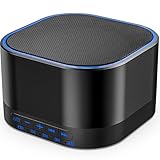
The table compares what each machine is, what the guest operates and what the host sets in advance. For what each machine costs, check the current price on Amazon on the exact listing — prices change, and the listing is the authority.
| Product | Sound source | What the guest operates | What the host sets in advance | Power | Link |
|---|---|---|---|---|---|
| SNOOZ Original (Charcoal) | Real fan | Three buttons, twist shell | App schedule and fade | Plug-in only | Check on Amazon |
| Hatch Rest, 2nd Gen | Recordings | Almost nothing — host-operated | Wi-Fi routines, stored on device | Plug-in only | Check on Amazon |
| Yogasleep Dohm (White/Gray) | Real fan | One switch, twist collar | Nothing to set | Plug-in only | Check on Amazon |
| LectroFan EVO | Generated electronically | Buttons — 22 sounds, fine volume | Timer out to 8 hours | Plug-in (USB or AC) | Check on Amazon |
| LectroFan Micro2 (White) | Recordings + Bluetooth speaker | Buttons, anywhere in the room | A full charge | Rechargeable battery, USB-C | Check on Amazon |
| Magicteam Sound Machine (SN-A1) | Recordings | One button — memory restores the pre-set | The sound and volume, once | Plug-in (AC or USB) | Check on Amazon |
How to Choose a White Noise Machine for a Guest Room Under $100
- Run the midnight test first. Stand in the guest room, lights off, and ask of each candidate: can a stranger start it, quiet it and stop it by touch? The Dohm and the Magicteam pass with one control each; the SNOOZ passes with three buttons; the Hatch, app-operated by design, passes only because the guest is never its operator.
- Decide who the app belongs to. In a guest room, app control is a host feature — schedules, fades and routines set before arrival. If a machine needs the guest’s phone, the guest’s account or the guest’s patience, it has failed this room’s basic test, whatever it costs.
- Name the schedule you actually need. “Start before bedtime, fade out by morning” is a SNOOZ. “Run the nursery’s routine while the grandchild visits” is a Hatch. “Be on when the switch flips” is a Dohm. An app bought for a schedule you never set is the most expensive feature in this guide.
- Count the guest room’s outlets before the features. Five of these six picks plug in. If the bedside outlet already carries a lamp and a phone charger, the honest shortlist is the Micro2 — charged in advance, placed anywhere — or a rearranged room, not a smarter plug-in machine.
- Match the machine to the guests you actually get. Grandparents and the technically unhurried: the Dohm. A couple on different schedules: the EVO, for its headphone jack. Guests with a baby: the Hatch, labeled a nursery machine because it is one. Everyone, cheaply and well: the Magicteam.
- Place it between the guest and the noise. Masking works by position — between the sleeper and the door, the hallway or the street wall, at the lowest volume that does the job. The SNOOZ’s own listing puts it three to six feet from the sleeper’s head; treat that geometry as the guide for every pick.
- Read what sits behind the subscription. The Hatch’s core sound, light and routines are free; its premium stories and content are rented through Hatch+. Every other pick here charges nothing after purchase. Decide which model you are comfortable hosting before the trial clock starts.
- Do not pay smart prices for the masking. The Magicteam — the lowest-priced pick here; check price on Amazon — masks a hallway as well as the top-of-band hero. Spend up for the fan’s texture, the schedule or the battery, never for a stronger grade of the basic effect, because no listing here sells one.
- Check the color listing, not just the model. Colors are separate Amazon listings with separate offers — the SNOOZ we pin is Charcoal, the EVO and Micro2 we pin are White. A cheaper color is a different listing; verify it as carefully as a different machine.
The Midnight Test: What a Stranger Can Run in the Dark
Every machine in this guide was re-read for this variant against a single scene: a guest, a dark room, a machine they have never seen. The results sort the slate more honestly than any feature table. At the top sit the machines with a physical answer to every question. The Dohm asks one thing — a switch — and offers one gesture, a twist; there is no state it can be left in that confuses the next person. The Magicteam is nearly as simple once the host has done its one piece of setup: its memory function means the power button returns the guest to the host’s chosen sound and volume, every time. The SNOOZ splits the difference by design — three buttons and a twisting shell for the guest, with everything complicated (schedules, fades, calibration) living in the host’s app, where it belongs.
The middle of the ranking is where hosts earn their keep. The EVO gives a guest buttons and a deep library: operable in the dark, but with choices to browse, which some guests love and others experience as homework at 1 a.m. The Micro2 is simple to run, yet it introduces the one failure mode no plug-in pick has — it can be dead, if the host forgot the charge, and a dead machine fails the midnight test completely. And the Hatch Rest inverts the test: controlled through its app with minimal physical controls, the guest operates almost nothing. That is a pass when the host’s routine runs itself, and a fail the night a guest wants the sound changed and finds a smooth, buttonless object. The lesson is not that smart is bad; it is that in a guest room, every feature must be assigned an owner — and the owner is you.
Set It Before They Arrive: Schedules, Fades and Timers as the Host’s Tools
The kindest sound machine is the one already running when the guest goes to bed — masking the hallway at a volume chosen by someone who knows the room. That is what this tier’s control features are for, and each pick offers the host a different instrument. The SNOOZ’s is the most complete: its free app sets automatic on and off times by day and fades the machine down as it winds off, so the room is masked at bedtime and silent by morning without the guest touching a schedule. The Hatch Rest stores its routines on the device — pair a light color with a sound, set the times once, and the routine repeats for the whole stay, which is exactly right for a visiting baby’s household and exactly why the machine is labeled a nursery product throughout this guide. The EVO’s eight-hour timer is the unconnected version of the same kindness: set it in the afternoon and it outlasts the falling-asleep, then stops itself.
The remaining picks ask less because they offer less — and say so. The Magicteam’s timers run one to four hours, enough for the falling-asleep window, and its memory function is the pre-set that matters: sound and volume chosen once, restored forever. The Micro2’s preparation is a charge, not a setting; do it the day before, and its maker’s battery ratings — 20 to 30 hours in the listing, up to 40 hours claimed elsewhere, both printed here as the conflicting claims they are — cover a long weekend either way. The Dohm asks nothing and offers nothing: no timer, no fade, a fan that runs until the guest’s own hand ends it, which many guests actively prefer. Whichever instrument you choose, do the setting before the visit, test it one night yourself, then leave the machine alone. A guest room is the one room where the technology should be finished before the door opens.
How Often the Room Works: Busy Nights and Quiet Years
A guest room machine is not used the way a bedroom machine is used nightly — it is used in bursts, when someone comes to stay, and sits ready the rest of the year. That rhythm, not any feature list, is the honest way to judge what this tier asks of a host. Take the two cadences a spare room actually lives at. A busy guest room hosts about 24 nights a year, which is 120 guest nights over five years; a quiet one hosts about 6 nights a year, which is 30 guest nights over five years. Against the busy cadence, every pick in this guide earns its place quickly: guests arrive often enough that schedules, fades, routines and a charged battery are exercised again and again, and the host’s setup work is repaid stay after stay. Against the quiet cadence, the same machines spend most of their lives waiting — still ready, but rarely asked.
Read that rhythm the way it wants to be read. In a busy guest room, the host layer is worth choosing carefully: buy the SNOOZ’s schedule and fan texture, the Hatch’s routines where a baby visits, or the EVO’s timer and headphone jack, without a second thought, because frequent guests will use them. In a quiet guest room, the honest purchase is the simplest machine that masks well — the low-band Magicteam, pre-set and forgotten, or the Dohm, which asks nothing between visits — for a machine that sits idle fifty weeks a year, simplicity ages better than features. The middle follows the same discipline: the Micro2’s battery is worth choosing in the room with no free outlet, and adds nothing in the room with three. Match the machine to the room you have and the guests you actually host, not to the room in the listing photo.
Common Buying Mistakes
- Buying an app machine and expecting the guest to pair it. In a guest room the app is the host’s tool; a machine that needs the guest’s phone has failed the room.
- Leaving the machine unconfigured in its box state. Guests will not read the manual, set the schedule or choose the sound — whatever you did not set before arrival does not exist.
- Buying the nursery machine for adult guests. The Hatch Rest is an excellent product for the room it was designed for; in an adult guest room its routines, light cues and subscription are answers to unasked questions.
- Forgetting the outlet count. Five of these six picks plug in, and guest rooms are where the lamp, the charger and the clock already won. The battery pick exists because of this mistake.
- Setting the volume for an empty house at noon. Masking is judged at 2 a.m. by a light sleeper in a strange bed: place the machine between the guest and the noise, at the lowest level that works.
- Believing the title: expecting headphone-style noise cancellation from machines that mask — the word is in nearly every listing here, the technology is in none of them.
- Trusting the strike-through price. Theatrical list prices are this band’s native art form; check the current price on Amazon on the exact listing instead, and judge the machine by its features, not by a discount story.
- Letting the rechargeable pick go flat between guests. A charged Micro2 is the most flexible machine here; an uncharged one is the only pick that can score zero on the night it is needed.
Final Recommendation
- Most guest rooms: SNOOZ Original (Charcoal).
- Guests with a baby, or a nursery that hosts: Hatch Rest, 2nd Gen.
- Zero learning curve: Yogasleep Dohm (White/Gray).
- Choice, timer and headphones: LectroFan EVO.
- No outlet by the bed: LectroFan Micro2 (White).
- Occasional room, honest minimum: Magicteam Sound Machine (SN-A1).
Our top two are the SNOOZ for hosts who will actually use the host’s layer — a real fan’s loop-free sound, scheduled and faded from your phone before the guest arrives, worked by the guest with three buttons and no subscription — and the Dohm for everyone else: the same family of sound with nothing attached, at a lower position in the band, in a form no visitor can operate wrongly. The Hatch Rest is the right buy for exactly the rooms its label describes; the EVO remains the flexible digital machine, now with a timer working the host’s shift; the Micro2 finally answers the battery question; and the Magicteam closes the series as it opened it, as the honest floor — pre-set it once and it will serve a decade of guests. None of these machines cancels noise or treats a condition; they mask, and at this budget you can choose not just the texture of the masking but who controls it. Check the live price on the exact color listing, set the machine up before the visit, sleep in the room once yourself — then let your guests sleep.
Frequently Asked Questions
Does a $100 machine mask better than a $30 one?
Not at the basic job. Masking depends on the sound’s character, its volume and the machine’s placement — between the sleeper and the noise source, at the lowest level that works — and the lowest-priced machine in this guide, playing brown noise by the door, masks a hallway as well as the top-of-band hero playing its fan sound from the same spot. What stepping up the band buys is texture (a real fan, generated tones), control (schedules, app remotes, routines) and, in one pick here, a battery. Your guest sleeps in the masking; the control is for you.
Will my guest need to download an app?
No — and if a machine required it, it would not belong in this guide. The SNOOZ works without its app: the listing describes a simple three-button design for power, tone and volume, and the app adds only what buttons cannot — schedules by day, a fade, and remote control within Bluetooth range, all set by the host. The Hatch Rest is the opposite design, controlled through its app with minimal physical controls, which is precisely why this guide assigns it to the host and labels it a nursery machine.
Which machine is simplest for a guest who hates technology?
The Dohm, and it is not close: one switch, two speeds, and a collar that twists to shape the tone. There is no menu, pairing or account, and nothing a guest can set wrongly. The runner-up is the Magicteam, once you have pre-set it — its memory function restores your chosen sound and volume, so the guest’s whole interaction is the power button.
What if the guest room has no free outlet near the bed?
That is the Micro2’s entire case: it is rechargeable, so you charge it before the visit and place it wherever the masking works. Its maker rates a charge at 20 to 30 hours in the listing and up to 40 hours in other materials — conflicting claims we print unharmonized — but even the low figure covers several guest nights. The other five picks all plug in, and an extension cord across a guest room floor is a worse answer than a smaller speaker.
Is the Hatch Rest a good choice for an adult guest room?
Honestly, no — it is a nursery machine, and this guide labels it as one wherever it appears. It earns its place here for the guest room that hosts a baby or toddler, or doubles as the nursery, where its Wi-Fi routines and time-to-rise light are genuinely the point. For adult guests it offers an app-operated machine whose best features answer needs they do not have; the SNOOZ, Dohm or EVO will serve them better.
Where should the machine sit, and how loud?
Between the guest and the noise — by the door for hallway sound, on the street-side wall for traffic — at the lowest volume that evens the room out. The SNOOZ’s own listing guidance puts the device three to six feet from the sleeper’s head, and that geometry serves every pick here. If the machine is ever used in a nursery, the commonly cited pediatric guidance is about distance and restraint: roughly seven feet from the crib, volume in the lower half of the range. If you have specific concerns about a child’s hearing or sleep, a pediatrician’s advice comes before a product page.
- Best White Noise Machines Under $100
- Best White Noise Machine For Apartments Under $100
- Best White Noise Machine For Small Bedrooms Under $100
- Best Weighted Blanket Under $100
- Best Wardrobe Under $100