Where to buy
Check the latest price, availability and delivery on Amazon. Orders are placed on Amazon. We may earn a commission from qualifying purchases.
- Best overall: SNOOZ Pro Smart White Noise Machine & Travel Case (Cotton) — Check on Amazon
- Adaptive Sound Technologies Sound+Sleep SE (White) — Check on Amazon
- SNOOZ Original Smart White Noise Machine (Charcoal) — Check on Amazon
- Hatch Rest Baby Sound Machine, Night Light, 2nd Gen (Wi-Fi) — Check on Amazon
See 2 more Amazon options
- Yogasleep Dohm (White/Gray) — The Original White Noise Machine — Check on Amazon
- Magicteam Sound Machine with 20 Non-Looping Sounds (SN-A1, Black) — Check on Amazon
Read the full guide ↓
Disclosure: As an Amazon Associate, umtsmarttool.com earns from qualifying purchases. Links to Amazon on this page are affiliate links; they cost you nothing extra. Listing details such as price and availability change often, so check the current Amazon listing before you buy.
A renter cannot fix the building: you cannot insulate the shared wall, replace the boiler that bangs at 6 a.m., or re-time the upstairs neighbor’s footsteps — the lease forbids most of it and the landlord funds none of it. Masking is the one intervention that is entirely yours: a machine on your nightstand that raises your room’s background sound evenly, so the building’s irregular noises stand out less against it. The best white noise machines for apartments under $200 are the finished versions of that intervention, and the honest headline is the one this series has printed at $30, $75 and $100: the masking itself still does not improve with price. The hero of our under-$30 guide — a small plug-in cube at the budget end of the range — survives into this fourth guide unchanged, because against a steady hallway it still masks as well as anything here. What $200 buys instead is refinement, and, for apartment dwellers specifically, one genuine novelty: adaptive volume. The Sound+Sleep SE listens to the room, its maker says, and raises or lowers its own level as the noise around it changes — and building noise, unlike a steady hum, is exactly the kind that changes.
So the under-$200 apartment field is the under-$100 field, finished. The sound is still made the same three ways — a real fan, an electronic generator, recordings — and the money above $100 polishes the delivery: a flagship fan whose schedule starts the masking before you get home, a 64-profile library with a self-adjusting volume, and the same nursery machine and unconnected classics in their established roles. The slate runs from a budget control at the lowest end of the band to a flagship at the top — check price on Amazon for each pick before you buy. Two honest displacements follow, detailed below: the LectroFan EVO is displaced by its own maker’s flagship, and the rechargeable question gets the same answer for the fourth guide running — not one of these six picks runs on a battery.
Within that map, most renters should start with the SNOOZ Pro — the complete fan machine, with the schedule, the case and the knob — while knowing the Original beneath it makes the identical sound for less — check the current price on Amazon for both before you choose. If your building’s noise comes and goes rather than humming steadily, the Sound+Sleep SE is the interesting machine in this guide — the first one aimed at your exact problem. If the machine is for a nursery corner of the apartment, the Hatch Rest remains the smart pick, labeled plainly below as the baby machine it is. And if you need none of it, the Dohm and the Magicteam close this guide at the accessible end of the band, as they have closed every tier. Below: a quick picks table, detailed notes on each machine, a comparison table, a buying checklist, the mistakes apartment shoppers make most, and answers to the questions that come up again and again.
In this guide
Quick Picks
Short on time, or comparing several options at once? Each row below names a buyer type and the machine that suits it, with a link to the listing.
| Buyer type | Pick | Why it stands out | Link |
|---|---|---|---|
| Best overall | SNOOZ Pro (Cotton) | The flagship real fan — schedules that start before you get home, tone knob, travel case | Check on Amazon |
| Best for changing building noise | Sound+Sleep SE | 64 profiles whose volume adjusts to the room, per the maker — plus a headphone jack | Check on Amazon |
| Best fan value | SNOOZ Original (Charcoal) | The same fan sound and app scheduling as the Pro, for less — check price on Amazon | Check on Amazon |
| Best smart nursery machine | Hatch Rest, 2nd Gen | Wi-Fi app control, routines and a color night light | Check on Amazon |
| Best without an app | Yogasleep Dohm (White/Gray) | The real two-speed fan, unchanged — a switch and a collar | Check on Amazon |
| Best value | Magicteam Sound Machine (SN-A1) | The under-$30 hero — the cheapest complete masking machine here | Check on Amazon |
How These Picks Were Chosen
The first filter was the budget itself, applied honestly. Every machine below is a real Amazon US listing pinned to an exact ASIN and verified at or under the $200 budget in our research — check price on Amazon to confirm the current price before you buy. Machines we could not pin to an exact Amazon listing are named without links at the end of this section, however good they may be. Because this guide continues our under-$100 guide, we re-checked that guide’s six picks: all six still fit this budget — but two are honestly displaced here. The LectroFan EVO is displaced by its own maker’s flagship, the Sound+Sleep SE, which takes the premium digital slot at this tier with 64 profiles to the EVO’s 22 and an adaptive mode the EVO does not have; the EVO remains the recommendation of our cheaper guides. The LectroFan Micro2 is displaced by scope rather than by a rival: still the best-verified rechargeable machine we can pin, it stays the battery answer of our under-$100 guide instead of taking a second slot here — which means, stated plainly for renters, that this slate has no battery pick at all. The Yogasleep Duet, Dreamegg D1 and Douni, displaced at $100, stay displaced.
We did not use these machines ourselves. We read the maker listings, manuals and specification pages, and compared what actually differs for an apartment: how the sound is made (fan, generator or recording), whether a machine adjusts itself or merely plays, what the app controls beyond the basics, whether a headphone jack lets you listen without adding sound to a shared wall, and what sits behind a paywall. Maker claims are printed as maker claims: when a listing says its sounds are non-looping, its volume adapts to the room, or its app will build you a healthier routine, we attribute that to the maker rather than assert it as something we tested. Decibel figures appear only where a listing states them — and, as in every guide in this series, none is printed here. And where a listing or a brand’s own pages contradict themselves, we print the contradiction rather than quietly picking the friendlier figure.
One word still needs the warning it got at $30, $75 and $100: “canceling.” Listing titles in this band use it too, and none of these machines cancels noise in the headphone sense — there is no anti-noise waveform in any of them. They mask: they raise the room’s background sound level evenly so that irregular noises — a door, a voice, a dog’s tags — have less contrast to stand out against. That is the whole of the effect; these machines do not treat any medical condition, and the app-store language about deeper, healthier sleep that surrounds the smart tier is marketing, printed here as such. The one partial exception to “they merely play” is the adaptive machine below, and it is still masking — masking whose volume moves.
Named without links, because each failed a test above: the Yogasleep Dohm Connect, the Dohm’s app-controlled sibling — a real fan with app power, volume and schedules, sold by the brand and other major retailers, but unpinnable to an exact Amazon US ASIN in this pass either, for the fourth guide running, so it is named here rather than linked; the Yogasleep Dohm Nova, the fan-plus-light model, which failed the same Amazon pinning test again; the Hatch Rest+ 2nd Gen, whose listing details still conflict and which a current source reports discontinued; the Hatch Rest Go, Hatch’s rechargeable nursery puck, pinned in our research but baby-only, its job covered for general buyers by the Micro2 in our under-$100 guide; the Hatch Restore 3, Hatch’s sunrise alarm clock, inside this budget in our research, but a clock whose sound machine is the supporting act, a different product from the one this guide is about, and the honest address for buyers whose real want is the sunrise; the SNOOZ Go 2, SNOOZ’s rechargeable travel machine, whose Amazon listing we still could not pin to an exact ASIN; the LectroFan Classic, displaced by its EVO sibling two tiers ago; the older Sound+Sleep, the SE’s 30-sound predecessor; and, carried over because they remain unpinned, the myBaby SoundSpa Portable, the Momcozy sound machine and the Yogasleep Hushh 2.
The 6 Best White Noise Machines for Apartments Under $200
SNOOZ Pro Smart White Noise Machine & Travel Case (Cotton)
Who it suits: The renter who decided the fan-plus-schedule idea was right in the lower tiers and wants its finished form — masking that starts before they get home, easier tone control, and a case for the trips and the eventual move.
The SNOOZ Pro is the flagship of the only idea this category has had above $75: a real fan, no speaker, no recordings, shaped by its housing and run by a free app. For an apartment, the app’s scheduling is the headline: set the machine to start before you walk in, and the mask is already up when the evening’s building noise begins; set it to fade out after you are asleep, or in as you wake. What the Pro adds over the Original is written down by the maker itself, and it is a refreshingly honest list: an upgraded build and fabric design, an easy-set tone control knob on the bottom of the machine instead of twisting the whole outer shell, expanded app functionality — the listing describes multiple timers, over-the-air updates and automatic daylight-saving adjustment alongside the scheduling with fades, remote control, night light mode and nursery calibration the app already had — and a protective travel case included in the box. The fan itself is unchanged: ten volume levels, adjustable tone, plug-in power on a world-voltage adapter, and 1.2 pounds with the case. Check the current price on Amazon for the SNOOZ Pro in Cotton before you buy — it sits at the flagship end of this band. An older crawl of this listing showed no featured offers, so confirm the live offer before ordering.
The honest limitation is the maker’s own sentence: the sound quality and volume range are the same across both SNOOZ models. The premium over the Original buys no masking and no new sound — it buys ergonomics (a knob is genuinely easier than a shell at 2 a.m.), software depth, and a case; a set-and-forget bedroom gets the Original’s identical sound for less. The standing smart-tier costs apply unchanged: the app is Bluetooth, not Wi-Fi, so the remote works from the bedroom or hallway rather than across town, there is no voice-assistant integration (the maker suggests a smart plug as the bridge), and there is no battery — it just travels in a nicer case, which in a renter’s life of moves and trips is worth more than it sounds. What it never asks for is money after the purchase: no subscription, ever, in the maker’s words — the feature this tier keeps failing to make standard.
- A real fan makes the sound — no recordings, no loop — with tone set by a knob instead of a twisting shell.
- A free app adds scheduling with fades, multiple timers and remote control over Bluetooth, with no subscription — set it to start before you get home.
- A travel case is included; 1.2 pounds with the case, on a 100-to-240-volt adapter.
- Flagship positioning in this band — check price on Amazon for the current price.
Honest limitation: The premium over the Original buys a knob, a case and app extras — by the maker’s own account, the sound and volume range are the Original’s.
Choose it if you want the finished version of the fan-plus-schedule idea and will use the schedule, the case or the knob. Skip it if the machine will sit on one nightstand forever — the Original below makes the same sound for less.

Adaptive Sound Technologies Sound+Sleep SE (White)
Who it suits: Renters whose building noise comes and goes — the flat over a street with traffic swells, the unit beside a boiler that cycles, the bedroom under a neighbor whose schedule is not yours — who want a machine that reacts instead of playing at one level all night.
The Sound+Sleep SE is the premium digital machine of this band, from the same maker as the LectroFan line, and it brings the one genuinely new mechanism in this guide — the one that happens to be aimed at the apartment problem. Apartment noise is changing noise — pipes, footsteps, a cycling radiator — and a fixed mask set for the quiet hour is too low for the loud one, and needlessly high all night if set for the loud one. The SE’s headline answers that directly: adaptive sound technology, which the maker describes as the machine listening to the room and adjusting its volume in response to changing noise — the traffic swell gets a louder mask, the quiet hour gets a softer one, without a hand on the dial. Its library is the deepest here: 64 sound profiles across 16 categories, four variations per category per the maker’s manual — fan sounds, white, pink and brown noise, and recorded nature and environment tracks the maker describes as non-looping. Around that core it is a fully equipped bedside box: precision volume settings, a choice of sleep timers, a 3.5 mm headphone jack — the thin-wall courtesy: private listening that adds no sound to the wall your neighbor sleeps against — an audio input, and two USB charging ports, a real economy in a bedroom short of outlets. It runs on a 100-to-240-volt adapter. Check the current price on Amazon for the Sound+Sleep SE in White — it sits in the premium part of this band.
The limitations deserve the same plainness. The adaptive mode is a maker-described system we did not test: it adjusts volume, which is the bluntest variable in masking, and a renter whose problem is a steady noise floor — a constant hallway hum — gains nothing from it; that is what the fans and the control below are for. The sounds are recordings, however high their fidelity and however the maker describes their looping; ears that fixate on patterns have the fans above as their honest answer. It is the largest, most desk-bound machine in this guide, with no app, no battery and no schedule — its intelligence is local and acoustic, not connected.
- 64 sound profiles in 16 categories — the deepest library in this guide, four variations per category.
- Adaptive mode: the maker says the machine listens and adjusts its volume as room noise changes — the apartment feature of this band.
- A headphone jack for thin walls, an audio input and two USB charging ports; precision volume; sleep timers.
- Premium positioning in this band — check price on Amazon for the current price.
Honest limitation: Recordings rather than a fan or a generator, an adaptive claim we print as the maker’s description, and no app or battery — a big, plugged-in, self-adjusting box.
Choose it if your building’s noise rises and falls and you want the deepest library with a jack. Skip it if your noise is steady (the fans mask it for less) or you want scheduling (the SNOOZ machines).

SNOOZ Original Smart White Noise Machine (Charcoal)
Who it suits: The loop-free renter with a routine, who wants the fan and the schedule — the mask already running when they walk in — and is happy to leave the flagship’s knob and case on the shelf.
Everything about this pick is inherited from our under-$100 guide, where the SNOOZ Original is the hero, and it earns its place at $200 on fresh evidence in the same role: check the current price on Amazon — it sits below the Pro in this band, in the mid-to-upper part of the range. Inside its fabric-covered dome — 5.6 by 5.6 by 3.2 inches, about 1.1 pounds — there is a real fan and no speaker at all: the listing is explicit that there are no digital sounds and no recordings, just one fan sound, shaped two ways. You twist the outer shell to change the tone, step through ten volume levels, and a free app — connected over Bluetooth — acts as remote and scheduler, with automatic on and off times and a fade as the machine winds down; the listing family also advertises a small built-in night light the app can toggle. Its role in this guide is to be the Pro’s control: the maker states the two machines’ sound and volume range are the same, so this pick is the standing proof of what the flagship premium does and does not buy — in an apartment, where the schedule is the feature that matters most, the Original delivers it whole.
Its limitations are the ones recorded at $100, unchanged. The app is Bluetooth, not Wi-Fi — a scheduler and a same-room remote, with no voice-assistant integration. The machine is plug-in only, on a six-foot cord, with no battery: in a bedroom where the only outlet is across the room, that cord length is a placement fact to plan around, not a detail. And one sound is one sound: ten volumes and a twisting shell give it range, but a household that cannot agree on fan noise gets no second answer.
- A real fan makes the sound — no recordings, no loop — with tone adjusted by twisting the shell.
- A free app adds scheduling, fade-out and remote control over Bluetooth, with no subscription.
- Below the Pro in this band — check price on Amazon for the current price.
Honest limitation: One fan sound only, plug-in only on a six-foot cord, and the app is Bluetooth-range — a scheduler and a remote, not a whole smart home.
Choose it if you want the fan’s texture with a routine attached and no ongoing costs. Skip it if you want the knob, the case and the deeper app (the Pro), sound variety, or battery power.

Hatch Rest Baby Sound Machine, Night Light — 2nd Gen (Wi-Fi)
Who it suits: Renters with a baby — households building a nursery routine in one corner of an apartment, who want the machine, the light and the wake-up cue run from a phone, and adjusted without opening the nursery door.
Label first, because this guide labels baby machines wherever they appear: the Hatch Rest is a nursery product, sold as a registry essential, and everything about it is designed for a child’s room. In this apartment guide it earns its slot only for renters with a baby, and it is not disguised as a general adult pick. Within that job it remains the most complete smart machine in this guide, carried up from our under-$100 guide in the same role — check the current price on Amazon, where it sits in the middle of this band, and let the live listing be the authority. It combines a sound machine — a library of sleep sounds, with Hatch’s current materials counting 24 included free — a night light whose color and brightness are set from the app, and a time-to-rise function that changes the light to tell a toddler the day has started. The connection is Wi-Fi, the step beyond the SNOOZ machines’ Bluetooth: the Hatch app controls the machine from anywhere in the home, builds routines that pair light and sound and run on schedule, and stores those routines on the device so they keep running once set. Nothing at $200 that we could pin displaces it.
The costs are the connected nursery’s costs, and they deserve plain statement. Part of Hatch’s world is a subscription, Hatch+: premium stories, music and extra content sit behind it on a subscription plan after an included trial, and the app will remind you it exists. The machine’s core job — sound, light, routines — works without paying, and this guide’s recommendation rests on that free core only. There is no battery: the Rest is mains-powered, and the sibling that added one could not be pinned inside this budget in our research. There is no headphone jack, and the sounds are recordings played through a speaker — the masking itself is ordinary, and parents should hold it to the same placement discipline as any nursery machine here: across the room from the crib, roughly seven feet is the commonly cited figure, and the volume in the lower half of its range. Buy it for the routine, not for a better grade of noise.
- Sound machine, color night light and time-to-rise cue in one Wi-Fi device, run from the Hatch app.
- Routines pair light and sound on a schedule and are stored on the device once set.
- Mid-band positioning — check price on Amazon for the current price.
Honest limitation: A nursery machine, mains-powered only, whose premium content sits behind the Hatch+ subscription — the free core is the buy, and renters without a baby should look at the other five.
Choose it if the machine is for a child’s room in your apartment and the routine is the point. Skip it if you want an adult bedroom machine, a battery, or a product with no subscription anywhere in its world.

Yogasleep Dohm (White/Gray) — The Original White Noise Machine
Who it suits: Any renter who read the reviews above and felt tired — buyers who want the fan’s sound with no app, no account, no pairing and nothing to update, for a decade of leases.
Everything about this pick is inherited from our under-$75 guide, where the Dohm is the hero, and it earns its place at $200 on the same evidence in the same role: check the current price on Amazon for the Dohm in White/Gray, sold by Yogasleep — it sits in the lower-middle part of this band. Inside there is no speaker and no sound file: a real electric fan, running at two speeds, pushes air through the housing, and you shape the sound physically — flip the switch, then rotate the cap and collar to open or close the housing, which changes tone and volume together. Because the sound is made by physics rather than played back, there is no loop for a light sleeper’s brain to find at 3 a.m. Yogasleep has made this machine, in evolving forms, since 1962, and says it is assembled in the USA. Its role in this guide is the one it has had since $75: the control for everything smarter. Set it beside the two SNOOZ machines and the comparison is exact — same family of sound, at a notably lower position in the band, and the difference is a scheduler, a knob, a case and an app. For a large share of apartment bedrooms that difference is worth nothing, and this machine is the proof.
Its paperwork carries the same honest note as in our cheaper guides, because the listing still contradicts itself on a small thing — and in an apartment the small thing matters twice, because cord length decides where the machine can sit against a fixed outlet: its product information gives dimensions of 5.5 by 5.5 by 4 inches, while Yogasleep’s own site describes the machine at 5.6 by 5.6 by 3.5 inches, and copies of the listing variously describe the power cord as six feet and as eight feet. We print both rather than choose. The limitations are the ones that define it: exactly one sound, two coarse speed steps rather than a fine volume ladder, no timer — it runs until you switch it off — no light, no jack, and no remote of any kind. A smart plug, bought separately, is the traditional owner’s answer to the missing timer, and the fact that owners bother tells you how they rate the sound. Buy it as the machine that cannot be bricked by an update.
- A real two-speed fan makes the sound — no recording, no loop, nothing to repeat.
- Tone and volume adjusted mechanically, by rotating the cap and collar.
- Lower-middle positioning in this band — check price on Amazon for the same physics as the hero’s.
Honest limitation: One sound only, no timer, no light, no app — and two speeds are coarser volume control than any digital pick here.
Choose it if you want the fan’s sound and a machine with no electronics to age, pair or update. Skip it if you want a schedule or control from your phone — that is the SNOOZ pair, higher in this band.

Magicteam Sound Machine with 20 Non-Looping Sounds (SN-A1, Black)
Who it suits: The renter who has read this far and realized they need none of it — no fan, no app, no adaptation — just masking, done well, at the budget end of this guide.
Everything about this pick is inherited from our under-$30 guide, where the Magicteam is the hero, and it earns its place at $200 on the same evidence in the same role: check the current price on Amazon — it is the lowest-priced complete pick in this guide, at the budget end of the band. It is a small black plug-in cube holding 20 sounds the maker describes as non-looping — white, brown, pink and blue noise, a fan, a brook, rain, ocean, birds and a bonfire among them — with 32 volume levels, timers at 1, 2, 3 or 4 hours or continuous play, and a memory function that restores your last sound and volume, which in a rental means one setup and then a single press every night after. There is no battery; it runs from its AC adapter or any USB port. For plain masking of a steady noise floor, by the door, at the lowest volume that works, the extra money buys a fan’s texture, a knob, a case, a library, an adaptive dial and a routine: everything except a better-masked room.
Its limitations are the entry tier’s limitations, carried up unchanged through three further guides. The listing does not list a headphone jack — so unlike the SE above, it offers no way to listen privately without adding sound to a shared wall — and there is no light, no Bluetooth and no schedule. The one-button sound cycling means your sound can be several presses away, a tax the memory function reduces to once at setup. And its sounds are recordings played through a small speaker: the maker calls them non-looping, we print that as the maker’s description, and a listener who fixates on patterns has the fans above, not this cube, as their honest answer. Against a steady hallway, though, nothing here out-masks it — which is why it closes the slate of the most expensive guide in the series exactly as it opened the cheapest.
- 20 sounds, described by the maker as non-looping, spanning four noise colors, fan and nature.
- 32 volume levels and timers to 4 hours — the finest cheap volume control in any of our guides.
- Budget-end positioning — the lowest-priced pick here; check price on Amazon for the current price.
Honest limitation: No headphone jack, no light, no app, no battery, and it must stay plugged in — the entry tier’s limits, carried up unchanged.
Choose it if masking a steady hallway is the whole brief and you would rather spend less. Skip it if you came to this guide for the fan, the schedule, or a machine that answers a changing building.
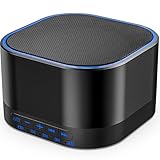
Comparison Table
| Product | Sound source | Sounds | App control | Power | Price | Link |
|---|---|---|---|---|---|---|
| SNOOZ Pro (Cotton) | Real fan | 1 (ten volume levels, adjustable tone) | Yes — Bluetooth app, schedules, fades, multiple timers | Plug-in only | Check price on Amazon | Check on Amazon |
| Sound+Sleep SE | Recordings, maker-described as non-looping | 64 profiles in 16 categories, adaptive volume | No — adaptive volume on-device instead | Plug-in only | Check price on Amazon | Check on Amazon |
| SNOOZ Original (Charcoal) | Real fan | 1 (ten volume levels, adjustable tone) | Yes — Bluetooth app, schedules and fade | Plug-in only | Check price on Amazon | Check on Amazon |
| Hatch Rest, 2nd Gen | Recordings | Library — 24 included free per Hatch | Yes — Wi-Fi app, routines, time-to-rise | Plug-in only | Check price on Amazon | Check on Amazon |
| Yogasleep Dohm (White/Gray) | Real fan | 1 (two speeds, adjustable tone) | No | Plug-in only | Check price on Amazon | Check on Amazon |
| Magicteam Sound Machine (SN-A1) | Recordings | 20, maker-described as non-looping | No | Plug-in (AC or USB) | Check price on Amazon | Check on Amazon |
How to Choose a White Noise Machine for an Apartment Under $200
- Decide whether you are buying sound, control or refinement. The sound was settled by $75 and the control by $100. Everything above that line buys finish: a knob instead of a shell, a case, a deeper app, a self-adjusting volume. Consider the layers separately in your head before you shop.
- Read the flagship’s difference list, not its name. The maker of this guide’s hero states its sound and volume range are identical to the cheaper model’s. That kind of sentence — in the maker’s own materials — is the most valuable line in this band; believe it, and pay the difference only for the listed conveniences.
- Match the machine to your building’s noise shape. A steady hum or a constant hallway is a fixed-volume problem: a fan or the budget control solves it. Noise that swells and fades — traffic, pipes banging then stopping, footsteps passing, a radiator cycling — is the one case where the adaptive machine’s moving volume is a real feature rather than a refinement, and it is the standard condition of apartment life.
- Name the schedule you actually need. “Start before I get home, fade out by 6” is a SNOOZ or a Hatch. “Be on when I flip the switch” is a Dohm. An app bought for a schedule you never set is the most expensive feature in this guide.
- Think about the wall behind the machine. Masking adds sound to your room; at the lowest volume that works, placed near you rather than against the shared wall, it stays your business. If you listen late and loud, the SE’s headphone jack is the courteous answer — private listening that adds nothing to your neighbor’s side.
- Read what sits behind the subscription. The Hatch’s core sound, light and routines are free; its premium stories and content are rented through Hatch+. The SNOOZ pair and every other pick here charge nothing after purchase. Decide which model you are comfortable living with before the trial clock starts.
- Ask the battery question honestly. No pick in this guide has one, for the fourth tier running — the features this money buys are power-hungry and stationary. If the machine must run away from outlets, the answer is still the rechargeable puck in our under-$100 guide, not anything here.
- Check the live listing, not the strike-through. This band’s offer pages attach theatrical headline prices to ordinary machines. Check the current price on Amazon on the exact listing before you buy.
Adaptive Volume: The First Masker Aimed at Building Noise
Every machine in the three cheaper guides in this series does one thing with its volume: holds it where you set it. The Sound+Sleep SE is the first pick we have verified that does something else. Its maker describes an adaptive mode in which the machine monitors the room’s noise and adjusts its own volume in response — louder as the street swells, softer as the house settles. In a house with a steady noise floor that is a refinement. In an apartment it is closer to the point, because a building’s noise is never steady: it is a sequence of events. The pipes bang at six and are silent by seven. Footsteps cross the ceiling at eleven and do not come back. The radiator knocks through its cycle and stops. A fixed machine forces you to choose which hour to mask for; the adaptive machine, on its maker’s description, follows the sequence — a real architectural difference, answering the one masking problem a fixed machine genuinely has.
Its limits are equally mechanical. Adaptive volume moves the bluntest variable in masking — level — and does nothing to the sound’s character; a recording you can hear looping at low volume is the same recording, louder. It is also, in this guide, a maker-described system: we print the claim as the maker’s, as this series prints every claim it cannot test, and the return window is the honest trial. And it arrives in the least connected box here — no app, no schedule, no battery — the mirror image of the SNOOZ pair: their intelligence is in the phone and the timetable, its intelligence is in the room and the moment. Choose which kind your building calls for; at $200 the category sells both, and they are not the same product.
Placement: Between You and the Noise
Masking works on contrast, and contrast is a geometry problem before it is a volume problem. The machine belongs between you and the noise — not beside your pillow by default, but on the path the noise takes to reach you. For hallway noise, that means near the door. For a shared wall, it means on that side of the room, closer to the wall than to the bed, so the mask is established before the neighbor’s television arrives. For street noise, it means toward the window. Placed on the noise path, a machine masks at a lower volume than the same machine across the room — and lower volume is the whole courtesy game in a building with other people in it. Placement is free, it is entirely within a renter’s rights, and no flagship feature in this guide substitutes for it.
Two placement facts deserve their sentences. The first is cords: every pick here plugs in, and the Dohm’s own paperwork cannot decide whether its cord is six feet or eight — we print both figures, as its guides always have — so measure your outlet-to-nightstand distance first, because in a rental the outlets are where the builder left them, not where your bed is. The second is the schedule as placement in time: the SNOOZ pair’s real apartment trick is the mask already running when you unlock the door, so the building’s loudest hour — everyone’s arrival hour — meets a room already masked. Between placement in space and placement in time, most apartment noise problems are answered before money enters it.
The Plug Problem: $200 Still Buys No Battery
Across four budgets — $30, $75, $100, $200 — the Magicteam control’s masking has never been beaten at the basic job, because the basic job does not scale with price: a steady sound of the right character, at the lowest volume that works, placed between the sleeper and the noise. What scaled instead was everything around the sound. Thirty dollars bought recordings and a timer. Seventy-five bought texture — a fan, a generator — and the first jacks and lights. A hundred bought control: schedules, remotes, routines. Two hundred buys finish — a knob, a case, a deeper app — and one machine that adjusts itself.
For renters, though, the honest absence at this tier is the same one as at $100, and it stings more in an apartment than anywhere: there is still no battery in the slate. The one room where an outlet may not exist near the bed — the converted studio, the pre-war bedroom with two sockets total — is the room this band serves worst. The rechargeable answer in this series remains the LectroFan Micro2, a travel puck in our under-$100 guide, whose maker-rated battery figures we print there as the conflicting claims they are; it was displaced here only because nothing at $200 improves on it, not because it stopped being the answer. If your bedroom’s outlet map is the binding constraint, buy the puck and spend the rest of this budget elsewhere. What $200 buys, finally, is choice among finished versions of settled ideas — and the standing advice of this series survives its most expensive tier intact: buy the cheap machine first, place it properly, live with it for a month, and upgrade only for a feature you can name.
Common Buying Mistakes
- Believing the title: expecting headphone-style noise cancellation from machines that mask — the word is in nearly every listing here, the technology is in none of them.
- Paying the flagship premium for sound the maker says is identical. The Pro’s premium buys a knob, a case and app extras; buy those knowingly or buy the Original.
- Buying adaptive volume for a steady room. A fixed noise floor is a fixed-volume problem; the fans and the budget control solve it for far less. Adaptive volume earns its money in buildings whose noise changes — which is most buildings, but check yours.
- Putting the machine beside the pillow by default. Masking belongs on the noise path — by the door, toward the shared wall, toward the window — where it works at lower volume.
- Cranking the volume to cover the building and becoming the building’s noise problem yourself. The lowest level that works, placed correctly, is both the effective and the courteous setting.
- Assuming “app control” means the same thing everywhere: Bluetooth range on the SNOOZ pair, whole-home Wi-Fi on the Hatch, and no voice-assistant support on either without a smart plug between.
- Discovering the subscription after the trial. On the Hatch, premium stories and content are rented through Hatch+; judge the machine on its free core.
- Trusting the strike-through price. Theatrical headline prices are this band’s native art form; check the current price on Amazon on the exact listing instead.
Final Recommendation
- Most renters: SNOOZ Pro (Cotton).
- Changing building noise: Sound+Sleep SE.
- The same fan, for less: SNOOZ Original (Charcoal).
- Smart nursery routines: Hatch Rest, 2nd Gen.
- The fan, without the app: Yogasleep Dohm (White/Gray).
- Lowest price, masking only: Magicteam Sound Machine (SN-A1).
Our top two are the SNOOZ Pro for the renter who wants the finished form of the fan-plus-schedule idea — the mask running before the door opens, the knob, the case for the next move, bought knowingly for its finish — and the SNOOZ Original for everyone else who wants that idea, for less and with the identical sound. The Sound+Sleep SE is the interesting machine of this band and the most apartment-shaped: the first masker here that adjusts itself, and the right buy for a building whose noise will not sit still. The Hatch Rest remains the nursery’s smart buy, bought for its routines and its free core; the Dohm remains the machine that cannot be bricked; and the Magicteam closes the series as it opened it, as the honest floor. At this budget you are choosing among finished versions of that one effect — its texture, its control, and now its responsiveness. Place the machine on the noise path, check the live price on the exact color listing, name the layer you are paying for, and order the machine that has it.
Frequently Asked Questions
Does a $200 machine mask apartment noise better than a $30 one?
For a steady noise floor, no — that is the conclusion of all four guides in this series. Masking depends on the sound’s character, its volume and the machine’s placement, and a budget machine playing brown noise by the door masks a quiet hallway as well as a flagship machine playing its fan sound from the same spot. The one honest exception at this tier is changing noise — the standard condition of a building: the Sound+Sleep SE’s adaptive mode, as its maker describes it, raises and lowers its volume as the room’s noise changes, which is a real answer to traffic swells, banging pipes and cycling boilers that no fixed machine offers. Buy the layers knowingly: texture, control, refinement, responsiveness.
Will a white noise machine disturb my neighbors?
Used the way this guide recommends, it should not: masking works at the lowest volume that evens out your room, and a machine placed near you — or on the noise path, by the door or toward the window — does its job at levels well below a television’s. The mistakes are placement and volume: a machine cranked up against a shared wall is adding sound to the thinnest boundary in the building. If you listen late and want it loud, the Sound+Sleep SE’s headphone jack is the courteous design — private listening that adds nothing to the wall at all.
SNOOZ Pro or SNOOZ Original — which should a renter buy?
Start from the maker’s own sentence: the sound quality and volume range are the same across both models, and both carry the scheduling app that matters most in an apartment — the mask running before you get home. The Pro’s premium buys a tone knob, expanded app features (multiple timers, over-the-air updates and automatic daylight-saving adjustment per the listing), an upgraded build, and a travel case. Renters who move often or travel with their machine get real value from the case; a machine that will sit on one nightstand for the whole lease gives you the identical fan and the same scheduling for less — check the current price on Amazon for both models.
What is adaptive sound, and do I need it in an apartment?
It is the Sound+Sleep SE’s headline feature, described by its maker: the machine monitors the room’s ambient noise and adjusts its own volume in response, so the mask rises with a traffic swell and settles when the house does. An apartment is the strongest case for it, because building noise is event noise — footsteps that pass, pipes that bang and stop, a boiler on a cycle. Against a steady hum or a constant hallway, a fixed machine at a fixed level does the same job for less, which is why the fans and the budget control are in this guide beside it.
Are any of these machines battery powered?
None of the six — and in an apartment, where the bedroom outlet may be across the room from the bed, that absence is the slate’s real limitation. The features this money buys are stationary and power-hungry: fans that run all night, lights, radios. The rechargeable answer in this series remains the LectroFan Micro2, a travel puck in our under-$100 guide, whose maker-rated battery figures we print there as the conflicting claims they are. If the machine must run away from outlets nightly, that puck is the shortlist; nothing at $200 changes it.
Are these machines suitable for a baby’s nursery?
One pick is designed for exactly that — the Hatch Rest, a nursery machine with routines and a time-to-rise light — and the SNOOZ pair carry registry followings, the Pro adding a nursery calibration mode in its app. The commonly cited pediatric guidance is about volume and distance rather than prohibition: place the machine well away from the crib, about 7 feet is the usual figure, run it in the lower half of its volume range, and prefer a timer or schedule over all-night maximum volume. If you have specific concerns about your child’s hearing or sleep, a pediatrician’s advice comes before a product page.
- Best White Noise Machines Under $100
- Best White Noise Machine Under $75
- Best White Noise Machine Under $200
- Best Weighted Blanket Under $200
- Best Wardrobe Under $200