Where to buy
Check the latest price, availability and delivery on Amazon. Orders are placed on Amazon. We may earn a commission from qualifying purchases.
- Best overall: SNOOZ Pro Smart White Noise Machine & Travel Case (Cotton) — Check on Amazon
- Adaptive Sound Technologies Sound+Sleep SE (White) — Check on Amazon
- SNOOZ Original Smart White Noise Machine (Charcoal) — Check on Amazon
- Hatch Rest Baby Sound Machine, Night Light, 2nd Gen (Wi-Fi) — Check on Amazon
See 2 more Amazon options
- Yogasleep Dohm (White/Gray) — The Original White Noise Machine — Check on Amazon
- Magicteam Sound Machine with 20 Non-Looping Sounds (SN-A1, Black) — Check on Amazon
Read the full guide ↓
Disclosure: As an Amazon Associate, umtsmarttool.com earns from qualifying purchases. Links to Amazon on this page are affiliate links; they cost you nothing extra. Listing details such as price and availability change often, so check the current Amazon listing before you buy.
The best white noise machines for a guest room under $700 are the best white noise machines under $200 — the same six machines, because there is nothing above them to buy. Our under-$400 and under-$700 guides swept the price bands from $200 to $700 and found no white noise machine that fully verifies on Amazon US above the Sound+Sleep SE. What sells up there instead is other categories wearing sleep’s clothing: sunrise alarm clocks, a contactless sleep tracker with a sound machine attached, and earbuds that mask one pair of ears at a time. So a $700 guest-room budget is not really a shopping budget. It is an allocation budget — enough to put a verified machine in the guest room, another in your own room, and a spare in the travel bag, with money left over.
The guest room adds one test that no other room in the house applies, and it is the spine of this guide: operability. Every other machine in this series is bought by the person who will use it. A guest-room machine is used by a stranger — tired, in an unfamiliar room, in the dark, too polite to wake you and ask how the thing works. So this guide runs every pick through a midnight test: what can a guest actually operate at 2 a.m., with no phone, no instructions and no host? The answers reorder the slate’s virtues. The app stops being the guest’s tool and becomes yours, the host’s — the thing you set before arrival so the guest never has to touch it. And the cheapest machine here turns out to have the one feature a host would design on purpose: it remembers.
The finding underneath has now held for six budgets in this series. Masking — raising a room’s background sound evenly so irregular noises stand out less — does not improve with price. The hero of our under-$30 guide, a plug-in cube — check its price on Amazon — survives into this guide unchanged, because by the door of a steady hallway it still masks as well as anything below. Each tier above $30 bought something real but different — texture, control, refinement, and one genuine novelty, the Sound+Sleep SE’s adaptive volume, which its maker describes as the machine listening to the room and adjusting its own level as noise changes. A guest room changes none of that physics. It only changes who has to work the machine.
In this guide
Quick Picks
Short on time, or comparing several options at once? Each row below names the guest-room situation and the machine that suits it, with a link to the listing.
| Guest-room situation | Pick | Why it stands out | Link |
|---|---|---|---|
| Best overall for guests | SNOOZ Pro (Cotton) | The flagship real fan — host-set schedules and fades, a tone knob a guest can work by touch | Check on Amazon |
| Best set-and-forget | Sound+Sleep SE | 64 profiles whose volume adjusts to the room, per the maker — nobody has to guess the right level | Check on Amazon |
| Best fan value | SNOOZ Original (Charcoal) | The same fan sound and app scheduling as the Pro, for less | Check on Amazon |
| Best for guests with a baby | Hatch Rest, 2nd Gen | A nursery machine — Wi-Fi routines and a color night light the host runs from the app | Check on Amazon |
| Best with nothing to learn | Yogasleep Dohm (White/Gray) | The real two-speed fan — a switch and a twist, nothing to pair, update or explain | Check on Amazon |
| Best value | Magicteam Sound Machine (SN-A1) | The under-$30 hero — its memory function is the host’s pre-set; the guest presses one button | Check on Amazon |
How These Picks Were Chosen
The first filter was the budget itself, applied honestly — and at this tier the filter is the story. Every machine below is a real Amazon US listing that we could pin to an exact ASIN, a live offer within this budget in November 2026 checks. We then swept the space above them, as our under-$400 and under-$700 guides did before this one, including every sleep-adjacent device priced between $140 and $700 that a shopper might mistake for this category. Nothing whose sound is its main act produced a full pin in that range. This guide continues our under-$200, under-$400 and under-$700 guides: we keep their six picks — all six still verify, so all six survive — and their two honest displacements stand unchanged. The LectroFan EVO remains displaced by its own maker’s flagship, the Sound+Sleep SE. The LectroFan Micro2 remains displaced by arithmetic: still the best-verified rechargeable machine we can pin, it stays the battery answer of our under-$100 guide rather than taking a second slot here — which means, stated plainly, that all six picks in this guide plug in.
We did not use these machines ourselves. We read the maker listings, manuals and specification pages, and compared what actually differs in this series: how the sound is made (fan, generator or recording), what flagships add over their cheaper siblings, whether a machine adjusts itself or merely plays, and what sits behind a paywall. For this guide we added the guest-room question to every check: which controls live on the machine, which live in an app, and what a first-time user meets in the dark. Maker claims are printed as maker claims: when a listing says its sounds are non-looping, its volume adapts to the room, or its app will build you a healthier routine, we attribute that to the maker rather than assert it as something we tested. Decibel figures appear only where a listing states them — and, as in every guide in this series, none is printed here. Where a listing or a brand’s own pages contradict themselves, we print the contradiction rather than quietly picking the friendlier figure.
One word still needs the warning it got at $30, $75, $100, $200, $400 and $700: “canceling.” Listing titles in this category use it at every price, and none of these machines cancels noise in the headphone sense — there is no anti-noise waveform in any of them, at any price in this guide. They mask: they raise the room’s background sound level evenly so that irregular noises — a door, a voice, a dog’s tags — have less contrast to stand out against. That is the whole of the effect; these machines do not treat any medical condition, and the app-store language about deeper, healthier sleep that surrounds the smart tier is marketing, printed here as such.
Named without links, each for a stated reason. The Hatch Restore 3, Hatch’s sunrise alarm clock, stays excluded on class, exactly as our under-$400 guide decided and our under-$700 guide held: its Amazon listing pins completely — an exact ASIN, a premium-tier price across multiple November 2026 Amazon reads, in-stock evidence — so it is verified, and it is still not a pick, because it is a clock whose headline act is a light that imitates dawn, with the sound machine as the supporting act; this guide ranks machines whose sound is the main act, and the FAQ below gives the full reasoning. The Hatch Sleep Clock is a contactless sleep tracker first, with light and sound attached; Hatch sells it on Amazon at a premium brand price, but its price reads conflict (one current third-party offer read sits higher still) and no exact Amazon ASIN could be pinned — tracker class, and an unpinned listing with an unsettled price. The Ozlo Sleepbuds 2, a premium-tier earbud pick in November 2026 Amazon reads, are earbuds: they mask one sleeper’s ears, not a room — and in a guest room the distinction is the whole purchase, because your guest’s partner, and the hallway outside, are still unmasked. The Bose Sleepbuds II survive only on the secondary market since Bose discontinued them. The Yogasleep Dohm Connect, the Dohm’s own app-controlled sibling, failed its Amazon US pinning test in the latest pass for the sixth consecutive guide — roundups still gesture at it, the brand still lists it as a mid-range model, and no exact Amazon listing could be pinned; the Yogasleep Dohm Nova failed the same test again. The Hatch Rest+ 2nd Gen’s price reads still conflict and a current source reports it discontinued; the Hatch Rest Go remains pinned as a budget-tier model but baby-only; the SNOOZ Go 2 still could not be pinned.
The 6 Best White Noise Machines for Guest Rooms Under $700
SNOOZ Pro Smart White Noise Machine & Travel Case (Cotton)
Who it suits: The host who wants the guest room handled before the guest arrives — schedule set, fade set, tone set — and a machine the guest then runs with two physical controls and no phone.
The SNOOZ Pro is the flagship of the only idea this category has had above $75: a real fan, no speaker, no recordings, shaped by its housing and run by a free app. The app is the host’s tool, never the guest’s: before arrival you set the schedule, the multiple timers, the fade as the machine winds down, and the tone — and the guest should never need the app at all. What the guest meets is the machine itself: on, off, volume, and a tone knob on the bottom of the unit — findable and turnable by touch at 2 a.m. What the Pro adds over the Original is written down by the maker itself, and it is a refreshingly honest list: an upgraded build and fabric design, that bottom knob, expanded app functionality — the listing describes multiple timers, over-the-air updates and automatic daylight-saving adjustment alongside the scheduling with fades, remote control, night light mode and nursery calibration the app already had — and a protective travel case included in the box. The fan itself is unchanged: ten volume levels, adjustable tone, plug-in power on a world-voltage adapter, and 1.2 pounds with the case. Check the price on Amazon for the SNOOZ Pro in Cotton before you order — an older crawl of this listing showed no featured offers, so confirm the live offer on the exact listing, as with several picks in this series. The included case means the machine that hosts your guest this weekend travels with you the next.
The honest limitation is the maker’s own sentence: the sound quality and volume range are the same across both SNOOZ models. The premium over the Original buys no masking and no new sound — it buys ergonomics, software depth, and a case; a set-and-forget bedroom gets the Original’s identical sound for less. The standing smart-tier costs apply unchanged: the app is Bluetooth, not Wi-Fi, so the remote works from the bedroom or hallway rather than across town, there is no voice-assistant integration, and there is no battery — the fan that never loops still never travels without an outlet, it just travels in a nicer case. What it never asks for is money after the purchase: no subscription, ever, in the maker’s words.
- A real fan makes the sound — no recordings, no loop — with tone set by a knob a guest can work by touch.
- A travel case is included; 1.2 pounds with the case, on a 100-to-240-volt adapter.
- Check price on Amazon — it sits above the Original, whose sound the maker says is identical.
Honest limitation: The premium buys a knob, a case and app extras — by the maker’s own account, the sound and volume range are the Original’s.
Choose it if you host often and want the setup done before arrival, with controls a guest cannot get wrong. Skip it if the machine will sit on one nightstand forever and never travel — the Original below makes the same sound for less.

Adaptive Sound Technologies Sound+Sleep SE (White)
Who it suits: The host who cannot predict the guest room — a room they do not sleep in, on the street side, over the boiler — and wants the machine to solve the volume problem by itself.
The Sound+Sleep SE is the premium digital machine of this series, from the same maker as the LectroFan line, and it carries the distinction it picked up at $400, now hardened by a second empty sweep: it is the most expensive white noise machine we can verify, full stop — not under this budget, but anywhere. Its library is the deepest here: 64 sound profiles across 16 categories — fan sounds, white, pink and brown noise, and recorded nature and environment tracks the maker describes as non-looping. On top of the library sits the headline, and in a guest room the headline changes meaning: adaptive sound technology, which the maker describes as the machine listening to the room and adjusting its volume in response to changing noise. In a guest room that answers the host’s structural problem — you do not sleep in that room, so any fixed volume you set is a guess about noise you will not hear. A machine that, on its maker’s description, raises and lowers itself against the room removes the guess: the guest picks a profile, and the level looks after itself. Around that core it is a fully equipped bedside box: precision volume settings, a choice of sleep timers, a 3.5 mm headphone jack — the polite option for a guest who would rather listen privately than fill the room — an audio input, and two USB charging ports, a small real courtesy in a guest room short on spare outlets. Check the price on Amazon for the Sound+Sleep SE in White — as the premium pick of this slate, it is the one whose live price is most worth confirming before you order.
The limitations deserve the same plainness. The adaptive mode is a maker-described system we did not test: it adjusts volume, which is the bluntest variable in masking, and a guest whose problem is a steady noise floor gains nothing from it — that is what the fans and the control below are for. The sounds are recordings, however high their fidelity and however the maker describes their looping; ears that fixate on patterns have the fans above as their honest answer. It is the largest, most desk-bound machine in this guide, with no app, no battery and no schedule — its intelligence is local and acoustic, not connected, so the host cannot pre-set it from the hallway; the guest runs it, from real buttons.
- 64 sound profiles in 16 categories — the deepest library in this guide, four variations per category.
- Adaptive mode: the maker says the machine listens and adjusts its volume as room noise changes — the host never has to guess a level for a room they don’t sleep in.
- A headphone jack, an audio input and two USB charging ports; precision volume; sleep timers.
Honest limitation: Recordings rather than a fan or a generator, an adaptive claim we print as the maker’s description, and no app or battery — a big, plugged-in, self-adjusting box the guest runs themselves.
Choose it if the guest room’s noise rises and falls and nobody can set the right volume in advance. Skip it if the room’s noise is steady (the fans mask it for less) or you want to schedule the machine from your phone (the SNOOZ machines).

SNOOZ Original Smart White Noise Machine (Charcoal)
Who it suits: The host who wants the fan and the schedule in the guest room and is happy to leave the flagship’s knob and case on the shelf — or who is buying two rooms’ worth and would rather the second room cost less.
It earns its place at this budget on fresh evidence: it still verifies on Amazon at the same tier as in our earlier guides — check price on Amazon — and it is a machine whose price has a history of dipping in sales several times a year. Inside its fabric-covered dome — 5.6 by 5.6 by 3.2 inches, about 1.1 pounds — there is a real fan and no speaker at all: one fan sound, shaped two ways. You twist the outer shell to change the tone, step through ten volume levels, and a free app — connected over Bluetooth — acts as remote and scheduler, with automatic on and off times and a fade as the machine winds down. For a guest, the split is the same as the Pro’s, one notch rougher: the host sets the schedule and the fade in the app before arrival, and the guest’s on-device job is volume and the twist. The twist is the one control in this guide a stranger has to be shown — thirty seconds at the door, or a tone pre-set by the host and left alone — and the midnight test below marks it down for exactly that and nothing worse. Its role in this series since $200 is the Pro’s control: the maker states the two machines’ sound and volume range are the same, so the SNOOZ Original is the standing proof of what the flagship’s premium does and does not buy — and at this budget it is also the allocation workhorse, the machine you buy twice for two bedrooms — check the price on Amazon for each room.
Its limitations are the ones recorded at $100, unchanged. The app is Bluetooth, not Wi-Fi — a scheduler and a same-room remote, with no voice-assistant integration. The machine is plug-in only, on a six-foot cord, with no battery. And one sound is one sound: ten volumes and a twisting shell give it range, but a household that cannot agree on fan noise gets no second answer.
- A real fan makes the sound — no recordings, no loop — with tone adjusted by twisting the shell.
- A free app adds scheduling, fade-out and remote control over Bluetooth, with no subscription.
Honest limitation: One fan sound only, plug-in only, the app is Bluetooth-range — and the twisting shell is the one control a guest needs shown once.
Choose it if you want the fan’s texture with the host’s routine attached and no ongoing costs. Skip it if you want the knob and the case (the Pro), sound variety, or battery power.

Hatch Rest Baby Sound Machine, Night Light — 2nd Gen (Wi-Fi)
Who it suits: Hosts whose guests arrive with a baby or toddler — and only them, a boundary this review states plainly below.
Label first, because this guide labels baby machines wherever they appear: the Hatch Rest is a nursery product, sold as a registry essential, and everything about it is designed for a child’s room. In a guest room it earns its slot in exactly two situations, stated plainly: the guests are bringing a baby or toddler, whose parents will run it the way they run their own at home; or it is your own household’s routine machine, moved into the guest room for a stay. For a lone adult guest it is the weakest fit in this guide — its controls live in its app, on the host’s phone. Within its real job it remains the most complete smart machine here, at the same mid-range tier as our under-$100 guide — check price on Amazon, and read the listing carefully, because some offers bundle subscription months into what you pay. It combines a sound machine — a library of sleep sounds, with Hatch’s current materials counting 24 included free — a night light whose color and brightness are set from the app, and a time-to-rise function that changes the light to tell a toddler the day has started. The connection is Wi-Fi, the step beyond the SNOOZ machines’ Bluetooth: routines pair light and sound, run on schedule, and are stored on the device so they keep running once set — which, for visiting grandparents on duty, means the routine the parents set keeps working even if nobody touches the app all week. It is also one of the more affordable picks here.
Part of Hatch’s world is a subscription, Hatch+: premium stories, music and extra content sit behind it at a monthly or yearly price after an included trial, and the app will remind you it exists — whose pricing this guide deliberately does not print, because our sources conflict on the figures. The machine’s core job — sound, light, routines — works without paying, and this guide’s recommendation rests on that free core only. There is no battery: the Rest is mains-powered. There is no headphone jack, and the sounds are recordings played through a speaker — the masking itself is ordinary, so hold it to the same placement discipline as any nursery machine: across the room from the crib, roughly seven feet is the commonly cited figure, and the volume in the lower half of its range. Buy it for the visiting family’s routine, not for a better grade of noise.
- Sound machine, color night light and time-to-rise cue in one Wi-Fi device, run from the Hatch app.
- Routines pair light and sound on a schedule and are stored on the device once set — they survive a week of nobody opening the app.
Honest limitation: A nursery machine, mains-powered only, whose premium content sits behind the Hatch+ subscription — and whose controls live in the host’s app, which is the wrong place for a lone adult guest at 2 a.m.
Choose it if the guest room is hosting a baby or toddler and the routine is the point. Skip it if your guests are adults travelling alone — every other pick here hands the guest the controls.

Yogasleep Dohm (White/Gray) — The Original White Noise Machine
Who it suits: The host who has watched a guest defeated by a gadget before — anyone who wants the machine in the guest room to be the one with nothing to learn, pair, update or explain.
It earns its place at this budget on the same evidence: the Dohm in White/Gray is a budget-tier pick on Amazon, in stock and sold by Yogasleep — check price on Amazon. Inside there is no speaker and no sound file: a real electric fan, running at two speeds, pushes air through the housing, and you shape the sound physically — flip the switch, rotate the cap and collar, which changes tone and volume together. Because the sound is made by physics rather than played back, there is no loop for a light sleeper’s brain to find at 3 a.m. In the guest-room frame, that simplicity is not a compromise — it is the feature. The Dohm is the zero-learning-curve pick: one switch, two speeds, a twist, and a guest who has never seen one before has already mastered it, in the dark, half asleep, without waking you. and the maker itself sells the multi-room answer at this end of the market: a two-pack of this machine is sold on Amazon — two rooms of real fan sound for less than one flagship, which is the allocation argument in a single listing. And the Dohm’s own app-controlled sibling, the Connect, failed its Amazon pinning test in the latest pass again — the unconnected original remains the only orderable Dohm here.
The limitations are the ones that define it: exactly one sound, two coarse speed steps rather than a fine volume ladder, no timer — it runs until you switch it off, which in a guest room means it may run all weekend unless the guest bothers — no light, no jack, and no remote of any kind. Its paperwork also still contradicts itself on a small thing, as in our cheaper guides: the listing’s product information gives dimensions of 5.5 by 5.5 by 4 inches while Yogasleep’s own site describes 5.6 by 5.6 by 3.5 inches, and copies of the listing variously describe the power cord as six feet and as eight feet; we print both rather than choose. Buy the Yogasleep Dohm as the machine that cannot be bricked by an update — or misunderstood by a guest.
- A real two-speed fan makes the sound — no recording, no loop, nothing to repeat.
- A budget-tier staple — check price on Amazon — for the same physics as the hero’s.
Honest limitation: One sound only, no timer, no light, no app — and two speeds are coarser volume control than any digital pick here.
Choose it if your guests span every age and patience level and the machine must simply work. Skip it if you want a schedule, a fade, or control from your phone — that is the SNOOZ pair.

Magicteam Sound Machine with 20 Non-Looping Sounds (SN-A1, Black)
Who it suits: The host who wants the guest room solved for the price of the towels — and, at this budget, the host who wants a second one in the drawer as a spare and a third in the travel bag.
Everything about this pick is inherited from our under-$30 guide, where the Magicteam is the hero, and it earns its place at this budget on the same evidence: it is still the budget-tier hero — check price on Amazon. It is a small black plug-in cube holding 20 sounds the maker describes as non-looping — white, brown, pink and blue noise, a fan, a brook, rain, ocean, birds and a bonfire among them — with 32 volume levels, timers at 1, 2, 3 or 4 hours or continuous play, and a memory function that restores your last sound and volume. That memory function is, in a guest room, the whole product: it is the host pre-set. You choose the sound and the level once, and from then on the guest’s entire interaction with the machine is one button, on, at the sound you chose, at the level you chose. There is no battery; it runs from its AC adapter or any USB port. For plain masking of a steady noise floor, by the door, at the lowest volume that works, everything the pricier tiers add buys a fan’s texture, a knob, a case, a library, an adaptive dial and a routine: everything except a better-masked room.
Its limitations are the $30 tier’s limitations, carried up unchanged. The listing does not list a headphone jack, and there is no light, no Bluetooth and no schedule. The one-button sound cycling means your sound can be several presses away, a tax the memory function reduces to once at setup — but a guest who idly presses through the sounds at midnight has to cycle back, which is the one sentence of briefing this machine needs: leave it on the sound it wakes up with. And its sounds are recordings played through a small speaker: the maker calls them non-looping, we print that as the maker’s description, and a listener who fixates on patterns has the fans above, not this cube, as their honest answer.
- 20 sounds, described by the maker as non-looping, spanning four noise colors, fan and nature.
- 32 volume levels and timers to 4 hours — the finest cheap volume control in any of our guides.
- The memory function restores the host’s chosen sound and volume — the guest presses one button.
Honest limitation: No headphone jack, no light, no app, no battery, and it must stay plugged in — the $30 tier’s limits, carried up unchanged.
Choose it if masking a steady noise floor is the whole brief and you would rather keep the spend minimal — or equip every room for the price of one flagship. Skip it if your guest fixates on recording patterns, or the room’s noise changes through the night.
Comparison Table
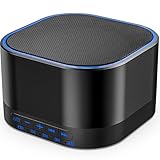
Prices for every pick here are live on Amazon — check the listing for the current figure before you compare, because these machines’ prices move. What does not move is what separates them: how the sound is made, how many sounds there are, and who runs the machine in the dark.
| Product | Sound source | Sounds | Who runs it | Power | Price |
|---|---|---|---|---|---|
| SNOOZ Pro (Cotton) | Real fan | 1 (ten volume levels, adjustable tone) | Host pre-sets in the app; guest uses on/off, volume and the tone knob | Plug-in only | Check price on Amazon |
| Sound+Sleep SE | Recordings, maker-described as non-looping | 64 profiles in 16 categories | Guest, from on-device buttons; volume then adjusts itself, per the maker | Plug-in only | Check price on Amazon |
| SNOOZ Original (Charcoal) | Real fan | 1 (ten volume levels, adjustable tone) | Host pre-sets in the app; guest uses volume and the twisting shell | Plug-in only | Check price on Amazon |
| Hatch Rest, 2nd Gen | Recordings | Library — 24 included free per Hatch | Host (or the visiting parents), from the Wi-Fi app | Plug-in only | Check price on Amazon |
| Yogasleep Dohm (White/Gray) | Real fan | 1 (two speeds, adjustable tone) | Guest — a switch and a twist, nothing else exists | Plug-in only | Check price on Amazon |
| Magicteam Sound Machine (SN-A1) | Recordings | 20, maker-described as non-looping | Guest presses one button; the memory function restores the host’s pre-set | Plug-in (AC or USB) | Check price on Amazon |
How to Choose a White Noise Machine for a Guest Room Under $700
- Start by admitting what the budget is for. No machine in this guide comes close to the top of this budget, because no sound machine above the Sound+Sleep SE verified. A $700 budget equips the whole visit — guest room, your room, a spare — so decide which rooms get machines before you decide which machines the rooms get.
- Ask the midnight question first. Who operates this machine at 2 a.m., and with what? If the answer involves your phone, your app or your instructions, the machine is a host tool wearing a guest-room label. The picks above divide honestly on exactly this line.
- Pre-set everything that can be pre-set. Schedules, fades, timers, tone and the remembered sound are all set before arrival, by you. A guest room machine should wake up already correct; the guest’s job is one button, or none.
- Match the machine to the room’s noise, not the guest’s. You know the room; the guest is the variable. A steady hallway is a fixed-volume problem the budget control solves. Noise that swells and fades — traffic, a boiler cycling — is the one case where the adaptive machine’s moving volume, as its maker describes it, is a real feature rather than a refinement.
- Read the flagship’s difference list, not its name. The maker of this guide’s hero states its sound and volume range are identical to the cheaper model’s. Believe that sentence, and pay the premium only for the listed conveniences — in a guest room, the knob genuinely earns its share of it.
- Read what sits behind the subscription. The Hatch’s core sound, light and routines are free; its premium stories and content are rented through Hatch+. Every other pick here charges nothing after purchase. Price any subscription-adjacent machine on its free core.
The Midnight Test: What a Stranger Can Run in the Dark
It is 2 a.m. Your guest is awake in a room they have slept in once, the house is making a noise they cannot name, and they are too polite to wake you. What can they do with the machine on the nightstand — no phone, no manual, no pairing, no account? The Yogasleep Dohm passes perfectly, because there is nothing to fail: a switch that is either on or off, two speeds, and a collar that twists. A guest who has never seen one has mastered it before the fan reaches full speed. The Magicteam passes almost as cleanly, and for the opposite reason: not simplicity of mechanism but memory. Because the cube restores the sound and volume you chose, the guest’s whole task is one button — provided nobody has cycled the sounds since you set it, which is why the one sentence of briefing this machine needs (“just press once”) belongs on a card in the room, next to it.
The SNOOZ pair passes in two halves, and the halves belong to different people. Everything connected — the schedule, the fade, the multiple timers on the Pro — is the host’s half, done before arrival; a guest should never need the app, and neither SNOOZ asks for it. The guest’s half is physical: power, volume, tone. The Pro’s bottom knob passes by touch. The Original’s twisting shell is the slate’s one learnable control — obvious once shown, but a genuine thirty seconds of a stranger’s night the first time, which is why the host either demonstrates it at the door or pre-sets the tone and treats volume as the guest’s only dial. The Sound+Sleep SE passes on effort rather than simplicity: real buttons, a real volume control, and then — on its maker’s description — the adaptive mode takes the level off the guest’s hands entirely, the closest any machine here comes to passing the test by making the test unnecessary. Its guest-room cost is that nothing about it can be pre-set from outside the room.
The Hatch Rest fails the test for a lone adult — the same fact that makes the machine right for its actual job. Its controls live in an app on somebody’s phone. For visiting parents running their baby’s routine, that is no failure at all — the app is theirs, the routine is stored on the device, and the machine is the most competent nursery tool here. For your college friend on the spare bed, a machine whose settings sit in your phone is a machine set by committee. Match the operator to the machine, and every pick in this guide passes somebody’s night.
Spending $700 on the Whole Visit: Guest Room, Your Room, and a Spare
Once the upper bands are understood to be empty, the budget question changes from shopping to planning. Start with the maximalist reading: one of everything in this guide — check each price on Amazon as you go — still leaves much of this budget unspent, because only the flagship pair and the SE sit anywhere near the premium end of this category. The whole-visit build this guide recommends — a SNOOZ Pro in the guest room, host-pre-set and knob-simple; a SNOOZ Original in your own room, so the house’s schedule runs on both sides of the wall; and a Magicteam as the travel spare and the drawer backup — equips three roles for a fraction of the budget. Swap the guest room to the set-and-forget build — a Sound+Sleep SE where the noise changes, your Pro kept for your own room, the spare unchanged — and the same three roles stay well inside the budget. Four rooms of real fan sound, via two Dohm two-packs from the maker, cost less again. And because every pick here is a one-time purchase with no subscription behind its core job, the cost question settles quickly once you have checked the live prices. At these levels, the towels are competitive.
The discipline of allocation is the discipline of the whole series, applied room by room. Masking is local: a machine masks the room it is in, at the lowest volume that works, placed between the sleeper and the noise — by the guest-room door, not beside the pillow, so the sound floor rises where the noise enters. A second machine in a second room therefore buys exactly as much masking as the first did — the only purchase in this category whose value does not diminish as you repeat it. So allocate by operator, not by symmetry: the finished machine where a stranger sleeps, the unconnected fan where nobody wants an app, the budget control where the noise is a hallway and nothing more, and the nursery machine only where a baby actually visits.
Common Buying Mistakes
- Assuming a $500 sound machine exists for the guest room. Between $140 and $700 the shelves hold sunrise clocks, a sleep tracker and earbuds; the most expensive verifiable sound machine in this series is the Sound+Sleep SE — check its price on Amazon.
- Buying a machine the guest needs your phone to run. If the settings live in the host’s app, the guest’s 2 a.m. options are the machine’s physical controls or nothing — check which those are before the visit, not during it.
- Believing the title: expecting headphone-style noise cancellation from machines that mask — the word is in nearly every listing here, the technology is in none of them.
- Paying the flagship premium for sound the maker says is identical. The Pro’s premium buys a knob, a case and app extras; in a guest room the knob may well be worth it — buy it knowingly, for that reason.
- Buying a sunrise clock as a sound machine. The Restore 3 is a leading sunrise clock whose sound is the supporting act; a guest who needs masking needs a machine here, and a guest who needs gentle waking needs a clock comparison, not this slate.
- Guessing a fixed volume for a room you don’t sleep in. Set it with the guest awake, at the door, lower than feels right — or buy the machine whose maker says it adjusts itself.
- Leaving no instructions at all. One line on a card — what the machine is, the one button or switch, where the volume lives — converts every pick in this guide into a passed midnight test.
Final Recommendation
- Most hosts: SNOOZ Pro (Cotton) — set it before arrival; the guest works a knob.
- The room whose noise you can’t predict: Sound+Sleep SE.
- The same fan, for less: SNOOZ Original (Charcoal).
- Guests arriving with a baby: Hatch Rest, 2nd Gen.
- Guests who should meet no technology at all: Yogasleep Dohm (White/Gray).
- Lowest price, and one per room: Magicteam Sound Machine (SN-A1).
Our top two are the SNOOZ Pro for the host who hosts often — the schedule and fade set before the doorbell, the knob for the guest’s hand, the case for the host’s own travels — and the Yogasleep Dohm for the host whose guests should never have to think about the machine at all. The Sound+Sleep SE is the interesting machine of the series and the right buy for the guest room whose noise will not sit still; the Magicteam is the honest floor, a pre-set in a cube, cheap enough to be its own spare; the Hatch Rest is the visiting baby’s machine and no one else’s. At $700 you are choosing among finished versions of one effect, among the rooms you will put them in, and among the people who will have to run them in the dark. Check the live price on the exact color listing, set everything before arrival, leave one line of instructions on the nightstand, and order the machines that match the operators.
Frequently Asked Questions
Is there a white noise machine that costs $500 or $700?
Not that we could verify in November 2026 — and we looked: an exact Amazon ASIN and a live offer within the band. The most expensive machine whose sound is its main act that passes those tests is the Sound+Sleep SE — check its price on Amazon — and two consecutive sweeps — $200 to $400, then $400 to $700 — found nothing above it. What sells in the upper country instead is the sunrise clocks (the Hatch Restore 3, a premium-tier clock), a contactless sleep tracker with sound attached (the Hatch Sleep Clock, sold on the brand’s pages at a premium tier, with conflicting higher reads and no listing we could pin), and sleep earbuds (Ozlo’s Sleepbuds 2, a premium-tier earbud pick in November 2026 Amazon reads). None is a room-masking machine.
Which machine can a guest work out with no instructions at all?
The Yogasleep Dohm — a switch, two speeds and a twist, with nothing digital anywhere in it — followed by the Magicteam, once the host has pre-set its memory function, leaving the guest a single button. The SNOOZ Pro is next: its guest-facing controls are power, volume and a knob. The Sound+Sleep SE asks a little more — a profile choice and a volume setting — and then, on its maker’s description, adjusts the volume itself. The Hatch Rest is the honest exception: its controls live in its app, which suits the visiting parents who own the routine and suits a lone adult guest least of all.
Should a guest-room machine have an app?
For the host, yes; for the guest, never as a requirement. The app’s real guest-room work is done before arrival — the SNOOZ schedule that starts the fan before bedtime, the fade that winds it down, the routine stored on the Hatch that runs all week untouched. During the stay, the guest’s tools should be the machine’s own controls. No pick here requires a subscription for its core job: both SNOOZ machines work from their physical controls with the free app on top, the Hatch’s core works without Hatch+, and the SE, the Dohm and the Magicteam have no app at all.
Is the Hatch Restore 3 a white noise machine?
It is a sunrise alarm clock with a sound machine inside it — a different product, in that order — and our under-$400 guide is where we could finally say the whole sentence. The Restore 3’s Amazon listing now verifies completely: an exact listing, a premium-tier price across multiple November 2026 Amazon reads, in stock. What has not changed is what it is: Hatch builds it around routines that pair a gradually brightening light with audio, its deeper library sits behind the Hatch+ subscription, and it is sold and reviewed everywhere as a clock. We name it here rather than rank it, on class rather than on evidence. In guest-room terms: a guest whose problem is waking gently in a strange room is a real case, and the Restore 3 is a leading name in its own category — compare sunrise clocks for it. A guest whose problem is the hallway needs a machine whose sound is the main act — every pick above.
What does a guest-room machine actually cost per night?
Less than the coffee. Every pick here is a one-time purchase with no subscription behind its core job, bought once and used for years of guest nights — check the live price on Amazon, and even the flagship is a modest one-off cost for a room that hosts again and again; the budget control costs less again. The comparison section above is where the picks sit side by side.
Is a sound machine suitable for a baby sleeping in the guest room?
One pick is designed for exactly that — the Hatch Rest, a nursery machine with routines and a time-to-rise light — and the SNOOZ pair carry registry followings, the Pro adding a nursery calibration mode in its app. The commonly cited pediatric guidance is about volume and distance rather than prohibition: place the machine well away from the crib, about 7 feet is the usual figure, run it in the lower half of its volume range, and prefer a timer or schedule over all-night maximum volume. If you have specific concerns about your child’s hearing or sleep, a pediatrician’s advice comes before a product page.
- Best White Noise Machines Under $700
- Best White Noise Machine For Guest Rooms Under $400
- Best Weighted Blanket For Guest Rooms Under $700
- Best Sleep Pillow For Guest Rooms Under $700
- Best Wardrobe For Guest Rooms Under $700