Where to buy
Shopping for the best car jump starter for beginners under $50? Check the latest price, availability and delivery on Amazon. Orders are placed on Amazon. We may earn a commission from qualifying purchases.
- Best compact pick: AstroAI S8 Car Battery Jump Starter, 1500A — Check on Amazon
- NEXPOW T11F Battery Jump Starter, 1000A — Check on Amazon
- GOOLOO GE1200 Jump Starter, 2000A — Check on Amazon
See more options in the full guide
- GOOLOO G7 Jump Starter, 3000A with Built-in USB-C Cable — Check on Amazon
- NEXPOW Q10S Car Jump Starter, 1500A — Check on Amazon
- GOOLOO GP2000 Jump Starter, 2000A — Check on Amazon
Read the full guide ↓
Disclosure: As an Amazon Associate, umtsmarttool.com earns from qualifying purchases. Links to Amazon on this page are affiliate links; they cost you nothing extra. Listing details such as price and availability change often, so check the current Amazon listing before you buy.
Searching for the best car jump starter for beginners under $50 usually happens within a week of the first dead-battery experience — the click, the sinking feeling, the wait for help — and the beginner’s question is not really about amps. It is about forgiveness: which of these boxes will supervise me while I learn, refuse to spark when I clamp in the wrong order, and work the first time I need it despite my never having done this before? This guide answers that question first and the sizing question second, because a beginner’s pack succeeds on its protections and its clarity before it succeeds on its ratings.
The six picks were chosen with a first-timer’s hands in mind: smart clamps across the board, protections listed rather than implied, instructions and documentation that treat the reader as new. They span the tier’s sizes from glovebox compact to fleet headroom, and every engine rating is the maker’s, translated in the reviews into the vehicles it honestly covers. Beginners assembling a first emergency kit will also want Best Portable Tire Inflator For Beginners Under $15 for the other classic roadside moment, and Best Car Organizer For Beginners Under $15 so the kit can be found in the dark.
One beginner reassurance, stated plainly because fear is the real barrier: a modern lithium pack with a smart clamp is one of the safest tools in the car. It checks your connections, blocks the dangerous ones, and asks only that you follow a five-step order that the topical section below walks through slowly. The final recommendation names the confidence pick and the documented all-rounder for beginners who want the category’s reference model from day one.
In this guide
Quick Picks
Short on time, or comparing several options at once? Each row below names a buyer type and the product that suits it, with a link to the listing where one applies.
| Buyer type | Pick | Why it stands out | Link |
|---|---|---|---|
| Best compact pick | AstroAI S8 Car Battery Jump Starter, 1500A | 1500A peak, maker-rated 6.0L gas / 3.0L diesel, 10,000 mAh, 3-mode LED light | Check on Amazon |
| Best value coverage | NEXPOW T11F Battery Jump Starter, 1000A | 1000A peak with QDSP, maker-rated 7.0L gas / 5.5L diesel, USB Quick Charge, smart clamp | Check on Amazon |
| Best headroom at the tier | GOOLOO GE1200 Jump Starter, 2000A | 2000A peak, maker-rated 8.0L gas / 6.0L diesel, SuperSafe protections, USB charging | Check on Amazon |
| Best modern format | GOOLOO G7 Jump Starter, 3000A with Built-in USB-C Cable | 3000A peak, maker-rated 8.5L gas / 6.0L diesel, 12,000 mAh, built-in 45W USB-C cable | Check on Amazon |
| Best outputs | NEXPOW Q10S Car Jump Starter, 1500A | 1500A peak, maker-rated 7.0L gas / 5.5L diesel, QC 3.0 USB, USB-C input, 12V/10A DC output | Check on Amazon |
| Best documented all-rounder | GOOLOO GP2000 Jump Starter, 2000A | 2000A peak, maker-rated 8.0L gas / 6.0L diesel, 37Wh battery, USB Quick Charge | Check on Amazon |
How These Picks Were Chosen
The budget was applied as a ceiling, and jump starters are the category where ceilings and headlines fight: the biggest number on every box — peak amps — is the least standardized figure in the industry, a burst measurement each maker defines for itself. We therefore chose on the numbers that can be compared: the maker’s published engine-size ratings (gas and diesel listed separately), battery capacity where the maker publishes it in watt-hours or milliamp-hours, the protection suite in the clamp, and what else the pack verifiably does. Check the current price on Amazon before you buy; this category promotes aggressively and positions move weekly.
We did not jump-start vehicles with these packs. We read maker listings, manuals and spec sheets — crediting makers who publish real documentation, like watt-hour figures and recharge intervals, over makers who publish only adjectives — and we applied two reality filters. First, every engine rating assumes a sound engine and a discharged battery: no lithium pack at any price resurrects a battery with a failed cell, and guides that imply otherwise are selling magic. Second, readiness is a habit, not a spec: every pick here needs a top-up charge on a calendar rhythm, and the reviews note each maker’s guidance where it is published.
One famous name is deliberately not a pick: NOCO’s Boost Plus GB40 (1000A, rated 6.0L gas / 3.0L diesel, ASIN B015TKUPIC) is the category’s premium benchmark, and its usual street position sits well above both of this guide’s tiers. It is mentioned here so the comparison is honest — if your real budget reaches it, its safety record and support are the premium case — but a guide that links it as a budget pick would be lying about arithmetic, so it is covered in prose only, without a purchase link.
Finally, a note on how to read the comparison table: peak amps are printed because buyers ask for them, side by side with the engine ratings that actually size a pack to a vehicle. Buy by the second and third columns — your engine against the maker’s rating, with margin for cold and age — and treat the first as the marketing it is. The picks that follow were ordered by that discipline, not by the size of their headline.
A note on what the $50 ceiling means in this category, because it is the most honest constraint in this guide: the premium benchmark brand in jump starters prices its comparable unit at roughly double this tier, and this guide does not pretend otherwise — the benchmark is named in the methodology section above, without a purchase link, precisely so the comparison stays visible. What the tier buys instead is the verified middle of the market: five brands’ worth of lithium packs whose maker ratings cover the engines most readers own, with the differences between them — clamp quality, port selection, protection design, storage temperature discipline — being the things that actually decide ownership satisfaction. Spend the tier on those differences, not on chasing the benchmark’s badge at a discount that does not exist.
The 6 Best Car Jump Starters For beginners Under $50
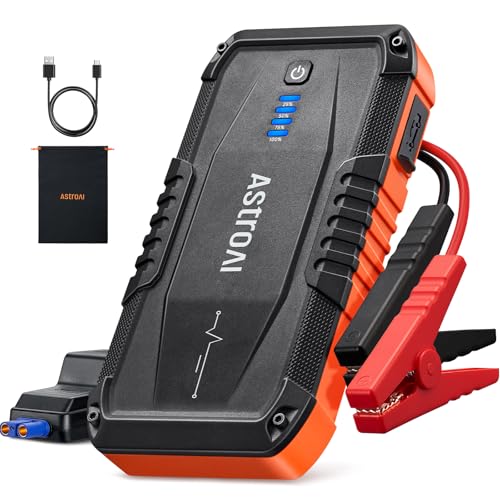
AstroAI S8 Car Battery Jump Starter, 1500A
Who it suits: Drivers of sedans and crossovers who want the pack most likely to be in the car — glovebox-sized, simple, and protected against beginner errors.
AstroAI’s S8 is the compact end of serious: a 1500A peak lithium pack, maker-rated for gas engines up to 6.0L and diesels up to 3.0L, with a 10,000 mAh battery that also works as a power bank, and a three-mode LED light (steady, strobe, SOS). It weighs well under a pound in the hand — published figures put it around 12 to 15 ounces depending on the listing’s configuration — and it is sized like a thick paperback, which is the correct size for a device whose entire job is to be in the car on the one day it is needed. A glovebox that cannot fit it is a glovebox that has made its priorities clear.
The ratings deserve the guide’s standard translation: peak amps are a burst figure, not a sustained one, and the engine-size rating is the maker’s own claim for a healthy engine with a discharged — not destroyed — battery. Within those honest bounds the S8 covers the realistic fleet: family sedans, crossovers, most V6s, small diesels. Its safety suite covers the beginner errors — reverse polarity, short circuit, over-charge, overload — and the two-year manufacturer warranty is a genuine differentiator in a category where many rivals offer a year or silence. At this guide’s tiers it is the size-and-simplicity pick: the one most likely to actually be in the car, charged, when the click happens. Check the current price on Amazon before you buy.
For a first jump starter this is the confidence pick: the safety protections forgive the clamp-order mistakes beginners fear, the light handles the dark parking lot, and the instructions assume a first-timer because most of its buyers are.
- Glovebox size and under a pound — the pack that is actually there when needed.
- Full safety suite plus a two-year manufacturer warranty, rare at this tier.
- Power-bank and three-mode light roles keep it useful between emergencies.
Honest limitation: Its 3.0L diesel ceiling is the guide’s narrowest: owners of larger diesels and big V8s should size up to the 2000A class below.
Choose it if your car is a sedan, hatchback or crossover and size is why previous packs got left at home. Skip it if you drive a large diesel or V8 — the GOOLOO picks below are rated for your engine.
NEXPOW T11F Battery Jump Starter, 1000A
Who it suits: Budget-focused drivers who want the broadest published engine coverage at the friendly end of the tier — including a diesel rating that embarrasses costlier packs.
NEXPOW’s T11F is the value-mechanics pick: 1000A peak from the maker’s QDSP (Quick Discharge Start Power) design, rated by NEXPOW for gas engines up to 7.0L and diesels up to 5.5L — a notably generous diesel figure for the class — with USB Quick Charge output, a three-mode LED light and an intelligent clamp carrying the safety protections. The package is the complete one: pack, smart clamp, USB-C charging cable and manual, in a unit compact enough for a glovebox or a door pocket.
The 1000A headline needs the honest context this guide gives every pack: peak current is the least comparable number in the category, printed largest and defined loosest, and NEXPOW’s engine ratings — like every maker’s — assume a battery that is discharged rather than internally failed. A pack cannot jump a battery with a dead cell, and no rating on any box changes that. Judged on what is verifiable — the rating breadth, the quick-charge output, the clamp intelligence, the complete box — the T11F is the budget-mechanics answer: the most engine coverage per dollar in this guide, from a brand whose jump starters are its whole business. Its typical street position sits at the friendly end of this guide’s lower tier. Check the current price on Amazon.
Beginners should read the T11F’s smart clamp as the feature: it is the component that supervises the connection while you learn, beeping and blocking the mistakes instead of sparking at them.
- Published diesel rating of 5.5L — the broadest coverage per dollar in this guide.
- Intelligent clamp supervises the connection with the full protection suite.
- Complete box: pack, smart clamp, USB-C cable and manual.
Honest limitation: The 1000A peak figure is the guide’s lowest, and on a deeply discharged big engine in deep cold it will work harder than the 2000A class — ratings assume a sound engine and a merely discharged battery.
Choose it if coverage breadth matters more to you than headline amps, and your budget is firm. Skip it if you want maximum cold-morning headroom for a large engine — step to the GE1200 or GP2000.
GOOLOO GE1200 Jump Starter, 2000A
Who it suits: Drivers of larger SUVs, V8s and mid-range diesels who want real headroom without leaving the budget tier.
GOOLOO’s GE1200 brings the guide’s headline number up a class: 2000A peak, maker-rated for gas engines up to 8.0L and diesels up to 6.0L, in the brand’s SuperSafe architecture with its suite of connection protections. GOOLOO is one of the category’s volume specialists, and the GE1200 is its straightforward expression — no compressor, no inverter, no screen-driven complexity: a jump pack, smart clamps, USB charging for phones, an LED light, and ratings that cover essentially every passenger vehicle a household is likely to own, including the V8 truck that smaller packs describe optimistically.
The buyer’s translation is the same one this guide applies everywhere: 2000A is a peak burst claim, the engine ratings are the maker’s, and the real-world difference between this and the 1500A class shows up on cold mornings, tired batteries and bigger engines — exactly the situations where a jump starter earns its existence. If your vehicle is a large SUV, a V8, or a diesel in the middle of the range, this is the tier’s honest answer rather than its hopeful one. The pack’s street position moves with the brand’s frequent promotions, so check the current price on Amazon; at its usual level it sits inside this guide’s lower tier and embarrasses packs a class up on coverage alone.
Beginners with a big vehicle should start here rather than at the minimum: the wider engine coverage means the pack’s first real test — a cold morning, a V8, a tired battery — is a success story instead of a lesson in sizing.
- 2000A class with fleet-wide engine ratings at a budget position.
- GOOLOO’s SuperSafe protection suite in a jump-only, no-gimmick format.
- Covers the big vehicle in the household and everything smaller that borrows it.
Honest limitation: Jump-only focus: no compressor and a basic output panel compared with the feature picks in this guide.
Choose it if your engine is large, your winters are cold, or your battery is aging — and you want margin. Skip it if you want one box that also inflates tires — that is the A3, in the upper-tier articles.
GOOLOO G7 Jump Starter, 3000A with Built-in USB-C Cable
Who it suits: USB-C-everything drivers who want the pack that charges like their phone — fast, with a cable that cannot be lost because it is attached.
GOOLOO’s G7 is the modern-format pick: 3000A peak on the maker’s rating, for gas engines up to 8.5L and diesels up to 6.0L, with a 12,000 mAh battery and the detail that dates everything else in the guide — a built-in 45W USB-C cable with fast charging in and out. The integrated cable sounds like a convenience until the night it is the whole product: no separate cable to lose, no hunting for the right connector in a dark footwell, fast recharge of the pack itself, and phone charging at speeds that make the power-bank role real rather than nominal.
As ever, the translation: 3000A is a headline peak figure in a category where headline figures inflate annually, and the engine ratings are the maker’s claims for a discharged battery in a sound engine. What is verifiable is the format — the capacity, the USB-C speed, the built-in cable, the brand’s safety architecture — and the format is genuinely the most current in this guide. For drivers whose lives already run on USB-C, the G7 is the pack that joins the ecosystem instead of adding a proprietary one. Its street position fluctuates with promotions between this guide’s two tiers; check the current price on Amazon, and treat any position inside your tier as the value event it usually is.
A beginner’s most common jump-pack failure is an uncharged pack; the G7’s fast USB-C recharge — the same cable as your phone — removes the friction that causes it. Convenience is a safety feature here.
- Built-in 45W USB-C cable: fast charge in and out, nothing separate to lose.
- 12,000 mAh capacity with the guide’s broadest gas-engine rating on paper.
- The most current format in the guide — a power bank that also starts cars.
Honest limitation: The 3000A headline is a peak-burst claim in a category where such figures inflate yearly; judge it by its ratings and format, and note its street price fluctuates between this guide’s tiers.
Choose it if your life runs on USB-C and an uncharged pack is your most likely failure mode. Skip it if you prefer a long-documented reference model over the newest format — the GP2000 is that pick.
NEXPOW Q10S Car Jump Starter, 1500A
Who it suits: Drivers whose emergency kit includes 12V accessories — inflators, lights, coolers — and who want the pack to be the kit’s power station.
NEXPOW’s Q10S pairs the 1500A class with the guide’s most complete output panel: maker-rated for gas engines up to 7.0L and diesels up to 5.5L, with dual USB outputs including a Quick Charge 3.0 port, a USB-C charge input, and a 12V/10A DC output that can run small automotive accessories — a capability most packs omit and the one that turns a jump starter into a general emergency power source. The three-mode LED light and the maker’s listed protection suite (over-current, short circuit, overload, over-voltage, over-charge, high-temperature, reverse polarity) complete a specification that reads like a checklist of everything this category learned in a decade.
Its honest limitation is the mirror of its strength: outputs and features add size and cost, and its street position straddles this guide’s two tiers depending on the week’s promotion — it is linked in both, with the standing instruction to check the current price on Amazon. The DC output is the feature to decide on: if your emergency kit includes a 12V inflator, light or cooler that a pack could run, the Q10S is the only pick here that closes that loop; if your kit is a phone and a prayer, the simpler packs spend the same money on compactness. Either way, its engine ratings match the T11F’s breadth with a stronger burst figure behind them, which is a defensible definition of this guide’s middle pick.
Beginners get one pack that will not need replacing as their kit grows — the outputs they do not use today are the ones next year’s inflator or work light will ask for.
- 12V/10A DC output runs accessories other packs cannot — the kit power-station role.
- Broad 7.0L / 5.5L engine ratings with a full, maker-listed protection suite.
- Quick Charge 3.0 USB plus USB-C input: the complete modern output panel.
Honest limitation: Features add size, and its street price straddles this guide’s two tiers with promotions — check the listing before assuming its current position.
Choose it if your emergency kit has more than one device in it and you want one power source for all of them. Skip it if you want the smallest possible glovebox pack — the S8 spends its size budget better for you.
GOOLOO GP2000 Jump Starter, 2000A
Who it suits: Drivers who want the category’s reference budget pack — long market life, a manual with real numbers, and ratings covering the whole passenger fleet.
The GP2000 is GOOLOO’s best-known budget flagship: 2000A peak, maker-rated for gas engines up to 8.0L and diesels up to 6.0L, a 37Wh battery per the maker’s manual, USB Quick Charge output, and the brand’s SuperSafe protection suite, in a red-accented pack that has become one of the category’s reference designs. The maker’s documentation describes up to twenty jump starts per charge and a recharge interval measured in months, and the model’s long market life means its behavior — including its appetite for a top-up every few months — is documented rather than theorized.
Its tier position requires the guide’s honesty in the other direction: the GP2000’s street price fluctuates, spending much of its life inside this guide’s upper tier and visiting the lower one on promotion. It is linked in both tiers’ articles with that note attached, because excluding the category’s reference budget pack from a budget guide would be its own kind of dishonesty — but check the current price on Amazon before assuming which tier it is standing in today. What you are buying, at either position, is the known quantity: ratings that cover the whole passenger fleet, a manual that publishes real numbers like watt-hours, and a brand that will still sell you a replacement clamp in three years. In a category of disposable no-names, that continuity is a spec.
For a beginner who wants the documented choice — the pack with a manual full of real numbers and a long record — this is it: no surprises is a feature, and it is this pack’s whole personality.
- Fleet-wide engine ratings with watt-hour capacity published in the manual.
- Up to 20 jump starts per charge in the maker’s documentation; replacement clamps available.
- The known quantity of the category — behavior documented, brand persistent.
Honest limitation: Its street price fluctuates between this guide’s tiers with promotions, and its maker advises a top-up charge every few months — readiness is a calendar habit, not a purchase.
Choose it if you want the documented, no-surprises pack that the rest of the category is measured against. Skip it if you want the newest format or a built-in compressor — the G7 and the upper-tier A3 divide those roles.
Comparison Table
| Product | Type | Peak amps (maker) | Engine rating (maker) | Link |
|---|---|---|---|---|
| AstroAI S8 Car Battery Jump Starter, 1500A | Lithium pack | 1500A peak | 6.0L gas / 3.0L diesel (maker) | Check on Amazon |
| NEXPOW T11F Battery Jump Starter, 1000A | Lithium pack | 1000A peak | 7.0L gas / 5.5L diesel (maker) | Check on Amazon |
| GOOLOO GE1200 Jump Starter, 2000A | Lithium pack | 2000A peak | 8.0L gas / 6.0L diesel (maker) | Check on Amazon |
| GOOLOO G7 Jump Starter, 3000A with Built-in USB-C Cable | Lithium pack | 3000A peak | 8.5L gas / 6.0L diesel (maker) | Check on Amazon |
| NEXPOW Q10S Car Jump Starter, 1500A | Lithium pack | 1500A peak | 7.0L gas / 5.5L diesel (maker) | Check on Amazon |
| GOOLOO GP2000 Jump Starter, 2000A | Lithium pack | 2000A peak | 8.0L gas / 6.0L diesel (maker) | Check on Amazon |
How to Choose a Car Jump Starter Under $50
- Size by engine rating, with margin. Find your engine’s size and fuel, compare against the maker’s gas and diesel ratings separately, and buy at least one class of headroom if your winters are cold, your battery is old, or your engine is a diesel.
- Read peak amps as advertising. Useful only within one maker’s own line, where the measurement is at least consistent. Across brands, the engine rating and the documented capacity are the comparable figures.
- Prefer published capacity. Makers who state watt-hours or milliamp-hours and a recharge interval are telling you how the pack lives; makers who publish only a peak number are telling you how it markets. Documentation is a quality signal.
- Check the clamp, not just the pack. The smart clamp carries the protections — reverse polarity, short circuit, spark resistance — that make a jump safe for a beginner. A great battery behind a dumb clamp is half a product.
- Decide what else it must do. USB speed for phones, a DC output for accessories, a compressor for tires, a light with an SOS mode — the second job is what keeps a pack charged, carried and familiar. Buy the second job you will actually use.
- Plan the readiness system at purchase. Where it will live, when it will be topped up, and where its procedure lives (a photo of the manual page on your phone). A pack without a system is a countdown to a disappointing morning.
- Value the warranty and the replacement clamp. A pack is a multi-year object; a maker who sells replacement clamps and publishes a warranty term is planning to exist for its life. In a category of disposable listings, continuity is a purchasable feature.
- Keep the box’s second cable in mind. The pack charges by USB-C or proprietary cable depending on model; a proprietary cable is one more thing to lose and one fewer standard your glovebox shares with your phone. Small, but the small things are what readiness is made of.
- Match the pack to the car’s actual risk. A new car under warranty with roadside assistance needs a small glovebox pack; an aging high-mileage car in a cold climate needs headroom and your full attention. Spend where your risk lives.
Your First Jump, Walked Through Slowly
Before the emergency, rehearse once in daylight: find your battery, identify its positive terminal (marked +, usually with a red cover), and read your pack’s clamp indicators until they make sense. On the day: engine off, pack off. Clamp positive to positive — the smart clamp will confirm or complain — then the negative clamp where your manual directs, ideally a clean metal ground point away from the battery. Check the clamp’s indicator shows a valid connection. Turn the pack on if your model requires it, get in, and start the car the normal way. That is the whole performance, and it takes less time than reading this paragraph twice.
After it starts, reverse the order: clamps off (negative first), pack away, and drive for at least twenty minutes so the alternator returns real charge to the battery. Then do the beginner’s two follow-ups: put the pack on charge that evening, because it spent itself for you, and ask why the battery died — lights left on is a lesson, but a battery that dies unexplained is a battery announcing its retirement, and the announcement deserves a test at the parts store rather than a second performance next week.
The Mistakes First-Timers Make (All Preventable)
The classic errors are procedural, not technical. Clamping to a corroded terminal and concluding the pack is broken — bite the clamps down with a slight twist so they contact metal, not oxide. Giving up after ten seconds of cranking confusion when the clamp was quietly reporting a reversed connection the whole time — read the indicator before the ignition. Switching the car off immediately after it starts ‘to check something’ — let it run and drive it. And the deepest beginner mistake, buying the pack and never charging it: a jump starter arrives partially charged for storage, and its first act of ownership is a full charge, without which the whole purchase is theoretical.
There is also a social mistake worth retiring early: apologizing for owning one. A jump pack is not an admission of an unreliable car; it is the standard equipment of drivers who have had the click happen once. Keep it charged, keep it in the cabin, and be the person in the parking lot who can offer the jump as well as receive it — the packs in this guide start other people’s cars just as happily, which is the beginner’s fastest route to feeling like an old hand.
Keeping a Jump Pack Ready: The Calendar Is the Spec
Every jump starter ever sold has failed someone exactly once: on the morning it was needed, after fourteen months of being ignored in a trunk. Lithium packs self-discharge slowly and their owners forget them completely, and the collision of those two facts is the category’s true failure mode — not insufficient amps. The countermeasure is a calendar, not a product: charge the pack when you bring it home, mark a recurring top-up every three to four months (several makers in this guide publish exactly that guidance), and pair the habit with something you already do seasonally — the clock change, the tire rotation, the first frost warning.
Storage matters at the margins: a glovebox or cabin-adjacent spot beats a trunk’s far corner for both temperature kindness and the simple fact that the pack gets seen, and a pack that gets seen gets charged. Heat is the enemy of lithium longevity, so a pack that lives in a sun-baked car all summer ages faster than its twin in a garage-kept car — another argument for the cabin. And once a year, actually use the light and the USB port: a pack exercised is a pack verified, and the cheapest time to discover a dead pack is a calm afternoon, not a cold morning.
The last readiness item is knowledge, kept with the device: the clamp order and the override procedure (for batteries too flat to register) differ subtly by model, and the manual is a pamphlet nobody can find at midnight. Photograph the manual’s procedure page into your phone the day the pack arrives. Readiness, in the end, is three small habits — charge on a calendar, store where you see it, know the procedure — and every pick in this guide rewards them equally, which is why this section, rather than any amp figure, is the one to remember.
There is one more readiness decision, made once and then forgotten on purpose: which car the pack belongs to. Households with several vehicles should assign packs to cars, not to drivers — a pack that migrates with whoever ‘might need it’ is a pack that is statistically in the wrong car on the morning it matters. Assignment feels rigid and works precisely because it is: the pack lives in its car, gets charged on its car’s calendar, and is simply there, the way the spare tire is there. The spare is the right analogy in every way — nobody rotates the spare between cars based on optimism, and the jump pack has quietly become the spare’s modern twin: carried always, used rarely, and priceless exactly once.
Comparing across this guide’s budgets and trip styles helps too: readers weighing a neighboring tier start with Best Car Jump Starter For Car Owners Under $50, while those planning for a different kind of use read Best Car Jump Starter For Beginners Under $75 before deciding.
Common Buying Mistakes
- Buying by peak amps alone. The biggest, loosest number in the category. Engine-size ratings — gas and diesel separately, with margin for your engine, your winters and your battery’s age — are how a pack is actually sized.
- Expecting a pack to resurrect a dead battery. A jump pack starts a sound engine whose battery is discharged. A battery with a failed cell, a broken terminal or a parasitic drain that will flatten it again tonight is a diagnosis, not a jump.
- Storing it and forgetting it. Fourteen months in a trunk without a charge is how a good pack becomes a paperweight at the exact moment of need. Top up on a calendar, every three to four months, without exception.
- Clamping in the wrong order or on painted metal. Follow the model’s procedure: correct terminals, clean contact points, the ground clamp where the manual directs. Smart clamps forgive much, but they supervise connections — they do not invent them.
- Sizing exactly to your engine. Ratings assume a healthy engine on a mild day. Cold oil, altitude and an aging battery all tax the start; margin is not upselling, it is the difference between a rating and a result.
- Leaving the pack in a hot trunk all summer. Heat ages lithium cells faster than use does. Cabin storage is kinder, more visible, and therefore more likely to keep the pack charged — three virtues in one decision.
- Buying the pack after the stranding, for the car that stranded you, without fixing the cause. The pack treats the symptom forever and the battery fails forever; buy the pack for the fleet’s future and the battery for the car’s present, in that order.
- Hiding the pack from the other drivers in the household. A pack nobody else knows about, in a car everybody drives, is a secret, not a system. Its location and procedure should be common knowledge at the level of the spare tire’s.
- Jumping and immediately switching off. A started engine needs to run — a drive, not a minute of idling — to return charge to the battery, and a battery that dies again the same day is telling you it needs replacement or a mechanic, not a bigger pack.
Final Recommendation
For beginners, start with the AstroAI S8: glovebox size, the full protection suite, a two-year warranty, and an interface that assumes a first-timer. It is the pack most likely to be charged, present and correctly used on the day — and those three adjectives matter more than any rating. The runner-up is the GOOLOO GP2000, for the beginner who prefers the category’s most documented reference pack and whose vehicle wants the 2000A class.
Charge it the day it arrives, rehearse the clamps once in daylight, photograph the manual page, and set the calendar top-up. Check the current price on Amazon before ordering — and accept the quiet promotion every jump-pack owner feels: from the person who waits for help to the person who gives it.
Frequently Asked Questions
Can a jump starter damage my car’s electronics?
A modern pack with a smart clamp — reverse-polarity, short-circuit and spark protections, as every pick in this guide has — is designed specifically to make the connection safe. Damage stories come from reversed clamps on unprotected equipment and from using a pack on the wrong voltage system; stay with 12V packs for 12V cars and follow the model’s procedure.
How long does a jump pack hold its charge?
Months, not years. Makers in this guide advise a top-up every three to four months (standby claims of eight to twelve months describe a pack that may still start a car, at reduced margin). Treat the calendar top-up as part of the product and the pack will be ready on the morning that matters.
Why did my car start with the pack and die again the next day?
The pack did its job; the battery gave its diagnosis. A battery that cannot hold an overnight charge has failed or is being drained — it needs testing and likely replacement. Repeatedly jumping a dying battery strands you eventually somewhere worse than your driveway.
Can I jump-start a car in the rain?
Yes, with ordinary care: keep the pack itself as dry as practical, make solid clamp connections, and follow the normal procedure. The smart clamp’s protections do not care about weather; your footing and visibility do, so take the extra minute.
I have never jump-started a car. Is it safe for me to try?
With a modern smart-clamp pack, yes — the clamp checks polarity and blocks the dangerous errors, and the procedure is five ordered steps. Rehearse the clamp locations once in daylight, follow the walk-through in this guide, and your first jump will feel anticlimactic, which is the goal.
What if I clamp it on backwards?
The smart clamp detects reversed polarity and refuses to deliver power, typically with a light and a tone. Nothing sparks, nothing is damaged — you swap the clamps and proceed. That protection is exactly what a beginner is buying.
How do I know which size to buy for my first pack?
Find your engine size on the car’s paperwork or under the hood, match it to the maker’s gas or diesel rating in this guide, and add a class of margin if your winters are cold. When in doubt between two classes, a beginner should buy the larger — headroom forgives, minimums negotiate.
Should I buy a car mattress or just use a camping pad?
Not this guide’s subject — but the same beginner logic applies to both: buy the version designed for the job, keep it where you can find it, and rehearse once in daylight.
Will a jump pack work on a hybrid or EV?
On the 12V auxiliary battery, generally yes — hybrids and EVs use a conventional 12V battery for their electronics, and it is that battery a pack jumps, following the vehicle maker’s specified jump points. Never connect a pack to a traction battery; if the manual’s jump points are unclear, that is a dealer question, not an experiment.
How many years should a jump pack last?
Several, with the calendar top-ups this guide prescribes; lithium capacity fades gradually with age and heat exposure rather than failing suddenly. Retire the pack when its indicator behavior changes, its case swells, or it no longer holds a charge across a season — and replace it before the season in which you would have needed it.
Two companion guides round out the setup: Best Car Battery Charger For Beginners Under $30 and Best Car Vacuum For Beginners Under $30 cover the neighboring purchases most readers make alongside this one.