Where to buy
Shopping for the best portable jump starter for beginners under $30? Start with the linked picks below — check the latest price, availability and delivery on Amazon, where orders are placed. We may earn a commission from qualifying purchases. Picks marked as step-ups carry no link at this budget — the review explains what they cost and why they are worth planning for.
- Best thing this budget actually buys: CARTMAN 8-Gauge 12-Foot Jumper Cables with Carry Bag — Check on Amazon
- NOCO GENIUS1 1A Smart Battery Charger and Maintainer — Check on Amazon
- NOCO Boost GB20 500A Lithium Jump Starter (step up) — step-up pick, no link at this budget
- GOOLOO GP2000 2000A Jump Starter (step up) — step-up pick, no link at this budget
- DBPOWER DJS50 800A Jump Starter (step up) — step-up pick, no link at this budget
- Clore Jump-N-Carry JNC660 (traditional step up) — step-up pick, no link at this budget
Read the full guide ↓
Disclosure: As an Amazon Associate, umtsmarttool.com earns from qualifying purchases. Links to Amazon on this page are affiliate links; they cost you nothing extra. Listing details such as price and availability change often, so check the current Amazon listing before you buy.
The search for the best portable jump starter for beginners under $30 is usually a first search — the first check engine light, the first dead battery, the first trunk that needs taming — and first searches deserve guides that assume nothing. So this one explains as it goes: what the product actually does, which specifications matter and which are decoration, and where beginners reliably waste money (usually on a headline number, a fantasy rating, or a tool whose real features hide behind an app paywall). The picks are ordered for a newcomer: the simplest complete option first, the step-ups clearly labeled with what the extra money buys and what it does not. Nothing here requires experience to use safely, and every technique section is written as if it will be read in a driveway, possibly in the rain, by someone doing this for the first time — because it will be.
Thirty dollars does not buy a credible portable jump starter — the verified entry point is the NOCO GB20, several tiers up — and this guide will not link the fantasy-rated listings that claim otherwise. What thirty dollars does buy, and buy well, is the complete honest kit for the dead-battery problem: heavy-gauge jumper cables for rescue with help, and a smart maintainer that prevents the most common dead-battery pattern entirely. The real packs are here too, as researched step-ups for when the budget grows.
Below are the picks — the honest purchases at this budget first, then the verified step-up packs — with full reviews and specifications, a side-by-side comparison, a choosing guide that translates the category’s numbers into plain language, technique sections on safe jump starting and on why batteries actually die, the mistakes that strand drivers, and the questions this budget always raises, answered directly. Readers comparing the neighbouring budget should also see Best Portable Jump Starter Under $15.
In this guide
Quick Picks
Short on time, or comparing several options at once? Each row names a buyer type and the product that suits it, with a link where this budget honestly supports one.
| Buyer type | Pick | Why it stands out | Link |
|---|---|---|---|
| Best thing this budget actually buys | CARTMAN 8-Gauge 12-Foot Jumper Cables with Carry Bag | 8-gauge, 12 ft, T-Prene jacket flexible to -25 C, carry bag included | Check on Amazon |
| Best prevention pick at this tier | NOCO GENIUS1 1A Smart Battery Charger and Maintainer | 1A, 6V/12V, lead-acid and lithium, temperature compensation, 110-inch cable | Check on Amazon |
| Closest credible jump pack — step up | NOCO Boost GB20 500A Lithium Jump Starter (step up) | 500 peak amps, gas engines up to 4.0L, 24Wh lithium, up to 20 starts per charge | Step-up pick — no purchase link at this budget; see the review below. |
| Most power per step-up dollar — step up | GOOLOO GP2000 2000A Jump Starter (step up) | 2000A peak / 400A starting, 37Wh, up to 8.0L gas and 6.0L diesel | Step-up pick — no purchase link at this budget; see the review below. |
| Mid-size step-up alternative | DBPOWER DJS50 800A Jump Starter (step up) | 800A peak, 18000mAh, up to 7.2L gas and 5.5L diesel, LCD screen | Step-up pick — no purchase link at this budget; see the review below. |
| Old-school lead-acid power — step up | Clore Jump-N-Carry JNC660 (traditional step up) | 1700 peak amps, lead-acid battery, built-in 12V DC outlet | Step-up pick — no purchase link at this budget; see the review below. |
How These Picks Were Chosen
The budget was applied honestly, and at $30 that honesty changes the shape of this guide. We verified the real market before writing a word: no established brand sells a lithium jump starter anywhere near this budget — the credible entry point, represented here by the NOCO GB20, lives several tiers higher. Rather than invent bargain jump packs or link unverifiable no-name listings with fantasy amp ratings, this guide does two things: it shows you the real jump starters as clearly-labeled prose-only step-ups, with their verified specifications, and it links the products this budget genuinely buys that solve the dead-battery problem — quality jumper cables, and at the $30 tier a smart battery maintainer.
Every specification quoted for the step-up packs was verified against maker listings or manuals: peak amps, starting amps where published, battery capacity in watt-hours, engine-size ratings, light output and protection features. Peak-amp figures are maker ratings across this entire category — no independent standard governs them — and the reviews say so where it matters, favoring brands that also publish starting current or conservative engine ratings. The companion guide Best Portable Jump Starter For Beginners Under $15 covers the adjacent case in the same detail.
The linked picks were chosen the same way: a cable set whose gauge, length and jacket rating are published by its maker, and a maintainer from the category’s reference brand, with its charge rate, voltage coverage and cable length verified. Nothing in this guide carries a purchase link unless it is a real product at a real price inside the budget.
The exclusion list for this guide deserves its own paragraph, because at this budget the exclusions are the market. We excluded every lithium jump pack listing priced inside the tier: in session after session of checking, those listings shared the same anatomy — an unknown brand, a peak-amp figure several times the credible class norm, no published starting current, no watt-hour capacity, and no maker specification page to verify any of it against. A jump starter is the purest form of emergency equipment: it must work once, perfectly, after months of neglect, in the cold. A product that cannot document its own specifications before purchase has already failed the only test that matters. The cables and the maintainer that are linked here passed the opposite test — published gauge, length, jacket rating, charge rate and warranty from makers with names and histories — and the step-up packs were held to the same standard before being recommended in prose.
The 6 Best Portable jump starters for Beginners Under $30
Six picks, in the order most readers should consider them. Linked picks can be bought inside this budget today; step-up picks are the verified products this budget honestly points toward, presented without links so the planning is clean. For the related search, Best Portable Jump Starter For Car Owners Under $15 applies the same standards.
CARTMAN 8-Gauge 12-Foot Jumper Cables with Carry Bag
Who it suits: Drivers who need a dead battery solved at this budget today — with the one tool at this price that genuinely starts cars, provided a second vehicle is nearby. For a beginner, the CARTMAN 8-Gauge 12-Foot Jumper Cables with Carry Bag has a specific virtue worth naming: it does not require experience to use correctly the first time, and its limits are the visible, forgiving kind rather than the hidden kind.
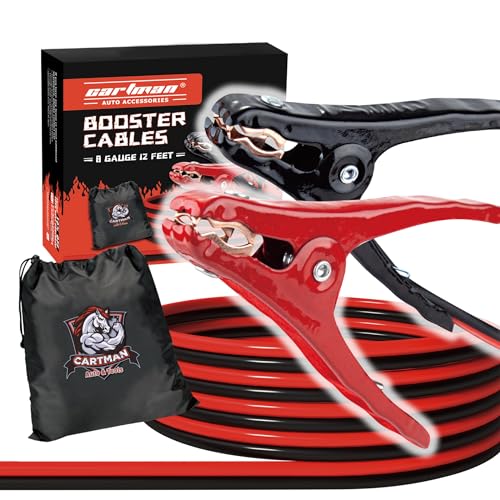
Start with the honest headline of this whole guide: a jumper cable set is not a jump starter, and it needs a donor car. What it is, at this budget, is the only purchase that will reliably put a dead car back on the road. This CARTMAN set uses 8-gauge cable — thick enough for honest current delivery on ordinary cars — across 12 feet, which reaches between two nose-to-nose vehicles without stretching clamps to their limit.
The construction details are the ones that decide whether cables survive their second winter. The T-Prene jacket stays flexible down to -25 degrees C, so the set uncoils in cold weather instead of fighting you; the clamps fit both top-post and side-terminal batteries; the surfaces are shielded for safer handling; and the included carry bag keeps the set coiled in the trunk instead of tangling around everything else you own.
Know the format’s limits before you rely on it. Twelve feet is a parking-space tool: cars must be close and correctly positioned, a donor vehicle and a willing driver are required, and the connection sequence matters for safety — the guide’s safety section below walks through it. Within those limits, this is the highest-value dead-battery purchase this budget can make, and it never needs recharging.
- Actually starts cars at this budget — no other pick here can say that
- 8-gauge cable with a cold-flexible T-Prene jacket
- Never needs charging, pairing or maintenance — works after years in the trunk
Honest limitation: It is not a jump starter: it requires a second vehicle, correctly positioned, every single time.
Choose it if you park where other cars are around and want the dead-battery problem solved for this budget, permanently. Skip it if you need to start your car alone in an empty lot — that requires a real jump pack from the step-up picks below.
NOCO GENIUS1 1A Smart Battery Charger and Maintainer
Who it suits: Owners of cars that sit — second cars, weekend cars, seasonal cars — who would rather never need a jump than get better at giving one. For a beginner, the NOCO GENIUS1 1A Smart Battery Charger and Maintainer has a specific virtue worth naming: it does not require experience to use correctly the first time, and its limits are the visible, forgiving kind rather than the hidden kind.
The GENIUS1 is the one product in this guide that attacks the cause. It is a fully automatic 1-amp smart charger for 6V and 12V batteries — flooded, gel, AGM and lithium (LiFePO4) — that charges, then maintains at float indefinitely, with thermal compensation adjusting its output to the weather and a desulfation function aimed at recovering some lost capacity in tired lead-acid batteries. A force mode can charge a battery reading as low as effectively zero volts.
The hardware is garage-friendly: a direct wall plug-in body, a 110-inch DC cable, and both clamps and integrated eyelet terminals, so a car that lives on the maintainer can be connected semi-permanently and unplugged in seconds. At under a pound it stores anywhere, and a three-year warranty backs it — NOCO’s charger line is the same brand as the GB20 jump pack in this guide.
Be clear about what 1 amp means: this is a maintainer first. It will recharge a flat car battery eventually — over a day or more — but its real job is keeping a healthy battery full through weeks of sitting and short-trip life. It cannot crank an engine, and it is not a rescue device. As prevention, at a street price that sits right at this tier’s ceiling, it is the smartest money in the guide. Check the current price on Amazon, as it moves around the tier line.
- Prevents sitting-and-short-trip battery death entirely
- Fully automatic: charge, float, temperature compensation, desulfation
- Clamps plus eyelets on a 110-inch cable; 3-year warranty
Honest limitation: Maintainer, not a starter — a flat battery takes a day or more at 1 amp, and it needs a wall outlet.
Choose it if your car’s battery dies from disuse or short trips and it parks near an outlet. Skip it if you need roadside rescue capability — pair it with the cables, or step up to a lithium pack.
NOCO Boost GB20 500A Lithium Jump Starter (step up)
Who it suits: Drivers ready to step above this budget for the smallest trustworthy solo-start solution — sized for four-cylinder and small-engine cars. For a beginner, the NOCO Boost GB20 500A Lithium Jump Starter (step up) has a specific virtue worth naming: it does not require experience to use correctly the first time, and its limits are the visible, forgiving kind rather than the hidden kind.
The GB20 is what the honest version of this purchase looks like one tier up. NOCO rates it at 500 peak amps for gasoline engines up to 4.0 liters, with up to 20 jump starts per charge from its 24Wh lithium battery, and its UltraSafe design brief — spark-proof connections and reverse polarity protection — is exactly what a nervous first-time user needs: connect it wrong and it refuses rather than sparks.
The supporting details are equally grown-up: a 100-lumen LED flashlight with seven modes including SOS and strobe, a USB power bank output for a phone, an IP65-rated rubberized enclosure, and a one-pound body that genuinely lives in a glovebox. It is designed in the USA and backed by a one-year warranty from a brand whose entire business is battery products.
Why is it prose-only here? Because it sells well above this guide’s budget, and pretending otherwise would be the exact dishonesty this guide exists to avoid. It is included so you can see the real entry price of a credible solo jump starter — and so the step-up decision, when you make it, is already researched.
- Spark-proof, reverse-polarity-protected — mistake-proof for beginners
- 500A for gas engines up to 4.0L, up to 20 starts per charge
- Flashlight, power bank and IP65 rugged housing in one pound
Honest limitation: Priced well above this budget — that is why it carries no purchase link in this guide.
Choose it if you can step up and your car is a four-cylinder or small six — this is the credible minimum. Skip it if your engine is larger than 4.0L gas — look at the GP2000 below instead.
Step-up pick — no purchase link at this budget; see the review below.
GOOLOO GP2000 2000A Jump Starter (step up)
Who it suits: Drivers of larger engines — V6 and V8 cars, trucks and diesels — who need the step-up pick with real headroom rather than a minimum rating. For a beginner, the GOOLOO GP2000 2000A Jump Starter (step up) has a specific virtue worth naming: it does not require experience to use correctly the first time, and its limits are the visible, forgiving kind rather than the hidden kind.
GOOLOO’s GP2000 is the value end of serious jump packs: a maker-rated 2000 amps of peak current (400 amps starting current in the manual’s specification table) from a 37Wh battery, rated for gasoline engines up to 8.0 liters and diesels up to 6.0 liters — coverage that includes essentially every car, SUV and light truck a household is likely to own. Ten built-in protections, including reverse polarity, short circuit, over-temperature and spark-proofing, guard the process.
The extras are the useful kind: a 400-lumen LED with strobe and SOS modes, USB outputs including a quick-charge port for phones, a storage case, and a 1.2-pound body measuring about 7.4 x 3.9 x 1.5 inches. GOOLOO’s manual advises recharging every three months to keep the pack ready, which is the correct ownership habit for every lithium jump starter in this guide.
Like the NOCO, it appears here without a purchase link because its real price lives above this budget — typically in the range where jump packs stop being toys. Treat it as the researched answer to ‘what should I buy when I am ready to spend what a jump starter actually costs,’ especially for bigger engines.
- Rated to 8.0L gas and 6.0L diesel — covers trucks and V8s
- Ten protection systems and all-metal heavy-duty clamps
- 400-lumen light, quick-charge USB and storage case included
Honest limitation: Above this budget, so prose-only here; peak-amp figures are maker ratings, as with all jump packs.
Choose it if you are stepping up and drive a larger engine or a diesel. Skip it if you drive a small four-cylinder — the GB20 covers it in a smaller, simpler package.
Step-up pick — no purchase link at this budget; see the review below.
DBPOWER DJS50 800A Jump Starter (step up)
Who it suits: Drivers who like the idea of a screen on their jump pack — charge level and output voltage at a glance — in a mid-priced step-up. For a beginner, the DBPOWER DJS50 800A Jump Starter (step up) has a specific virtue worth naming: it does not require experience to use correctly the first time, and its limits are the visible, forgiving kind rather than the hidden kind.
The DJS50 is the long-running mid-market alternative: a maker-rated 800 amps of peak current and an 18000mAh battery, rated for gasoline engines up to 7.2 liters and diesels up to 5.5 liters, with up to 20 starts per charge claimed by its maker. An LCD screen shows charge and output status — a small thing that removes the guesswork of a four-LED gauge — and a built-in compass and dual-mode LED light round out the emergency-kit brief.
Its USB outputs include a smart port for fast phone charging, and the pack can also output 12, 16 or 19 volts for laptops with the included adapters, which made it a favorite of drivers who wanted one battery for every roadside job. The intelligent clamps carry the standard protection set against reverse connection, short circuits and overcharging.
It is presented prose-only for two honest reasons: its price sits above this budget, and this session could not confirm its current Amazon ASIN from a primary listing — the model has been sold under several listings over its long life. If you shop for it, buy from the brand’s current storefront listing and verify the model number DJS50 on the page.
- LCD status screen instead of a vague LED gauge
- 800A peak with up to 7.2L gas / 5.5L diesel maker ratings
- Extra DC outputs for laptops and devices
Honest limitation: Above this budget, and its current ASIN could not be confirmed from a primary listing this session — prose-only.
Choose it if you are stepping up and value the LCD and device-charging versatility. Skip it if you want the cleanest verified purchase — the NOCO and GOOLOO above are the firmer pins.
Step-up pick — no purchase link at this budget; see the review below.
Clore Jump-N-Carry JNC660 (traditional step up)
Who it suits: Drivers and home mechanics who distrust tiny lithium ratings and want the traditional workshop jump box: heavy, simple and enormously strong. For a beginner, the Clore Jump-N-Carry JNC660 (traditional step up) has a specific virtue worth naming: it does not require experience to use correctly the first time, and its limits are the visible, forgiving kind rather than the hidden kind.
The JNC660 represents the older school of jump starting: a sealed lead-acid battery in a heavy case, rated at 1700 peak amps, with long heavy-gauge cables and industrial clamps, plus a 12V DC outlet for accessories. This is the format tow drivers and workshops used for decades before lithium packs existed, and it still starts engines that make small lithium units struggle — repeatedly, all day, without the pack’s electronics second-guessing the connection.
The trade is weight and upkeep. A lead-acid box is a two-hand carry, it wants regular recharging from a wall outlet to keep its battery healthy, and it offers none of the power-bank or flashlight versatility of the lithium picks. It is a tool, not a glovebox accessory, and it belongs to households with a garage corner to keep it in.
It is prose-only here because it costs several times this guide’s budget. It earns its place in the guide as the honest endpoint of the category: if your dead-battery problem is chronic and your vehicles are large, this traditional format — not a pocket pack — is what professionals reach for.
- 1700 peak amps of traditional lead-acid cranking strength
- Starts big engines repeatedly; no electronic lockouts
- Simple, repairable, workshop-proven format
Honest limitation: Heavy, needs routine wall recharging, and priced far above this budget — prose-only.
Choose it if you have garage space, large vehicles and a chronic dead-battery problem. Skip it if you want glovebox portability — every lithium pick above beats it there.
Step-up pick — no purchase link at this budget; see the review below.
How the picks divide the work: the linked products solve today’s problem inside today’s budget — rescue with a donor car, prevention in the garage — while the prose-only packs define the destination when the budget grows, sized from the GB20’s small-car brief to the GOOLOO’s truck coverage and the Clore’s workshop muscle. Read the list as a ladder rather than a contest: each rung is honest about what it is, and the right rung is the one that matches your parking situation, your engine and your battery’s actual pattern of dying.
Comparison Table
| Product | Format and key specification | Link |
|---|---|---|
| CARTMAN 8-Gauge 12-Foot Jumper Cables with Carry Bag | Booster cables; 8-gauge x 12 ft; top-post and side-terminal clamps | Check on Amazon |
| NOCO GENIUS1 1A Smart Battery Charger and Maintainer | Smart charger/maintainer; 1A; 6V/12V; clamps and eyelet terminals included | Check on Amazon |
| NOCO Boost GB20 500A Lithium Jump Starter (step up) | Lithium jump pack (prose-only step-up); 500A; up to 4.0L gas; 100-lumen LED, IP65 | Step-up pick — no purchase link at this budget; see the review below. |
| GOOLOO GP2000 2000A Jump Starter (step up) | Lithium jump pack (prose-only step-up); 2000A peak; up to 8.0L gas / 6.0L diesel; 400-lumen LED | Step-up pick — no purchase link at this budget; see the review below. |
| DBPOWER DJS50 800A Jump Starter (step up) | Lithium jump pack (prose-only step-up); 800A peak; 18000mAh; LCD and compass | Step-up pick — no purchase link at this budget; see the review below. |
| Clore Jump-N-Carry JNC660 (traditional step up) | Lead-acid jump box (prose-only step-up); 1700 peak amps; heavy workshop format | Step-up pick — no purchase link at this budget; see the review below. |
How to Choose: Best portable jump starter for beginners under $30
The criteria below are the ones that separated the picks above from everything else in this category at $30. This pairs naturally with Best Portable Jump Starter For Daily Driving Under $15 when you are equipping the whole car.
For beginners, the emphasis inside these criteria shifts toward forgiveness. Weight the items about simplicity, built-in guidance and protection electronics above the items about depth and speed: a first purchase should succeed even when its owner does everything slightly wrong, because that is what first purchases are for. Depth can be bought later, with knowledge; a bad first experience with a category often cannot be un-bought, because it teaches avoidance instead of skill. Every pick in this guide was chosen to be a good first teacher.
- Match the pack to your largest engine. Ratings are given as maximum engine displacement for gas and diesel separately, and diesel needs more. A pack sized exactly at your engine’s limit will struggle in deep cold, when batteries weaken and oil thickens. Buy headroom: the next size up is the correct size.
- Safety electronics are the beginner feature that matters. Spark-proof clamps and reverse-polarity protection turn the scariest part of jump starting — connecting to the wrong terminal — into a non-event. For a first pack, this protection set is worth more than extra capacity, and every lithium step-up in this guide has it.
- Capacity is measured in watt-hours, not promises. The internal battery’s watt-hour rating (24Wh for the GB20, 37Wh for the GP2000) tells you how much energy you are carrying. Starts-per-charge claims assume a healthy pack and a cooperative engine; treat them as best cases, and recharge the pack every few months as makers advise.
- Jumper cables are a specification, not a commodity. Gauge is the spec: lower numbers are thicker cable and carry starting current with less loss — 8-gauge serves ordinary cars, 4-gauge and thicker serve trucks and long reaches. Length buys positioning freedom; 12 feet is a minimum, 20 feet is comfortable. A jacket that stays flexible in deep cold is the difference between a tool and a fight.
- A maintainer is rated in amps and intelligence. One amp is maintenance pace; the value is in the automation — automatic float, temperature compensation, and compatibility with your battery type, including AGM and lithium. Clamps plus eyelet terminals make a semi-permanent connection possible for a car that lives on the charger.
- Cold changes every number. A battery can lose a third of its cranking strength in deep cold while the engine needs more. Whatever solution you choose — cables, pack or prevention — its worst day is a January morning. Judge every rating in this guide against that morning, not a mild afternoon.
- Storage decides whether the tool exists when needed. A jump pack in a warm house is a paperweight at a frozen trailhead; cables in the trunk are always on duty. Lithium packs want a charge check every three months or so; cables want nothing for a decade. Choose the solution whose upkeep matches your habits.
- Know when the battery itself is the problem. A battery that needs jumping weekly is not a starting problem — it is a dying battery announcing itself. No accessory in this guide fixes that; a load test at a parts store, usually free, gives the verdict, and a new battery ends the story.
- Decide whether your problem is rescue or prevention. A battery that died once, away from home, needs starting power. A battery that dies repeatedly from sitting or short trips needs a maintainer — or replacement. The two problems have different tools, and this budget only honestly covers one of them: prevention and cable-based rescue.
- Understand peak amps before believing them. Peak current is a momentary, maker-defined figure with no governing standard; two packs both claiming four-figure peaks can perform very differently. Starting current, where published — the GOOLOO in this guide publishes both — is the more honest number, and engine-size ratings from conservative brands are the most practical guide of all.
Why Batteries Die: The Four Patterns and Their Real Fixes
Pattern one is age. A car battery is a consumable with a typical service life measured in a handful of years, shortened by heat and by deep discharges. Its death is gradual — slower cranks on cold mornings, then a no-start. The fix is a load test and, when it fails, replacement. No charger or pack restores a battery whose plates have sulfated beyond recovery, though a maintainer’s desulfation mode can extend a healthy battery’s life.
Pattern two is disuse. A parked car still draws power for clocks, alarms and computers, and a battery left partially discharged sulfates as it sits. This is the maintainer’s home ground: an automatic float charger connected in the garage holds the battery at full charge indefinitely, and it is why the maintainer is a linked pick at this guide’s $30 tier. Pattern three is the short-trip life — starts that cost more charge than the drive replaces — which the same maintainer answers, or a weekly longer drive. If your situation sits between the two, Best Portable Jump Starter For Road Trips Under $15 is the other half of the picture.
Pattern four is a fault: an alternator that undercharges, a light or module that never sleeps, corrosion adding resistance at the terminals. The symptoms mimic a bad battery, and the tell is a good battery dying young. This pattern needs diagnosis — terminal cleaning, a charging-system check, a parasitic-draw test — rather than another accessory. Match the fix to the pattern, and the dead-battery problem usually stays fixed.
For beginners, one habit outranks every product in this guide: do the simple version of the job, in the right order, and write down what you find. Notes turn a first experience into the beginning of competence.
Peak Amps, Starting Amps and Other Numbers That Need Translating
Jump starter marketing runs on one number — peak amps — and it is the least standardized figure in the category. Peak current is the maximum the pack can deliver for an instant, defined by each maker, measured under each maker’s conditions. It correlates with capability the way a speedometer’s top number correlates with a car’s speed: loosely. A 500-amp pack from a conservative brand starts cars that a no-name pack claiming three times the figure cannot, which is precisely why this guide refuses to link unverifiable listings at fantasy ratings.
The more honest figures exist if you look. Starting current — the sustained cranking delivery — is published by better makers; GOOLOO’s manual lists 400 amps starting against its 2000-amp peak, and that ratio is the category’s open secret. Engine ratings are the practical translation: a maker who rates a pack for 4.0-liter gasoline engines is making a claim owners will test publicly, and conservative brands rate cautiously. Watt-hours complete the picture by sizing the fuel tank behind the amps.
For cables, the honest number is gauge, and it works backwards: 1-gauge is thickest, 10-gauge thinnest among common sets. Current through a cable loses energy to resistance, more so over distance, so a long thin set can starve a starter that a short thick set would spin happily. The CARTMAN pick in this guide publishes its 8-gauge construction and cold-flex rating — the two numbers that decide whether cables work on the worst morning of the year.
For beginners, one habit outranks every product in this guide: do the simple version of the job, in the right order, and write down what you find. Notes turn a first experience into the beginning of competence.
What a Real Jump Starter Budget Buys
Since this guide’s honest conclusion is that the genuine article lives above this budget, it owes you a map of that territory. The credible class begins with packs like the NOCO Boost GB20 500A Lithium Jump Starter (step up): a conservative brand, a published engine rating, spark-proof and reverse-polarity protection, and a body small enough to live in the glovebox it will be needed from. That class covers most cars on the road. Above it, capacity and current climb — the GOOLOO GP2000 2000A Jump Starter (step up)’s ratings reach into V8 and diesel territory — and the packs gain quick-charge ports, brighter lights and longer standby claims, at prices that still total less than one tow.
Above the lithium class sits the traditional workshop format, represented here by the Clore Jump-N-Carry JNC660 (traditional step up): lead-acid weight and cranking authority for chronic problems and the largest engines. Almost no household needs it, and that is the point of the map — the territory above this budget is well-ordered, each step buys a defined capability, and none of it requires the fantasy products this tier’s listings advertise. Save toward the rung that matches your largest engine, keep the cables in the trunk in the meantime, and the dead-battery problem is managed at every stage of the saving.
Common Buying Mistakes
- Assuming a bigger peak-amp number always means a stronger pack, when starting current and honest engine ratings tell the real story.
- Leaving a lithium jump pack uncharged for a year and expecting it to perform — makers advise a recharge every few months for a reason.
- Buying cables too short or too thin: a 10-gauge, 10-foot set may not reach between real parked cars or carry a truck’s cranking current.
- Using a maintainer as a rescue tool — a 1-amp charger needs a day, not a minute, and cannot crank an engine.
- Repeatedly jump-starting a dying battery for weeks instead of getting the free load test that ends the guessing.
- Forgetting that a revived car needs a real drive or a proper charge afterward — five minutes of idling leaves the battery nearly as empty as before.
- Buying a no-name ‘jump starter’ at this budget whose amp rating no maker will defend — and discovering its real rating on a cold morning in an empty lot.
- Connecting jumper cables in the wrong order and making the final, sparking connection directly on the dead battery’s negative terminal instead of an engine ground point.
- Jumping a frozen, cracked or leaking battery instead of replacing it — a damaged battery is a hazard, not a candidate for one more start.
Final Recommendation
Our top pick is the CARTMAN 8-Gauge 12-Foot Jumper Cables with Carry Bag — best thing this budget actually buys — because it answers this search most completely for the money this budget actually commands. The runner-up is the NOCO GENIUS1 1A Smart Battery Charger and Maintainer, the right answer when your priorities tilt toward its particular strength: 1a, 6v/12v, lead-acid and lithium, temperature compensation, 110-inch cable.
Whichever you choose, apply the guide’s closing discipline: verify the specification that matters most for your car and your load against the live listing, keep the packaging until the product has proven itself in real use, and build the small routine — the monthly check, the seasonal audit — that keeps any purchase in this category earning its place. The companion guide Best Roof Cargo Carrier For Car Owners Under $30 covers the adjacent case in the same detail.
One last calibration before you buy: the right purchase in this category is the one matched to the car and the routine you have today, verified against the live listing’s specifications, and then actually used on the schedule the technique sections describe. Equipment earns its keep in rituals, not in receipts — set the monthly check, the seasonal audit or the pre-trip inspection on your calendar now, while the intention is fresh, and whichever pick you choose will still be serving you when the next version of this search comes around.
Frequently Asked Questions
What size jump starter does my car need, when I step up?
Match the pack’s engine rating to your largest vehicle with headroom: the GB20’s up-to-4.0L gas rating suits four-cylinder and small cars; the GOOLOO GP2000’s 8.0L gas and 6.0L diesel ratings cover trucks and V8s. Cold climates and diesels argue for the larger pack regardless.
Will a battery maintainer fix my dead battery?
A maintainer prevents flat batteries and can slowly recharge one — at 1 amp, over a day or more — but it cannot start a car now, and it cannot restore a battery that has failed from age. Prevention and rescue are different tools; this guide’s linked picks cover prevention, cables cover rescue with help. For the related search, Best Trunk Organizer Under $15 applies the same standards.
How often should a jump pack be recharged?
Makers such as GOOLOO advise every three months, and NOCO’s packs hold charge well but deserve the same calendar habit. A pack checked quarterly is a rescue tool; a pack forgotten for a year is a hope. Put the recharge date on the same list as your tire-pressure checks.
Is jump starting safe for a beginner?
With modern protected equipment, yes. Lithium packs with spark-proof, reverse-polarity-protected clamps refuse a wrong connection instead of punishing it. With cables, safety is the connection sequence — positive to positive, negative to a ground point away from the battery — plus never attempting a frozen or damaged battery.
Why does my battery keep dying even though it tests fine?
Look beyond the battery: an undercharging alternator, a module or light that never sleeps (parasitic draw), corroded terminals adding resistance, or a life of short trips that never repay the starter. A maintainer masks the short-trip pattern; the others need diagnosis, which most parts stores will start for free with a charging-system check.
How long should jumper cables be?
Twelve feet is the practical minimum for nose-to-nose cars; twenty feet gives real positioning freedom, including cars parked in line. Remember that length and gauge work together — a long set needs a thicker gauge to deliver the same current.
Can a jump starter also charge my phone?
Most lithium packs double as USB power banks — the GB20 and GP2000 in this guide both do — which is a genuine emergency virtue. It is a secondary feature, though: buy starting capability first and treat the power bank as a bonus.
Can jumper cables damage either car’s electronics?
Connected in the correct sequence, no — the procedure in this guide is the manufacturer-standard one used by roadside services daily. The risks live in reversed connections and sparks near the battery, which the sequence and, in the step-up packs, the protection electronics are designed to prevent.