Where to buy
Shopping for the best portable tire inflator for beginners under $30? Start with the linked picks below — check the latest price, availability and delivery on Amazon, where orders are placed. We may earn a commission from qualifying purchases. Picks marked as step-ups carry no link at this budget — the review explains what they cost and why they are worth planning for.
- Best overall under $30: EPAuto 12V DC Portable Air Compressor Pump — Check on Amazon
- AstroAI S1 Tire Inflator Portable Air Compressor 12V — Check on Amazon
- Slime 40050 Tire Inflator — Check on Amazon
- VacLife Tire Inflator VL701 (ATJ-1166) — Check on Amazon
- TEROMAS Tire Inflator Portable Air Compressor (AC/DC) — Check on Amazon
- Kensun Portable Air Compressor Pump (AC/DC, Analog) — Check on Amazon
Read the full guide ↓
Disclosure: As an Amazon Associate, umtsmarttool.com earns from qualifying purchases. Links to Amazon on this page are affiliate links; they cost you nothing extra. Listing details such as price and availability change often, so check the current Amazon listing before you buy.
The search for the best portable tire inflator for beginners under $30 is usually a first search — the first check engine light, the first dead battery, the first trunk that needs taming — and first searches deserve guides that assume nothing. So this one explains as it goes: what the product actually does, which specifications matter and which are decoration, and where beginners reliably waste money (usually on a headline number, a fantasy rating, or a tool whose real features hide behind an app paywall). The picks are ordered for a newcomer: the simplest complete option first, the step-ups clearly labeled with what the extra money buys and what it does not. Nothing here requires experience to use safely, and every technique section is written as if it will be read in a driveway, possibly in the rain, by someone doing this for the first time — because it will be.
Thirty dollars is the inflator category’s sweet spot: digital presets with automatic shut-off, honest working pressures, published duty cycles and dual-power options all live here, from makers who publish real specification sheets. Every pick below is linked, verified and chosen against the same job — passenger cars, bikes and midsize SUVs — with the exclusions (light-truck tires, marathon duty) stated in each review rather than buried.
Below are the quick picks, full reviews with verified specifications — working pressure, airflow and duty cycle for every unit — a side-by-side comparison, a choosing guide built around the specs that matter, technique sections on the monthly pressure ritual and on the physics of duty cycles, the mistakes that shorten inflators’ lives, and the questions drivers ask at the tire shop and the roadside. Readers comparing the neighbouring budget should also see Best Portable Tire Inflator For Beginners Under $15.
In this guide
Quick Picks
Short on time, or comparing several options at once? Each row names a buyer type and the product that suits it, with a link where this budget honestly supports one.
| Buyer type | Pick | Why it stands out | Link |
|---|---|---|---|
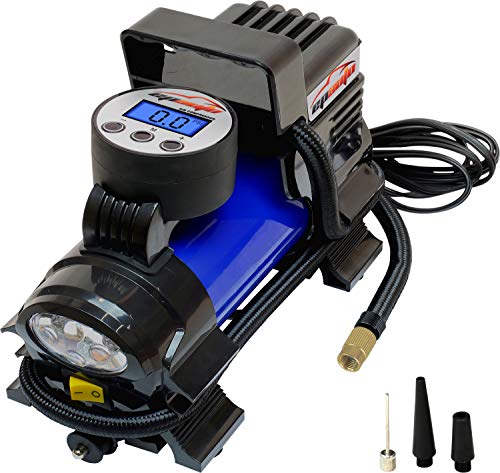
| Best overall under $30 | EPAuto 12V DC Portable Air Compressor Pump | 70 PSI max working pressure, 1.06 CFM, 120W, auto shut-off, LED light | Check on Amazon |
| Best compact digital pick | AstroAI S1 Tire Inflator Portable Air Compressor 12V | 150 PSI max, 12V DC, preset and auto shut-off, 9.87 ft cord, 1.54 lb | Check on Amazon |
| Best analog simplicity | Slime 40050 Tire Inflator | Dial gauge 0-100 PSI, 0.49 CFM, 8-minute standard tire fill, 10 ft cord | Check on Amazon |
| Best budget digital feature set | VacLife Tire Inflator VL701 (ATJ-1166) | 120W, digital gauge with auto shut-off, 9.8 ft cord, LED light | Check on Amazon |
| Best for home and car | TEROMAS Tire Inflator Portable Air Compressor (AC/DC) | 12V DC and 110V AC dual power, 150 PSI max, 120W, programmable auto shut-off | Check on Amazon |
| Best heavy-duty home pick | Kensun Portable Air Compressor Pump (AC/DC, Analog) | Dual-motor AC/DC, 100 PSI max, 20 L/min, 30-minute continuous working time | Check on Amazon |
How These Picks Were Chosen
The budget was applied as a hard ceiling: every linked pick is a real Amazon listing positioned within the $30 budget in the United States — check the current price on Amazon before you buy, as prices in this category move constantly. At the lowest tier in this series, that honesty produces a guide built around the one verifiable entry inflator and clearly-labeled step-ups, because a guide that links unverifiable listings to fill slots helps no one.
We did not use these inflators ourselves. We read maker listings, manuals and comparison charts, and compared the specifications that decide real-world usefulness: maximum working pressure for car tires (not headline pressure), airflow in CFM or liters per minute, duty cycle — how long the unit may run before it must cool — cord and hose reach, gauge type, and whether the unit stops itself at a preset pressure. Maker-published figures were preferred wherever they exist, and each pick’s sources note where a figure comes from. The companion guide Best Portable Tire Inflator For Car Owners Under $15 covers the adjacent case in the same detail.
Two filters sat on top of the specs. First, the job definition: passenger cars, bikes and midsize SUVs — no pick is recommended for light-truck or heavy-duty tires unless its maker says so. Second, honesty of interface: a published duty cycle and a realistic pressure rating counted for more than a spectacular headline number, because an inflator is emergency equipment and emergency equipment must be believed.
The exclusions shaped this list as much as the inclusions. We excluded inflators whose only pressure figure was a bicycle headline with no car-tire working rating, units with no published duty cycle — the specification that decides whether a compressor survives its second year — and the anonymous listings whose airflow figures changed between their own title and their own description. We also excluded anything marketed for truck tires in this class, because a compact compressor asked to fill light-truck volumes is a unit being set up to overheat, and a guide that repeats the marketing inherits the failure. What remains is a list built from makers who publish manuals, comparison charts and honest numbers: Slime’s own chart, for instance, rates its smallest unit’s fill at twelve minutes where a less honest brand would print four. In emergency equipment, that kind of candor is a specification in itself, and it is weighted accordingly in the rankings below.
The 6 Best Portable tire inflators for Beginners Under $30
Six picks, in the order most readers should consider them. Linked picks can be bought inside this budget today; step-up picks are the verified products this budget honestly points toward, presented without links so the planning is clean. For the related search, Best Portable Tire Inflator For Daily Driving Under $15 applies the same standards.
EPAuto 12V DC Portable Air Compressor Pump
Who it suits: Everyday drivers who want the proven, simple trunk inflator: plug into the 12V socket, set the pressure, and let it stop itself. For a beginner, the EPAuto 12V DC Portable Air Compressor Pump has a specific virtue worth naming: it does not require experience to use correctly the first time, and its limits are the visible, forgiving kind rather than the hidden kind.
The EPAuto is the inflator this class is judged by, because its specification sheet is honest about what a car inflator actually needs to do. Its maximum working pressure is 70 PSI — far above the 30 to 36 PSI a passenger tire wants — and its 1.06 CFM airflow fills at a useful pace rather than a headline pace. It plugs into the vehicle’s 12V outlet, draws 10 to 15 amps, and its digital gauge reads in PSI, KPA, BAR and KG/CM.
The usability details are the ones owners actually praise: set the target pressure and the unit shuts off automatically when it gets there, adding a small allowance for the air lost when the chuck comes off; a bright LED torch handles the nighttime flat; and adapters for balls and inflatables are in the box. It is a set-and-check tool, not a babysitting tool.
The boundaries are stated by the maker itself: it does not support truck tires — no light-truck (LT) or heavy-duty fitments — and it is 12V only, with no wall-outlet mode. For cars, bikes and midsize SUVs, which is the job description in this guide, it remains the default recommendation.
- Automatic shut-off at your preset pressure — no gauge babysitting
- Honest 70 PSI working rating with strong 1.06 CFM airflow
- LED torch and multi-unit digital display included
Honest limitation: Not for light-truck or heavy-duty tires, and 12V vehicle power only — no home outlet mode.
Choose it if you want the proven all-rounder for a car, bike or midsize SUV. Skip it if you need wall-outlet power at home — look at the TEROMAS or Kensun below.
AstroAI S1 Tire Inflator Portable Air Compressor 12V
Who it suits: Drivers who want the smallest serious inflator: a 1.5-pound digital unit that presets, fills fast for its size, and disappears into a trunk corner. For a beginner, the AstroAI S1 Tire Inflator Portable Air Compressor 12V has a specific virtue worth naming: it does not require experience to use correctly the first time, and its limits are the visible, forgiving kind rather than the hidden kind.
The S1 is AstroAI’s compact answer: a 12V inflator with a 150 PSI maximum rating, a digital display with preset pressure and automatic shut-off, and a body weighing just 1.54 pounds. Its maker quotes a 185/55 R14 tire going from 30 to 36 PSI in under a minute and a full 0 to 36 PSI fill in under five — brisk pace for a unit this small — and the 9.87-foot power cord plus roughly 1.6-foot hose reaches around a typical car without repositioning the unit at every wheel.
The accessory kit is complete for household inflation: nozzle adapters, a Presta-to-Schrader adapter for bicycles, a needle for balls, and a spare fuse. The LED light and backlit screen make the classic dark-driveway top-up a non-event, and the four pressure units cover whatever your door-jamb sticker or bike frame demands.
Respect the duty cycle: the maker caps continuous use at 15 minutes, which is ample for top-ups and a single flat car tire but not for inflating four truck tires back to back. It is a car, motorcycle and bicycle tool — exactly the brief — and within that brief it is the most carryable full-featured pick here.
- Featherweight 1.54 lb body with preset-and-stop digital filling
- Fast top-ups for its size; full accessory kit with spare fuse
- Long 9.87 ft cord reaches all four corners of most cars
Honest limitation: 15-minute continuous-use cap; not intended for heavy-duty or truck tires.
Choose it if you want maximum portability with digital preset convenience. Skip it if you regularly inflate large SUV or truck tires — choose a higher-duty pick.
Slime 40050 Tire Inflator
Who it suits: Drivers who distrust digital presets and want a gauge they can read at a glance, from the brand synonymous with tire repair. For a beginner, the Slime 40050 Tire Inflator has a specific virtue worth naming: it does not require experience to use correctly the first time, and its limits are the visible, forgiving kind rather than the hidden kind.
Slime’s 40050 is the traditionalist’s inflator: a 12V unit with an analog dial gauge reading 0 to 100 PSI, an air-cooled motor, and a twist-on valve connector, powered through a 10-foot cord with a 2-foot air hose for 12 feet of total reach. Slime rates it at 0.49 CFM and quotes about eight minutes to fill a standard P195/65 R15 tire from flat — slower than the digital picks, and the maker says so plainly.
What you get in exchange for the pace is simplicity and a certain honesty of interface: no presets to program, no screen to fail, just a needle climbing a dial while an LED light shows the valve. The duty cycle is published — run up to 10 minutes, then cool for 25 — and the unit is tire-sensor safe. For monthly top-ups of a few PSI, which is most inflator use, the eight-minute flat-fill figure is irrelevant; the job takes a minute or two.
There is no automatic shut-off, so this is the one pick in the guide that asks you to watch the gauge — the flip side of its analog charm. Drivers who want set-and-forget should choose the EPAuto or AstroAI; drivers who want the fewest possible things to go wrong will feel at home here.
- Analog dial gauge — readable at a glance, nothing digital to fail
- Published duty cycle and honest fill-time figures from the maker
- Tire-sensor safe, with LED light and 12 ft total reach
Honest limitation: No auto shut-off — you watch the gauge yourself — and the slowest fill rate in this guide.
Choose it if you prefer analog simplicity and mostly do quick top-ups. Skip it if you want preset-and-stop convenience or the fastest fills.
VacLife Tire Inflator VL701 (ATJ-1166)
Who it suits: Value hunters who want digital preset-and-stop features and an LED light at the friendliest price point in the class. For a beginner, the VacLife Tire Inflator VL701 (ATJ-1166) has a specific virtue worth naming: it does not require experience to use correctly the first time, and its limits are the visible, forgiving kind rather than the hidden kind.
The VL701 packs the digital feature set — a backlit pressure display in PSI, BAR, KPA and KG/CM, preset pressure with automatic shut-off, and an LED work light — into the class’s budget slot. Its maker specifies 120 watts of power and about 35 liters per minute of airflow, a 9.8-foot power cord, and a 10-minute maximum continuous working time before a rest, which covers a full set of passenger-car top-ups with room to spare.
Read its pressure rating the way the maker writes it: the working range for car tires is up to about 50 PSI — comfortably above any passenger car’s specification — while the higher headline figure applies to bicycle tires. That is not a weakness for this guide’s job; it is a reminder to shop working ratings, not headline ratings, a theme the how-to-choose section develops.
One sourcing note, stated plainly: this model’s ASIN was confirmed from a secondary roundup source rather than the primary listing during this session, so verify the model number ATJ-1166 and the VL701 name on the live listing before ordering. The product itself is a long-running budget staple sold in several colors under the same model number.
- Digital preset with auto shut-off at a budget price
- 35 L/min airflow rating and 9.8 ft cord
- LED light and four pressure units
Honest limitation: Car-tire working pressure is about 50 PSI despite the higher headline figure; ASIN flagged as single-source in this guide’s sources.
Choose it if you want digital convenience at the lowest cost in the class and drive a passenger car. Skip it if you inflate high-pressure or light-truck tires — choose a heavier-duty pick.
TEROMAS Tire Inflator Portable Air Compressor (AC/DC)
Who it suits: Drivers who inflate things at home as often as on the road — bikes in the garage, mattresses, pool gear — and want one inflator for both outlets. For a beginner, the TEROMAS Tire Inflator Portable Air Compressor (AC/DC) has a specific virtue worth naming: it does not require experience to use correctly the first time, and its limits are the visible, forgiving kind rather than the hidden kind.
The TEROMAS solves the one problem every other pick here has: it runs on the car’s 12V outlet and on a 110V wall outlet, with separate cords for each — about 126 inches of DC cable and 60 inches of AC. Its digital gauge is programmable with automatic shut-off, the maker rates it to 150 PSI, and the quoted fill for a P195/65R15 from flat to 35 PSI is under four minutes.
That dual citizenship changes how an inflator gets used. Bicycle tires, sports equipment, air mattresses and pool inflatables stop being reasons to move the car, and the inflator becomes a household tool that also travels. Three nozzle adapters and a carrying bag are included, and the LED-lit backlit display keeps the roadside mode fully competent at night.
The maker’s duty guidance is to cool the unit for at least five minutes after every 15 minutes of use, and heavy-duty truck and tractor tires are explicitly out of scope. Its street price also moves around this tier’s ceiling, so check the current price on Amazon before counting it as an under-$30 buy — when it sits above the line, it is the step-up pick, not a budget error.
- Runs on car 12V and home 110V — one inflator for garage and road
- Programmable digital gauge with auto shut-off
- Fast quoted fills and a full adapter kit with carrying bag
Honest limitation: Not for heavy-duty truck tires; street price sometimes sits above this tier — verify before buying.
Choose it if you inflate at home as much as on the road and want one dual-power tool. Skip it if you only ever inflate car tires and want the simplest, cheapest format.
Kensun Portable Air Compressor Pump (AC/DC, Analog)
Who it suits: Home-first users who want a sturdier, longer-running inflator with separate motors for wall and car power, and an analog gauge. For a beginner, the Kensun Portable Air Compressor Pump (AC/DC, Analog) has a specific virtue worth naming: it does not require experience to use correctly the first time, and its limits are the visible, forgiving kind rather than the hidden kind.
Kensun’s design brief is durability through duplication: separate motors for the 110V AC and 12V DC modes, so neither power source is a compromised afterthought. The maker rates the unit to 100 PSI maximum with about 20 liters per minute of airflow, an analog pressure gauge, and — the figure that separates it from this class — a continuous working time of up to 30 minutes at car-tire pressures, roughly double the duty cycle of the compact picks.
The cables are sized for real use: about 6 feet of AC cord and just over 9 feet of DC, with a 22-inch air hose, and the body has compartments that swallow cords, hose and accessories so the kit travels as one tidy unit. At about four pounds it is the heavyweight here, and that weight is the point — this is a small appliance, not a glovebox gadget.
The analog gauge means no preset-and-stop: like the Slime, it asks you to watch the needle. Its size also makes it the least trunk-friendly pick in the guide. For a household that inflates bikes, balls, mattresses and car tires from the garage most weeks, those trades are the right ones.
- Separate AC and DC motors — full performance on both power sources
- 30-minute continuous working time, the longest duty cycle here
- Cord and hose storage built into the body; sturdy four-pound build
Honest limitation: Analog gauge with no auto shut-off, and the bulkiest pick in the guide.
Choose it if most of your inflating happens at home and you value duty cycle and build over size. Skip it if you want the smallest trunk unit with digital presets.
How the picks divide the work: by interface and by power. The digital picks — preset, watch, walk away — serve drivers who value automation; the analog picks serve drivers who value a gauge that can never crash. The dual-power picks add the garage to the map, and the duty-cycle figures sort everyone by workload: top-ups forgive everything, while regular flat tires promote the long-duty units. There is no wrong pick here for a passenger car — only a wrong match between a unit’s published limits and the job you actually give it.
Comparison Table
| Product | Format and key specification | Link |
|---|---|---|
| EPAuto 12V DC Portable Air Compressor Pump | 12V corded; 70 PSI max; 1.06 CFM; digital gauge in PSI/KPA/BAR/KG-CM | Check on Amazon |
| AstroAI S1 Tire Inflator Portable Air Compressor 12V | 12V corded; 150 PSI max; digital preset with auto shut-off; LED light | Check on Amazon |
| Slime 40050 Tire Inflator | 12V corded; analog dial gauge; 0.49 CFM; run 10 min / cool 25 min duty cycle | Check on Amazon |
| VacLife Tire Inflator VL701 (ATJ-1166) | 12V corded; digital; car tires to 50 PSI working pressure; 10-minute continuous duty | Check on Amazon |
| TEROMAS Tire Inflator Portable Air Compressor (AC/DC) | AC/DC dual power; 150 PSI max; digital programmable gauge; LED light | Check on Amazon |
| Kensun Portable Air Compressor Pump (AC/DC, Analog) | AC/DC dual motor; analog gauge; 100 PSI max; 20 L/min; long duty cycle | Check on Amazon |
How to Choose: Best portable tire inflator for beginners under $30
The criteria below are the ones that separated the picks above from everything else in this category at $30. This pairs naturally with Best Portable Tire Inflator For Road Trips Under $15 when you are equipping the whole car.
For beginners, the emphasis inside these criteria shifts toward forgiveness. Weight the items about simplicity, built-in guidance and protection electronics above the items about depth and speed: a first purchase should succeed even when its owner does everything slightly wrong, because that is what first purchases are for. Depth can be bought later, with knowledge; a bad first experience with a category often cannot be un-bought, because it teaches avoidance instead of skill. Every pick in this guide was chosen to be a good first teacher.
- Duty cycle is the spec nobody reads and everybody needs. Small compressors heat up. Makers publish a run limit — 10, 12, 15, up to 30 minutes in this guide — followed by a cooling rest. A unit that must rest after one tire is a top-up tool; a full set of flats needs the long-duty picks or patience between tires.
- Auto shut-off is the feature that changes the experience. Set the target, attach the chuck, and the inflator stops at pressure. Without it, you crouch by the tire watching a needle. Every digital pick here has it; the analog picks trade it for simplicity. Know which bargain you are making.
- Gauge type is a genuine fork. Digital gauges read to a decimal and often drive the auto shut-off. Analog dials need no interpretation and nothing electronic to fail, but they ask you to watch. Accuracy of a few PSI either way is typical in this class — verify monthly with a separate quality gauge if you are particular.
- Cord reach must circle the car. Add the power cord and hose: roughly 12 feet of total reach is the minimum to serve all four tires of a typical car from one socket without moving the unit awkwardly. Longer is better; the dual-power picks add a wall outlet to the map entirely.
- Power source decides where the tool lives. A 12V-only inflator lives in the car and works at the roadside. An AC/DC model also works in the garage for bikes, balls and mattresses — and can be tested at home, which is how you learn it works before the night you need it.
- Chuck design affects air loss. Screw-on chucks seal securely and lose little air on removal; lever-lock chucks are faster. Preset digital units that add a small allowance for disconnect loss — the EPAuto does — quietly solve the problem. Either way, check pressure after disconnecting until you know your unit’s habit.
- Respect the vehicle exclusions. Makers state them plainly: no light-truck (LT) or heavy-duty tires on the compact picks. LT tires run higher pressures and larger volumes that overheat small compressors. If you drive a truck on LT tires, this budget class is not your category.
- The inflator is half the system; the spare is the other half. An inflator handles leaks and low pressure. A tire with sidewall damage or a failed valve needs the spare — and a spare that is itself flat, as most neglected spares are, needs the inflator. Check the spare’s pressure with the same monthly ritual.
- Shop working pressure, not headline pressure. Passenger tires want 30 to 36 PSI. Some inflators headline 150 PSI — a figure earned on bicycle tires — while their car-tire working range is lower. The EPAuto’s honest 70 PSI maximum working pressure is the model: any rating comfortably above 40 PSI serves a car; beyond that, airflow and duty cycle matter more.
- Airflow decides how long you stand in the cold. Flow in CFM or liters per minute sets the pace: around 1 CFM fills a car tire in minutes; a third of that takes three times as long. For monthly top-ups of a few PSI, even slow units finish quickly — for a flat tire at midnight, pace is the product.
Duty Cycle, Heat and the Physics of Small Compressors
A portable inflator is a small piston squeezing air, and squeezing air makes heat. The motor and cylinder of a glovebox-sized unit have little mass and less cooling, so makers specify a duty cycle: a maximum continuous run — ten to thirty minutes across this guide’s picks — followed by a cooling rest that is often longer than the run. Ignoring the limit does not usually cause instant failure; it causes the slow kind — a unit that gets weaker across a summer and dies during the third tire of a winter night.
The practical translation is to match the tool to the workload. Top-ups of a few PSI per tire keep any pick in this guide comfortably inside its limits. A fully flat tire is the stress test: the Slime chart’s eight-to-twelve-minute fills for the analog class are continuous runs near those units’ caps, which is why the honest sequence for a full set of low tires is one tire, a rest, the next — or choosing a long-duty pick like the Kensun’s thirty-minute rating if flats are your regular pattern. If your situation sits between the two, Best Portable Tire Inflator Under $30 is the other half of the picture.
Heat management is also storage management. Let the unit cool before it goes back into its bag or the trunk’s hot corner, keep its vents unblocked while it runs, and run the car’s engine while inflating — both for full voltage at the socket and so a long session does not borrow charge the battery cannot spare. Small courtesies, extended to a small machine, are what make emergency equipment still work in year three.
For beginners, one habit outranks every product in this guide: do the simple version of the job, in the right order, and write down what you find. Notes turn a first experience into the beginning of competence.
Reading the Door-Jamb Sticker: Pressure Numbers That Actually Apply
Every car carries two pressure numbers, and only one of them is for you. The sidewall’s ‘max press’ figure is the highest pressure the tire’s construction tolerates — a ceiling, not a target. The recommendation lives on the driver’s door-jamb sticker (or inside the fuel door): the vehicle maker’s chosen pressures for the fitted tire sizes, front and rear sometimes differing, with a separate, usually much higher figure for the space-saver spare. That sticker, checked cold, is the whole authority an inflator user needs.
Cold means the car has sat for a few hours or been driven less than a mile — driving heats the air in the tire and raises the reading by several PSI, which is why a tire filled ‘to spec’ at a highway rest stop is underinflated the next morning. If you must fill warm tires, the common workshop rule is to add the difference — roughly 4 PSI above the cold figure for a thoroughly warmed tire — and then verify properly the next cold morning with your gauge.
Special cases deserve their sentence. A full-size load, a trailer or a long high-speed trip does not change the sticker for most modern cars — the maker already allowed for it. Winter tires follow the same sticker. And a tire-pressure monitoring system light typically triggers around a quarter below the recommended pressure, which means the light is a late warning, not a reminder: the monthly ritual with your inflator should always beat it to the job.
For beginners, one habit outranks every product in this guide: do the simple version of the job, in the right order, and write down what you find. Notes turn a first experience into the beginning of competence.
What the Next Tier Up Buys in Tire Inflators
The tier above this one buys three things, and it is worth knowing their names before you decide whether to climb. The first is airflow with duty cycle behind it: units that fill a flat in two to three minutes and can do four in a row without a rest, where this tier’s honest picks ask for patience or pauses. The second is power independence: cordless inflators with real battery capacity, and dual-power units like the TEROMAS Tire Inflator Portable Air Compressor (AC/DC) and Kensun Portable Air Compressor Pump (AC/DC, Analog) in this guide that already straddle the line — tools that work where no socket and no running engine are available. The third is build: metal cylinders, better chucks, quieter operation, the difference between an appliance and a gadget.
What the next tier does not buy is equally clarifying: it does not buy meaningfully better top-ups, which are this tier’s home ground and take a minute or two at any level; it does not buy truck-tire capability in a small body, which remains a question of compressor size at every price; and it does not buy freedom from the monthly ritual, because pressure still falls a PSI a month through the best tire ever made. Buy this tier for the car you have and the use you have measured, and let a changed pattern — bigger tires, more vehicles, a farm’s worth of inflatables — make the case for climbing when it is real.
The Monthly Ten Minutes: A Tire Pressure Ritual That Pays
Tires lose roughly a PSI a month through the rubber itself, and pressure falls further as temperatures drop — about a PSI for every ten degrees Fahrenheit. That is why the first cold snap fills tire shops: a fleet of cars that were merely low in September are genuinely underinflated in November. A portable inflator turns the correction into a ten-minute driveway ritual: check all four tires cold, before driving, against the door-jamb sticker — never the number molded on the tire’s sidewall, which is a maximum, not a recommendation.
The ritual’s order matters. Check first with a gauge, then inflate to the sticker figure, then re-check after disconnecting the chuck, because screw-on chucks release a puff of air as they come off. Do the spare last and do not skip it: a space-saver spare typically wants a much higher pressure than the road tires, and it is useless at road-tire pressure. Note which tire needed the most air — a tire that consistently loses more than its siblings has a slow leak, usually a nail or a valve, and it is telling you early, while the fix is still cheap. Readers comparing the neighbouring budget should also see Best Obd2 Scanner For Beginners Under $50.
The payoffs compound quietly. Correct pressure is the tire’s designed shape: even wear across the tread, full grip in the wet, honest fuel economy, and steering that feels like the car you bought. Underinflation is the opposite of each, plus heat — the flexing of an underinflated sidewall at highway speed is the classic prelude to a blowout. Ten minutes a month is the cheapest insurance in this entire guide.
For beginners, one habit outranks every product in this guide: do the simple version of the job, in the right order, and write down what you find. Notes turn a first experience into the beginning of competence.
Common Buying Mistakes
- Buying by headline PSI — a bicycle-pressure figure — instead of the car-tire working pressure and airflow that decide real fills.
- Skipping the spare for a year, then discovering on the shoulder that the space-saver is as flat as the tire it replaces.
- Leaving the inflator untested in the trunk from purchase to emergency; a two-minute home test is how you learn the chuck, the gauge and the fuse before it matters.
- Using a compact car inflator on light-truck tires against the maker’s exclusion, and overheating the unit on a job it was never built for.
- Ignoring the tire that always needs more air than its siblings — the slow leak it is reporting is cheapest on the day it is first noticed.
- Storing the inflator loose so its hose kinks and its chuck goes missing; the bag or case it came with is part of the tool.
- Inflating to the maximum pressure printed on the tire’s sidewall instead of the vehicle maker’s door-jamb recommendation.
- Checking and filling hot tires after a highway drive, then wondering why they read low the next cold morning.
- Running a compact inflator past its published duty cycle to finish a fourth tire, and shortening its life for the sake of five saved minutes.
Final Recommendation
Our top pick is the EPAuto 12V DC Portable Air Compressor Pump — best overall under $30 — because it answers this search most completely for the money this budget actually commands. The runner-up is the AstroAI S1 Tire Inflator Portable Air Compressor 12V, the right answer when your priorities tilt toward its particular strength: 150 psi max, 12v dc, preset and auto shut-off, 9.87 ft cord, 1.54 lb.
Whichever you choose, apply the guide’s closing discipline: verify the specification that matters most for your car and your load against the live listing, keep the packaging until the product has proven itself in real use, and build the small routine — the monthly check, the seasonal audit — that keeps any purchase in this category earning its place. The companion guide Best Obd2 Scanner For Car Owners Under $50 covers the adjacent case in the same detail.
One last calibration before you buy: the right purchase in this category is the one matched to the car and the routine you have today, verified against the live listing’s specifications, and then actually used on the schedule the technique sections describe. Equipment earns its keep in rituals, not in receipts — set the monthly check, the seasonal audit or the pre-trip inspection on your calendar now, while the intention is fresh, and whichever pick you choose will still be serving you when the next version of this search comes around.
Frequently Asked Questions
Why does my inflator’s gauge disagree with my hand gauge?
Small differences of a PSI or two are normal in this class, and gauges read at different moments — before and after the chuck’s disconnect puff — disagree further. Pick one gauge as your reference, use it consistently, and set pressures cold against the door-jamb sticker.
Do I need the car’s engine running while I inflate?
It is the recommended habit: full voltage makes the compressor run at its rated pace, and a long session cannot flatten the battery you are about to rely on. Every pick here is designed for vehicle power with the engine on. For the related search, Best Portable Jump Starter Under $15 applies the same standards.
Can these inflators fill a completely flat tire?
A tire that has gone flat from a slow leak, with the bead still seated, yes — that is the flat-fill times quoted above. A tire that has come off the bead, or has sidewall damage, is a spare-tire job; no portable inflator reseats a bead at the roadside.
What is the difference between the analog and digital picks?
Digital picks preset a pressure and stop automatically, with a decimal readout. Analog picks show a needle on a dial and ask you to stop the unit yourself. Both fill tires; the choice is between automation and simplicity, and this guide includes both because households genuinely differ.
Is a 150 PSI inflator better than a 70 PSI one for my car?
For car tires, not meaningfully: your tires want about 30 to 36 PSI, and both ratings clear that easily. The 70 PSI figure on the EPAuto is a working maximum with strong airflow behind it; the 150 PSI figures are maximums earned on small, high-pressure volumes like bicycle tires. Airflow and duty cycle separate real performance at car pressures.
How often should I check tire pressure?
Monthly, and before any long trip — plus whenever the temperature swings hard, since pressure falls about a PSI per ten degrees Fahrenheit of cooling. Always check cold, before driving more than a short distance.
Can I use a car inflator for bicycles and sports balls?
Yes — that is what the included nozzle adapters and needle are for, and the dual-power picks do it from a wall outlet at home. Bicycle tires are also where the high PSI ratings of the digital picks are genuinely useful.
Should I overinflate slightly to allow for the air lost disconnecting?
With a screw-on chuck you will lose a small puff on removal; preset digital units like the EPAuto already compensate. The reliable method is to inflate, disconnect, then verify with your gauge and add a touch if needed — measuring beats guessing in both directions.