Where to buy
This page covers the best car battery charger for car owners under $20 — the shortlist below is the result of verifying every candidate against manufacturer data. Check the latest price, availability and delivery on Amazon for the linked picks. Orders are placed on Amazon. We may earn a commission from qualifying purchases. Picks marked as step-up options are described in full in the reviews — check their current Amazon listings via the guide’s linked alternatives in the same class.
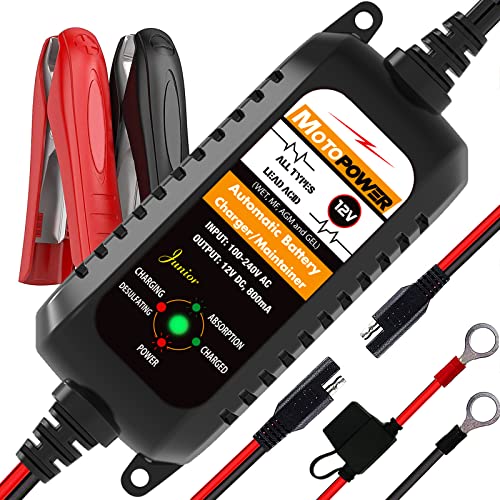
- Best true budget maintainer: MOTOPOWER MP00205A 12V 800mA Automatic Battery Charger — Check on Amazon
- NOCO GENIUS1 1A Smart Battery Charger (step-up pick — see review)
- Battery Tender Junior 800 (12V, 800mA, Selectable) (step-up pick — see review)
- NOCO GENIUS2 2A Smart Battery Charger (step-up pick — see review)
- NOCO GENIUS5 5A Smart Battery Charger (step-up pick — see review)
- NOCO GENIUS10 10A Smart Battery Charger (step-up pick — see review)
Chargers are safety equipment, and the listings above reflect that: linked picks go to the exact verified models reviewed below, and step-up picks are named precisely so you can find the genuine article. This category has convincing counterfeits; buy from the manufacturer’s own storefront or a major retailer, and treat a price far below the field as the warning it is.
Read the full guide ↓
Disclosure: As an Amazon Associate, umtsmarttool.com earns from qualifying purchases. Links to Amazon on this page are affiliate links; they cost you nothing extra. Listing details such as price and availability change often, so check the current Amazon listing before you buy.
Shopping for the best car battery charger for car owners under $20 means sorting real engineering from shelf-filler, and this guide does the sorting for you. We verified every pick against manufacturer or major-retailer data — specifications, capacities and compatibility, not marketing lines — and we state this tier’s honest limits where they exist. Twenty dollars is where the category’s one true budget maintainer lives: the MOTOPOWER MP00205A is linked below as the pick that honestly fits this tier, while the NOCO and Battery Tender models are the verified step-ups, shown prose-only with their real capabilities, for owners whose job turns out to need more than maintenance. Below you will find the six picks, what each one is genuinely best at, the criteria behind the shortlist, a side-by-side comparison, and the mistakes that waste money in this category. If you are also equipping the car more widely, our guide to Best Car Battery Charger Under $15 covers a related job in the same spirit.
Owners approach a charger as infrastructure: the tool that makes a second car, a classic, a motorcycle and a mower all start on the first turn, in the garage they share. The arithmetic is compelling — one maintainer costs less than one replacement battery, and a battery kept floated outlives a neglected one by years — but only if the tool matches the fleet. This guide is organised around ownership reality: chemistries mixed across vehicles, batteries of very different sizes, storage measured in seasons, and the difference between the charger that babysits and the charger that rescues.
One promise about how this guide handles the budget: the figure in the keyword is a hard ceiling for the primary recommendation, and the step-ups are labelled as step-ups with their relationships to the ceiling stated plainly. In a category where a few dollars separate a maintainer from a smart charger, that honesty matters more than the fiction that every tier contains a complete answer. You will always know what your exact money buys today, and what the next rung adds.
In this guide
Quick Picks
Short on time? This table is the whole guide in one screen: the six best car battery charger options for this brief, what each is best for, and the verified specification that defines it. Step-up picks are the models that begin just above this budget, included because they are the honest answer to the brief.
| Pick | Best for | Key verified spec |
|---|---|---|
| MOTOPOWER MP00205A 12V 800mA Automatic Battery Charger | Best true budget maintainer | 12V, 800 mA, lead-acid only (SLA/AGM/wet/gel), float at 13.6V, ETL listed |
| NOCO GENIUS1 1A Smart Battery Charger | Best small smart charger (step-up pick) | 1A, 6V/12V, lead-acid + LiFePO4, charges to 30Ah, Force Mode, thermal sensor |
| Battery Tender Junior 800 (12V, 800mA, Selectable) | Best set-and-forget classic (step-up pick) | 12V, 800 mA, switchable lead-acid / LiFePO4, 4-step charging, 5-year warranty |
| NOCO GENIUS2 2A Smart Battery Charger | Best step-up for car batteries (step-up pick) | 2A, 6V/12V, lead-acid + LiFePO4, charges to 40Ah, IP65, Force Mode |
| NOCO GENIUS5 5A Smart Battery Charger | Best all-round car charger (step-up pick) | 5A, 6V/12V, charges to 120Ah, 12V Repair mode, lead-acid + LiFePO4 |
| NOCO GENIUS10 10A Smart Battery Charger | Best for trucks, RVs and deep-cycle (step-up pick) | 10A, 6V/12V, charges to 230Ah, Repair + 12V Supply modes, lead-acid + LiFePO4 |
How to read this shortlist: the order is a recommendation, not a ranking of worth. The first pick is the charger we would hand to this brief’s reader first; each pick after it wins a narrower, named job — a chemistry, a capacity, a rescue feature — and its ‘best for’ line says which job that is. If your battery’s label or your storage pattern matches a later pick’s line better than the first pick’s, that later pick is your first pick. The full reviews below exist to make that call on verified output and certified capacity rather than on the table alone.
How These Picks Were Chosen
Every product in this guide was verified by web research against the manufacturer’s own pages, manuals or major-retailer listings before it earned a place: model numbers, capacities, dimensions, power figures and compatibility claims were checked at the source, and anything we could not verify was left out rather than repeated. No star ratings or review counts are quoted anywhere in this guide, because those numbers change constantly and a buying decision deserves sturdier evidence. Prices are likewise never stated for individual products — listings move too fast — so linked picks say “check price on Amazon” and the guide works in budget framing instead. You may also find our guide to Best Car Battery Charger For Car Owners Under $15 useful if this purchase is part of a wider round of car equipment.
For owners we scored fleet coverage: chemistry breadth including explicit lithium modes, 6V support for classics and small machines, battery-size ratings matched to real car batteries, and the connection hardware — ring harnesses and quick disconnects — that makes a multi-vehicle routine practical. Warranty length counted, because owners keep tools long enough to use warranties.
A note on ratings, because charger specifications reward a careful reader. The amp figure is a maximum the charger can deliver to a battery that can accept it, not a promise about every battery — a small motorcycle battery on a 10A charger still charges gently, because the smart programme governs the flow. The amp-hour rating is the largest battery the maker certifies the unit to charge, while ‘maintains all sizes’ means its float can hold any battery once charged. Reading those two numbers together — amps for speed, amp-hours for scope — tells you more about a charger than any feature list, and it is how this guide ranked the step-ups.
The shortlist is deliberately small. Six products that survived verification teach a buyer more than sixteen that merely exist, and the six here were chosen to span the genuine decision in this category — the formats, the power or connection types, and the honest step from this budget to the next — rather than six near-identical versions of the same idea. Where a pick is a step-up beyond the stated budget, it is labelled as such everywhere it appears, and the guide explains what the extra money buys in capability rather than pretending the budget stretches further than it does.
Best car battery charger for car owners under $20
MOTOPOWER MP00205A 12V 800mA Automatic Battery Charger — Best true budget maintainer
Who it suits: owners of a motorcycle, mower or stored car who need a battery kept alive through weeks of sitting, for the least money that still buys a real automatic maintainer. For car owners, this pick earns its place on the shortlist on the strength of the verified specification below — not on claims we could not check.
The MP00205A is a fully automatic 800 mA charger and maintainer for 12V lead-acid batteries — SLA, AGM, wet and gel. It charges toward 14.2V (±0.2V), then holds a 13.6V float indefinitely, with spark-proof connections, reverse-polarity, overcharge and short-circuit protection, automatic sulfation detection and a 24-hour safety timer. MOTOPOWER rates it to charge motorcycle batteries up to about 30Ah quickly and car batteries up to about 80Ah slowly. It accepts 100–240V AC input, activates from 4V, carries CE, CEC, ETL and RoHS listings, ships with both alligator clips and a fused eyelet-terminal SAE cable, and is backed by a two-year warranty.
In practice, the MP00205A is the charger owners buy in pairs — one for the bike, one for the stored car — because its price makes dedication cheaper than sharing. It asks nothing: connect, confirm the light, and return in spring. Its limits are equally practical: do not ask it to rescue a flat car battery or touch a lithium pack, and within its brief it is as reliable as anything in this guide at any price.
Pros:
- Genuinely automatic float maintenance at 13.6V — connect and forget
- Both clip and fused ring-terminal cables in the box
- ETL-listed with spark-proof and reverse-polarity protection
- Two-year warranty at a budget price point
Honest limitation: 800 mA is maintenance pace, not rescue pace — a flat car battery takes a very long time — and there is no lithium mode or temperature compensation.
Choose it if your battery is healthy and your only job is stopping it going flat while the vehicle sits.
Skip it if you need to recover discharged car batteries or charge lithium — the NOCO models below do both.
NOCO GENIUS1 1A Smart Battery Charger — Best small smart charger (step-up pick)
Who it suits: owners who want NOCO’s smart charging, lithium support and dead-battery Force Mode in the smallest, cheapest genuine package. For car owners, this pick earns its place on the shortlist on the strength of the verified specification below — not on claims we could not check.
The GENIUS1 delivers 1 amp across 6V and 12V modes for lead-acid (wet, gel, MF, calcium, EFB, AGM) and 12V lithium LiFePO4 batteries, charging batteries up to 30Ah and maintaining any size. An integrated thermal sensor adjusts the charge for ambient temperature, it detects batteries as low as 1 volt, and Force Mode allows manual charging from zero volts. It is spark-proof and reverse-polarity protected, plugs directly into the wall with a 110-inch DC cable ending in clamps with integrated eyelets, and carries a three-year warranty. NOCO rates the housing at IP60 in its documentation — dust-tight, not water-rated.
In practice, the GENIUS1 is the powersports owner’s charger: motorcycles, mowers and classics live on it year-round, and its Force Mode has talked more than one ‘dead’ small battery back into service. Car owners use it as the second charger — the maintainer — while a bigger unit handles rescues. Its small size means it travels in a tool roll without comment, which is how it ends up being the charger that is present when needed.
Pros:
- 6V and 12V plus a lithium mode — rare flexibility this small
- Force Mode attempts batteries other chargers refuse to start
- Temperature compensation protects batteries in hot and cold garages
- Maintains batteries of any size once charged
Honest limitation: One amp is slow: fine for powersports and maintenance, tedious for a flat car battery, and the IP60 housing wants a dry garage.
Choose it if you maintain small batteries and want smart features over raw speed.
Skip it if your main job is recharging a depleted car battery — the GENIUS5 is five times faster.
Step-up pick: presented without a direct link in this guide — search the model name on Amazon to check its current price and availability.
Battery Tender Junior 800 (12V, 800mA, Selectable) — Best set-and-forget classic (step-up pick)
Who it suits: owners who want the original maintainer brand’s simple ritual: connect it, watch the light, and know the battery is being floated properly for years. For car owners, this pick earns its place on the shortlist on the strength of the verified specification below — not on claims we could not check.
Deltran’s Junior 800 is a 12V, 800 mA charger and maintainer with a button to switch between lead-acid (AGM, flooded, gel) and lithium (LiFePO4) profiles. Its ISM microcontroller runs a four-step program — initialization, bulk, absorption and float — and the unit is spark-proof with reverse-hook-up protection, shipping with alligator clips and fused ring terminals on a quick-disconnect harness. It is UL, CSA, BC and FCC listed and backed by a five-year warranty, the longest in this guide.
In practice, the Junior 800 is the charger owners install and then describe, years later, as ‘just always there’. The quick-disconnect harness is the detail that makes it so: after the first fitting, connecting is a plug, not a procedure. Its five-year warranty matches its ownership pattern — Deltran expects it to be kept, and owners oblige. For a single stored vehicle, it remains the category’s reference maintainer.
Pros:
- Five-year warranty from the brand that defined the category
- Switchable lead-acid and lithium profiles
- Four-step charging with automatic float
- Quick-disconnect harness makes moving between vehicles easy
Honest limitation: Like the MOTOPOWER it is a maintainer first: 800 mA will not rescue a flat car battery in reasonable time, and it is 12V only.
Choose it if you want a name-brand maintainer with the longest warranty for a stored vehicle.
Skip it if you need 6V support or faster charging — NOCO covers both better.
Step-up pick: presented without a direct link in this guide — search the model name on Amazon to check its current price and availability.
NOCO GENIUS2 2A Smart Battery Charger — Best step-up for car batteries (step-up pick)
Who it suits: car owners whose battery actually goes flat sometimes, and who want a charger that can both recover it slowly and maintain it properly. For car owners, this pick earns its place on the shortlist on the strength of the verified specification below — not on claims we could not check.
The GENIUS2 doubles the GENIUS1’s output to 2 amps, charging 6V and 12V lead-acid and 12V LiFePO4 batteries up to 40Ah while maintaining any size. It keeps the family’s thermal sensor, 1-volt detection and Force Mode for dead batteries, adds an IP65-rated housing, and ships with a 72-inch AC cable, an 80-inch DC cable with clamps and integrated eyelets, and a mounting bracket. A three-year warranty applies.
In practice, the GENIUS2 is the household’s compromise that does not feel like one: fast enough to be useful on a car battery, small enough to live anywhere, smart enough to be trusted with everything from the mower to the lithium-equipped bike. Owners commonly buy it as their first NOCO and stop shopping — its ceiling, the absence of a repair mode, only matters to owners of tired batteries, who know who they are.
Pros:
- Twice the charging speed of the 1A class, still compact
- IP65 housing shrugs off garage dust and splashes
- Force Mode and temperature compensation included
- Charges to 40Ah — covers most car batteries for top-ups
Honest limitation: Still not a fast charger for a big, flat battery, and there is no repair mode — that starts at the GENIUS5.
Choose it if one charger must handle both maintenance and the occasional flat car battery.
Skip it if you only ever maintain a small powersports battery — the GENIUS1 or the budget picks do that for less.
Step-up pick: presented without a direct link in this guide — search the model name on Amazon to check its current price and availability.
NOCO GENIUS5 5A Smart Battery Charger — Best all-round car charger (step-up pick)
Who it suits: households with a family car, an SUV and maybe a boat or RV battery, who want one charger that genuinely recharges — not just maintains — all of them. For car owners, this pick earns its place on the shortlist on the strength of the verified specification below — not on claims we could not check.
At 5 amps and a 120Ah charging rating, the GENIUS5 is where this lineup becomes a true car charger: 6V and 12V lead-acid and LiFePO4 support, a 12V Repair mode that attempts to restore stratified, sulfated batteries, Force Mode for dead ones, and the family thermal sensor for temperature-compensated charging. It maintains batteries of any size, is spark-proof and reverse-polarity protected, and includes clamps with integrated eyelets, a mounting bracket and a three-year warranty in a 75-watt unit weighing about 1.5 lb.
In practice, the GENIUS5 is where chargers stop being seasonal and become garage infrastructure. It rescues the daily car, maintains the stored one in its spare hours, attempts the tired battery’s repair, and does it all with one set of leads. Owners describe it the way they describe a good jack or a reliable drill: bought once, used constantly, never reconsidered. It is the step-up this guide recommends without reservation to any household with a car battery that matters.
Pros:
- Real charging speed for car and SUV batteries up to 120Ah
- Repair mode attempts recovery of tired lead-acid batteries
- Full chemistry coverage including LiFePO4
- Still small enough to live on a garage shelf permanently
Honest limitation: It costs several times the budget maintainers, which is wasted money if your battery never actually goes flat.
Choose it if you want the one charger most households should own, full stop.
Skip it if your need is purely winter storage of a healthy battery — a maintainer does that job.
Step-up pick: presented without a direct link in this guide — search the model name on Amazon to check its current price and availability.
NOCO GENIUS10 10A Smart Battery Charger — Best for trucks, RVs and deep-cycle (step-up pick)
Who it suits: owners of trucks, RVs, boats and dual-battery rigs whose batteries are big enough that a 5A charger becomes an overnight-and-then-some proposition. For car owners, this pick earns its place on the shortlist on the strength of the verified specification below — not on claims we could not check.
The GENIUS10 doubles the GENIUS5 again: 10 amps, a 230Ah charging rating, 150 watts, and the full mode list — 6V, 12V, 12V AGM, 12V lithium, 12V Repair and a 12V Supply mode that can hold vehicle voltage during battery swaps or diagnostics, plus a 6V AGM mode. It charges batteries from as low as 1 volt with Force Mode below that, compensates for temperature, maintains any size battery, and carries the three-year warranty in a roughly 3.3–4 lb unit with the usual clamps, eyelets and mounting bracket.
In practice, the GENIUS10 belongs to the multi-battery household: the truck, the boat, the RV, the tractor. Its speed changes behaviour — a big battery charged in an evening instead of a weekend gets charged when it should be, not when time allows. The supply mode quietly becomes the favourite feature at battery-change time. Owners of one ordinary car will never use its headroom; owners of fleets wonder how they managed without it.
Pros:
- Fastest charging here — halves GENIUS5 times on big batteries
- 230Ah rating covers deep-cycle marine and RV banks
- 12V Supply mode is a genuinely useful extra for battery changes
- Same smart protections and chemistry coverage as the range
Honest limitation: It is the biggest and most expensive unit here, and its speed is pointless on small batteries that cannot accept 10 amps anyway.
Choose it if your batteries are large, numerous or regularly deeply discharged.
Skip it if you maintain one ordinary car — the GENIUS5 already covers that with money to spare.
Step-up pick: presented without a direct link in this guide — search the model name on Amazon to check its current price and availability.
Comparison Table
The six picks side by side, on verified specifications only — no prices, no ratings. If you are cross-shopping a related job at the same time, Best Car Battery Charger For Road Trips Under $15 applies the same verified-spec approach to it.
Read the table by the columns that govern ownership: output and certified capacity first, because together they decide both speed and scope; chemistry support second, because a lithium battery on a lead-acid-only charger is the category’s one dangerous mismatch; and connection type third, because the harness you fit once decides whether the charger gets used daily or seasonally. Price position is shown as a tier relationship — the check-price links carry the live number.
| Pick | Best for | Key spec | Format |
|---|---|---|---|
| MOTOPOWER MP00205A 12V 800mA Automatic Battery Charger | Best true budget maintainer | 12V, 800 mA, lead-acid only (SLA/AGM/wet/gel), float at 13.6V, ETL listed | Maintainer |
| NOCO GENIUS1 1A Smart Battery Charger | Best small smart charger (step-up pick) | 1A, 6V/12V, lead-acid + LiFePO4, charges to 30Ah, Force Mode, thermal sensor | Smart charger/maintainer |
| Battery Tender Junior 800 (12V, 800mA, Selectable) | Best set-and-forget classic (step-up pick) | 12V, 800 mA, switchable lead-acid / LiFePO4, 4-step charging, 5-year warranty | Smart maintainer |
| NOCO GENIUS2 2A Smart Battery Charger | Best step-up for car batteries (step-up pick) | 2A, 6V/12V, lead-acid + LiFePO4, charges to 40Ah, IP65, Force Mode | Smart charger/maintainer |
| NOCO GENIUS5 5A Smart Battery Charger | Best all-round car charger (step-up pick) | 5A, 6V/12V, charges to 120Ah, 12V Repair mode, lead-acid + LiFePO4 | Smart charger/maintainer |
| NOCO GENIUS10 10A Smart Battery Charger | Best for trucks, RVs and deep-cycle (step-up pick) | 10A, 6V/12V, charges to 230Ah, Repair + 12V Supply modes, lead-acid + LiFePO4 | Smart charger/maintainer |
How to Choose the Right Car Battery Charger for You
Inventory your fleet before your wallet. List what actually needs charging: the daily car’s 12V flooded or AGM battery, the classic’s 6V, the motorcycle’s small 12V, the boat’s deep-cycle, the newer machine’s lithium. That list dictates the tool: 6V needs the NOCO GENIUS line; lithium needs a named lithium mode; a deep-cycle bank needs charging amps and capacity rating, which is GENIUS10 territory. Owners who buy for the fleet they have stop buying twice — the cheap maintainer that cannot touch the classic, then the real charger anyway.
Then decide your two-tool truth. Many households honestly need both shapes: a budget maintainer living permanently on the stored car, and a real charger on the shelf for rescues and the rest of the fleet. This budget buys the first tool completely and honestly; the step-up GENIUS5 or GENIUS10 is the second. What does not work is the compromise of one mid-amps charger dragged between cars — it is always connected to the wrong vehicle when the other one fails to start. Owners should also standardise connections: ring harnesses on every stored vehicle, one plug standard across the garage, and any maintainer becomes a five-second connection on any car.
Finally, decide with the battery in front of you. Read its label: chemistry, amp-hour capacity, and its age. A young lead-acid battery needs maintenance; a lithium conversion needs a lithium mode; a battery of unknown age and chemistry needs a charger’s diagnosis before it needs a charger’s optimism. Photograph the label if the battery is awkward to reach — you will consult it again at ordering time, and at every future battery conversation. The label, the storage pattern and the budget: those three facts choose the charger, and this guide has ranked them for every combination.
Owners confuse three different battery tools, and the confusion costs money. A jump pack is an emergency starter: a burst of energy to crank an engine now, which repays almost none of the battery’s deficit. An alternator is a running engine’s power supply: it maintains charge during use and tops up gradually, but it is a poor battery charger — it tapers early, prioritises the car’s loads, and rarely returns a flattened battery to genuine full. A charger is the only one of the three whose entire job is the battery’s health: a controlled programme that refills completely, conditions, and then floats.
The ownership pattern that works uses each tool in its lane. The jump pack lives in the boot for the day everything else failed. The alternator is left to its work, unthanked and unburdened. And the charger — maintainer or smart charger, per this guide’s tiers — does the quiet, scheduled work that makes the other two nearly unnecessary. Households that internalise this division stop having battery emergencies, not because their batteries became immortal, but because the tool whose job is prevention was finally bought and used. That tool is what this guide is about.
The calendar completes the toolkit’s logic. Spring brings stored vehicles out on a full charge; summer’s heat, the silent battery killer, rewards monthly checks on anything stored; autumn is the professional’s season — full charge, terminal care and a smart charger’s verdict before the cold; winter means maintainers on everything that sits and no battery ever left discharged in freezing weather, where a flat battery can freeze and die. Four small rituals a year, and the jump pack in the boot becomes what it should be: the tool you own and never use.
Budget discipline deserves its own word, because this category’s ladder buys named capabilities in a strict order. The first rung buys safe, automatic maintenance — the non-negotiable foundation. The next buys current: faster recovery for real car batteries. Then come the judgement features — repair modes, supply modes, lithium programmes — each valuable exactly when your battery fleet needs it. The error to avoid is buying the foundation twice: a household that starts with a maintainer and graduates to a smart charger owns both forever, which is fine, but a household that knows it has a flattening daily car should skip straight to the rung that handles it. Match the rung to the worst battery you own, not the average one, and the charger will never be the reason a job went unfinished.
One last filter applies to every pick in this guide: buy from a listing you can verify. Check the model number against the manufacturer’s page, confirm the specification in this guide matches the listing in front of you, and be wary of lookalike listings borrowing a known model’s name. Readers comparing across budgets will find the same discipline applied in Best Car Battery Charger For Beginners Under $20.
Battery Economics: What a Maintainer Actually Saves
Run the owner’s numbers. A car battery that lives its life charged — floated by a maintainer whenever the car sits — commonly serves five to seven years. The same battery repeatedly deep-discharged by a sitting car can be ruined in a single winter, because deep discharge is the specific injury lead-acid chemistry cannot forgive: sulfation hardens, capacity collapses, and the battery that ‘just needs a charge’ stops holding one. Against that, a maintainer at this budget costs less than a tank of fuel, draws a few watts, and converts battery replacement from an emergency purchase at the roadside into a planned purchase at leisure, years later.
The savings compound across a fleet. The classic that starts every spring on its old battery, the mower that does not need a new battery every second season, the motorcycle ready on the first dry day — each is the same small discipline paying out again. Owners sometimes ask whether the electricity matters: a maintainer floats at single-digit watts, costing less over a winter than the battery it saves costs in a week of its life. In the whole garage economy, there is no cheaper insurance per pound than keeping stored batteries charged. If this purchase is part of a bigger round of equipping the car, Best Car Battery Charger For Beginners Under $15 is worth reading alongside this guide.
One Garage, Many Chemistries: Charging a Mixed Fleet Safely
The modern garage is chemically diverse, and the charger’s modes are how that diversity is managed safely. Flooded, AGM and gel lead-acid batteries each want slightly different voltages — the NOCO and Battery Tender picks select or detect these profiles — while lithium LiFePO4, increasingly standard in motorcycles and classic-car upgrades, wants a distinctly different charge and must never be fed a lead-acid profile with desulfation pulses it was not designed for. The owner’s rule is absolute: the charger’s stated mode list is the list of batteries it may touch, and a battery whose chemistry you do not know gets identified — by its label — before it gets charged. A related verified shortlist, Best Bluetooth Obd2 Scanner For Beginners Under $30, covers the neighbouring job.
Practically, label your harnesses. A ring-terminal lead on the classic’s 6V battery and an identical lead on the daily car’s 12V invite a cross-connection that a moment’s inattention makes real; a tag on each lead naming the vehicle and chemistry is the owner’s five-second fix. Keep one charger log — a notebook or a note on the garage wall: which battery, which mode, when connected. Fleets forgive forgetfulness poorly, and the log is what turns a collection of vehicles into a managed system. The tools in this guide are all capable of the work; the system around them is the owner’s contribution.
The Seasonal Battery Calendar: A Year on the Charger
Battery care has a calendar, and following it is the difference between owners and victims of the first cold morning. Spring: bring stored vehicles out with a full charge, check electrolyte-era batteries’ levels where serviceable, and clean the terminals the winter corroded. Summer: heat is the silent killer — batteries in hot climates age fastest now — so keep stored vehicles on maintainers and check the project car’s charge monthly rather than seasonally.
Autumn is the professional’s season: a full charge and a load-test or a smart charger’s verdict before the cold arrives, terminals protected, harnesses fitted while the weather still allows pleasant work. Winter: maintainers on everything that sits, a top-up for the daily car after any week of short trips, and no battery left discharged in the cold, where a flat battery can freeze and die outright. Four small rituals a year, and the charger’s work — and this guide’s — is done.
Common Buying Mistakes
Most charger disappointments are not product failures; they are mismatches between a battery’s real needs and a charger’s real abilities, set before the box was opened. These are the ones that recur, in the order this audience meets them.
- **Assuming one charger setting suits every battery in the garage.** Chemistries differ and modes exist for a reason. A lithium battery on a lead-acid profile is the expensive version of this mistake.
- **Buying a maintainer as the fleet’s only tool.** The stored car is covered; the day the daily driver flattens its battery, 800 mA is not a rescue. Fleets need a real charger on the shelf too — that is the GENIUS5’s job.
- **Letting a battery sit flat ‘until the weekend’.** Deep discharge damage begins immediately and compounds. A flat battery gets charged the day it is discovered, or replaced on a schedule of the battery’s choosing.
- **Skipping the ring harnesses and relying on clips forever.** Clips in a dark engine bay are how maintainers stop being used. Five minutes per vehicle with the included harness is the highest-value job in this guide.
- **Ignoring a battery that gets warm or smells while charging.** Heat and a rotten-egg smell mean a failing cell and hydrogen gas. Disconnect, ventilate, replace the battery. No charger setting negotiates with a dying cell.
Final Recommendation
Owners should dedicate a budget maintainer to each stored vehicle — the MOTOPOWER or Battery Tender here — and keep a NOCO GENIUS5 or GENIUS10 as the fleet’s rescue charger.
Our top pick is the MOTOPOWER MP00205A 12V 800mA Automatic Battery Charger — Check on Amazon, with the NOCO GENIUS1 1A Smart Battery Charger as the runner-up. Both were verified for this guide in the same way, and either will serve the brief well; the choice between them is the format and emphasis difference described in their reviews. Readers whose budget or lens differs slightly from this brief should start with Best Bluetooth Obd2 Scanner For Car Owners Under $30 and apply the same checks.
One last consideration belongs to every buyer in this category: label the charger’s harness with the vehicle it serves and store the unit itself out of damp and dust. These are decade-class tools — the warranties in this guide run to five years because the makers expect exactly that service — and a charger treated as garage infrastructure repays the treatment by simply never being the reason a vehicle fails to start.
Whichever charger you choose, fit its ring-terminal harness the day it arrives and make the connection a habit measured in seconds. Battery care fails on friction, not knowledge: the owners who never meet a flat battery are simply the ones whose charger was always already connected. Set yours up once, properly, and let the seasons pass.
And if the choice still feels close, choose by the cost of being wrong: the wrong charger costs a return, while the neglected battery it failed to protect costs a replacement, a jump start, or a morning that starts with a click instead of an engine. Every charger in this guide was verified to keep you out of that second ledger.
Frequently Asked Questions
Can one charger look after several vehicles?
One charger can serve several vehicles in rotation, and owners with a charger plus harnesses on each vehicle do exactly that for top-ups. For storage, though, a battery needs its own maintainer to stay connected — which is why this budget’s maintainers are cheap enough to dedicate one per stored vehicle, with a GENIUS-class charger shared for rescues.
How long should a maintained battery last?
Years longer than a neglected one. A quality car battery kept charged commonly reaches five to seven years; repeated deep discharge can kill the same battery in a season or two. The maintainer does not add life so much as stop the specific injury — sitting flat — that subtracts it.
Do I need 6V charging?
Only if your fleet includes a 6V vehicle or machine — classic cars, vintage motorcycles, some garden equipment. If it does, the NOCO GENIUS models in this guide cover 6V and 12V in one tool, which is the economical way to own both.
Is a repair mode worth paying for?
For owners with aging lead-acid batteries, it can be: the GENIUS5 and GENIUS10’s repair mode attempts to reverse sulfation and stratification, sometimes recovering real capacity. It is a legitimate attempt, not a resurrection — a battery with a failed cell stays failed — but across a fleet it pays for itself the first time it works.
Can I charge a battery while it is still connected to the car?
Yes, with a modern smart charger used as directed — that is the normal method for both maintaining and charging, and the picks here are designed for it. The exceptions are workshop procedures like load testing, not charging.
What size charger does a boat or RV battery need?
Deep-cycle batteries are large — often 100Ah and up — so charging current and the charger’s capacity rating both matter. The GENIUS5 (120Ah rating) handles single batteries; the GENIUS10 (230Ah) is the pick for banks and faster turnaround. A budget maintainer will hold a charged marine battery over winter happily, but will not refill one after a season’s use in any hurry.
Can I charge two batteries with one charger?
One at a time, in rotation — or simultaneously only with a multi-bank charger designed for it, which sits above this guide’s budget. Owners of several stored vehicles usually dedicate an inexpensive maintainer to each, as this guide recommends, rather than buying banks; rotation suits occasional top-ups, dedication suits storage.
Still deciding between briefs? Best Bluetooth Obd2 Scanner For Daily Driving Under $30 looks at the neighbouring version of this purchase with the same verified approach.