Where to buy
Here are the Amazon options for the best torque wrench for small workshops under $15 — check the latest price, availability and delivery on Amazon. Orders are placed on Amazon. We may earn a commission from qualifying purchases.
- Best verified pick at this budget: Neiko 03727A 1/4-Inch Drive Beam Torque Wrench — Check on Amazon
- EPAuto 1/4-Inch Drive Click Torque Wrench (20–200 in-lb) — described in the guide below (prose-only pick; see the review for why)
- LEXIVON LX-181 1/4-Inch Drive Click Torque Wrench (20–200 in-lb) — described in the guide below (prose-only pick; see the review for why)
- TEKTON 1/4-Inch Drive Micrometer Torque Wrench, 20–200 in-lb class (24320) — described in the guide below (prose-only pick; see the review for why)
- Amazon Basics 1/4-Inch Drive Click Torque Wrench (20–150 in-lb class) — described in the guide below (prose-only pick; see the review for why)
- A foot-pound click wrench (the automotive step-up) — described in the guide below (prose-only pick; see the review for why)
Read the full guide ↓
Disclosure: As an Amazon Associate, umtsmarttool.com earns from qualifying purchases. Links to Amazon on this page are affiliate links; they cost you nothing extra. Listing details such as price and availability change often, so check the current Amazon listing before you buy.
If you are searching for the best torque wrench for small workshops under $15, the first thing this guide owes you is the truth about what this budget buys — because at this level, honest information is worth more than any single product. Torque wrenches split into two honest classes at this budget. Beam wrenches — a deflecting beam and a pointer — are simple, durable and genuinely available here; the Neiko in this guide is a real, specified instrument. Click wrenches, the kind most buyers picture, mostly begin above this budget: the credible named models cluster just over the ceiling, and this guide shows them as clearly labeled step-ups rather than pretending they fit. What does not exist here is a trustworthy digital wrench, and any no-name click wrench priced implausibly low should be treated as an uncalibrated guess with a handle — torque you cannot trust is worse than torque you estimate, because it feels precise.
In a small workshop, floor space and bench space are the real budget — money is only the second constraint. A tool that occupies a square foot must justify that square foot every single week, ideally by doing two jobs or by storing inside another tool’s footprint. The picks below are judged on footprint first and capability second: how they hang, stack, nest and share space, and whether they still perform when the bench is already covered with the project they are supposed to be helping with.
This guide is written for small workshops: tight workshop spaces, where every tool must earn its footprint and pull more than one duty. The six picks below were chosen on footprint and storage density, multi-duty usefulness, and performance in a crowded bench environment, and every specification quoted was verified against a maker page, a retailer listing or a reputable roundup during research — the sources for each pick are recorded with its review notes. Where a pick carries no Amazon link, the review says exactly why: either its honest price sits above the $15 ceiling this search sets, or its exact model could not be tied to a verified listing. We would rather show you a smaller number of trustworthy recommendations than a full set of convenient ones. You will also find a comparison table, a buying checklist tuned to this category, two in-depth sections on using the purchase well, the mistakes that waste money at this tier, and answers to the questions buyers at this budget actually ask. Readers comparing across this series should also see Best Table Saw Under $30 Best Table Saw For Beginners Under $30.
In this guide
Quick Picks
Short on time, or comparing several options at once? Each row below names a buyer type and the product that suits it.
| Buyer type | Pick | Key specification | Link |
|---|---|---|---|
| Best verified pick at this budget | Neiko 03727A 1/4-Inch Drive Beam Torque Wrench | 1/4 in drive · 0–80 in-lb / 0–9 Nm dual scale · ±4% accuracy · beam type, no calibration needed | Check on Amazon |
| Best click-type step-up | EPAuto 1/4-Inch Drive Click Torque Wrench (20–200 in-lb) | 1/4 in drive · 20–200 in-lb / 2.26–22.6 Nm · ±4% pre-calibrated · Cr-V ratchet head (maker figures, prose-only step-up) | Prose-only — see review |
| Best documented calibration step-up | LEXIVON LX-181 1/4-Inch Drive Click Torque Wrench (20–200 in-lb) | 1/4 in drive · 20–200 in-lb / 2.26–22.6 Nm · ±4% · calibration certificate with serial · Electro-Black finish (maker figures, prose-only step-up) | Prose-only — see review |
| Best-known brand step-up | TEKTON 1/4-Inch Drive Micrometer Torque Wrench, 20–200 in-lb class (24320) | 1/4 in drive · 20–200 in-lb class · micrometer click type (line figures, prose-only step-up) | Prose-only — see review |
| Budget-brand click alternative | Amazon Basics 1/4-Inch Drive Click Torque Wrench (20–150 in-lb class) | 1/4 in drive · 20–150 in-lb / 2.5–15 Nm class (listing figures, prose-only) | Prose-only — see review |
| Best answer for lug nuts and chassis work | A foot-pound click wrench (the automotive step-up) | 1/2 in drive class · 10–150 ft-lb class — a different instrument for a different job (guidance, prose-only) | Prose-only — see review |
How These Picks Were Chosen
The budget was applied as a ceiling, not a target: every linked product below is positioned within the budget in the keyword — check the current price on Amazon before you buy, as listing prices change often. Products that exceed the ceiling are shown only as clearly labeled step-ups, without purchase links, so the guide never quietly spends money you did not budget.
We did not use these products ourselves. We read maker listings, specification sheets and reputable roundups, and compared the published figures that define this category. Every pick had to publish its torque range, its drive size and an accuracy figure — the three numbers that define a torque wrench. Beam and click mechanisms are never compared as if interchangeable: beams read continuously and never need recalibration, clicks signal at a preset value and do. Step-up picks are included only from makers that publish calibration information (a stated ±4% class accuracy and, for the LEXIVON, a traceable calibration certificate), and they are labeled as step-ups in the text, the tables and the sources file.
A final filter applied to every pick: documentation. A maker that publishes full specifications, a model number and a manual is a maker whose product can be checked before it arrives and serviced after. At this budget, that paper trail is often the largest real difference between two otherwise similar products, and it is weighted accordingly in the order below.
Best torque wrench for small workshops under $15 — The 6 Picks Reviewed
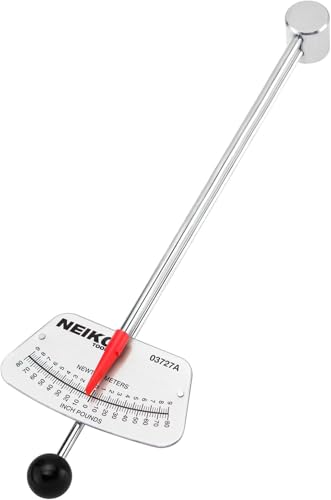
Neiko 03727A 1/4-Inch Drive Beam Torque Wrench
Who it suits: Beginners, bicycle owners and small-fastener users who want a real, specified torque instrument that this budget genuinely covers.
The Neiko 03727A is the rare budget tool that needs no apology. Its beam design reads 0–80 inch-pounds and 0–9 Newton-metres on a dual scale, with increments fine enough for delicate work and a stated accuracy of ±4%. The ball-detent head holds sockets positively, the beam reads in both directions, and there is no battery, no spring and no calibration schedule — the instrument’s accuracy is a property of its steel.
Its working limits are the beam type’s own: you must watch the scale while pulling, which is awkward in the tightest corners, and 80 in-lb is the ceiling — anything larger needs a bigger wrench. Within its range it is ideal first torque wrench and a permanent second wrench afterward, because a beam makes an honest cross-check for any click wrench you buy later. It anchors every torque guide in this series as the linked pick; check the current price on Amazon.
For small workshops, the deciding detail is this: 1/4 in drive · 0–80 in-lb / 0–9 Nm dual scale · ±4% accuracy · beam type, no calibration needed. Weigh that figure against the pattern of your own work before the price — a wrench that matches your routine at this tier will outperform a nominally stronger one that fights it, and the reviews in this guide are ordered with that routine in mind. If your pattern differs from the one described, the choose-if and skip-if lines below each pick are written to redirect you to the right alternative inside the same guide rather than leaving you to guess.
- Published range and ±4% accuracy — a specified instrument, not a guess
- Dual in-lb / Nm scale reads both unit systems at a glance
- Beam mechanism never needs calibration and works both directions
Honest limitation: You must see the scale during the pull, and the 80 in-lb ceiling excludes larger automotive fasteners.
Choose it if your fasteners are small — bicycles, small engines, electronics, delicate assemblies. Skip it if your work is lug nuts or suspension bolts; those need a foot-pound wrench well above this guide.
EPAuto 1/4-Inch Drive Click Torque Wrench (20–200 in-lb)
Who it suits: Users whose fasteners regularly exceed the beam’s 80 in-lb ceiling and who can step modestly above this guide’s budget for the click workflow.
EPAuto’s click wrench covers 20–200 in-lb (2.26–22.6 Nm) with a high-contrast dual scale in 1 in-lb increments, a reversible ratchet head in hardened chrome-vanadium steel, a knurled non-slip handle and a stated pre-calibration of ±4%. At roughly ten inches long it works in the same small-fastener world as the Neiko but with the preset-and-click workflow that speeds repeated fasteners.
It is prose-only here for one honest reason: its established positioning sits above this guide’s ceiling — a step-up, not a fit. Its ASIN (B01LX4ND65) is recorded in the sources file for the coordinator’s records, but no link is published in an article whose budget it exceeds. If your fastener list centers above 80 in-lb, this class — not a stretched beam — is the correct destination for the extra money.
For small workshops, the deciding detail is this: 1/4 in drive · 20–200 in-lb / 2.26–22.6 Nm · ±4% pre-calibrated · Cr-V ratchet head (maker figures, prose-only step-up). Weigh that figure against the pattern of your own work before the price — a wrench that matches your routine at this tier will outperform a nominally stronger one that fights it, and the reviews in this guide are ordered with that routine in mind. If your pattern differs from the one described, the choose-if and skip-if lines below each pick are written to redirect you to the right alternative inside the same guide rather than leaving you to guess.
- 20–200 in-lb range covers the small-fastener world the beam cannot reach
- Stated ±4% pre-calibration and dual high-contrast scale
- Cr-V reversible ratchet head; knurled handle for oily hands
Honest limitation: Priced above this guide’s budget — a step-up pick — and as a click wrench it needs lowest-setting storage and eventual calibration.
Choose it if your common fasteners sit between 80 and 200 in-lb and the budget can stretch once. Skip it if the budget is firm — the Neiko covers up to 80 in-lb honestly within it.
Prose-only pick — no Amazon link, for the reason given in the review above. Check price on Amazon by searching the exact model name if you decide to step up or verify availability.
LEXIVON LX-181 1/4-Inch Drive Click Torque Wrench (20–200 in-lb)
Who it suits: Precision-minded buyers who want paper with their accuracy — a calibration certificate traceable to the individual wrench.
LEXIVON’s LX-181 matches the EPAuto’s 20–200 in-lb envelope and adds the strongest documentation in its class: each wrench is calibrated and shipped with a certificate bearing its individual serial number, tested to ±4% under the ASME B107.300 standard per the maker’s manual. The dual-side scale prints inch-pounds and Newton-metres on opposite faces, with 1 in-lb increments, a 24-tooth Cr-V ratchet and a corrosion-resistant Electro-Black finish.
The maker’s own direct price places it well above this guide’s budget, so it stands here as the documented step-up: the wrench to buy when the work — carbon bicycle parts, precision assemblies — justifies paying for traceability. Prose-only, with specifications verified from the maker’s manual and product page; no ASIN was confirmed during research, so buy by exact model number.
For small workshops, the deciding detail is this: 1/4 in drive · 20–200 in-lb / 2.26–22.6 Nm · ±4% · calibration certificate with serial · Electro-Black finish (maker figures, prose-only step-up). Weigh that figure against the pattern of your own work before the price — a wrench that matches your routine at this tier will outperform a nominally stronger one that fights it, and the reviews in this guide are ordered with that routine in mind. If your pattern differs from the one described, the choose-if and skip-if lines below each pick are written to redirect you to the right alternative inside the same guide rather than leaving you to guess.
- Individual calibration certificate with serial number — traceable accuracy
- ASME B107.300 standard cited in the maker’s documentation
- High-contrast dual scale designed for low-light readability
Honest limitation: Well above this guide’s budget at maker pricing; no confirmed ASIN — purchase by exact model.
Choose it if traceable calibration matters for your assemblies and the budget stretches. Skip it if you need a working wrench inside this budget — the Neiko is the in-budget instrument.
Prose-only pick — no Amazon link, for the reason given in the review above. Check price on Amazon by searching the exact model name if you decide to step up or verify availability.
TEKTON 1/4-Inch Drive Micrometer Torque Wrench, 20–200 in-lb class (24320)
Who it suits: Buyers who prefer a US tool brand with a broad support network when stepping above the budget.
TEKTON’s quarter-inch micrometer wrench occupies the same 20–200 in-lb class as the two step-ups above and appears consistently across independent roundups of the category, which is why it earns a place as the brand-conservative step-up. TEKTON’s support model — direct, no-receipt warranty handling — is the substantive reason to prefer it at a similar specification.
Prose-only: we verified the model’s class and range through roundup coverage rather than a confirmed ASIN and maker spec sheet during this research pass, so no link is published. Buy by the exact model number (24320), confirm the range on the listing, and store it at its lowest setting like every click wrench.
For small workshops, the deciding detail is this: 1/4 in drive · 20–200 in-lb class · micrometer click type (line figures, prose-only step-up). Weigh that figure against the pattern of your own work before the price — a wrench that matches your routine at this tier will outperform a nominally stronger one that fights it, and the reviews in this guide are ordered with that routine in mind. If your pattern differs from the one described, the choose-if and skip-if lines below each pick are written to redirect you to the right alternative inside the same guide rather than leaving you to guess.
- Established brand with a strong direct-support reputation
- Same useful 20–200 in-lb class as the other step-ups
- Consistently represented in independent category roundups
Honest limitation: Above this budget, and ASIN-level verification was not completed — buy by model number.
Choose it if brand support matters more than a calibration certificate. Skip it if you want the strongest paper trail — the LEXIVON documents more.
Prose-only pick — no Amazon link, for the reason given in the review above. Check price on Amazon by searching the exact model name if you decide to step up or verify availability.
Amazon Basics 1/4-Inch Drive Click Torque Wrench (20–150 in-lb class)
Who it suits: Buyers watching for the click format at the lowest credible price point, willing to verify the current listing carefully.
Amazon’s own-label click wrench covers a slightly narrower 20–150 in-lb class range and is the click format’s budget-frontier representative in roundup coverage. A house-brand instrument lives or dies on its listing’s stated accuracy — check that the current listing states one, and treat the wrench accordingly if it does not.
Prose-only in this guide: positioning relative to the ceiling varies with Amazon’s pricing, and we did not confirm an ASIN for the exact variant during research. It is included so the click landscape at the budget’s edge is complete; the in-budget recommendation remains the beam Neiko, whose numbers are verified and stable.
For small workshops, the deciding detail is this: 1/4 in drive · 20–150 in-lb / 2.5–15 Nm class (listing figures, prose-only). Weigh that figure against the pattern of your own work before the price — a wrench that matches your routine at this tier will outperform a nominally stronger one that fights it, and the reviews in this guide are ordered with that routine in mind. If your pattern differs from the one described, the choose-if and skip-if lines below each pick are written to redirect you to the right alternative inside the same guide rather than leaving you to guess.
- Click workflow at the category’s lowest credible tier
- Narrower range concentrates accuracy where small fasteners live
- House-brand availability is usually strong
Honest limitation: Verify the current listing’s accuracy statement and ASIN before purchase; positioning vs. the budget fluctuates.
Choose it if you find it listed within budget with a stated accuracy figure. Skip it if the listing omits an accuracy figure — an unstated-accuracy wrench is a guess.
Prose-only pick — no Amazon link, for the reason given in the review above. Check price on Amazon by searching the exact model name if you decide to step up or verify availability.
A foot-pound click wrench (the automotive step-up)
Who it suits: Readers whose actual job list says lug nuts, suspension or engine structural bolts — work no inch-pound wrench in this guide can touch.
Automotive structural torque lives in foot-pounds: a common 1/2-inch click wrench class covers 10–150 ft-lb, which is 120–1,800 in-lb — an order of magnitude beyond this guide’s instruments. Using an inch-pound wrench on such fasteners is not ‘close enough’; the fastener simply never reaches specification, and the wrench itself can be damaged trying.
This guidance pick carries no product link because the foot-pound class deserves its own verified guide. The directional advice is firm: match the wrench family to the fastener family, own one of each only when your work genuinely spans both, and never let a budget guide blur the two into one recommendation.
For small workshops, the deciding detail is this: 1/2 in drive class · 10–150 ft-lb class — a different instrument for a different job (guidance, prose-only). Weigh that figure against the pattern of your own work before the price — a wrench that matches your routine at this tier will outperform a nominally stronger one that fights it, and the reviews in this guide are ordered with that routine in mind. If your pattern differs from the one described, the choose-if and skip-if lines below each pick are written to redirect you to the right alternative inside the same guide rather than leaving you to guess.
- The correct instrument family for wheels and chassis
- Prevents the dangerous error of under-torqued structural fasteners
- Clarifies the two-wrench reality for serious home mechanics
Honest limitation: A separate purchase in a separate price class — nothing in this guide substitutes for it.
Choose it if your job list includes wheels, suspension or structural automotive bolts. Skip it if your work is bicycles and small assemblies — inch-pounds are your world.
Prose-only pick — no Amazon link, for the reason given in the review above. Check price on Amazon by searching the exact model name if you decide to step up or verify availability.
Related guides in this series: Best Table Saw For Diy Projects Under $30 Best Table Saw For Home Use Under $30
Comparison Table
| Product | Best for | Key specification | Link |
|---|---|---|---|
| Neiko 03727A 1/4-Inch Drive Beam Torque Wrench | Best verified pick at this budget | 1/4 in drive · 0–80 in-lb / 0–9 Nm dual scale · ±4% accuracy · beam type, no calibration needed | Check on Amazon |
| EPAuto 1/4-Inch Drive Click Torque Wrench (20–200 in-lb) | Best click-type step-up | 1/4 in drive · 20–200 in-lb / 2.26–22.6 Nm · ±4% pre-calibrated · Cr-V ratchet head (maker figures, prose-only step-up) | Prose-only |
| LEXIVON LX-181 1/4-Inch Drive Click Torque Wrench (20–200 in-lb) | Best documented calibration step-up | 1/4 in drive · 20–200 in-lb / 2.26–22.6 Nm · ±4% · calibration certificate with serial · Electro-Black finish (maker figures, prose-only step-up) | Prose-only |
| TEKTON 1/4-Inch Drive Micrometer Torque Wrench, 20–200 in-lb class (24320) | Best-known brand step-up | 1/4 in drive · 20–200 in-lb class · micrometer click type (line figures, prose-only step-up) | Prose-only |
| Amazon Basics 1/4-Inch Drive Click Torque Wrench (20–150 in-lb class) | Budget-brand click alternative | 1/4 in drive · 20–150 in-lb / 2.5–15 Nm class (listing figures, prose-only) | Prose-only |
| A foot-pound click wrench (the automotive step-up) | Best answer for lug nuts and chassis work | 1/2 in drive class · 10–150 ft-lb class — a different instrument for a different job (guidance, prose-only) | Prose-only |
How to Choose Torque Wrenches Under $15
- Match the range to the fasteners, not the other way round. A torque wrench is accurate across the middle of its range and weakest at the extremes. List your actual fasteners — bicycle components and small engine work live in inch-pounds; lug nuts live in foot-pounds far above any wrench in this guide — and choose a range that puts your common values in its middle half.
- Inch-pounds and foot-pounds are different worlds. The wrenches in this guide are inch-pound instruments for small fasteners: 0–80 in-lb (beam) and 20–200 in-lb (click class). Confusing in-lb with ft-lb over-torques by a factor of twelve — the single most destructive mistake a new torque-wrench owner can make. Read the scale twice before the first pull.
- Beam versus click is a workflow choice. A beam wrench shows torque continuously, so you watch the value arrive — ideal for learning and for one-off fasteners, awkward in tight spaces where you cannot see the scale. A click wrench lets you preset and pull until the signal — faster on repeated fasteners, blind by design. Neither is ‘better’; they suit different hands and jobs.
- Accuracy figures need a range qualifier. A ±4% claim typically applies across the wrench’s stated range for a quality instrument, and calibration certificates with serial numbers (as the LEXIVON step-up provides) are the strongest evidence a budget buyer can ask for. A wrench with no stated accuracy is a wrench with no accuracy.
- Store a click wrench at its lowest setting. The standard maker instruction: return a click wrench to its lowest torque setting for storage so the internal spring rests unloaded, and never use any torque wrench to loosen fasteners or as a breaker bar. Beam wrenches, having no spring, forgive what click wrenches cannot.
- Technique is half the accuracy. Pull smoothly from the handle’s grip point, perpendicular to the fastener, and stop at the signal — a second pull ‘to be sure’ over-torques. Threads should be clean and in the condition the torque specification assumes; a torque figure for dry threads misreads badly on oiled ones.
How a Beam Wrench Works, and Why It Never Needs Calibration
A beam torque wrench is two steel bars and a scale. The main beam bends under load by an amount fixed by its metallurgy; the pointer beam, attached only at the head, does not bend, so the pointer’s position against the scale reads the deflection — and therefore the torque. There is no spring to fatigue, no mechanism to drift, and nothing to recalibrate: unless the beam itself is physically bent, the instrument reads as truly in year ten as on day one.
That physics explains both the beam’s virtues and its limits. It reads continuously, so you learn what torque feels like — the single best training a beginner can get. It works in both directions. And it demands eyes on the scale during the pull, which in an engine bay’s worst corners is sometimes impossible. The Neiko reviewed below adds a dual SAE/metric scale, so the same glance reads inch-pounds or Newton-metres.
For bicycle work, small engines, electronics assemblies and any fastener under 80 in-lb, a beam wrench at this budget is not a compromise instrument. It is the correct one, and its click-type rivals must justify themselves on workflow, not accuracy.
Torque Mistakes That Break Parts
Over-torque breaks bolts, strips threads in soft aluminum, crushes gaskets and warps the clamped parts; under-torque loosens under vibration until joints fret and fail. The wrench prevents both only when its user avoids the standard errors. The worst is unit confusion — setting 80 ft-lb on a job that specified 80 in-lb multiplies torque twelvefold and snaps or strips almost anything small. The second worst is the confirmation pull: clicking once, then pulling again ‘to check’, which adds torque past the setting every time.
Extension errors come next. A torque wrench reads correctly only when force is applied at its handle; choking up or adding a pipe changes the leverage and the result. Crowfoot extensions change effective length and require a correction calculation — a real procedure, documented by wrench makers, and a sign you have reached the edge of budget-tool territory.
Finally, condition errors: torquing dirty, rusty or lubricated threads against a specification written for clean dry ones. Friction is part of every torque figure; change the friction and the same wrench setting delivers a different clamp load. Clean the threads, match the specified condition, and the numbers mean what they claim.
Making It Earn Its Footprint
In a small workshop the purchase is not finished when it works; it is finished when it stores. Mount it, hang it, nest it or stack it in the exact place it will live, and measure that place before ordering rather than after. Prefer the pick whose storage form matches dead space you actually have — a wall strip, a shelf end, the inside of a cabinet door. Review the arrangement after a month: small workshops evolve, and the tool that earned its footprint in January must re-earn it when the bench layout changes in June.
Before the mistakes section, one cross-check worth making: compare this tier with its neighbours — Best Table Saw For Small Workshops Under $30 Best Table Saw Under $50 — because the right budget is the one that matches your job list, not the first one you searched.
Setting Up the Purchase on Day One
Day one sets the tool’s whole life. Unpack it fully, read the manual before the first use rather than after the first problem, and run it once on a low-stakes task whose only purpose is learning its signals. Register the purchase if the maker offers it, keep the manual where the tool lives, and write the purchase date on a piece of tape inside the storage spot — future you, judging whether a tool earned its keep, will want that date. Finally, stage the consumables and accessories the tool needs beside it now, while the need is obvious, instead of discovering each absence mid-job over the coming months.
Sharing the Tool in a Household or a Shared Workshop
Shared tools need shared rules, and the rules can be short: where it lives, how it is returned, and what it must never be used for. Most damage to shared budget tools comes from the forbidden use nobody mentioned — the wrench as a hammer, the bag as a step, the light left in the rain. One sentence per rule, agreed once, prevents nearly all of it. Return condition matters as much as the rules: clean, complete and ready is the standard, because the next user’s first impression of the tool is the state the last user left it in.
Recognizing When a Job Has Outgrown the Tool
Every budget tool has an honest envelope, and the skill that protects both the tool and the workpiece is recognizing the envelope’s edge before crossing it. The signs are consistent across categories: the tool strains, heats, flexes, slips or demands a second person to force what should be a one-person motion. At that moment the correct move is to stop and change the plan — borrow, rent, hire or re-sequence the job — because the cost of the alternative is measured in broken tools and damaged work, and both cost more than the rental would have.
What to Do When the Purchase Disappoints
Sometimes a verified, well-chosen purchase still disappoints in the hand, and the response should be procedural rather than emotional. First, re-read the review’s honest-limitation line and the listing’s specification table: if the product matches its paper and the paper matches your job list, the mismatch is fit, and the return window exists for exactly that. If the product does not match its paper, that is a defect or a mis-listing, and the return is even clearer. Either way, decide inside the window, keep the packaging until you have decided, and let the experience refine the written job list rather than souring you on the category.
Reading the Specification Sheet Like a Buyer, Not a Fan
Specifications are the only part of a listing the maker can be held to, so they deserve a slower read than the marketing copy around them. Find the three numbers that define the category — the ones this guide’s How to Choose section names — and check them against your actual job list, written down, not remembered. Where a figure is missing, treat the product as unspecified in that dimension rather than assuming the class average; missing numbers are information too, and they usually mark the dimension where the product is weakest.
The Total Cost of a Budget Purchase
The sticker is the smallest part of a tool’s cost. Consumables, replacement parts, batteries, blades, storage and the eventual second purchase all belong in the arithmetic. A budget pick with standard, sourceable consumables is cheaper over three years than a cheaper pick with orphan parts, even before the orphan forces a full replacement. This is why the reviews in this guide keep returning to documentation and standard sizes: they are cost features disguised as paperwork.
When to Stop Researching and Buy
Research has diminishing returns, and at this budget they diminish fast. Once a product publishes the defining specifications, fits the written job list, and comes from a maker whose documentation you can read, further comparison shopping mostly trades your time for pennies. The better investment is the hour after purchase: read the manual fully, run the tool on a scrap job or a staged kit, and learn its signals while the stakes are zero. Familiarity bought early is worth more than the last few percent of specification.
Care Habits That Double a Budget Tool’s Life
Budget tools rarely die from their design limits; they die from storage and neglect. Clean after use, store dry, keep moving parts and contacts free of grit, and never lend the tool without its one-sentence instruction — most lending damage is ignorance, not malice. A five-minute reset after each job is the entire maintenance program for most of this guide’s categories, and it is the difference between a tool that serves a decade and one that serves a season.
A Pre-Purchase Checklist You Can Run in Ten Minutes
Before ordering, run this sequence. One: write the job list the purchase must serve, with materials and sizes named. Two: extract the three defining specifications from this guide’s How to Choose section and write your minimum acceptable figure beside each. Three: open the chosen pick’s listing and find those three figures in its own specification table — not in its title, not in its photographs. Four: check the consumables and accessories the job needs and whether they are included or standard. Five: confirm the return route while the purchase is still hypothetical. Ten minutes, five checks, and the purchase stops being a hope and becomes a decision.
How Listings Try to Spend Your Money for You
Listing pages are engineered to move a buyer upward: a slightly larger size, a bundle with accessories of no use, a premium finish on a working tool. None of that is sinister, but all of it should be resisted with the written job list. If an upgrade does not answer a line on that list, it is not an upgrade — it is a donation. The discipline matters most at this budget, where the step-up is proportionally largest: money added here is money taken from the next tool the workshop needs, and the workshop always has a next tool.
The Second Purchase Is the Real Test of the First
A first purchase in a category teaches you your own pattern: how often you use it, on what materials, stored where, carried how. The buyers who end up satisfied are the ones who let the second purchase be guided by that evidence rather than by the first purchase’s marketing. Keep the first purchase honest and modest, use it for a season, and your second will be the right size, the right mechanism and the right tier — which is why this guide keeps steering first-time buyers toward the documented, mid-envelope pick instead of the extreme one.
Storing the Purchase So It Is Ready
Readiness is a storage property. A tool stored clean, complete, charged or oiled as its kind requires, in one known place, is a tool that gets used; a tool stored dirty in a pile is a tool that gets replaced. Build the storage into the purchase decision — the hook, the shelf space, the case or the drawer — and the budget goes further than any specification improvement could take it, because the most expensive tool in any workshop is the one that was bought twice.
Understanding What ‘Good Enough’ Means at This Tier
Every category has a threshold where the product becomes fully fit for its purpose, and a long slope above it where money buys refinement rather than capability. This guide’s job is to locate the threshold honestly for each category — and to say, where the budget sits below the threshold, that it does, rather than dressing a sub-threshold product in threshold language. Where the budget sits above the threshold, as it does for some picks here, the extra money is best spent on the consumables, storage and accessories that complete the system.
A Note on Prices, Listings and Change
Budget listings change constantly: prices move, variants rotate, models are revised under the same name. That is why this guide quotes no static prices, describes products by model number and specification rather than by offer, and tells you to check the live listing at the moment of purchase. If a listing’s specification table no longer matches the figures quoted in its review here, trust the discrepancy as a signal — the product may have been revised — and choose by the current table, not by this guide’s memory of the old one.
Common Buying Mistakes
- Confusing inch-pounds with foot-pounds — a twelvefold over-torque that breaks small fasteners instantly.
- Pulling past the click for a second confirmation, adding torque every time.
- Using a torque wrench to loosen fasteners or break them free.
- Storing a click wrench at a high setting, fatiguing its spring.
- Buying a no-name wrench with no stated accuracy and trusting its numbers on critical fasteners.
- Applying force anywhere but the handle grip, or extending the handle with a pipe.
- Torquing lubricated or dirty threads against a dry-thread specification.
Final Recommendation
- Best verified pick at this budget: Neiko 03727A 1/4-Inch Drive Beam Torque Wrench
- Best click-type step-up: EPAuto 1/4-Inch Drive Click Torque Wrench (20–200 in-lb)
- Best documented calibration step-up: LEXIVON LX-181 1/4-Inch Drive Click Torque Wrench (20–200 in-lb)
- Best-known brand step-up: TEKTON 1/4-Inch Drive Micrometer Torque Wrench, 20–200 in-lb class (24320)
- Budget-brand click alternative: Amazon Basics 1/4-Inch Drive Click Torque Wrench (20–150 in-lb class)
- Best answer for lug nuts and chassis work: A foot-pound click wrench (the automotive step-up)
Our top two at this budget are the Neiko 03727A 1/4-Inch Drive Beam Torque Wrench, as best verified pick at this budget, and the EPAuto 1/4-Inch Drive Click Torque Wrench (20–200 in-lb), as best click-type step-up. Between them they cover the two shapes this search usually takes: the buyer who wants the strongest verified option the budget fully covers, and the buyer whose needs sit at the edge of what the budget can honestly do. Every other pick in the guide exists because real buyers differ — in materials, in space, in routine — and the choose-if lines are there to route you to your pick, not to the guide’s favorite.
Whichever you choose, do the unglamorous homework first: write down the job list, measure what needs measuring, read the specification line one more time, and check the live price on Amazon before ordering. At this budget, that ten minutes is the entire difference between a purchase that serves for years and one that gets replaced by spring.
Frequently Asked Questions
Can you buy a good torque wrench at this price?
A good beam wrench, yes — the mechanism is simple enough to be made honestly at this budget, and the Neiko in this guide publishes its range and ±4% accuracy. Click wrenches from makers with calibration backing begin just above this budget and are shown as step-ups.
What is the difference between beam and click torque wrenches?
A beam wrench deflects and shows torque continuously on a scale — no calibration, both directions, but you must watch the scale. A click wrench is preset and signals when the value is reached — faster for repeated fasteners, but it needs careful storage and periodic calibration.
What torque range do I need for bicycle and small DIY work?
Most bicycle and small-assembly fasteners live between about 20 and 200 inch-pounds, with delicate parts lower. The beam pick covers 0–80 in-lb; the click class covers 20–200 in-lb. Lug nuts and automotive structural bolts need foot-pound wrenches outside this guide.
How accurate is a budget torque wrench?
The verified picks here state ±4%, which is the standard figure for quality mechanical wrenches. Treat any wrench with no stated accuracy as uncalibrated, and never use it where the manufacturer of the thing you are assembling specifies torque for safety.
Do torque wrenches need calibration?
Click wrenches drift with use and abuse and benefit from periodic checks; beam wrenches have no mechanism to drift and need only an undamaged beam and a pointer that rests at zero. Check a beam’s zero before use — a bent pointer announces itself there.
Can I use a torque wrench to loosen bolts?
No. Loosening — especially breaking free a corroded fastener — can demand multiples of the wrench’s range and damages click mechanisms outright. Loosen with a breaker bar or ratchet; torque only on tightening, in the wrench’s stated direction.