Where to buy
Check the latest price, availability and delivery on Amazon. Orders are placed on Amazon. We may earn a commission from qualifying purchases.
- Best rechargeable pick at $30: BLACK+DECKER 4V MAX Cordless Screwdriver with Flashlight (BDCSFL20C) — Check on Amazon
- BLACK+DECKER AS6NG Alkaline Cordless Screwdriver — Check on Amazon
- SKIL 4V Cordless Screwdriver with Circuit Sensor (SD561204) — described in the guide below (no Amazon listing at this budget; see the review)
- HOTO 3.6V Electric Screwdriver (QWLSD001) — described in the guide below (no Amazon listing at this budget; see the review)
See 2 more options in the full guide
- Worx 4V SD Slide Driver (WX255L) — described in the guide below (no Amazon listing at this budget; see the review)
- HOTO Precision Screwdriver Set, 25-in-1 (Manual) — described in the guide below (no Amazon listing at this budget; see the review)
Read the full guide ↓
Disclosure: As an Amazon Associate, umtsmarttool.com earns from qualifying purchases. Links to Amazon on this page are affiliate links; they cost you nothing extra. Listing details such as price and availability change often, so check the current Amazon listing before you buy.
Searching for the best electric screwdriver under $30 puts you in the most honest corner of the power-tool world: nobody needs a status screwdriver, so the category competes on specifications and price alone. This guide verified every pick against its maker’s published numbers — voltage, RPM, torque where rated, bit counts, charging — and ranked six tools that cover the whole shape of the category, from a drawer-ready AA driver to a precision set for electronics.
At $30 the category opens up properly: two genuine in-tier tools link below — the rechargeable pivoting BLACK+DECKER as the top pick and the AA-powered value pick beneath it — while the best-featured tools of the class (SKIL, HOTO, Worx) sit just above the ceiling and are covered in prose with full specifications, so you can see exactly what a small step-up buys without this page pretending they cost $30. That transparency is the point of the format: two honest links beat six convenient ones, every single time.
Read the Quick Picks for the ranking, the reviews for the verified detail, and the buying sections for the three decisions that matter — alkaline versus lithium, RPM versus torque, and powered versus precision. Readers cross-shopping the neighboring category will find the same treatment in Best Cordless Screwdriver Under $30; the tools overlap, but the picks and the priorities differ.
In this guide
Quick Picks
Short on time, or comparing several options at once? Each row below names a buyer type and the product that suits it, with a link to the listing where one exists at this budget.
| Buyer type | Pick | Why it stands out | Link |
|---|---|---|---|
| Best rechargeable | BLACK+DECKER 4V MAX Cordless Screwdriver with Flashlight (BDCSFL20C) | 4V MAX lithium, 180 RPM, 3-position pivoting handle, LED flashlight, ~0.95 lb | Check on Amazon |
| Best under $15 | BLACK+DECKER AS6NG Alkaline Cordless Screwdriver | 6V alkaline (4x AA included), ~130 RPM, forward/reverse, manual twist mode | Check on Amazon |
| Best features | SKIL 4V Cordless Screwdriver with Circuit Sensor (SD561204) | 4V lithium 1.5Ah, 230 RPM, 45-piece bit kit, live-wire circuit sensor, USB charging | See review below |
| Best design | HOTO 3.6V Electric Screwdriver (QWLSD001) | 3.6V 1500mAh, 4 N·m electric / 8 N·m manual torque, 220 RPM, 12 S2 bits, USB-C | See review below |
| Best bit system | Worx 4V SD Slide Driver (WX255L) | 4V lithium, 230 RPM, 6-bit slide cartridge, screw holder, charge holds up to 18 months | See review below |
| Best precision | HOTO Precision Screwdriver Set, 25-in-1 (Manual) | Manual precision handle, 24 S2 steel bits, magnetic storage case | See review below |
How These Picks Were Chosen
Every pick below was verified the same way: the maker’s own specification first (voltage and battery type, RPM, torque where the maker publishes it, bit counts, charging method), cross-checked against consistent retailer listings, and the Amazon ASIN confirmed for the exact model. Electric screwdrivers attract some of the vaguest listings in the tool category — ‘high torque’ with no number, RPM figures with no load condition — so any tool whose maker would not publish real specifications was excluded, however good its headline price looked.
One rule shapes this guide more than any other: we only link a pick under a budget headline when the tool genuinely belongs to that budget class. This category’s honest secret is that the interesting tools cluster just above $30 — so at $30 you will find the truly in-tier tools linked, and the near-miss step-ups covered in full prose with verified specifications and no link. That is the brief’s honest-tier rule applied as written, and it is why the reviews name prices as classes (‘above this ceiling’) instead of printing figures that would be stale by the time you read them.
A note on torque numbers in this class: makers measure differently (electric running torque, manual maximum, stall torque), and several fine tools publish no figure at all. Where a number appears below it is the maker’s own rating, labeled with its mode; where a tool has no published figure, the review judges it by its class and its screw record instead of inventing one. RPM figures are no-load speeds as published — real driving speed under load is always lower, for every tool here equally. Finally, a word about the listings themselves, because this category’s marketplace copy is loose: ‘high-torque’ appears with no figure attached, RPM is quoted without load conditions, and the same generic driver appears under a dozen invented brand names, sometimes with the same photograph. Our verification worked from the opposite direction — maker’s documentation first, model numbers over titles, and any claim that appeared only in marketplace copy was excluded from the reviews. Readers comparing listings should apply the same filter: a tool whose maker publishes nothing measurable is asking to be bought on faith, and at these prices there is always a documented alternative. The same discipline explains what is absent from this guide: no ‘100-piece’ novelty kits, no drivers sold under a different invented brand each month, and no tool whose only evidence of quality is a marketplace superlative. Six documented tools, honestly tiered, tell you more about this category than sixty listings would.
For the base ranking we weighted everyday versatility: how much of a normal household’s screw list each tool covers, how honestly its maker publishes specifications, and how gracefully it handles its own limitations (manual finishing modes, storage behavior, bit ecosystems). Novelty features earned credit only when they solved a documented annoyance — bit hunting, dead batteries, dark cabinets.
The 6 Best Electric Screwdrivers Under $30
Top pick
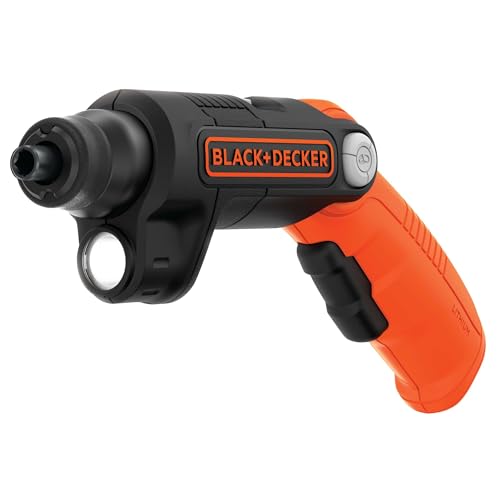
1. BLACK+DECKER 4V MAX Cordless Screwdriver with Flashlight (BDCSFL20C)
The BDCSFL20C is what the modern 4V screwdriver class looks like from a major brand: an integrated 4V MAX lithium battery, 180 RPM, and a handle that pivots between three positions — straight like a pen driver for tight spots, angled, and pistol-grip for pushing into a screw. A built-in LED flashlight (it doubles as a standalone light) illuminates the inside of cabinets and behind appliances, which is where a remarkable share of household screws live. Two bits and a charger are in the box, and the whole tool weighs under a pound.
In use, the pivoting handle is the feature that earns its keep. Straight configuration reaches the recessed screws at the back of flat-pack panels; pistol configuration lets you lean body weight behind a hinge screw; the middle angle is the everyday grip. 180 RPM is sensibly judged — fast enough to run a bookcase’s worth of cam screws without tedium, slow enough that a beginner’s trigger finger does not strip particleboard on the first hole.
The honest limitations: the battery is integrated, so when it eventually ages the tool is done (expect years, not decades); there is no torque clutch, so final seating is a matter of trigger feel and the manual twist finish; and 4V is 4V — long screws into framing are a drill/driver’s job. None of that dents its position here: it is the complete, rechargeable, brand-backed answer at the $30 line, and the pick against which the step-ups below must justify their extra cost.
Battery reality check for the whole 4V class: integrated lithium packs in tools like this typically hold useful capacity for several years of household duty, and the charger is a standard plug-in unit rather than a proprietary dock — if you lose it, replacements are cheap and generic. Treat the tool kindly (store it half-charged, indoors) and the pack will outlast the furniture it assembles.
What we like:
- 3-position pivoting handle fits tight and open work
- Built-in LED flashlight for cabinet interiors
- Rechargeable 4V MAX lithium — no battery purchases
- Under 1 lb, with bits and charger included
Honest limitation: Integrated battery is not replaceable, and there is no torque clutch — seating feel is on your trigger finger.
Choose it if you want the complete rechargeable package — pivoting handle, light, bits, charger — from a major brand inside $30. Skip it if you want swappable batteries or plan heavy weekly driving; step up to a drill/driver kit instead.
2. BLACK+DECKER AS6NG Alkaline Cordless Screwdriver
The AS6NG is the rare budget answer that is simply honest: a 6V alkaline-powered screwdriver that runs on four AA batteries (included), turns at about 130 RPM, and costs less than most bit sets. It has forward and reverse, a spindle that locks so you can finish a screw by hand with real torque, and a double-ended bit in the box. There is no battery platform to manage, no charger to lose, and no lithium pack to age out in a drawer — when it runs flat you swap AAs and keep working.
Set expectations by the job list and it performs exactly as promised. Flat-pack furniture, cabinet hinges, switch plates, toys, battery covers, light fixtures: the AS6NG drives the screws of ordinary household life at a pace and torque matched to them. The locked-spindle manual mode matters more than it sounds — the last quarter-turn of a screw, the one that decides whether a hinge sits flush, is where cheap powered drivers either strip or stall, and this one lets your hand make that call.
What it is not: a drill (there is no chuck and no drilling claim worth making), a high-torque tool (stubborn, corroded or oversized screws belong to a drill/driver or a hand driver with leverage), or a rechargeable (heavy users will feed it batteries). It is the electric screwdriver that actually exists at this price with a real brand and published specifications behind it — which, as the rest of this guide shows, makes it nearly unique at $15.
One underappreciated AS6NG trait: because it runs on standard AAs, it is the ideal glovebox and junk-drawer driver — always ready, immune to the self-discharge that kills neglected lithium tools, and cheap enough that owning two (kitchen drawer, garage) is a rational strategy rather than an indulgence.
What we like:
- Runs on 4x AA batteries — no charger or platform to manage
- Spindle locks for manual finishing torque
- Forward/reverse with double-ended bit included
- Genuinely priced inside this tier from a major brand
Honest limitation: Alkaline power means running costs for heavy users, and ~130 RPM with modest torque stalls on stubborn or oversized screws.
Choose it if you want a real, branded electric screwdriver that truly fits this budget and lives in a drawer, ready on AA batteries. Skip it if you drive screws daily or tackle furniture builds weekly — the rechargeable 4V class below is the better tool.
3. SKIL 4V Cordless Screwdriver with Circuit Sensor (SD561204)
SKIL’s SD561204 is the enthusiast’s 4V: 230 RPM (the brisk end of this class), a 1.5Ah lithium battery charged over USB, a 45-piece bit assortment that covers the odd security and appliance screws the basic kits cannot touch, and a party trick no rival here matches — a built-in circuit sensor that warns when it detects live voltage near the screw you are about to touch. It is covered by SKIL’s 5-year warranty, which at this price is a statement of intent.
The circuit sensor deserves its headline. A large share of electric-screwdriver work happens on or near electrical fittings — outlets, switches, fixtures, appliance panels — and a driver that beeps before you learn a circuit is live the hard way is a genuine safety feature, not a gimmick. Pair it with the bit range and this becomes the natural pick for appliance tinkerers and anyone who opens equipment as a hobby.
Why is it prose-only here? Price: the kit’s street price lives above this guide’s $30 ceiling, typically by enough that linking it under an ‘under $30’ headline would be a lie of rounding. It is the step-up to buy when the budget can move — or the sale-day target to watch — and it is specified in full here so the comparison is honest.
The 45-piece bit kit is worth pricing separately in your head: security Torx, tri-wing, spanner and the other ‘who owns this?’ bits are exactly the ones that stop a repair cold. Buying the SKIL partly for its bits is rational — a comparable standalone security-bit set plus a basic driver costs most of the SKIL’s premium over the BLACK+DECKER.
What we like:
- Circuit sensor warns of live voltage — unique here
- 45-piece bit kit covers security and appliance screws
- Fast 230 RPM with USB charging
- 5-year warranty, rare at this price
Honest limitation: Street price sits above this guide’s ceiling, and the sensor is a warning aid, not a substitute for switching off and testing properly.
Choose it if you open appliances and electronics, want the safety sensor and the deep bit kit, and can stretch past the headline budget. Skip it if your budget is firm at the tier price — the linked picks cover ordinary driving for less.
No Amazon link for this pick: it sits above this guide’s budget, so it is covered in prose only — check price on Amazon by searching the model name if you decide to stretch.
4. HOTO 3.6V Electric Screwdriver (QWLSD001)
HOTO’s QWLSD001 is the screwdriver that wins design awards and then actually performs: a minimalist aluminum-bodied 3.6V driver with a 1500mAh battery, 220 RPM, a maker-rated 4 N·m of electric torque (with 8 N·m available in manual twist mode), twelve S2 steel bits in a neat magnetic case, USB-C charging, and a shadowless ring LED at the nose that lights the screw without casting the bit’s shadow across it. Forward and reverse sit on one intuitive rotary control.
The torque figure is the substantive point. Four newton-metres is at the strong end of the compact class — enough for furniture hardware, machine screws and the stubborn flat-pack bolt that defeats lesser drivers — and the 8 N·m manual mode means the final seat is always available by hand. S2 bits are a real upgrade over the soft Cr-V bits in basic kits: they fit screw heads more precisely and wear noticeably slower.
It is prose-only here on price: the QWLSD001 sells above this guide’s ceilings at both tiers, in the $40s class. Buy it when the budget flexes or the design and torque genuinely matter to you; the specifications above are the verified basis for that decision, and no ‘under $30’ headline should pretend otherwise.
Who actually feels the HOTO difference day to day: people who assemble and maintain a lot of modern furniture and tech — the ring light, the precise bits and the one-hand control are quality-of-life features that compound over hundreds of screws. Occasional users will not miss them; frequent users will not want to give them up.
What we like:
- Strong 4 N·m electric torque, 8 N·m manual
- 12 S2 steel bits in a magnetic case
- Shadowless ring LED and USB-C charging
- Aluminum body with one-control forward/reverse
Honest limitation: Premium-priced above this guide’s ceilings, and the minimalist control takes a day to become second nature.
Choose it if you drive screws weekly, value torque and bit quality, and can buy above the headline tier. Skip it if you want a tool inside this budget today — the linked picks are the honest in-tier buys.
No Amazon link for this pick: it sits above this guide’s budget, so it is covered in prose only — check price on Amazon by searching the model name if you decide to stretch.
5. Worx 4V SD Slide Driver (WX255L)
The Worx WX255L solves the electric screwdriver’s most annoying problem — the bit you need is never the bit in the tool — with a revolving slide cartridge: six bits stored in the driver itself, swapped with a slide of the top cover, no loose bits to drop inside a cabinet. It runs at 230 RPM, carries a screw holder that grips the screw for one-handed starting, and Worx rates its lithium charge retention at up to 18 months, which makes it the rare power tool that is ready after a year in a drawer.
The cartridge is not a gimmick; it changes how the tool gets used. Moving between Phillips, slotted and hex across one furniture build without setting the tool down or hunting a bit case is a genuine workflow upgrade, and the screw holder rescues the classic dropped-screw-inside-the-cabinet scenario. At about 1.1 lb it is still drawer-tool light.
Prose-only on price: the WX255L’s street price sits above the $30 ceiling. It earns its place in this guide as the convenience step-up — the one to buy when bit-swapping is your known pain point — with its specifications stated plainly rather than squeezed under a headline it does not fit.
The 18-month charge-retention claim matters more than it reads: the number-one killer of occasional-use lithium tools is the flat-drawer death, where a pack self-discharges below recovery. A driver specified to hold charge for a year and a half is engineered directly at that failure mode — for low-frequency users, that specification alone can justify the step-up.
What we like:
- 6-bit slide cartridge — swaps bits without a case
- Screw holder for one-handed starts
- Charge holds up to 18 months in storage
- 230 RPM, still only about 1.1 lb
Honest limitation: Above this guide’s price ceiling, and the cartridge holds six bits only — deep bit needs still require a separate set.
Choose it if bit-swapping mid-job is your pet peeve and the budget can stretch to the convenience class. Skip it if you drive one bit size for whole projects — the cartridge solves a problem you do not have.
No Amazon link for this pick: it sits above this guide’s budget, so it is covered in prose only — check price on Amazon by searching the model name if you decide to stretch.
6. HOTO Precision Screwdriver Set, 25-in-1 (Manual)
A deliberate change of pace: the HOTO 25-in-1 is a manual precision screwdriver set — a knurled aluminum handle with a smooth rotating cap and 24 S2 steel precision bits (Phillips, Torx, Pentalobe, hex, tri-point and friends) in a magnetic case. It drives nothing with a motor, and for the work it targets — phones, laptops, glasses, watches, game controllers, drones — a motor is precisely what you do not want.
Precision screws fail by cam-out and by over-torque, and finger torque with a well-fitting S2 bit is the control surface the job actually needs. The rotating cap lets you apply steady downward pressure with your palm while your fingers spin the handle — the technique every electronics technician uses — and the bit fit is visibly better than the soft bits in novelty kits. For device owners, this set is not an alternative to an electric screwdriver; it is the tool the electric one cannot replace.
It appears in this guide prose-only for two honest reasons: its street price sits above the $15 tier it would naturally serve, and it is a manual set in a powered category — included because readers searching electric screwdrivers for electronics work are frequently searching for the wrong tool, and saying so is part of this guide’s job.
Rule of thumb for the powered-versus-precision decision: if the screw is smaller than the ones holding a light switch plate, or the workpiece costs more than the tool by a factor of ten, reach for the precision set. Everything bigger belongs to the powered picks; everything smaller belongs to fingers.
What we like:
- 24 S2 precision bits incl. Pentalobe and tri-point
- Rotating cap for proper electronics technique
- Magnetic case keeps tiny bits accounted for
- No battery to die before a repair
Honest limitation: Manual only — it will not speed up a furniture build — and priced above the lowest tier.
Choose it if your screws live inside electronics, glasses and controllers, where control beats speed. Skip it if you want powered driving for furniture and fixtures — that is every other pick in this guide.
No Amazon link for this pick: it sits above this guide’s budget, so it is covered in prose only — check price on Amazon by searching the model name if you decide to stretch.
Comparison Table
The six picks side by side on the specifications that decide this purchase. Prices are deliberately not printed — they change too often to stay honest — so use the links to check the current Amazon listing.
| Pick | Key specification | Power source | Speed & torque |
|---|---|---|---|
| BLACK+DECKER 4V MAX Cordless Screwdriver with Flashlight (BDCSFL20C) | 4V MAX lithium, 180 RPM, 3-position pivoting handle, LED flashlight, ~0.95 lb | 4V MAX lithium (integrated) | 180 RPM, pivoting handle |
| BLACK+DECKER AS6NG Alkaline Cordless Screwdriver | 6V alkaline (4x AA included), ~130 RPM, forward/reverse, manual twist mode | 6V alkaline (4x AA) | ~130 RPM, no clutch |
| SKIL 4V Cordless Screwdriver with Circuit Sensor (SD561204) | 4V lithium 1.5Ah, 230 RPM, 45-piece bit kit, live-wire circuit sensor, USB charging | 4V lithium, USB charging | 230 RPM, circuit sensor |
| HOTO 3.6V Electric Screwdriver (QWLSD001) | 3.6V 1500mAh, 4 N·m electric / 8 N·m manual torque, 220 RPM, 12 S2 bits, USB-C | 3.6V 1500mAh, USB-C | 220 RPM, 4 N·m electric |
| Worx 4V SD Slide Driver (WX255L) | 4V lithium, 230 RPM, 6-bit slide cartridge, screw holder, charge holds up to 18 months | 4V lithium | 230 RPM, ~3 Nm |
| HOTO Precision Screwdriver Set, 25-in-1 (Manual) | Manual precision handle, 24 S2 steel bits, magnetic storage case | Manual (no battery) | Precision bits, finger torque |
How to Choose an Electric Screwdriver
Decision one: alkaline or lithium. The AA-powered AS6NG trades running cost for eternal readiness — no charger, no self-discharge death, batteries everywhere. The lithium tools (BLACK+DECKER 4V, and the SKIL/HOTO/Worx step-ups) cost nothing to feed and deliver more speed, but ask for minimal storage discipline. Occasional users are honestly served by either; weekly users should go lithium and stop buying AAs.
Decision two: RPM versus torque. Speeds here run 130–230 RPM; torque runs from ‘adequate for furniture’ to HOTO’s rated 4 N·m. High RPM with low torque zips cam screws and strips soft board if you are careless; torque is what seats a hinge screw in hardwood. Most household lists are speed-limited, not torque-limited — until one stubborn screw per project argues otherwise, which is why manual finishing modes matter.
Decision three: powered or precision. If the screws live in electronics, glasses or controllers, the answer is the manual precision set, full stop — motors are a liability at that scale. If the screws live in furniture and fixtures, powered wins on speed and wrist fatigue. A remarkable number of readers need both and should budget for the pair rather than compromise either way.
Whichever direction you choose, keep the ecosystem standard: 1/4-inch hex bits interchange across every powered pick here and with Best Drill Driver Combo Under $30 if a drill joins the drawer later. Proprietary-bit tools were excluded from this guide for exactly that reason.
What 4V Actually Buys: The Class Between Toys and Drills
The 4V class exists because 12V drills are overkill for most screws and hand drivers are slow for most builds. A 4V tool assembles a bookcase in minutes, weighs under a pound and a half, and lives in a drawer instead of a case. Its ceiling is equally clear: no chuck (no drilling beyond token holes with hex-shank bits), no clutch, and torque sized for hardware, not framing.
Knowing the ceiling is what makes the class satisfying. Readers who buy a 4V driver as a furniture-and-fixtures tool report the highest satisfaction in budget tools; readers who buy one as a drill substitute report the lowest. The reviews above mark each tool’s ceiling explicitly — believe them, and the class delivers exactly what it promises.
The Jobs List Test: Matching the Driver to Your Actual Screws
Before choosing, list your last twenty screw jobs. Furniture assembly and hardware swaps point to the rechargeable picks. Outlet plates, toys and battery covers point to the AS6NG’s always-ready simplicity. Appliance and electronics opening points to the SKIL’s bits and sensor, or the precision set. Gate hinges and deck furniture point past this category entirely, to Best Impact Driver Under $15 territory and drill/drivers.
The test takes two minutes and prevents the category’s classic error: buying for the imagined project instead of the recurring one. Your recurring screws are your specification sheet; the guide’s job is matching tools to it honestly.
The Screw Itself: Fastener Literacy for Driver Owners
Half of all ‘weak driver’ stories are fastener stories. Screws differ in drive type (Phillips, Pozidriv, square, Torx, hex), in thread (wood, machine, self-tapping), and in quality — and each mismatch masquerades as a tool problem. The classic trap is Pozidriv versus Phillips: the two look alike, cross-contaminate constantly in furniture hardware, and a Phillips bit in a Pozidriv head cams out at half the torque, convincing owners their driver is feeble when the interface is simply wrong. The bit markings and the screw head’s extra tick marks tell them apart; learning to see the difference upgrades every driver you own, permanently, for free.
Thread literacy matters just as much. A wood screw forced into a machine-screw hole (or the reverse) will feel exactly like insufficient torque. Self-tapping screws into sheet metal want speed and pressure; wood screws into hardwood want pilot holes; machine screws want the correct thread pitch and a gentle hand at seating. The drivers in this guide cover the household range of all three families — but only when the bit, the thread and the material agree, which is a knowledge specification, not a price specification.
Keep a small fastener library beside the driver: quality wood screws in #6 and #8, common machine screws with nuts, a few wall anchors rated for your wall type, and the furniture fasteners your home actually uses. With the library stocked, the driver’s real capability shows up immediately — jobs stop failing at the fastener and start succeeding at the tool’s actual limits, which are higher than most owners ever reach.
Torque, Speed and Feel: Reading This Class’s Numbers Like an Owner
Torque first, because it is the number this class markets hardest and defines loosest. Electric running torque (what the motor sustains while driving), stall torque (what it makes for an instant before stopping) and manual torque (what the locked spindle lets your hand apply) are three different numbers, and a listing that prints one figure without a mode is telling you the largest of the three. In this guide, HOTO’s 4 N·m is explicitly an electric rating with 8 N·m manual behind it — the transparent pattern. Where a maker publishes no figure, the review judges the tool by its screw record and class rather than borrowing a number from a marketplace title.
Speed is more honest but easier to misread. RPM here is no-load speed: how fast the bit spins in free air. Under load every tool slows, and the useful question is whether the working speed matches your material — fast for running long cam screws into pre-threaded furniture fittings, slow for seating hardware without overshoot. The 130–230 RPM spread in this guide is the difference between ‘careful’ and ‘brisk’, not between weak and strong; several professional assemblers prefer the slow end precisely because control, not pace, is what finished work shows.
Feel is the unlisted specification that owners actually talk about: trigger progression (does the tool creep at partial press, or is it an on/off switch?), balance (nose-heavy tools tire the wrist across a build), and grip texture in dusty hands. The reviews note these where they distinguish a pick — the BLACK+DECKER’s pivot, the HOTO’s single control — because at equal paper specifications, feel is what decides which tool gets picked up for the next hundred screws.
The practical synthesis: choose by your failure mode. If your screws strip, buy control (slower tool, manual finish). If your builds bore you, buy speed and bit coverage. If your tools die in drawers, buy storage behavior. Every pick in this guide wins at least one of those arguments outright, and the reviews are organized so you can match your failure mode to its winner without reading a single marketplace superlative.
One more number deserves respect: bit count is not bit quality. A 45-piece kit in decent steel (SKIL) out-covers a 100-piece kit in soft metal, and six S2 bits (HOTO, Worx) outlast twenty unbranded ones. Count the sizes you will use, weigh the steel they are made from, and let the headline piece count impress someone else.
Bits, Batteries and the Screws Themselves: Getting More From Any of These Drivers
The bit is half the tool. Every driver in this guide takes standard 1/4-inch hex bits (the precision set excepted), which means the cheapest performance upgrade in the category is a quality bit: a name-brand Phillips #2 in hardened S2 or impact-rated steel fits the screw head measurably better than the soft bits bundled with budget tools, cams out less, and stops chewing the screws you will need to remove again someday. When a bit starts slipping, replace it — a worn bit damages every screw it touches from then on.
Battery care divides by chemistry here. The AS6NG’s AA alkalines want only to be removed if the tool will sit for a year (leak insurance). The lithium tools want the opposite treatment: store them around half charge, indoors, and top them up a few times a year — the Worx’s 18-month retention rating is the class benchmark precisely because drawer-neglect is this category’s top killer. A driver that lives in a kitchen drawer at half charge will be ready for a decade of odd jobs.
Finally, the screws: much ‘weak tool’ frustration is screw quality. The zinc-plated screws bundled with flat-pack furniture vary wildly, and a driver that stalls on a bad screw will drive a good one from a hardware-store box without complaint. Keep a small assortment of quality #6 and #8 wood screws and common machine screws on hand, drill pilot holes in hardwoods and near board edges, and every tool in this guide will feel a class stronger than its price.
Common Buying Mistakes
Buying the unbranded novelty driver. No published specs, no bit standard, no maker to warrant it. Every pick here has a specification sheet behind it; that is not snobbery, it is how you know what you bought.
Using the electric driver inside electronics. Motors strip micro-screws and crack device housings. Precision work has its own tool — it is pick six in this guide for a reason.
Judging by RPM alone. 230 RPM with nothing behind it strips board; 130 RPM with a manual finish seats hardware properly. Read torque and modes, not just speed.
Letting the lithium tool die in a drawer. Store half-charged, top up occasionally. The AA pick exists for households that know they will not do this.
Forgetting pilot holes in hardwood. No 4V tool splits the difference — literally. A pilot hole is thirty seconds; a split rail is a new part.
Blaming the driver for a fastener mismatch. Phillips bit in a Pozidriv head, wood screw in a machine thread — the tool gets the review the screw deserved. Check the interface before upgrading the motor.
Using a powered driver for the final seat, every time. The last quarter-turn decides whether hardware sits flush or the screw strips its hole. Power to near-seat, then finish by hand — every pick here either locks its spindle or twists manually for exactly this reason.
Final Recommendation
Start with the BLACK+DECKER 4V MAX Cordless Screwdriver with Flashlight (BDCSFL20C). It earns the top spot by covering the widest share of real screw jobs at this tier with published specifications and no ownership traps.
The runner-up is the BLACK+DECKER AS6NG Alkaline Cordless Screwdriver. It is the right answer when your job list leans its way — the review names the trade plainly so the decision is yours with full information.
Buy for your recurring screws, not your imagined ones. Complete the drawer with Best Hand Tool Set Under $15 for the prying, gripping and measuring that no driver does, and the household’s fastener work is covered at a total cost below one service call.
Frequently Asked Questions
What is the best electric screwdriver under this budget, in one line?
At $15, the BLACK+DECKER AS6NG — the only branded tool that truly fits. At $30, the BDCSFL20C adds lithium power, a pivoting handle and a light. The full ranking with verified specifications is in the Quick Picks above.
Can an electric screwdriver replace a drill?
For driving, mostly; for drilling, no. Hex-shank drill bits exist for pilot holes in soft material, but there is no chuck, no clutch and no drilling torque. Households with hanging and building plans should pair it with a drill/driver — the companion guide is Best Drill Driver Combo Under $15 for the budget end of that category.
How long do the batteries last per charge?
Makers rate these tools in screws-per-charge under test conditions; in household terms, every lithium pick here assembles multiple furniture pieces between charges. The AS6NG’s AAs last months of odd jobs. Runtime is rarely the constraint in this class — storage behavior is.
Are the bits interchangeable between these tools?
Yes — all powered picks use the standard 1/4-inch hex shank, so bits move freely between them and with most drills. The precision set uses smaller 4mm precision bits, which is a separate ecosystem by design.
Is a torque clutch important in a screwdriver?
Helpful, rare in this class, and partly replaced by manual finishing modes. None of the picks here has a true clutch; the technique sections explain the power-then-hand method that covers the gap.
What is the difference between an electric screwdriver and a cordless screwdriver?
None in this class — the terms describe the same compact drivers, and retailers use them interchangeably. The distinction that matters is against drill/drivers (chuck, clutch, drilling torque) and impact drivers (hammering torque for structural fasteners). This guide’s category sits deliberately below both in power and above both in convenience for small screws. If a job needs a hole, it belongs to the first; if it needs a lag bolt, the second; if it needs forty hardware screws seated neatly, it belongs here.
Why do some picks have no purchase link?
Because their street prices sit above this guide’s budget ceiling, and linking them under an ‘under $30’ headline would mislead you about what they cost. They are reviewed in full — verified specifications, strengths, limitations — so the step-up decision is informed, and the linked picks are the ones that honestly belong to this tier. When a step-up’s price drops into the tier during a sale, it becomes the obvious buy; the reviews tell you which one to watch.
Electric screwdriver or drill/driver — which should I own first?
If your jobs include drilling holes, hanging heavy items or any construction, the drill/driver comes first — see Best Drill Driver Combo Under $30 for that category at this money. If your life is furniture, fixtures and devices, the electric screwdriver is the tool you will actually reach for weekly, and the drill can wait. Many households end with both, in that order of need.