Where to buy
Check the latest price, availability and delivery on Amazon. Orders are placed on Amazon. We may earn a commission from qualifying purchases.
- Best overall: Kidde KN-COB-LP2 Battery-Powered Carbon Monoxide Alarm — Check on Amazon
- Kidde KN-COPP-3 Nighthawk Plug-In Carbon Monoxide Alarm with Digital Display — Check on Amazon
- First Alert CO605 Plug-In Carbon Monoxide Alarm with Battery Backup — check price on Amazon
- First Alert CO615 Plug-In Carbon Monoxide Alarm with Backlit Digital Display — check price on Amazon
- Kidde KN-COP-DP-10YH Plug-In Carbon Monoxide Alarm with 10-Year Sealed Battery Backup — check price on Amazon
- First Alert SCO5CN Combination Smoke and Carbon Monoxide Alarm — check price on Amazon
Read the full guide ↓
Disclosure: As an Amazon Associate, umtsmarttool.com earns from qualifying purchases. Links to Amazon on this page are affiliate links; they cost you nothing extra. Listing details such as price and availability change often, so check the current Amazon listing before you buy.
Choosing the best carbon monoxide detector for home use under $30 means thinking like a house rather than a shopper: several floors, a boiler or furnace doing quiet work in a utility space, bedrooms upstairs where the family spends the night unconscious, and maybe a fireplace or an attached garage adding their own sources. The alarm system that protects all of that is a pattern, not a product — one alarm per floor, one outside the sleeping rooms — and at this budget the skill is buying that pattern with listed, trustworthy alarms instead of spending the whole amount on one feature-heavy unit.
At the under-$30 tier the picture improves: the two battery and plug-in designs at the top of this list are genuinely sold within reach of this budget and are linked normally. The remaining four picks usually sell above the tier, so they are covered in prose as step-up benchmarks — the models to choose if the budget stretches, or to watch for in sales — rather than linked as though they were budget buys. That split is deliberate: a CO alarm guide that fudges prices would fail at the one thing it exists for, which is being trustworthy about safety equipment.
The six designs in this guide are the building blocks of that pattern. The battery top pick duplicates cheaply across floors. The plug-in display models make the best main-hallway alarms, with peak memory that helps a heating engineer after an event. The sealed-battery plug-in removes a decade of maintenance from the hardest-to-reach spot. And the combination unit covers rooms that need smoke and CO protection together. All are electrochemical and listed; the reviews concentrate on where each one belongs in a house.
In this guide
Quick Picks
| Pick | Best for | Key spec |
|---|---|---|
| Kidde KN-COB-LP2 Battery-Powered Carbon Monoxide Alarm | Best overall | Electrochemical sensor, 2 AA batteries, 85 dB alarm |
| Kidde KN-COPP-3 Nighthawk Plug-In Carbon Monoxide Alarm with Digital Display | Best with a digital display | Plug-in AC with 9V battery backup, display shows 30–999 PPM |
| First Alert CO605 Plug-In Carbon Monoxide Alarm with Battery Backup | Best simple plug-in | Plug-in AC with battery backup, electrochemical sensor |
| First Alert CO615 Plug-In Carbon Monoxide Alarm with Backlit Digital Display | Best backlit display | Plug-in AC, 2 AA battery backup, backlit display with peak level |
| Kidde KN-COP-DP-10YH Plug-In Carbon Monoxide Alarm with 10-Year Sealed Battery Backup | Best set-and-forget plug-in | Plug-in AC, 10-year sealed lithium backup, digital display, night light |
| First Alert SCO5CN Combination Smoke and Carbon Monoxide Alarm | Best combination smoke + CO unit | Photoelectric smoke + electrochemical CO sensors, 9V battery powered |
How These Picks Were Chosen
Every pick in this guide uses an electrochemical CO sensor and comes from a major safety brand whose alarms are listed to the UL 2034 standard for residential carbon monoxide alarms. That listing matters more than any feature: it means the alarm’s response times at set CO concentrations have been independently verified. Unbranded alarms sold at suspiciously low prices frequently carry no recognised listing at all, and a CO alarm is the last product in the house where an unverifiable sensor is acceptable — you cannot see, smell or taste the gas it watches for, so the listing is the only quality signal you get.
Within that listed, electrochemical field, the picks were separated by the things that actually differ: power source (battery, plug-in with replaceable backup, plug-in with a sealed 10-year backup, or a combination unit), whether there is a digital display with peak-level memory, and how the alarm behaves at end of life. Prices were checked against the article’s tier honestly — where a model usually sells above the tier, it is covered in prose as a step-up benchmark rather than linked as if it were a budget buy, and the guide says so openly.
No alarm was credited with detection abilities beyond its listing. All UL 2034 alarms respond to CO concentrations on the same standardised schedule; a more expensive alarm buys you information (a display), convenience (sealed batteries), or a second sensor (smoke) — not faster or more sensitive CO detection. Any product claiming otherwise is marketing, and it was treated that way here.
One more filter was applied before any model earned a place: the alarm had to be buyable, returnable and warrantied through normal retail channels under its real model name. That sounds obvious, but it removes a long tail of white-label alarms that appear under rotating brand names with no service network behind them. With safety equipment, the manufacturer standing behind the listing is part of the product.
Home use rewards coverage, so the picks were assessed as a set: could a household protect a typical two- or three-floor home at this tier without an unlisted alarm anywhere in the pattern? The answer shaped the ordering — the affordable battery model leads because it is the one most homes will buy two or three of.
The 6 Best Carbon Monoxide Detectors Under $30
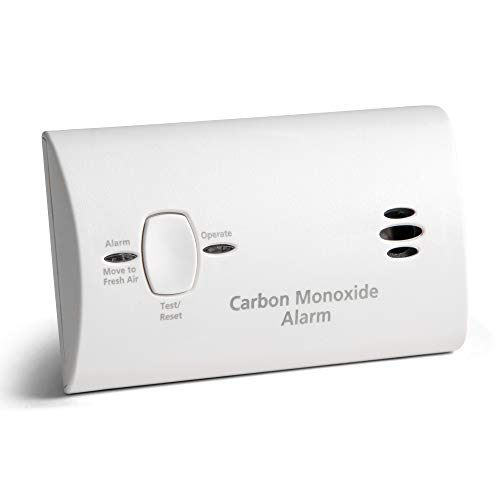
Kidde KN-COB-LP2 Battery-Powered Carbon Monoxide Alarm
For general home use this is the default recommendation: one in the hallway outside the sleeping rooms and one on any other floor with a fuel-burning appliance. It suits houses with a gas furnace, a boiler, a fireplace or an attached garage.
The KN-COB-LP2 uses an electrochemical sensor — the sensing technology used in virtually every UL-listed residential CO alarm — powered by two AA batteries that are included in the box. There is no display; a green LED shows the unit has power, a red LED flashes with the alarm, and the horn sounds at 85 decibels. It can be wall-mounted with the included hardware or simply stood on a tabletop or shelf, which makes placement flexible. Kidde backs it with a 10-year limited warranty, and the alarm pattern is the standard temporal pattern of four short beeps, a pause, and a repeat, so anyone who has heard a CO alarm before will recognise it instantly.
Living with the KN-COB-LP2 is mostly a matter of forgetting it exists. The AA batteries typically last well over a year in normal use, and the alarm warns with a chirp when they run low rather than dying silently. A monthly button test takes seconds. The one discipline it asks is the same as every alarm here: when the unit eventually signals end of life — listen for the pattern described in the manual, and check the date you wrote on the casing — replace the whole alarm, because the sensor cannot be renewed. Owners who keep a spare set of AAs in the same drawer as the torch will never think about this alarm at all, which is precisely the design goal.
- Electrochemical sensor from the largest name in home CO detection
- Runs entirely on AA batteries, so it keeps working through power cuts
- Wall-mount or tabletop placement with no wiring and no outlet needed
- 10-year limited warranty
Honest limitation: there is no digital display, so you cannot see low-level CO readings or a peak level — it tells you when levels reach alarm thresholds, not what the air is doing day to day.
Choose it if you are covering the sleeping-area hallway and want a dependable unit you can duplicate on other floors. Skip it if you specifically want a readout of parts-per-million levels; a display model from this list serves you better.
Kidde KN-COPP-3 Nighthawk Plug-In Carbon Monoxide Alarm with Digital Display
Around a house, the Nighthawk is the natural pick for the main sleeping hallway of a home with gas heating, and its peak memory helps a heating engineer diagnose an intermittent appliance fault after an event.
The KN-COPP-3 plugs directly into a wall outlet and runs on AC power with a 9-volt battery backup for outages. Its digital display continuously shows CO levels from 30 to 999 parts per million, and a peak-level button recalls the highest reading since the last reset — genuinely useful information if an alarm event happens while you are out, because it tells you and any technician what the unit actually saw. The sensor is electrochemical, the horn is rated at 85 decibels, and the plug can be mounted directly in the outlet, on the wall with the included adapter, or set on a tabletop using its retractable cord.
Day to day, the Nighthawk’s display becomes part of the hallway furniture: a small red readout that almost always shows a low or zero number, checked in passing the way you glance at a thermostat. The 9-volt backup battery is the only consumable, and it needs changing on the alarm’s prompting rather than a schedule. The peak-level button rewards a press after any event, before the reading is reset. One practical note from long-term owners of plug-in alarms generally: if the outlet is at skirting level in a dark hall, the display can be awkward to read — the corded tabletop mounting option exists for exactly that situation, and it is worth using.
- Continuous digital PPM display plus peak-level memory
- AC power means no routine battery changes; 9V backup covers outages
- Three mounting options, including a corded tabletop position
- Electrochemical sensor and 85 dB horn
Honest limitation: it occupies an outlet permanently, and in older homes the hallway outside the bedrooms — exactly where a CO alarm belongs — sometimes has no free socket, which forces a placement compromise.
Choose it if you want the main hallway alarm to double as a diagnostic tool for your heating system. Skip it if your hallway has no spare outlet near the sleeping rooms, or you need an alarm for a room with no socket at all.
First Alert CO605 Plug-In Carbon Monoxide Alarm with Battery Backup
Around the home, the CO605 is a sensible utility alarm for a floor without bedrooms — a basement near the boiler, a utility room, or a hallway by the garage door — where a display adds little.
The CO605 is First Alert’s straightforward plug-in CO alarm: it slides into a standard outlet, runs on AC power, and carries a battery backup so protection continues through an outage. The sensor is electrochemical, there is a single test/silence button, and there is deliberately no display — the design trades information for simplicity and a lower street price than its display-equipped sibling. It is the model often fitted in bulk by landlords and builders precisely because there is nothing on it to misconfigure.
The CO605 asks the least of its owner of any pick here: plug it in, test it monthly, change the backup battery when it chirps. There is no display to interpret and no data to wonder about, which some households actively prefer — the alarm is either silent, chirping for attention, or sounding for a reason, and the manual’s short chart explains each pattern. Because it has no readout, keeping the purchase date written on the casing matters more than usual; there is no end-of-life display to consult, only the unit’s own warning signal when the sensor’s life is spent.
- Plug-in simplicity with battery backup for outages
- Electrochemical sensor from a major safety brand
- Single test/silence button — nothing to set up wrong
- Compact body that leaves the second outlet socket usable in most cases
Honest limitation: with no display you get no PPM readings and no peak memory, so after an alarm event you know it sounded but not how high levels rose.
Choose it if you need a utility-floor alarm where a readout would never be looked at. Skip it if you want any kind of readout, or your only hallway outlet is already fully occupied.
Check the current price on Amazon before you buy — this pick is covered in prose because it sits above this article’s budget tier or its listing price moves too much to pin down responsibly.
First Alert CO615 Plug-In Carbon Monoxide Alarm with Backlit Digital Display
For home use the CO615 is a strong main alarm for the bedroom hallway, and its end-of-life timer suits owners who keep a simple maintenance calendar for the house.
The CO615 is the display version of First Alert’s plug-in line. It runs on AC power with two AA batteries as backup, and its backlit digital display shows current CO concentrations in parts per million and stores the peak level it has recorded, so the information is readable in a dark hallway at 3 a.m. without a torch. The sensor is electrochemical, and an end-of-life timer warns when the unit itself is due for replacement — a detail worth having, because CO sensors age out whether or not the alarm ever sounds.
Living with the CO615 means having numbers when you want them and darkness-friendly ones at that: the backlit screen is legible during a night-time event without switching on lights and waking the whole house. Its backup runs on the same AA batteries most homes already stock for remotes and torches, which simplifies the spares drawer. The end-of-life timer removes the guesswork that plagues simpler alarms — when the unit says it is done, it is done. As with all plug-ins, check during the first week that nobody has unplugged it to charge a phone; a small label or a word with the household prevents the classic silent failure.
- Backlit display readable in the dark, with peak-level memory
- AC power plus AA backup — no 9V batteries to stock
- End-of-life warning so the unit is replaced on schedule
- Electrochemical sensor from a major safety brand
Honest limitation: like every plug-in, it is only as good as your outlet placement, and its street price usually sits above this article’s tighter tiers — it is a step-up pick, not a bargain one.
Choose it if you want the main hallway unit to be the informative one. Skip it if you are shopping strictly at the lowest tier, or you have no outlet anywhere near the sleeping area.
Check the current price on Amazon before you buy — this pick is covered in prose because it sits above this article’s budget tier or its listing price moves too much to pin down responsibly.
Kidde KN-COP-DP-10YH Plug-In Carbon Monoxide Alarm with 10-Year Sealed Battery Backup
For a house, this is the premium hallway alarm: mains power, a decade of backup, a display, and a light that helps everyone find their way out if it ever sounds at night.
The KN-COP-DP-10YH is Kidde’s worry-free plug-in: AC-powered, with a sealed lithium battery backup rated for the full 10-year life of the alarm, so there are no backup batteries to change and no low-battery chirps at 3 a.m. It has a digital display that auto-dims at night, a peak-level memory, and an LED safety light that works as a night light and brightens as an escape light when the alarm sounds — a thoughtful touch for a hallway device. The sensor is electrochemical, the horn is rated 85 dB at 10 feet, the model is UL-listed, and an end-of-life warning tells you when the decade is up.
The KN-COP-DP-10YH is the closest thing in this guide to fitting an alarm and deleting the subject from your mind for a decade. No backup batteries exist to change, the display dims itself at night, and the hallway light it provides turns out to be the feature owners mention most — a soft guide light that becomes a bright escape light if the alarm sounds. The obligations that remain are the monthly test and a note in the calendar ten years out. For a holiday home, an elderly relative’s hallway, or any property you do not visit weekly, that maintenance profile is worth more than the display or the light.
- Sealed 10-year lithium backup — zero battery maintenance for the alarm’s whole life
- Digital display with peak memory and night-time auto-dim
- Built-in LED night/escape light for the hallway
- UL-listed, electrochemical sensor, 85 dB horn
Honest limitation: it is the most expensive design pattern on this list and usually sells well above the budget tiers in this article — it earns its place as the step-up benchmark, not as a budget buy.
Choose it if you want the best-equipped plug-in for the main sleeping hallway. Skip it if you are buying strictly to a low budget, or your hallway lacks a free outlet.
Check the current price on Amazon before you buy — this pick is covered in prose because it sits above this article’s budget tier or its listing price moves too much to pin down responsibly.
First Alert SCO5CN Combination Smoke and Carbon Monoxide Alarm
Around a house, the SCO5CN is the efficient choice for secondary rooms — guest rooms, a hallway on a floor that has a boiler but no bedrooms — where combined cover beats two separate devices.
The SCO5CN combines two alarms in one ceiling- or wall-mounted unit: a photoelectric smoke sensor — the type generally preferred near kitchens and bathrooms because it is less prone to nuisance alarms from cooking — and an electrochemical CO sensor. It runs on a single 9-volt battery with a hinged battery drawer that makes changes quick, and it has separate indicator lights so you can tell which hazard triggered it. For a room that currently has neither a working smoke alarm nor any CO cover, one SCO5CN closes both gaps with one set of screws.
The SCO5CN’s ownership story is the 9-volt battery: one cell, changed through a hinged drawer that can be opened without taking the unit off its bracket — a small design kindness you appreciate on a step-stool. Because it is a combination unit, keep both halves of its identity in mind: it will signal smoke events and CO events with different light indications, and the manual’s key to those patterns deserves a read on fitting day, not during an event. When the CO sensor reaches end of life the whole unit is replaced; budget it as a single device with a single lifespan and it will never disappoint you.
- Two hazards, one unit: photoelectric smoke plus electrochemical CO
- Photoelectric smoke sensing means fewer cooking nuisance alarms
- Battery powered — mounts anywhere, works through outages
- Hinged battery drawer for fast 9V changes
Honest limitation: combination units couple the lifespans of two different sensors, and when the CO sensor reaches end of life you replace the whole unit even if the smoke side is fine; it also has no display for CO levels.
Choose it if a secondary room needs both kinds of cover without two separate installs. Skip it if the room already has good smoke alarms and you only need CO cover — a dedicated CO alarm is cheaper and lasts longer in the role.
Check the current price on Amazon before you buy — this pick is covered in prose because it sits above this article’s budget tier or its listing price moves too much to pin down responsibly.
Comparison Table
| Pick | Sensor | Power | Display | Alarm |
|---|---|---|---|---|
| Kidde KN-COB-LP2 Battery-Powered Carbon Monoxide Alarm | Electrochemical | 2 AA batteries (included) | None — LED indicators | 85 dB |
| Kidde KN-COPP-3 Nighthawk Plug-In Carbon Monoxide Alarm with Digital Display | Electrochemical | AC plug-in, 9V battery backup | Digital, 30–999 PPM with peak memory | 85 dB |
| First Alert CO605 Plug-In Carbon Monoxide Alarm with Battery Backup | Electrochemical | AC plug-in, battery backup | None | 85 dB class horn with test/silence button |
| First Alert CO615 Plug-In Carbon Monoxide Alarm with Backlit Digital Display | Electrochemical | AC plug-in, 2 AA battery backup | Backlit digital, peak level shown | 85 dB class horn with test/silence button |
| Kidde KN-COP-DP-10YH Plug-In Carbon Monoxide Alarm with 10-Year Sealed Battery Backup | Electrochemical | AC plug-in, 10-year sealed lithium backup | Digital with auto-dim, plus LED night/escape light | 85 dB at 10 ft |
| First Alert SCO5CN Combination Smoke and Carbon Monoxide Alarm | Photoelectric smoke + electrochemical CO | 9V battery | None — LED indicators | 85 dB class horn |
How to Choose Carbon Monoxide Detectors Under $30
Choosing a CO alarm is mostly about matching the power source and placement to your home, because the sensing itself is standardised. Work through these five points and the right model from the list usually selects itself.
Insist on a recognised listing. Look for UL 2034 (or your region’s equivalent) on the box and a major brand behind it. This is the single most important buying rule for CO alarms. If a listing page cannot tell you the standard the alarm meets, walk away, however low the price.
Decide battery versus plug-in. Battery alarms mount anywhere and work through outages but need battery changes. Plug-in alarms never need routine batteries but need an outlet near where the alarm belongs and rely on a backup battery during cuts. Sealed 10-year backup models remove the maintenance question entirely at a higher price.
Weigh up a display. A digital display with peak memory does not detect CO any better, but it shows low-level readings and records the highest level seen — useful reassurance day to day and real evidence for a landlord or heating engineer after an event. If the numbers would only worry you, a simple alarm is fine.
Count your locations before you buy. Guidance from fire services is consistent: a CO alarm on every floor, and outside each sleeping area, plus near (not inside) rooms with fuel-burning appliances. Most homes need two or three alarms, not one — budget for the set, which is exactly why the honest low-tier options in this guide matter.
Plan for end of life. CO sensors wear out. Alarms signal end of life after roughly 7 to 10 years depending on model, and an expired alarm must be replaced, not ignored. Write the fitting date on the unit with a marker so future-you knows when it is due.
Check what the alarm does at end of life. Every CO sensor expires. Better alarms warn unambiguously; sealed ten-year models turn the warning into the product’s whole lifespan. Before buying, read how the specific model signals end of life, and make sure that signal is one your household will recognise and act on rather than mistake for a low battery.
Map the house before ordering: count floors, mark the sleeping areas, mark the fuel-burning appliances. That map is your shopping list. Houses being equipped room by room often pair this guide with Best Home Security Camera Under $150 for the outside of the home and a smoke-alarm refresh via Best Smoke Detector Under $15 — the same fit-once, forget-mostly philosophy throughout.
Building Whole-House CO Coverage: The Pattern That Actually Protects a Family
Start with the sleeping floor. The alarm outside the bedrooms is the most important alarm in the house, because CO incidents do their worst at night, when a faulty boiler cycles for hours and nobody is awake to notice symptoms. That alarm should be the best-placed and, if any alarm in the house has a display, this is the one — its peak memory is what the engineer will ask about after an event.
Next, every other floor gets an alarm, positioned near the stairs or in the main living space. The floor with the boiler, furnace or water heater gets one in the room-adjacent space the manual recommends — near the appliance but at the specified distance, never inside a sealed boiler cupboard unless the manual says so. A floor with a fireplace or wood stove gets one in that room, again at the manual’s distance from the hearth.
Finally, the attached garage changes the map: an alarm in the hallway just inside the connecting door covers the car-idling scenario without putting a sensor in the garage itself, where exhaust would age it. Fit the pattern in that order — bedrooms, floors, appliances, garage door — and a house is properly covered with three or four alarms, which is exactly what this budget tier is designed to make affordable.
Maintaining Alarms Across a Whole House Without Losing Your Mind
A house with four alarms has four batteries, four end-of-life dates and four test buttons, and the households that manage this well use systems, not memory. The simplest: test every alarm on the same day each month — the first Saturday, or the day the bins go out — walking the pattern floor by floor. It takes five minutes and catches dead batteries before they chirp at night.
Write fitting dates on every casing, and consider writing the replacement year, not just the date, so a glance tells you the deadline. When one alarm in the house reaches end of life, check the ages of the others; alarms fitted together expire together, and replacing the set in one go resets the whole system for another decade.
This is also where the sealed-battery plug-in in this guide earns its higher price for specific spots: the alarm at the top of a stairwell or in a tall hallway that needs a step-stool to reach. Put zero-maintenance models where maintenance is genuinely awkward, and affordable battery models everywhere else. Mixed systems are not a compromise — they are how sensible houses are actually equipped.
CO Alarms and the Rest of the House’s Safety Kit: How the Pieces Fit Together
A CO alarm is one instrument in a small orchestra. Smoke alarms watch for fire, CO alarms watch for combustion gas, and neither substitutes for the other — a house needs both, placed by different rules: smoke alarms inside and outside bedrooms and on every floor, CO alarms outside sleeping areas and on every floor with attention to appliance rooms. The combination pick in this guide exists for rooms where one device can honestly do both jobs, but the default assumption is separate, dedicated units.
Around those two, a sensible house adds a few cheap specialists: an emergency radio and torch for outages (see Best Emergency Radio For Home Use Under $15), a fire extinguisher and blanket in the kitchen used only by someone who has read the instructions, and — where the house has them — alarms near the garage door for the car scenario. None of this needs to be bought in one weekend; it accumulates, one payday at a time, and the CO pattern in this guide is the right place to start because it guards the hazard nobody can sense.
Review the whole kit once a year — many households use the start of heating season, when the boiler comes back to work and CO risk rises. Test every alarm, check every date, replace what has expired. Thirty minutes a year is the entire running cost of a properly protected house.
How This Budget Tier Fits Into a Whole Safety Plan
A single alarm bought at this tier is a beginning, not a finished system, and it helps to know where it sits in the sequence. The sleeping-area alarm comes first. After that, most households add one alarm per remaining floor, and the step between this article’s tier and the next one up is where that expansion usually happens — the companion guide to Best Carbon Monoxide Detector Under $15 covers the same six designs with a little more room in the budget, and the Best Carbon Monoxide Detector For Apartments Under $30 variant of this guide looks at the same problem from another household’s angle.
Beyond CO itself, the alarms belong alongside working smoke alarms on the same floors — the two systems watch for different hazards and are normally bought, tested and replaced on the same household calendar. If your smoke cover is as old as your CO cover probably is, start with Best Smoke Detector Under $15 and work through both sets together: the placement rules overlap, the test day can be shared, and the total cost of doing both properly is still modest next to almost any other home-safety spending.
It is also worth saying plainly what a CO alarm does not do, because the purchase sometimes carries false expectations. It does not make a faulty boiler safe, it does not ventilate a room, and it does not summon help by itself — it buys time and information, and what the household does with that time is the rest of the safety plan: appliances serviced on schedule, flues swept, a known route out of the house, and the emergency number saved in every phone. Bought with those habits in place, an alarm at this tier is not a compromise purchase at all. It is the standard, listed, fit-for-purpose equipment that fire services themselves recommend, and the fact that it can be had this cheaply is one of the better bargains in home safety.
What this tier should never be spent on is breadth without depth: three unlisted alarms are not better than one listed alarm, in this category above all. Build the pattern out of listed units one at a time, in the order this guide sets out — bedrooms, floors, appliance rooms — and the house becomes properly protected at a pace any budget can sustain. That patience is the real skill in safety buying, and it is why this guide would rather sell you one honest alarm now and a second next month than a basket of unverifiable ones today. The same patience applies inside the home’s calendar: stagger replacements if you must, test what you have monthly, and let the pattern grow alarm by alarm until every floor and every sleeping area is covered — then stop, maintain, and get on with living in a house that is quietly, properly watched.
Common Buying Mistakes
Buying the cheapest unbranded alarm online. Marketplace CO alarms with no UL listing and no verifiable brand are the one genuinely dangerous purchase in this category. The sensor is the product; if it is not independently listed, you have bought a plastic box that beeps, which is worse than nothing because it feels like protection.
Fitting one alarm and calling the house covered. A single alarm in the kitchen leaves the bedrooms — where people spend eight unconscious hours — unmonitored if a boiler faults at night. Cover every floor and the sleeping areas first; add appliance-room alarms after.
Mounting the alarm in the wrong place. CO alarms should not go inside a garage, directly above a cooker, in a steamy bathroom, or within a short distance of a fuel-burning appliance where normal operation can cause nuisance alarms. Follow the manual’s placement distances — they exist because placement errors cause both false alarms and missed ones.
Ignoring the end-of-life signal. When an alarm chirps its end-of-life warning, the sensor is finished. Silencing it and carrying on is a common and serious mistake: replace the whole unit promptly.
Assuming a combination unit lasts as long as two separate alarms. A smoke/CO combo retires when the shorter-lived sensor does. That is fine if you know it going in — just do not budget it as a 10-year smoke alarm and a 10-year CO alarm simultaneously.
Testing with the button once and never again. The test button checks the electronics and horn, and manufacturers recommend testing monthly. It takes ten seconds; put it on the same mental list as checking the door is locked.
Protecting the boiler room but not the bedrooms. Homeowners often fit the first alarm beside the boiler, reasoning that it watches the source. But boilers rarely harm anyone in the boiler room — the harm happens to sleeping people two rooms and a floor away. The sleeping-area alarm comes first in the pattern; appliance-room alarms are additions, not substitutes.
Final Recommendation
Equip the pattern, not the product page: bedrooms first, then every floor, then appliance rooms. At this budget that is entirely achievable with listed alarms, and it is worth far more than any single premium feature. Fit the first alarm this weekend, while the decision is fresh, rather than adding it to the list of jobs the house is still waiting for.
Start with the Kidde KN-COB-LP2 Battery-Powered Carbon Monoxide Alarm — it is the pick that fits this budget and this kind of home with the fewest compromises. Check the current price on Amazon before ordering.
As a runner-up, look at the Kidde KN-COPP-3 Nighthawk Plug-In Carbon Monoxide Alarm with Digital Display. It trades a little of the top pick’s polish for strengths that matter in specific homes, and it is the one to choose when its particular advantage matches your situation.
Frequently Asked Questions
How many CO alarms does a typical house need?
Usually three or four: one outside the bedrooms, one on every other floor, and one near (at the manual’s distance from) the boiler or furnace room if it sits on a floor of its own. Larger homes with a fireplace room or an attached garage may add one more. The pattern matters more than the exact count.
Should every alarm in the house be the same model?
It does not need to be. Many households use a display model in the main hallway and simpler battery models elsewhere. Consistency helps with battery shopping, but mixing is fine — what matters is that every unit is listed and in date. The sealed-battery plug-in suits the hardest-to-reach position in the house.
Where should the alarm go in a house with a basement boiler?
On the basement level, place an alarm in the living or circulation space near the boiler room at the distance the manual specifies — not sealed inside the boiler cupboard. Then the standard pattern applies above: every floor, and outside the bedrooms as the priority position.
We have a fireplace. Does that change anything?
Yes — the room with the fireplace or wood stove deserves its own alarm, placed at the manual’s distance from the hearth so normal use does not cause nuisance alarms. Keep the chimney swept and the flue clear; the alarm is the backstop for a blocked flue or a downdraught night. If you are also reviewing winter safety, Best Emergency Radio Under $15 is the other cheap household staple worth having.
What if the alarm sounds while the children are asleep?
Wake them, get everyone outside, and call the emergency services from fresh air. Do not pause to ventilate or collect belongings. Afterwards, appliances stay off until inspected. Rehearse this once with the family the way you would a fire drill — thirty seconds of conversation now saves confusion at 3 a.m.
Do CO alarms need to be hardwired in a house?
No. Battery and plug-in alarms meet the same listing standard and are the normal choice in existing homes. Hardwired interconnected systems appear in new builds and major renovations; they are an upgrade path, not a requirement for proper protection.
We are renovating. Should the alarms change?
Renovation is the natural moment to upgrade: if walls are open and an electrician is on site anyway, hardwired interconnected alarms become practical, and they are the one genuine step up from the battery and plug-in models in this guide. Until then, keep the existing pattern working through the works — dust sheets and blocked vents during a renovation are themselves a reason not to let coverage lapse.