Disclosure: As an Amazon Associate, Reviews Took earns from qualifying purchases. Links to Amazon on this page are affiliate links; they cost you nothing extra.
Check SAE vs metric support.
This guide is built from Amazon product listings and maker specs, not our own testing, so confirm size, contents and current price on each product page. Health products are for general information and are not medical advice.
Check the current price on Amazon.
Last updated: November 2, 2026.
In this guide
Quick Picks
| Product | Type | Best for |
|---|---|---|
| Klein Tools D5074 4-Piece Extra Capacity Adjustable Wrench Set | Wrench set | general fastening |
| DISEN Ratcheting Wrenches Set 90 Tooth Flex-Head with Nickel | Wrench set | general fastening |
| 9-Piece Ratchet Wrenches Set SAE Combination Wrench Set 72 Tooth | Wrench set | general fastening |
| CRAFTSMAN Ratchet Wrenches Set 20 Pc 90 Tooth SAE/Metric | Wrench set | general fastening |
| IRWIN Vise-Grip Adjustable Wrench Set SAE/MM 4-Piece (2078706) | Wrench set | general fastening |
| WORKPRO 5 PCS Adjustable Wrench Set 4″ 6″ 8″ 10″ 12″ Wide Jaw | Wrench set | general fastening |
| KLEIN TOOLS D5073 3-Piece Extra Capacity Adjustable Wrench Set | Wrench set | general fastening |
| CRAFTSMAN Adjustable Wrench Set 3-Piece All Steel Metirc and SAE | Wrench set | general fastening |
Our Picks
Top pickBest for general fastening
1. Klein Tools D5074 4-Piece Extra Capacity Adjustable Wrench Set
A Klein Tools D5074 4-Piece Extra Capacity Adjustable Wrench Set (wrench set), per the listing. Check price on Amazon.
Good for: general fastening. Watch out: Check jaw capacity.

Best for general fastening
2. DISEN Ratcheting Wrenches Set 90 Tooth Flex-Head with Nickel
A DISEN Ratcheting Wrenches Set 90 Tooth Flex-Head with Nickel (wrench set), per the listing. Check price on Amazon.
Good for: general fastening. Watch out: Check jaw capacity.

Best for general fastening
3. 9-Piece Ratchet Wrenches Set SAE Combination Wrench Set 72 Tooth
A 9-Piece Ratchet Wrenches Set SAE Combination Wrench Set 72 Tooth (wrench set), per the listing. Check price on Amazon.
Good for: general fastening. Watch out: Check jaw capacity.
Best for general fastening
4. CRAFTSMAN Ratchet Wrenches Set 20 Pc 90 Tooth SAE/Metric
A CRAFTSMAN Ratchet Wrenches Set 20 Pc 90 Tooth SAE/Metric (wrench set), per the listing. Check price on Amazon.
Good for: general fastening. Watch out: Check jaw capacity.
Best for general fastening
5. IRWIN Vise-Grip Adjustable Wrench Set SAE/MM 4-Piece (2078706)
An IRWIN Vise-Grip Adjustable Wrench Set SAE/MM 4-Piece (2078706) (wrench set), per the listing. Check price on Amazon.
Good for: general fastening. Watch out: Check jaw capacity.

Best for general fastening
6. WORKPRO 5 PCS Adjustable Wrench Set 4″ 6″ 8″ 10″ 12″ Wide Jaw
A WORKPRO 5 PCS Adjustable Wrench Set 4″ 6″ 8″ 10″ 12″ Wide Jaw (wrench set), per the listing. Check price on Amazon.
Good for: general fastening. Watch out: Check jaw capacity.

Best for general fastening
7. KLEIN TOOLS D5073 3-Piece Extra Capacity Adjustable Wrench Set
A KLEIN TOOLS D5073 3-Piece Extra Capacity Adjustable Wrench Set (wrench set), per the listing. Check price on Amazon.
Good for: general fastening. Watch out: Check jaw capacity.

Best for general fastening
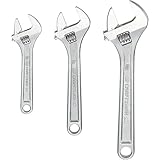
8. CRAFTSMAN Adjustable Wrench Set 3-Piece All Steel Metirc and SAE
A CRAFTSMAN Adjustable Wrench Set 3-Piece All Steel Metirc and SAE (wrench set), per the listing. Check price on Amazon.
Good for: general fastening. Watch out: Check jaw capacity.
How to Choose
Rating
Check size, strength or protection ratings.
Build
Durable materials last longer.
Safety
Use protective gear and follow instructions.
Adjustable Versus Fixed and Ratcheting Wrenches
A wrench set can mean quite different tools, and the list above includes more than one style. An adjustable wrench has a movable jaw that you set to fit a nut or bolt head, so a few tools cover a wide range of sizes. A fixed combination wrench has an open end and a box end at one exact size, and a set holds one wrench per size. A ratcheting wrench has a box end that clicks around the fastener, so you do not lift and reposition the tool between turns.
Each style has strengths. Adjustable wrenches are versatile and suit occasional jobs, plumbing, and situations where you do not know the size in advance. Fixed wrenches grip more securely on the flats of a fastener because the fit is exact, which reduces the chance of rounding corners. Ratcheting types speed up work in tight spaces, but the mechanism adds bulk and needs clearance. Many households end up with an adjustable set for convenience and a combination or ratcheting set for the tougher jobs.
- Adjustable: flexible and compact, but the jaw can shift under load if it is not set snugly.
- Combination fixed: secure fit for each size, with more pieces to carry.
- Ratcheting: faster in repeated turning, depending on the design and the room around the fastener.
- Extra-capacity adjustable: a wider jaw opening for large nuts and pipe fittings.
Read each listing to see which style it is, and avoid comparing the pieces of a ratcheting set directly with an adjustable set.
Jaw Capacity and Set Size Selection
Jaw capacity is the largest fastener or pipe width that the wrench can open to. A set of different lengths usually covers a range of capacities, with the shorter tools handling small fasteners and the longer ones handling larger sizes. When you read a listing, find the stated opening for each wrench and compare it with the sizes you work with. If you mainly do household repairs, bicycle maintenance, or furniture assembly, the smaller and middle sizes will see the most use. If you work on plumbing or larger machinery, the biggest sizes matter more.
It also pays to think about tool length. A longer handle gives more leverage, which makes it easier to turn a stubborn nut but also makes it easier to over-tighten or damage a fastener. A short tool is better for delicate work and tight spots. Check the stated length of each tool and consider whether you have space to swing a long one.
- List the fasteners you tighten most often.
- Measure a few of them or look up their sizes.
- Compare those against the listed capacity of each wrench.
- Choose a set with a spread of lengths that covers your range.
- Check whether the set includes both small and large wrenches or only a few similar ones.
A three-piece or four-piece set can be enough for most homes, and larger sets suit workshops that need more variety.
SAE, Metric Markings, and Readability
Fastener sizes come in two measurement systems, inch-based (often called SAE) and metric. Some jobs need both, such as work on mixed equipment, imported furniture, or older and newer machines. A set that is marked in both systems lets you read the setting without guessing. Markings should be clear, deep enough to remain legible after use, and placed where you can see them while the wrench is on the fastener.
Keep in mind that scale markings on an adjustable wrench are approximate. The moving jaw has some play, and the stated size may be slightly off when the jaw is tightened. Use the scale as a starting point and test the fit. A snug fit matters more than the number. If a listing says a set is labeled for both systems, confirm which sizes each wrench shows and whether the markings are laser-etched, stamped, or printed. Stamped or etched markings generally last longer than printed ones, though you should check the product description.
- Look for both scales if you work on a variety of equipment.
- Check that markings are easy to read in dim light.
- Do not rely on the scale alone, and test the fit on the fastener.
- Keep a spare fixed wrench of the most common sizes for precise work.
Mixing up the systems can strip a fastener, so slow down if a wrench feels loose.
Build Quality, Materials, and Jaw Fit
The feel of an adjustable wrench tells you a lot about quality. The jaw should slide smoothly along its track with minimal side-to-side wobble, and the adjusting wheel or screw should turn without gritty resistance. When tightened on a fastener, the jaws should be parallel to each other, since angled jaws grip only at the edges and can round the corners of a nut. Check reviews and listings for comments about play in the jaw, but treat them as impressions only.
Materials and finish matter. Forged steel alloys are common in quality tools, while cast or thinner metals may flex under load. Finishes such as chrome or oxide coatings help resist rust, and a textured surface improves grip. Handles may be bare steel or covered with a grip, which adds comfort but can wear. Look for details on the material and finish in the listing, and remember that the maker’s description is not the same as independent testing.
- Hold the wrench and test the jaw slide, if you can handle it before buying.
- Close the jaws on a fastener and see whether the fit is snug and square.
- Check for sharp edges, rough casting marks, or uneven finishes.
- Look at the thickness of the jaw and the neck, since a thin neck is a weaker point.
- Check warranty or return policy details in case the tool does not meet expectations.
A well-made tool can serve for many years, so the extra care at purchase tends to pay off.
Using Adjustable Wrenches Correctly and Safely
Correct technique protects both the fastener and your hands. Place the wrench so that the force is applied toward the fixed jaw, with the movable jaw on the side that you pull away from. This direction puts the load on the stronger part of the tool and reduces the chance of the jaw slipping open. Tighten the jaw until it fits snugly, and re-check it after the first slight turn, since it may shift.
Pull the handle toward you instead of pushing it away, when possible. Pulling gives better control and, if the wrench slips, your hand moves away from the work rather than into it. Keep your body balanced, and watch for sharp edges nearby. Wear gloves and eye protection when working in awkward spots or with rusty fasteners, and do not use a wrench on live electrical equipment.
- Do not add a pipe over the handle to increase leverage, because this can damage the tool and cause injury.
- Do not use it as a hammer or to strike surfaces.
- Replace a wrench with a bent handle, cracked jaw, or loose adjusting mechanism.
- Use the right size tool for the job instead of stretching a small wrench to its limit.
- Apply penetrating oil to rusted fasteners, following the product directions, and allow it time to work.
When a fastener resists, switching to a fixed or box wrench with a snug fit often succeeds where an adjustable one slips.
Which Jobs Call for Which Wrench
A wrench set is only useful if it matches the work you do. The eight sets in this guide include adjustable wrenches in three- to five-piece groups, and ratcheting combination sets in larger counts. Thinking through typical jobs shows which style belongs in your toolbox.
Plumbing and pipe fittings
Plumbing often means large nuts, odd sizes and fittings in awkward spots. An extra-capacity adjustable wrench, such as the Klein pieces in this guide, suits these jobs because the jaw can open wide. Often two wrenches are needed at once, one to hold a fitting steady and the other to turn the nut. That is a good reason to own more than one adjustable wrench in a set.
Bicycles, furniture and appliances
These jobs involve small and medium fasteners, usually in tight spaces. A ratcheting wrench set with a flex head can save time here, because you do not need to lift and reposition the tool between turns. A smaller adjustable wrench is still handy for the odd nut that does not match your set.
Automotive and mechanical work
Mechanics usually favor fixed or ratcheting combination wrenches, because an exact fit gives a better grip on the flats of a bolt head. Sets with both SAE and metric sizes matter on mixed vehicles. Adjustable wrenches are a backup for the odd size.
Home maintenance and emergencies
A small adjustable set kept in a drawer covers a large share of household tasks, such as tightening a loose faucet, a gas grill fitting or a swing set bolt. In such cases, versatility counts for more than speed.
Workshops and job sites
Someone who works with tools every day will probably want several kinds: ratcheting wrenches for repetitive work, fixed wrenches for stubborn fasteners and adjustables for plumbing and unknowns. In that case, a set is a starting point, and you fill gaps as they appear.
Grip, Handle Comfort and Leverage
A wrench is held in the hand for the whole job, so comfort affects both safety and results. Handle shape matters. A flat, thin handle is easy to slip into tight spaces but can dig into the palm under heavy force. A thicker or contoured handle spreads pressure. Some sets have coated or cushioned grips, which can be comfortable but may wear or get slippery with oil, so check what the listing says and what the grip is made of.
Handle length determines leverage. A longer handle makes it easier to break a stubborn nut loose, but it also makes it easy to apply too much force and damage a fastener or the tool itself. As the guide mentions earlier, shorter wrenches are more controllable on delicate work. A set with a spread of lengths gives you the choice.
Ratcheting wrenches change the equation. Because the tool does not need to be removed, you can work in tight spots with a small swing arc. The number of teeth in the mechanism, such as the 72 and 90 tooth figures in the listings, determines how far you must swing the handle before the ratchet engages. A higher tooth count means a smaller swing, which helps in cramped places. The mechanism also adds bulk at the box end, so check whether it will fit in the space you work in. A ratcheting wrench is not meant for heavy breaking force. For a stuck fastener, use a solid fixed wrench or a breaker bar, and follow the maker’s guidance for the ratchet.
Flex heads let the box end pivot, which helps reach fasteners at an angle. They add a pivot point that can wear with use, so avoid using them for hard, high-torque jobs. Check whether the head locks in place, since a floppy head can be frustrating.
- Comfort: hold the wrench if you can, and look at handle shape.
- Control: choose lengths that match the force you need.
- Access: check the head thickness and swing arc for tight spots.
- Durability: be careful with flex heads under heavy load.
Storage, Organization and Keeping a Set Complete
A wrench set is only as useful as its ability to be found. Sets come in different packaging, such as a roll-up pouch, a molded case or simply loose in a blister pack. Roll pouches pack small and fit in a drawer or vehicle, but tools can shift and rub together. Molded cases hold each piece in a labeled slot, which makes it easy to see what is missing, and they tend to be bulkier. If the listing does not say what storage is included, assume it may not be and plan to buy a pouch or organizer.
Keep tools dry. Rust is the main enemy of steel wrenches, and a humid garage can cause it quickly. Wipe tools after use, especially if they have been exposed to water or chemicals. A light coat of oil on the adjusting mechanism and a silica gel pack in the toolbox can help. Do not oil the jaw faces so heavily that the wrench slips on the fastener. Wipe off any excess.
Mark or label your wrenches if you share a workspace. A set that is lent out often returns incomplete. A small dab of paint or a label on each handle makes your tools easy to identify. Keep sizes in order in the case, and return each wrench to its slot after use so you notice when one is missing.
Finally, plan for growth. A starter set of adjustables covers many jobs, but over time you will find gaps, such as a specific metric size or a deep-reach option. Buy individual wrenches to fill those gaps rather than a whole new set. Check the warranty and return details on the current listing, and keep proof of purchase, since some makers will replace a tool that fails under normal use according to the terms.
Frequently Asked Questions
Is it right for beginners?
Check the features and manual.
Do I need extras?
Often protective gear or accessories.
How do I store it?
Dry and covered.
What size adjustable wrenches do I need first?
A small and a medium size handle most household jobs. Add a larger one if you work on plumbing or bigger machinery. Check the stated jaw capacity in each listing.
Are adjustable wrenches as good as fixed ones?
They are more versatile but less precise. A fixed wrench fits one size snugly, which helps on tight or stubborn fasteners. Many toolboxes include both.
Why does my adjustable wrench slip?
The jaw may not be tightened fully, the fastener may be worn, or you may be applying force in the wrong direction. Re-tighten the jaw and pull toward the fixed jaw side.
Do I need a set with both SAE and metric markings?
If you work on mixed equipment, it is useful. If you only use one system, a single-scale set is fine. Remember to confirm the fit on the fastener.
Is a ratcheting wrench set a substitute for an adjustable set?
Not entirely. Ratcheting wrenches fit specific sizes and work well in repeated turning, while adjustable wrenches cover many sizes with fewer tools.
How can I tell if a wrench is worn out?
Look for a jaw that no longer closes square, excessive play, bent handles, cracks, or an adjusting mechanism that slips. Replace tools that show these signs.
Can I use an adjustable wrench on plumbing fittings?
Many people do, but choose the right size and take care not to crush soft fittings. Follow the guidance for the specific material you are working on.
What does tooth count mean on a ratcheting wrench?
It is the number of teeth in the ratchet mechanism. A higher count, such as 90 versus 72, means a smaller swing arc before the ratchet engages, which helps in cramped spaces. It does not by itself say how strong the tool is.
Should I use a ratcheting wrench to loosen a stuck bolt?
Ratcheting mechanisms are better for repeated turning than for breaking force. For a stuck fastener, a solid fixed wrench or breaker bar is usually safer for the tool. Follow the maker’s guidance for torque limits.
Why do some adjustable wrenches have two scales?
They are marked in both inch-based SAE and metric sizes so you can estimate the opening without guessing. Treat the scale as approximate and confirm a snug, square fit on the fastener before turning.
How do I stop wrenches from rusting?
Wipe them dry after use, store them in a dry spot and keep moisture out of the toolbox, for example with a silica gel pack. A thin film of oil on moving parts helps, but wipe off any excess from the jaw faces.
Bottom Line
Extra-capacity wrenches handle odd sizes.
More Workshop Guides
- Best Folding Work Tables with Vise
- Best 20V Impact Drivers and Combo Kits
- Best Rechargeable and Stand Work Lights
- Best Anti-Fog Safety Glasses
- Best Noise Reduction Ear Muffs
- Best Caulking Guns and Finishing Tools
- Best Dump Carts and Wheelbarrows
- Best HVLP and Airless Sprayers