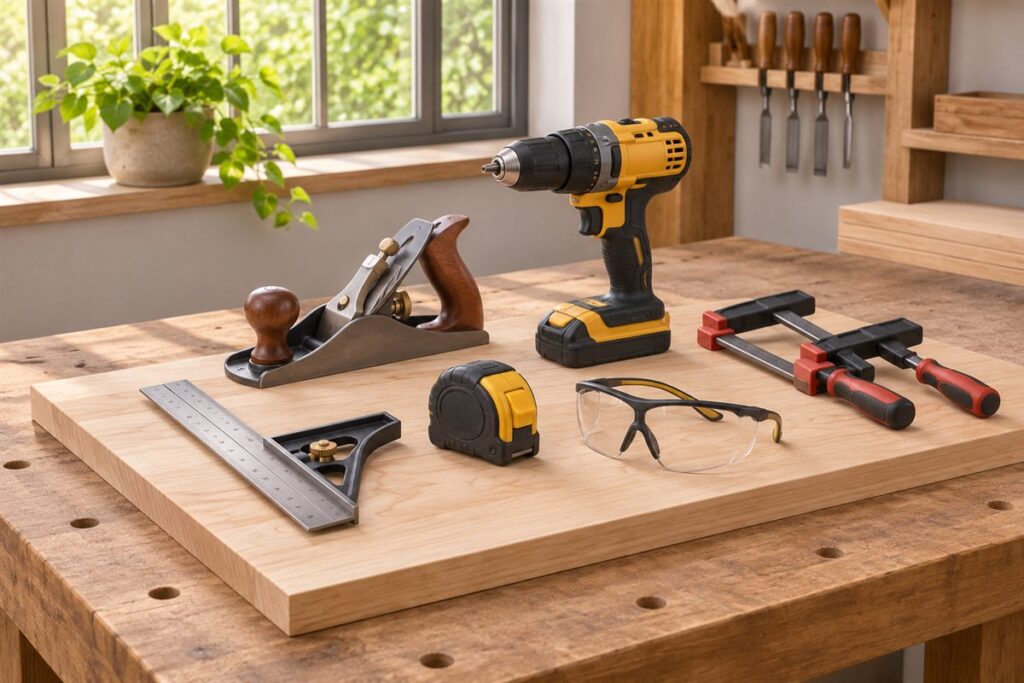
A battery platform is a family of tools from one maker that share the same battery packs and chargers. Choosing one matters because each extra tool you buy is less costly to own when it uses batteries you already have. This guide covers what to weigh before you commit, how to map your own projects onto a system, and how to keep a growing collection of packs organized.
What a Platform Really Means
When you buy into a platform, you are buying more than a single drill. You are choosing a system of packs, chargers and a range of bare tools you can add later, often sold without a battery.
Packs are usually labeled by voltage and amp-hour capacity. Voltage relates to the power class of the tool, and amp-hours relate to how long it runs. Compatibility between classes varies, so read the maker’s guide.
What to Check Before Committing
| Factor | Why it matters | What to check |
|---|---|---|
| Tool range | You may want saws, sanders and lights later | Does the maker offer the tools you expect to need |
| Bare-tool options | Lets you add tools without extra packs | Are tools sold without battery and charger |
| Pack sizes | Small for light work, large for long jobs | Range of capacities offered |
| Charger speed | Affects downtime | Charge time stated by the maker |
| Backward fit | Older packs may or may not fit new tools | Compatibility notes in the guide |
Steps to Choose a System
- List the tools you own and the ones you expect to add within a couple of years.
- Look at which makers cover most of that list.
- Check whether your local store stocks batteries and tools from that maker.
- Compare kits, including what comes in the box.
- Note any adapters, and read what the maker says about using them.
Habits That Keep a Platform Useful
- Label packs so you can rotate them evenly.
- Store batteries as the maker describes, away from heat and damp.
- Use only the charger made for your packs.
- Do not use damaged packs. Follow the maker’s disposal instructions.
Planning for the Long Term
Platforms change over time, and makers add or retire tools. Before you commit, look at how long a maker has supported older packs and whether new tools keep the same connection. Keep your receipts and manuals together, and note which packs came with which tools so you can match chargers correctly later. A little planning now makes it much easier to add tools one at a time as your projects grow.
Worked Walkthrough: Mapping Projects to a System
A simple table on paper does more than a long comparison. Here is a method, with invented example projects.
- List the next three projects. For example: build a garden bed, hang shelves, trim a hedge.
- Write the tools each one needs. The bed needs a drill, driver and circular saw. The shelves need a drill, a stud finder and a level. The hedge needs a trimmer.
- Mark which are battery tools. Not every tool needs a pack. A hand saw or a level never will.
- Check each maker’s range. For every battery tool on your list, see whether the maker offers it in a bare-tool form.
- Count the gaps. A maker that covers all but one tool may still be fine if you are happy to buy that tool elsewhere. A maker that covers half the list is a weak fit.
- Decide on packs. One medium pack plus a spare covers most light work. Add a larger pack only when a heavy tool demands it.
Common Scenarios
First cordless purchase
A kit with a drill, a pack and a charger is the simple route. Check the maker’s range for the next two or three tools you expect to want before choosing.
Already own tools from two makers
Choose a main platform and let the other fade out as tools wear. Running two systems means two sets of chargers, packs and storage habits.
Inherited a set of older tools
Check whether the maker still supports those packs and whether replacement packs are available. Old packs lose capacity with age, so a replacement may be sensible.
Sharing tools with family or neighbors
Sharing the same platform means packs and tools can swap freely. It also means labeling each pack so they find their way home.
Quick Troubleshooting
| Symptom | Likely cause | What to try |
|---|---|---|
| Pack will not fit the tool | Different voltage class or system | Check the compatibility notes in the manual |
| Tool has pack but does nothing | Pack empty or contacts dirty | Charge the pack and clean contacts with a dry cloth |
| Charger will not accept pack | Wrong charger or pack too hot or cold | Use the matching charger and allow the pack to reach room conditions |
| Runtime much shorter than before | Age or heavy use | Rotate packs and compare with a spare |
Mistakes to Avoid
- Choosing on one tool alone. A single great drill does not help if the maker lacks the saw or sander you need later.
- Buying many kits. Each kit repeats a charger and pack you may not need. Bare tools are often the better way to expand.
- Relying on adapters without reading the guidance. Follow what the tool maker says about their use, as fit does not guarantee safe operation.
- Ignoring local stock. A platform is only handy if you can find packs and service near you.
Care and Upkeep Over Time
Check packs and chargers every few months. Look for cracked cases, bent or dirty contacts and cords that have been pinched. Wipe contacts with a dry cloth, keep vents on tools and chargers clear of dust, and charge in a dry, ventilated room as the maker advises. Rotate packs so none sits unused for a long time, and write the purchase month on each with a marker so you can see which are oldest. When a pack runs short or fails, follow the maker and local rules for recycling rather than binning it.
Glossary
- Platform: a set of tools sharing one battery type.
- Bare tool: a tool sold without battery or charger.
- Kit: a tool bundled with a pack and charger.
- Voltage class: the power tier of a system, such as light-duty or heavy-duty.
- Adapter: a part that lets a pack from one system connect to another system’s tool.
FAQ
Can I mix batteries from different makers?
Generally no, since packs and tools are designed to work together. Third-party adapters exist, but follow the tool maker’s guidance on their use. Some makers advise against them entirely.
Should I buy the tool alone or in a kit?
A kit gives you a pack and charger to begin with. If you already own packs on the same platform, a bare tool is often the sensible option.
How many packs do I need?
Two is a common minimum so one can charge while the other works. Add more only if your jobs run long, or you use several tools in the same session.
Will a platform I choose today still be supported later?
Makers do not always promise this, so look at how they have treated older packs and tools in the past. The maker’s guide and customer support can say what they currently offer.
Is a higher voltage system always better?
No. Higher voltage suits heavier tools, while lighter systems suit small tools and keep weight down. Match the class to the work you do most often.
The Short Version
Treat the battery system as the main purchase and the first tool as the entry point. Map your upcoming projects to a maker’s range, then add bare tools over time. Use the maker’s guidance for storage, charging and disposal.