Disclosure: As an Amazon Associate, UMT Smart Tool earns from qualifying purchases. This guide is built from product listings and maker specifications, not from our own hands-on testing. Prices are approximate and can change, so check the current price before you buy. Last updated: November 10, 2026.
A 5 gallon water cooler is simply a dispenser built around the standard 5 gallon bottle — the big refillable or exchange jug used by home delivery and self-serve refill stations. The differences that matter are how the bottle loads, how many temperatures you get, and how much upkeep the machine asks of you. Top-loaders are cheaper and let you see the water level at a glance, but every bottle change means lifting roughly 40 pounds overhead. Bottom-loaders hide the jug in a cabinet and spare your back, at a higher price. This guide is organized by use case — all-day home and office drinking, coffee brewing, cleaner water, tight spaces and tight budgets — so you can start with the job the cooler has to do.
In this guide
Quick Picks
The short version: six 5 gallon water coolers we would look at first, one per use case.
| Pick | Type | Best for |
|---|---|---|
| Brio Self-Cleaning Bottom Loading (CLBL520SC) | Bottom load, UV self-cleaning | Most households that want low upkeep |
| Avalon Top Loading (A1WATERCOOLER) | Top load, hot & cold | Seeing the bottle level and simple controls |
| Primo hTRIO (601225-B) | Bottom load with K-Cup brewer | Coffee drinkers who want one machine |
| Brio 520 Bottom Load with 2-Stage Filter (CLNLPOU520SCF2) | Bottom load, filtered | Better-tasting water from the bottle |
| GE Top-Loading (GXCF01P) | Top load, tall dispense area | Filling tall bottles and pitchers |
| Frigidaire EFWC498 | Top load, compact | Small spaces and smaller budgets |
Our Picks

1. Brio Self-Cleaning Bottom Loading Water Cooler (CLBL520SC) — Best Overall
The Brio CLBL520SC covers the three things most 5 gallon buyers end up caring about: no heavy lifting, three temperatures and a machine that helps keep itself clean. The bottle slides into the lower cabinet instead of being hoisted on top, and the dispenser serves hot, cold and cool (room-temperature) water. Its headline feature is UV self-cleaning: at the press of a button, ultraviolet light sanitizes the water lines and reservoirs, working against the biofilm that makes neglected coolers taste stale. The cabinet is stainless steel, and the footprint is a compact 12.2 inches wide by 15.6 inches deep.
The trade-offs are the usual bottom-load ones. You cannot see how much water is left without opening the cabinet, so an empty bottle tends to announce itself mid-pour. The self-cleaning cycle also does not excuse you from wiping the drip tray and dispensing area. But for a family or a small office that goes through a bottle a week and wants the lowest-effort ownership experience, this is the most complete package here — mid-range to premium tier money, spent on convenience rather than gadgets.

2. Avalon Top Loading Water Cooler Dispenser (A1WATERCOOLER) — Best Top Loading
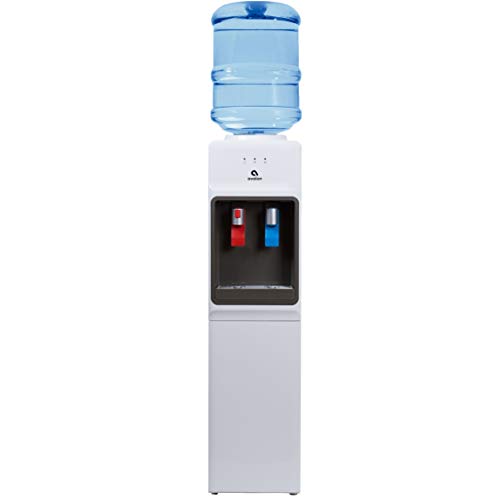
Avalon’s freestanding top-loader is the classic water cooler format, done plainly and well. The bottle sits on top, so the water level is always visible — a genuinely useful feature in offices, where running dry is otherwise a surprise. It dispenses hot and cold water, has a child safety lock on the hot spout, and its slim cabinet (model A1WATERCOOLER) is UL listed. It accepts both 3 and 5 gallon bottles, so you can drop to the lighter 3 gallon jug if bottle changes are a struggle.
What you give up versus the bottom-loaders is exactly that bottle change: a full 5 gallon jug weighs about 40 pounds and has to be lifted, flipped and seated without spilling. There is also no room-temperature tap — just hot and cold — and no self-cleaning cycle, so periodic manual sanitizing is on you. In return you get one of the simplest, most proven designs in the category at a budget-friendly tier. For a garage, workshop, break room or any spot where someone able-bodied handles the bottles, it is hard to argue with.

3. Primo hTRIO Water Dispenser with K-Cup Coffee Brewing (601225-B) — Best with a Coffee Maker
The hTRIO is a bottom-loading 5 gallon cooler that also brews single-serve coffee. It takes K-Cup pods at 6, 8 or 10 ounce brew sizes, includes a reusable filter for your own grounds, and stores up to 20 pods in a built-in tray. On the water side it is a two-temperature machine: Primo rates the hot water at 188.5 degrees Fahrenheit or higher — properly hot for tea and instant meals — and the cold side at 39.2 degrees. The black and stainless model 601225-B measures 12.2 by 14.2 by 43.5 inches, has a child safety lock, and the drip tray is removable and dishwasher-safe.
The obvious compromise is focus: two water temperatures instead of three, and a brewer that will not match a dedicated coffee machine for features or cup clearance. Primo’s own dispenser-only models are simpler and cost less. But in a small office or a kitchen short on counter space, one appliance doing water and coffee from the same 5 gallon bottle is a real space saving, and the bottom-load layout keeps bottle changes easy. It sits in the premium tier, and earns it if the coffee function replaces a second machine.
4. Brio 520 Bottom Load Water Cooler with 2-Stage Filter (CLNLPOU520SCF2) — Best with Built-In Filtration
Most bottled coolers simply chill and heat whatever is in the jug. The Brio 520 (model CLNLPOU520SCF2) adds a 2-stage filter between the bottle and the taps, aimed at chlorine, VOCs and the bad taste and odor that make people avoid tap-refilled bottles. It is a bottom-load design — 14.3 by 12.2 by 40.5 inches — with hot, cold and room-temperature dispensing, and it keeps Brio’s self-cleaning theme with an ozone cycle that sanitizes the dispenser at the press of a button. If your 5 gallon bottles come from a refill station rather than a spring-water delivery service, this filtration stage is the difference between water you tolerate and water you actually drink.
The costs are filters and discipline: the 2-stage cartridges are consumables that need replacing on schedule, and a neglected filter is worse than none. The plumbing-free setup is genuinely simple — no water line, just the bottle in the cabinet — but read the listing carefully so you understand how the filtration loop works with your bottles before ordering. For households whose local refill water tastes of chlorine, this is the pick that fixes the actual problem.

5. GE Top-Loading Hot and Cold Water Dispenser (GXCF01P) — Best for Tall Bottles and Pitchers
The detail that sells the GE GXCF01P is in its name: a taller 13-inch dispenser height. Many coolers leave barely enough room for a drinking glass, so filling a sports bottle or a pitcher means tilting it under the spout and spilling. GE’s extra clearance makes the fill-up noticeably less awkward, and it is the feature owners of other coolers most often wish they had. Otherwise this is a straightforward top-loading machine: hot and cold water, a child safety lock, a clean white cabinet, and no plumbing or installation beyond plugging it in and seating a 5 gallon bottle (sold separately).
As with every top-loader, bottle changes are a lift-and-flip job, and there are only two temperatures — no room-temperature tap for people who dislike chilled water. It is also a newer entry than the long-running Avalon and Frigidaire designs, so the long-term track record is thinner. But if your household fills gym bottles and coffee carafes all day, the taller dispensing area solves a daily annoyance the other top-loaders here do not, at a mid-range tier price.

6. Frigidaire Top Load Water Cooler Dispenser (EFWC498) — Best Budget
The Frigidaire EFWC498 has been a default budget recommendation for years for a simple reason: it does the basics in a small box. At 11 inches deep, 11.5 inches wide and 36 inches tall, it fits corners of dorm rooms, garages, RVs and cottages where a full-size cooler will not. It is a top-loader serving hot and cold water from 3 or 5 gallon bottles, with a stainless steel weld tank and a child safety lock on the hot side — a spec sheet that covers what most buyers actually use, at a firmly budget-friendly tier.
The compromises are size and simplicity. The compact cabinet means a smaller presence but also the standard top-load lift for every bottle change, and there are no extras: no room-temperature tap, no self-cleaning, no filtration. Taller users may also find a 36-inch unit low to pour from. None of that matters much if the job is cold water in a workshop or hot water for noodles in a dorm. For the money tier it occupies, the EFWC498 remains the low-risk way into 5 gallon water.
Best Picks by Category
- Best overall: Brio Self-Cleaning Bottom Loading (CLBL520SC) — bottom loading, three temperatures and UV self-cleaning in one cabinet.
- Best top loading: Avalon Top Loading (A1WATERCOOLER) — visible water level, hot and cold, slim and UL listed.
- Best with a coffee maker: Primo hTRIO (601225-B) — brews K-Cup coffee at three sizes from the same 5 gallon bottle.
- Best with filtration: Brio 520 Bottom Load with 2-Stage Filter (CLNLPOU520SCF2) — filters bottle water for chlorine and taste before dispensing.
- Best for tall bottles: GE Top-Loading (GXCF01P) — a 13-inch dispensing height that fits pitchers and sports bottles upright.
- Best budget: Frigidaire EFWC498 — compact hot and cold top-loader sized for small rooms and small budgets.
Notice the pattern: loading style is the first decision, because it decides every bottle change for years. Features like self-cleaning, filtration and coffee brewing come second, and they are worth paying for only when they match how your household actually drinks.
How to Choose
Top loading vs bottom loading
This is the defining choice. Top-loaders cost less, have fewer parts, and show you the water level — but a full 5 gallon bottle weighs about 40 pounds, and every change means lifting it to shoulder height, flipping it and seating it on the probe without a spill. Bottom-loaders pump water up from a jug hidden in the cabinet, so changes are a slide-in job anyone can do, and the machine looks cleaner. They cost more and hide the water level. If anyone in the household has a bad back, or bottles get changed weekly, bottom loading is worth the premium.
Two temperatures or three
Two-temperature machines serve hot and cold. Three-temperature models add a cool or room-temperature tap, which matters more than it sounds: people who dislike ice-cold water drink measurably more when a room-temperature option exists, and room-temperature water is what most recipes, plants and pets actually want. Check the maker’s stated temperatures too — hot water around 185 degrees Fahrenheit or above handles tea and instant coffee properly, while cold sides near 40 degrees feel genuinely chilled rather than cool.
Self-cleaning and filtration
A cooler is a wet, dark box: reservoirs and lines grow biofilm over time, and the water starts to taste stale. UV and ozone self-cleaning cycles — found on both Brio picks here — sanitize the internals at the press of a button and are the single best upkeep feature in this category. Filtration is a separate question: it improves the taste of the water itself, which matters if you refill bottles at a store station. Neither replaces manual cleaning of the drip tray, taps and probe.
Dispensing height and footprint
Measure the space under the spouts, not just the cabinet. Standard dispensing areas fit a glass or mug; tall sports bottles, pitchers and coffee carafes need a taller alcove like the GE’s 13-inch clearance, or a removable drip tray you can set aside. For the cabinet, most freestanding 5 gallon coolers land around 12 inches wide and 40 to 44 inches tall, but compact top-loaders like the Frigidaire can be as short as 36 inches — friendlier for tight corners, lower to pour from.
Safety locks and certifications
If children use the kitchen, a child safety lock on the hot tap is non-negotiable: cooler hot tanks run hot enough to scald. Look for a two-step action on the hot side, and check for UL or ETL listing, which means the electrical design has been independently tested. Energy Star certification is worth having on a machine that heats and chills around the clock, and most of the established brands here carry one or both marks — verify on the specific listing before you buy.
Bottle logistics and routine care
The cooler is the cheap part; the water is the commitment. Decide where 5 gallon bottles come from — delivery service, exchange racks at grocery stores, or refill stations — and confirm empties have a storage spot, because a spare bottle and an empty always seem to exist at once. Almost all of these machines also accept 3 gallon bottles, which are far easier to lift. For care: wipe the exterior weekly, empty the drip tray, sanitize reservoirs every few months (or run the self-cleaning cycle if fitted), and descale the hot tank if your water is hard.
Which 5 Gallon Water Cooler Should You Buy?
Choose the 5 gallon water cooler by loading style first, then by the one extra feature you will use daily. The six picks here split cleanly along those lines.
- If you want the least upkeep and no heavy lifting: choose the Brio Self-Cleaning Bottom Loading (CLBL520SC), which combines bottom loading, three temperatures and UV self-cleaning.
- If you want a classic design where you can see the water level: choose the Avalon Top Loading (A1WATERCOOLER).
- If you want one machine for water and coffee: choose the Primo hTRIO (601225-B) with its K-Cup brewer.
- If your refill water tastes of chlorine: choose the Brio 520 with 2-Stage Filter (CLNLPOU520SCF2).
- If you fill tall bottles and pitchers: choose the GE Top-Loading (GXCF01P) for its taller dispensing area.
- If space and budget are tight: choose the Frigidaire EFWC498, the compact top-loader.
A quick way to decide is to ask who changes the bottle. If it is someone who dislikes lifting, go bottom-loading. If it is a facilities person or a household member who does not mind, a top-loader saves money and shows the water level. Then ask what you drink: coffee drinkers lean toward the Primo, taste-sensitive households toward the filtered Brio, and anyone who dislikes cold water toward a model with a room-temperature tap.
What to Check Before You Buy a Water Cooler, and Who Should Skip It
Before you buy a 5 gallon water cooler, confirm the space, the bottle supply and the upkeep you are willing to do. A cooler that does not fit your routine ends up unused. Use this checklist on the live listing.
- Cabinet dimensions against the spot you have, including clearance for ventilation.
- Bottle size accepted, and whether it takes 3 gallon bottles too.
- Number of temperatures and the stated hot and cold ranges.
- Child safety lock on the hot tap.
- Filter or cleaning-cycle details, plus the cost and schedule of replacement cartridges.
- Where empty and spare bottles will be stored.
- Warranty and return terms from the seller.
Now the trade-offs. Bottled water is a recurring commitment, and bottles must be bought, exchanged or refilled. Hot water adds a small risk in homes with young children. Bottom-loaders cost more and hide the water level, while top-loaders demand a heavy lift. A cooler also uses power around the clock to hold temperature.
You may want to skip a bottled cooler if you have no easy way to get bottles, little storage, or prefer a model plumbed to your water line. A filter pitcher or a bottleless unit can fit better there. If a bottled cooler suits you, compare the picks above, check the current listing for size and what is included, then choose the one that fits how you will use it.
Ownership, Month by Month: What a Cooler Asks of You
A water cooler is one of the few appliances whose ownership experience is mostly about small recurring habits, and the picks in this guide differ less in their first week than in their sixth month. A top-loader like the Avalon or the GE asks for a short, honest routine: wipe the dispensing area weekly, empty and wash the drip tray before it becomes a science project, and sanitize the reservoir on a regular cycle, because you are the cleaning system. The Brio self-cleaning models automate the invisible part — the UV or ozone cycle treats the lines and reservoirs you cannot reach — but they do not wipe the tray, clean the faucets, or excuse you from washing your hands before a bottle change. Treat self-cleaning as a reduction in chores, not an elimination of them, and these machines reward you with water that keeps tasting like water.
Bottle logistics shape the year more than any feature. Households going through a bottle a week should keep one full spare stored on its side away from sunlight and heat, because running dry on a Sunday is how a cooler quietly becomes furniture. Bottom-loaders like the Brio 520 models and the Primo hTRIO hide the empty-bottle problem — you cannot see the level — so the spare-bottle habit matters even more with them; open the cabinet and lift the bottle weekly to judge its weight rather than waiting for the pump to gulp air. Top-loaders tell you the truth at a glance, which is a genuine operational advantage in offices and busy family kitchens, and the Avalon and GE earn their simpler design partly on that honesty.
Who Should Skip Which Design
Skip top-loading entirely if lifting a full bottle overhead is difficult, risky or simply unwelcome — the jug’s weight is a fixed fact of the format, and the smaller-bottle workaround on the Avalon helps but does not change the lift’s height. Skip bottom-loading if you dislike pumps and cabinets: a bottom-loader has more to go wrong, an intake tube to keep clean, and a door that must seal well. Skip the Primo hTRIO if you already own and love a coffee setup, because its brewer earns its place only by replacing a second machine; as a pure water cooler it is a premium-priced two-temperature unit. Skip the filtered Brio 520 if you know you will not replace cartridges on schedule — a neglected filter undermines the very taste improvement it was bought for. And skip the compact Frigidaire if your household drinks a great deal of water, because compact machines in busy homes spend their lives being waited on.
Head to Head: Temperatures, Taste and Noise
Three temperatures versus two sounds like a small difference until you live with it. The Brio models’ room-temperature tap serves people who dislike chilled water, households filling kettles and pots, and anyone mixing drinks where cold water is wrong; two-temperature machines like the Avalon, the GE and the hTRIO ask you to blend hot and cold or wait, which is fine for most drinkers and mildly annoying for the rest. Judge the hot side by your habits: tea drinkers and instant-meal households use genuinely hot water daily, while households that only drink cold may find the hot tap mostly serves the child lock. Speaking of which, every household with small children should treat the hot-spout safety lock as non-negotiable and verify it on the listing of the exact model they order.
Taste differences in this group come from three places: the bottle source, the machine’s cleanliness, and filtration. The filtered Brio 520 is the only pick that intervenes after the bottle, which is why it is the answer for refill-station water with a chlorine edge. The self-cleaning Brio addresses the second cause, stale lines, which is the most common reason a cooler with good water starts tasting tired. Noise is the third lived difference: compressors cycle, pumps on bottom-loaders make themselves heard during a pour, and a cooler in a bedroom-adjacent kitchenette is a different proposition from one in a garage. Put the machine where its sounds belong — utility spaces forgive everything, open-plan living spaces forgive little.
Placement and Power, Decided Once
Give any cooler a level floor, a few inches of clearance behind for ventilation, and a spot out of direct sun, which warms bottles and works the compressor harder. Measure the doorway and the final footprint together; the GE’s tall dispense area is a daily pleasure for filling pitchers and tall bottles, but the machine still has to fit its corner. Keep the cooler near where water is actually consumed rather than where it looks tidy — a cooler ten steps too far away loses to the tap every time, and usage, not placement aesthetics, is what justifies the bottles.
Hygiene Habits That Actually Matter
Wash hands before changing a bottle, wipe the bottle neck and the cooler’s receiving area as the new jug goes on, and never touch the part of the bottle that meets the water. Keep cups and bottles from touching the faucets when filling, empty the drip tray often, and clean the dispensing area with a mild, food-safe routine on a schedule rather than when it looks dirty — by the time a cooler looks dirty, it has been that way for a while. If a cooler will sit unused for a holiday stretch, follow the maker’s guidance for draining and storing rather than leaving water standing warm and still, and run a cleaning cycle or sanitize before the first glass after any long pause. These are general good-practice habits for any dispenser, and they matter more than any single feature in this guide.
Questions Worth Asking Before You Order
How often will I really change bottles?
Count your household’s drinking honestly for a week, including cooking and guests, and divide by the bottle size. That number, more than any feature list, tells you whether the top-load lift is a monthly non-event or a weekly chore you will resent — and resentment is what moves buyers from top-load to bottom-load designs within a year.
Is self-cleaning worth choosing a model for?
If your household is disciplined about manual sanitizing, it is a convenience. If you know the cooler’s cleaning will slip — most households’ does — the Brio self-cleaning designs protect water taste in the gaps, which is a real, practical benefit rather than a gadget.
Where do filtered models fit if my delivered water already tastes good?
They mostly do not need to. Filtration earns its cartridges when the source water has a taste problem, typically self-refilled bottles. With good spring-water delivery, the standard Brio or the Avalon will serve the same glass of water without the consumable schedule.
The Economics of Bottled Water at Home
Choosing among these coolers is partly choosing a water supply system, and the running costs deserve the same clear-eyed treatment as the machines. Delivered spring water is the convenience option: bottles arrive, empties leave, and the per-bottle cost includes the labor you never do. Self-refill at a station is the economy option and pairs naturally with the filtered Brio 520 when the source water needs polish, or with any cooler when it tastes clean already. Exchange programs at retailers sit between the two. None of these systems is cheapest in every household — delivery wins where time is scarce and stairs are many, refill wins where a station is on an existing route — but the cooler choice interacts with the system: a bottom-loader makes any system easier on the body, a top-loader makes inventory visible, and a compact machine like the Frigidaire suits a low-volume household whose bottle lasts long enough that delivery minimums become the awkward part.
Electricity is the smaller, steadier cost. A cooler cycles its compressor and holds hot water at temperature around the clock; the hot tank is usually the hungrier half, so households that rarely use hot water can reasonably choose a model and a routine that reflects that, while tea-heavy households will consider the hot side the entire point. Placement helps a little — a cooler out of direct sun and away from ovens works less to stay cold — but honesty requires saying the savings there are modest. The real economy is usage: a cooler that the household actually drinks from replaces bottled singles and forgotten tap runs, and that habit, not the wattage, is where the money and the plastic are saved.
Offices, Garages and Other Second Homes for a Cooler
The Avalon’s case strengthens outside the kitchen. In a workshop or garage, visible bottle level, simple controls and a tolerant design beat filtration and self-cleaning, because the user is a rotating cast and the water is for drinking between tasks. The child lock on its hot spout matters in any space children pass through. In a small office, the Primo hTRIO’s combined footprint can retire a separate coffee machine and the counter clutter that comes with it, and the pod storage keeps the area looking kept; offices should assign the drip tray and the pod supply to someone’s weekly list, because shared machines fail socially before they fail mechanically. In a break room with heavy traffic, the GE’s tall dispensing area earns its place every time a pitcher or a sports bottle goes under the tap without a tilt-and-spill negotiation.
Home gyms and garden rooms are the Frigidaire’s natural territory: compact, sufficient, and close to the thirst. Wherever a cooler lives, give it a small mat or tray beneath if the floor is precious — bottle changes spill a little, in every design, forever — and keep a hand towel within reach as part of the installation rather than as an afterthought.
When a Cooler Starts Tasting Wrong
Taste problems arrive in a predictable order of causes. First, the bottle: a jug stored in sun or heat, or one that has sat open too long, will taste off in any machine. Second, the dispensing area: cups and bottle mouths touch faucets, trays collect drips, and a weekly wipe fixes more taste complaints than any filter. Third, the inside you cannot see: lines and reservoirs that have not been sanitized in months — the territory the Brio self-cleaning cycles were built for, and the reason manual designs carry a sanitizing schedule in their manuals. Fourth, the filter, on the filtered model, when it is overdue. Work that list in order before concluding a machine has failed; in practice the cooler is usually innocent and the routine is usually guilty.
Questions From the Second Month of Ownership
How do I stop the drip tray from becoming unpleasant?
Empty it into the sink every few days and wash it weekly with ordinary dish soap; the Primo’s tray being dishwasher-safe is a small convenience that owners genuinely use. A tray ignored for a month is the single most common reason a good cooler gets described as unhygienic.
Is it normal for a bottom-loader to sound like it is gulping?
Some pump and air sounds during dispensing are normal for bottom-load designs, and a new gulping pattern usually means the bottle is nearly empty or the intake tube is not seated as it should be. Check the bottle first, reseat the tube second, and only then suspect the pump.
A Final Word on the Daily Glass
A cooler justifies itself one glass at a time. The households that love these machines a year later are the ones whose pick matched their lifting tolerance, their water source and their cleaning temperament from the start — which is why this guide spends as much time on who should skip each design as on who should buy it. Choose the machine whose routine you will actually keep, keep a spare bottle if your design hides the level, and let the daily glass make the argument the feature list started.
Keep one small habit from the very first bottle and the whole ownership experience stays simple: note the date each bottle goes on, somewhere on the bottle itself or on a note inside the cabinet door. That single date quietly answers questions that otherwise become mysteries — whether a taste change tracks with an old bottle, whether consumption is speeding up, and when a spare needs ordering. It takes two seconds, it costs nothing, and it turns the vague feeling that something changed into information you can act on, which is the spirit in which every cooler in this guide rewards its owner.
Frequently Asked Questions
How long does a 5 gallon bottle last on a water cooler?
It depends entirely on headcount. A common rule of thumb from delivery services is about one bottle per person per month for drinking, so a household of four typically goes through three to five bottles a month once cooking and coffee are included. Offices burn through bottles much faster. If you are constantly running dry, the fix is a second spare bottle in rotation, not a different cooler.
Can a 5 gallon water cooler use a 3 gallon bottle?
Yes — nearly every dispenser in this guide accepts both 3 and 5 gallon bottles, since they share the same neck and probe standard. The 3 gallon bottle weighs roughly 25 pounds full instead of 40, which is why many top-loader owners switch: the cooler costs the same to run, bottle changes just happen a little more often and with much less strain.
Do 5 gallon water coolers need to be plumbed in?
No. That is the point of the format: a bottled cooler only needs a standard electrical outlet. Bottleless coolers are the ones that connect to a water line and filter tap water instead. If you like the idea of filtration without plumbing, a bottled model with a built-in filter, like the Brio 520 above, splits the difference.
How often should you clean a 5 gallon water cooler?
Wipe the taps and empty the drip tray weekly. Sanitize the reservoirs and lines every two to three months, or whenever the water starts to taste off — makers usually describe a simple bleach-or-vinegar rinse procedure in the manual. Models with UV or ozone self-cleaning handle the internal sanitizing at the press of a button, but the tray, probe and exterior still need manual attention.
Is the hot water from a cooler hot enough for tea and coffee?
Generally yes. Cooler hot tanks are typically set around 185 degrees Fahrenheit or higher — the Primo hTRIO, for example, is rated at 188.5 degrees or above — which is fine for tea, French press and instant drinks. It is not a rolling boil, so for pour-over coffee techniques that demand water just off the boil, a kettle is still the better tool.
Should I choose a cooler with a warranty and parts support?
Yes, and this is where the established brands earn their keep. Dispensers have pumps, compressors and heating elements that can fail in years three to five, and brands like Avalon, Brio, Primo, GE and Frigidaire publish manuals and sell replacement parts, while no-name imports often do not. Check the warranty length on the listing and favor a maker whose support you can actually reach.
Where should you put a 5 gallon water cooler?
Place it on a level floor near an outlet, away from direct sun and heat sources. Leave space around the back and sides for ventilation, as the manual describes. Keep it clear of spots where spills could reach electrical connections.
Do water coolers use a lot of electricity?
They use power to heat and chill continuously, so running cost depends on the model and how you use it. Check the listing for any energy certification and the maker's power information. Some units let you switch off the hot or cold function when not needed.
Can you leave the hot water tap switched on all the time?
Most are designed to stay on, and the hot tank cycles to keep its temperature. If the cooler sits unused for long periods, turning off the heater can save energy. Follow the maker's instructions in the manual.
What is the best way to store spare water bottles?
Keep them upright in a cool, dry place away from sunlight and strong odors. Cover the opening if the bottle has already been used. Store them where lifting is easy, ideally off the floor of a damp area.
Why does cooler water taste stale?
Old water, a dirty tap, or biofilm in the reservoir are common causes. Sanitize the cooler as the manual describes, clean the tap and drip tray, and use a fresh bottle. A filtered model may help if tap-sourced refills taste of chlorine.
Is a bottom loading water cooler worth the extra cost?
It is worth it if you change bottles often or lifting is difficult. The cabinet hides the bottle and spares your back. If a strong person handles bottles and you want to see the level, a top-loader can be enough.
Bottom Line
For most homes and offices, the Brio Self-Cleaning Bottom Loading cooler (CLBL520SC) is the easiest 5 gallon machine to live with: no lifting, three temperatures and UV self-cleaning. Choose the Avalon top-loader if you prefer the classic visible-bottle format, the Primo hTRIO if coffee brewing matters, the Brio 520 with filtration if your refill water tastes of chlorine, the GE for filling tall bottles, and the Frigidaire EFWC498 when space and budget are tight. Whichever you pick, confirm the dimensions, the bottle style it accepts and the current price before you order.