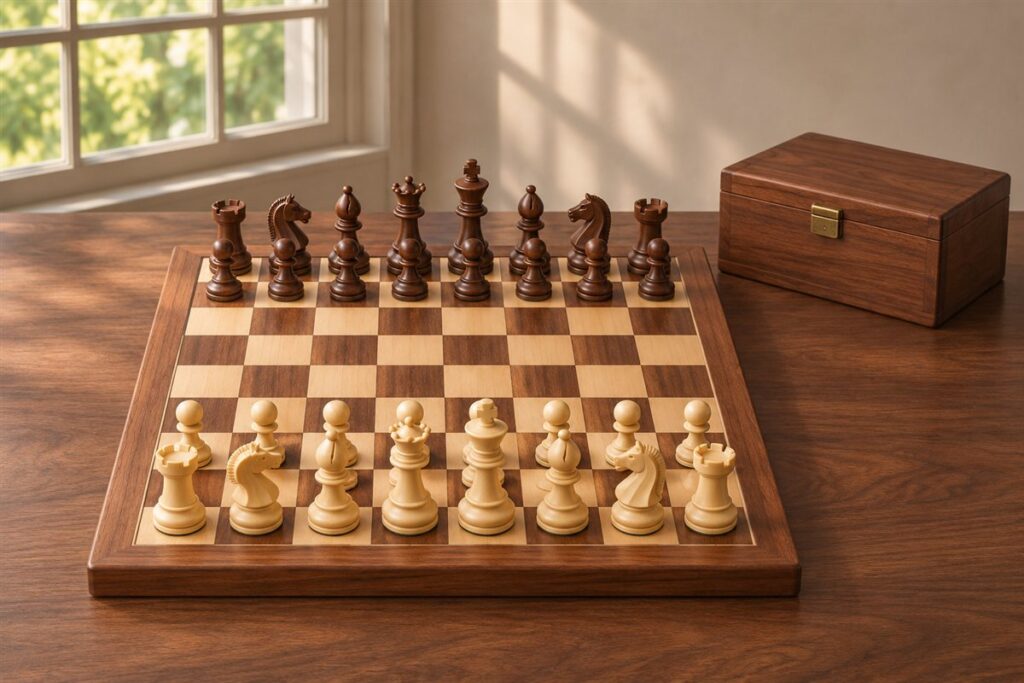
The Bauhaus chess design strips pieces down to simple geometric forms: cubes, cylinders and spheres, with each piece’s role shown by its shape. It is a classic of modern design, and many people buy a set as a design object as much as a game. Clear rules for shape help, but players still need to read pieces quickly.
We have not used these products ourselves, so this guide gives no claims about results. It shows how to choose from the details makers list. Use the factors below to compare listings, and decide whether you value the look, the play or both. Think about who will use the set. Experienced players may enjoy the challenge of reading abstract forms, while newer players may prefer a set with clearer hints in each shape. Matching the design to the people at the table helps the set get used instead of only admired.
As an Amazon Associate we earn from qualifying purchases. Links on this site are affiliate links, and they do not change the information we give.
What to Look For
| Factor | Why it matters | What to check |
|---|---|---|
| Piece shapes | The geometry is the point of the design | Check that shapes are clean and each piece type is easy to tell apart |
| Material | Material decides weight and feel | Compare wood, metal, plastic or glass as the maker describes |
| Piece contrast | Both sides must be easy to tell apart | Look for strongly different colors or finishes for each side |
| Board | The board completes the look | Check size, square contrast and whether it is wood or another material |
| Weighting | Stable pieces are more comfortable to play | Look for weighted bases and soft felt underneath |
| Scale | Pieces should fit the squares | Compare piece base size with square size |
| Storage | Clean lines suit a neat box | Check for a case or tray that holds each piece in place |
Setup and Care Tips
- Wipe flat surfaces with a soft dry cloth to avoid marks.
- Keep the set out of direct sun to protect colors and finish.
- Handle pieces by their bases so fingerprints do not build up on the tops.
- Teach new players the shape key so pieces are quickly recognized.
- Keep pieces in a fitted tray rather than loose.
Mistakes to Avoid
- Choosing very abstract shapes without checking a guide to the pieces.
- Overlooking contrast between the two sides.
- Buying a board that is far larger than your table.
- Ignoring piece weight when the set will be used often.
- Assuming all sets with the name follow the same shape rules.
FAQ
Is a Bauhaus set hard to play with?
The shapes take a short while to learn, since the design uses form to hint at each piece’s movement. Most players adapt after a few games.
Are these sets for display only?
They suit both. Weighted pieces and a good board make play comfortable, while the clean look works well on a shelf.
Questions to Ask Before You Buy
- Will this set be played regularly, or mainly displayed on a shelf or table?
- Can my guests and I tell each piece apart quickly at a glance?
- What material do I prefer: wood, metal, glass or another finish?
- Is the board size comfortable for the pieces, with enough space between squares?
- Do the pieces have felt or soft bases to protect the board?
- Is there a box or case so the set stays clean when put away?
Matching It to Your Room and Players
A set built on geometric forms is as much an object as a game. Think about the table where it will sit and the colours around it. A natural wood set may blend with warm interiors, while a monochrome set can add contrast to a modern room.
If children or beginners will play, check how clear the piece shapes are. Abstract designs can slow recognition at first, so some players like to keep a traditional set for teaching and use the design set for experienced company.
Feature Trade-offs
| Choice | Appeal | Consideration |
|---|---|---|
| Weighted pieces | Feel solid and stay put | Heavier to move and store |
| Light wood | Warm, natural look | Shows marks over time |
| Folding board | Easy storage | Visible centre seam |
| Fixed display board | Clean appearance | Needs permanent space |
Storage Notes
Keep the pieces and board away from direct sunlight, which can fade colours and dry out wood. Store the pieces in their own box or a lined drawer so they do not rub against each other. Wipe lightly with a soft dry cloth, and follow the maker’s care guidance for any finish. If the board folds, avoid stacking heavy items on top, since a lasting bend can leave the squares uneven and the set harder to enjoy.
Who Should Skip It
If you play fast casual games in noisy places, a rugged, familiar set may serve you better. Competitive players who need pieces that match tournament conventions should check the rules of their club before choosing an unusual design. People who want a very low-maintenance set may prefer simple plastic pieces.
When in doubt, ask the seller for exact dimensions and materials, and follow the maker’s manual and any care instructions for cleaning.
The Short Version
Choose a Bauhaus set for clear geometry, easy contrast between sides, weighted pieces and a board that suits your table. Make sure you are comfortable reading the shapes.