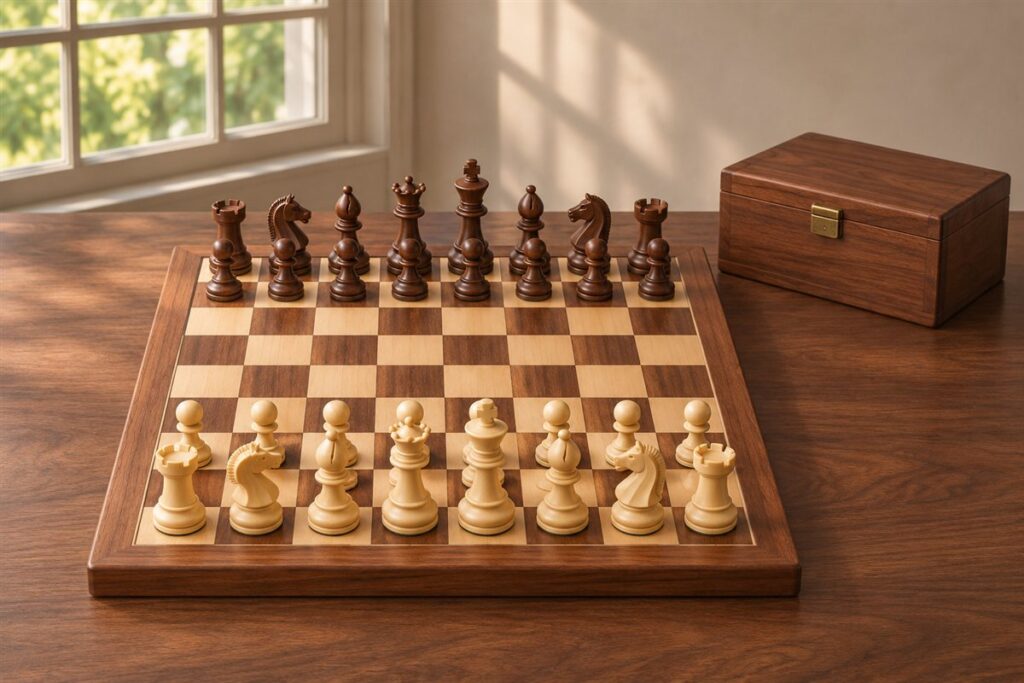
A chess briefcase is a carry case that holds a board and pieces together, often with a handle and a latch. Some include the pieces, and others are an empty case you fill yourself.
Check what is included and how the pieces are held. We have not used these products ourselves; we compare listing information, which is the makers’ own description of size and materials.
As an Amazon Associate we earn from qualifying purchases. Links on this site are affiliate links, and they do not change the information we give.
What to Look For
| Factor | Why it matters | What to check |
|---|---|---|
| Included items | Some cases come with pieces and others do not | Confirm the exact contents |
| Size | The case must fit your pieces and your bag | Check inside and outside dimensions |
| Material | Wood, leatherette and plastic feel different | Read the listed material and finish |
| Piece storage | Loose pieces can scratch each other | Look for slots, trays or lined compartments |
| Closure | Latches and clasps keep it shut | See what type of closure is used |
| Handle | You will carry the case often | Check the grip and its fixing |
| Board | A built-in board saves bringing one | See whether the board is printed or inlaid |
Setup and Care Tips
- Place pieces in their slots with the larger ones at the back.
- Close the latch gently and check it shut before lifting.
- Wipe the outside with a soft cloth.
- Keep it away from heat, sun and damp.
- Remove pieces from time to time to check the lining.
Mistakes to Avoid
- Not checking if pieces are included.
- Choosing a case that is too small for tall pieces.
- Carrying it by a weak handle.
- Mixing different piece sizes in one case.
- Leaving it in a hot car.
Briefcase Formats Explained
A chess briefcase is a carrying case built to hold a board, pieces or both, and the format you choose shapes how you will use it. Some briefcases open into a playable board, with the pieces stored in compartments or foam-lined trays. Others are simple storage cases with space for a separate roll-up or folding board and a set of pieces. A third type is a slim carrier for a board and a small bag of pieces, which suits clubs and tournaments where you carry only the essentials.
Think through how you plan to travel. If you commute by train or bicycle, a slimmer case with a shoulder strap or backpack-style handle may be more practical than a rigid, boxy one. If you drive to events, a sturdier, structured case offers more protection and room. Decide whether you want the case to double as a board, or whether you prefer to keep a dedicated board separate. A briefcase that opens into a board saves space but ties the playing surface to the case’s design, so check how flat and stable the playing area is. Always confirm the interior dimensions against the pieces you own.
If the case will also hold a clock, notebook or tournament paperwork, favor a layout with separate pockets rather than one open cavity, so loose items do not shift into the pieces and cause scratches while you walk or ride.
Fit Checks for Your Pieces
The most common mistake is buying a case that does not hold your pieces. Chess pieces vary a lot in height, base width and weight, so measure before buying. Start with the king, because it is the tallest piece, then check the interior depth of the case or tray against it. Check that the compartments are wide enough for the bases, and that the pieces do not have to be forced into place.
- Measure the king height and base diameter, and note the number of pieces in your set.
- Check whether slots are fixed-size, which may not suit unusual pieces, or adjustable.
- Look at whether the case has room for extras such as a clock, score sheets or a notation pad.
- Weighted pieces need sturdier slots or foam so they do not shift or damage the lining.
When you buy a case and pieces together, confirm the listing says they are designed to fit. If it does not say so, assume you should check the dimensions yourself or contact the seller. A snug but not tight fit protects pieces during travel without causing wear.
Remember that sets vary in how many extra queens they include. Count every piece before measuring slots, and check whether a thick lining reduces the usable interior size compared with the outside dimensions given in the listing.
Materials, Padding and Protection
The outer material decides how well a briefcase survives knocks, rain and daily travel. Hard-shell cases protect best against crushing, while soft fabric cases are lighter and often have useful outside pockets. Faux leather or leather-look finishes look professional, but their wear resistance varies, so check the listing for materials and stitching. Wooden cases have an attractive look but can be heavier, and they may be vulnerable to moisture.
Inside, padding and linings matter. Foam, felt or soft fabric prevents scratches and chipping, especially on wood or painted pieces. Make sure the lining is secure and does not shed fibers. Latches, zippers and hinges deserve a close look, since a weak closure can open in a bag or on a crowded train. Metal hardware generally lasts longer than thin plastic, but check each product’s description.
- Handles should feel comfortable and be firmly attached.
- Corner protection helps cases survive drops.
- A water-resistant exterior helps in bad weather, though it rarely makes the case fully waterproof.
Choose the level of protection that matches your journey, and do not pay for armor you do not need.
Think about how the case is closed under stress. A latch that clicks firmly shut is more reassuring than a loose snap, and a zipper with a metal pull usually outlasts a thin plastic one. Test both the opening and closing action several times when the case arrives.
Portability and Everyday Carry
A briefcase you dislike carrying will stay at home. Weight and shape matter as much as the number of features. Check the case’s overall dimensions against your usual bag, locker or car seat. If you plan to fly with it, review the airline’s carry-on and checked-bag rules, since sizes and handling vary. Fragile pieces are often better in a carry-on than in checked luggage.
Think about handles and straps. A padded handle is more comfortable for longer walks, and a detachable shoulder strap spreads the weight. Backpack-style cases free your hands, which is helpful for cyclists and commuters. Wheels are rare, but may be useful if you carry a lot of equipment.
- Keep the case balanced so one side does not sag or tip.
- Look for pockets that keep small items such as pens and score sheets organized.
- Pack heavy items low and snug so they do not shift.
A lighter case is nice, but not if it sacrifices the protection your pieces need. Balance comfort, capacity and safety based on your trip.
Try carrying it loaded with your actual set for a few minutes before committing to it. Handle comfort, balance and noise from loose parts are easy to miss on a product page but quickly become obvious in daily use.
Care, Security and Knowing When to Replace It
With sensible care, a chess briefcase can last for years. Wipe the exterior with a soft, slightly damp cloth, and follow the manufacturer’s advice for leather, faux leather or fabric. Let the case dry fully before closing it, because trapped moisture can damage pieces and cause odors. Vacuum or shake out dust from the lining, and check for loose felt or foam.
Store the case in a cool, dry place away from direct sun, radiators or damp basements. Do not leave it in a hot car, which can warp materials and soften glue. If the case has a lock, keep the key separate and consider whether you need it. Locks on small cases are generally for keeping the lid closed rather than for strong security.
- Check hinges and latches now and then, and tighten loose screws.
- Replace worn foam or lining if the manufacturer offers parts, or add a thin felt layer.
- Pack pieces gently, rather than forcing them into slots.
It is time to replace the case when the closure no longer holds, the frame is cracked, the lining sheds, or pieces rattle and scratch. A case that no longer protects its contents is not worth keeping, however attractive it still looks.
FAQ
Do chess briefcases include pieces?
Some do and some are empty cases. Read the listing closely to see what is in the box.
Will any pieces fit in any case?
Not always. Piece height and base width must match the interior, so check the measurements.
Can a chess briefcase be used as a playing board?
Some can, but not all. Check the listing to see whether the case opens into a board, and confirm that the playing surface is flat and the squares suit your pieces.
Should I choose fixed slots or an open interior?
Fixed slots keep each piece in place and prevent chipping, but only suit pieces of a matching size. An open or adjustable interior is more forgiving if you own unusual pieces or may change sets later.
Is a hard case better than a soft case?
A hard case protects better against crushing, while a soft case is lighter and often has more outside pockets. Choose based on how you travel and how fragile your pieces are.
Can I take a chess briefcase on a plane?
Many people do, but rules vary by airline and size. Check carry-on dimensions and consider carrying the case rather than checking it to protect the pieces.
How do I stop pieces from rattling inside?
Use a case with fitted foam or slots, or add a layer of soft felt or tissue. Avoid overfilling, which can cause damage.
Will a briefcase protect a chess clock too?
Only if it has the space. Measure your clock and look for a case with a dedicated compartment or extra room.
How do I clean a leather-look briefcase?
Wipe with a soft damp cloth and dry it well. Avoid harsh cleaners, and check the care notes in the listing or manual.
Questions to Ask Before You Buy
- Do I want the case to double as a board when it is opened?
- Will I carry it by hand, over the shoulder, or in a larger bag?
- How tall are my pieces compared with the inner depth?
- Is there space for a clock, score pad and pen?
- Does the closure feel dependable after repeated use?
- How much weight can I comfortably carry on my usual route?
Matching It to Your Routine
Tournament players tend to value quick setup. A case that opens flat into a playing surface, with pieces held in place by slots or foam, saves time before a round. Casual players who meet at a cafe may care more about a slim shape that fits in a daily bag.
Teachers and coaches often carry several sets. For them, stackable cases and clear labeling matter more than finish. A tough exterior and easy-clean interior will keep a classroom set in good order through a busy term.
Compatibility Checks
Compare piece height and base diameter with the case’s pocket sizes. Sets with tall kings or wide knights may need deeper pockets than a standard layout offers. If the case has a fixed board, check that the square size suits your pieces, because oversized bases can crowd neighboring squares.
Who Should Skip It
If you rarely leave home to play, a briefcase may add bulk you will not use. A simple box or drawer can keep a set tidy at home. Anyone who needs a fully flexible board size may prefer a roll-up mat with a separate pouch.
Feature Trade-offs
| Feature | Benefit | Trade-off |
|---|---|---|
| Foam slots | Pieces stay in place | Fits only matching sets |
| Open pockets | Fits more set sizes | Pieces can shift |
| Shoulder strap | Hands stay free | Adds bulk |
| Hard shell | Protects contents | Heavier to carry |
Think about which trade-off matters most on the journey you make most often. A short walk to a club room can tolerate extra weight, while a long commute by train may call for a slimmer carrier. If you share the case with family members or students, also look at how easy the latches are for smaller hands, and whether the handle stays comfortable when the case is full.
The Short Version
Decide whether you need pieces included, confirm the interior size, and look at storage and closure. A well-fitted case keeps pieces tidy on the move.