A hacksaw is a hand saw with a thin blade held under tension in a frame. It is the usual tool for cutting pipe, bolts, rod and angle by hand. The main choices are the blade length, how stiff the frame is, whether the blade can turn to 45 or 90 degrees and how easy it is to change a blade.
The six saws below range from a compact 10 inch frame to 12 inch high-tension frames, one with a jab saw conversion. Sizes, tension figures and materials come from each listing page and are the makers’ own claims. We have not used these saws ourselves. Where a listing disagrees with itself, such as a power or battery line on a hand tool, we say so.
As an Amazon Associate we earn from qualifying purchases. Links below are affiliate links, and they do not change the product information we give.
What to Look For
| Feature | Why it matters |
|---|---|
| Blade length | 12 inch blades are the common size; 10 inch frames fit tighter spaces |
| Frame tension | A stiffer frame holds the blade straighter during the cut |
| Blade angle | A 45 degree or flush position helps near a wall |
| Blade change | Tool-free release saves time when blades wear |
| Spare blade storage | Blades kept in the frame stay with the saw |
In this guide
Specs at a Glance
| Saw | Blade | Listed tension | Notes |
|---|---|---|---|
| Klein 31430 | 12 in, 24 TPI bi-metal | Up to 30,000 PSI | Converts to jab saw with 6 in blade; 1.5 lb |
| CRAFTSMAN CMHT20138 | 12 in fixed | Up to 225 lb | 4.375 in cutting depth; lifetime warranty |
| Lenox HT50 | 12 in, 24 TPI | Up to 50,000 PSI | I-beam frame; stores 5 spare blades; 1.9 lb |
| Bahco 325 | 12 in, 24 TPI bi-metal | Described as extremely high | 55 degree flush mount; spring-loaded release |
| WORKPRO 12 in | 12 in, 3 blades | Adjustable knob | Aluminum frame; 45 or 90 degree mount; 1.3 lb |
| Milwaukee 48-22-0012 | 10 in | Not listed | Compact; tool-free blade change; 227 g |
The 6 Best Hacksaws
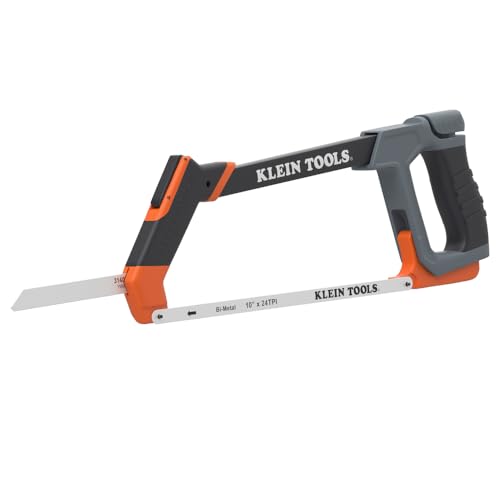
Top pickBest for pipe and conduit work plus occasional jab cuts
1. Klein Tools 31430 High Tension Hacksaw with Jab Saw
A 12 inch hacksaw with a top-mounted tension knob that the maker says applies up to 30,000 PSI. It ships with a 12 inch, 24 TPI bi-metal hacksaw blade and a 6 inch, 24 TPI blade, and the frame converts to a jab saw without tools. The blade can be mounted at 45 or 90 degrees. The specs table gives plastic as the surface while the bullets say metal, PVC and wood.
Suits: pipe and conduit work plus occasional jab cuts. Strengths: two blades and a tool-free conversion. Weaknesses: the surface line in the table disagrees with the bullets. Skip it if you want a small saw for tight spots.

View Klein Tools 31430 High Tension Hacksaw with Heavy-Duty Frame and Jab Saw on Amazon
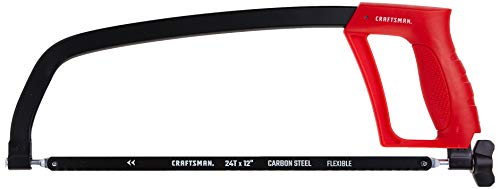
Best for general shop cutting
2. CRAFTSMAN 12-Inch Hacksaw (CMHT20138)
A solid metal frame hacksaw with a fixed 12 inch blade length, a 4.375 inch cutting depth and tension listed up to 225 pounds. The maker lists 90 and 180 degree blade angles for flush cuts, a large tension knob and a full-grip handle. The table shows 6 teeth, which looks like a data entry error for a blade of this type, so check the blade that arrives.
Suits: general shop cutting. Strengths: deep cutting depth and a lifetime warranty line. Weaknesses: the tooth count in the listing is unclear. Skip it if you want spare blade storage in the frame.
View CRAFTSMAN Hand Saw, 12-Inch Hacksaw (CMHT20138) on Amazon

Best for a shop saw that keeps its own spares
3. Lenox Tools HT50 High-Tension Hacksaw
An I-beam frame that the maker says tensions the blade up to 50,000 PSI. The rubberized handle, the 12 inch, 24 TPI blade and storage for up to five extra 12 inch blades inside the I-beam are all listed. The frame accepts Lenox reciprocating saw blades so it can act as a jab saw. The weight is listed at 1.9 pounds.
Suits: a shop saw that keeps its own spares. Strengths: the highest tension figure in this group. Weaknesses: heavier than the compact frames. Skip it if you need a small frame for confined work.


Best for frequent cutting with quick blade swaps
4. Bahco 325 Professional Hacksaw, 12 in
A 300 mm frame with an ergonomic handle, a spring-loaded single-touch blade release and a 55 degree alternative blade mount for flush cutting. It comes with a 12 inch bi-metal blade, 24 TPI. The listing also mentions a Silver Award from the Industrial Designers Society of America. The table lists an AA battery and a round blade shape, which do not fit a hand hacksaw, so treat those lines as errors.
Suits: frequent cutting with quick blade swaps. Strengths: fast release and a flush angle. Weaknesses: the listing data contains clear errors. Skip it if you want a jab saw option.

View Bahco 325 Professional Hacksaw with Ergo Handle, 300mm (12in), Silver on Amazon

Best for a home toolbox with mixed materials
5. WORKPRO 12-inch Hacksaw with Extra Blades
An aluminum alloy frame with a thermoplastic rubber handle, a tension knob and a blade that sets at 45 or 90 degrees. The package lists two 24 tooth bi-metal blades for metal and plastic plus one 18 tooth blade for wood. The table shows 42 teeth, which does not match the bullets. The weight is listed at 1.3 pounds.
Suits: a home toolbox with mixed materials. Strengths: three blades and a light frame. Weaknesses: the tooth count differs between sections. Skip it if you need the highest tension figure.


Best for tight spaces and quick small cuts
6. Milwaukee 48-22-0012 Compact Hack Saw, 10 in
A compact hand saw with a 10 inch blade, a rubber over-mold grip, tool-free blade changes and an adjustable blade length for flush cutting. The maker says it changes blades up to 10 times faster. The listing shows 18 volts and an AAAA battery, which cannot apply to a hand saw, so we read those as errors. The weight is 227 grams.
Suits: tight spaces and quick small cuts. Strengths: light and compact with tool-free changes. Weaknesses: a 10 inch blade and no tension figure. Skip it if you cut thick stock all day.

Care and Setup
- Fit the blade with the teeth pointing away from the handle.
- Tighten the tension knob as the maker describes.
- Clamp the work so it does not move during the cut.
- Wipe the frame and blade dry before storing.
Mistakes to Avoid
- Trusting a table line that contradicts the bullets.
- Running a coarse blade on thin tube.
- Leaving the blade slack.
- Buying a 10 inch frame when you need a long stroke.
Choosing Teeth per Inch for the Material
The number of teeth per inch, or TPI, is the single most useful blade spec when you pick a hacksaw blade. The rule of thumb is to keep at least a few teeth in contact with the work at all times. Thick material can use coarser blades with fewer teeth, which clear chips well and cut fast. Thin-walled tube, sheet and angle need finer teeth so the blade does not snag, grab and strip teeth.
A blade in the middle of the range, such as the 24 TPI blades in several of the picks above, is a popular general choice for mixed metals and pipe. Coarser blades suit soft metals and plastics, where fine teeth can clog with swarf. Finer blades suit thin steel and conduit, where a coarse tooth would catch the edge. If the wall you are cutting is thinner than the spacing between teeth, step up to a finer blade.
Blade material also matters. Bi-metal blades combine a hard cutting edge with a flexible spine, which resists breaking and stays sharp longer on harder metals. Simpler carbon steel blades cost less and suit softer material and occasional use, but they dull and snap more easily. Check the listing for the blade type and be aware that some tables contain errors, as the post notes for a few models.
- Use a coarser blade for thick, soft stock.
- Use a finer blade for thin tube, sheet and hard alloys.
- Keep two or three teeth on the work at all times.
Cutting Technique for Straight, Clean Cuts
Good technique matters more than muscle. Start with the work held firmly, then mark the line and make a small notch with a file or a few light strokes at a shallow angle. This guide notch keeps the blade from wandering. Hold the saw with both hands, one on the handle and one steadying the front of the frame, and keep your strokes long and even.
Hacksaw blades cut on the push stroke, so apply gentle forward pressure on the push and ease off on the return to avoid dulling the teeth. Use the full length of the blade rather than a short chopping motion, which wears a patch of the blade and shortens its life. A steady pace, not a fast one, keeps the blade cooler. Too much downward pressure will bend the blade and cause a crooked cut, and too little will make the teeth skid and glaze.
Lubricant helps on thicker or harder metals. A few drops of cutting oil reduce heat and friction and extend blade life, but do not use it on plastic unless the maker allows it. Slow down near the end of the cut and support the offcut so it does not fall and tear the last section, leaving a burr.
- Start with a small notch and a shallow angle.
- Let the blade do the work with light, steady pressure.
- Deburr the cut edge with a file afterward.
Workholding and Staying Safe
A hacksaw is simple, but the way you hold the work can make a poor or dangerous cut. Clamp the material in a vise, close to the cut line to reduce vibration, and support long pieces so they do not flex or droop. Pipe and round bar tend to roll, so use a vise with a pipe or V jaw, or add a wooden block under soft jaws to protect finished surfaces. Never hold small parts in your hand while you cut.
Wear eye protection, because broken blades and flying chips are the main hazards. Wear gloves only if they fit well and do not catch on the frame. Check that the blade is straight in the frame, with the teeth pointing away from the handle, and that the tension is adequate. A slack blade bows and wanders and is likely to bind and break.
When a blade breaks, do not try to finish the cut with a new blade in the same kerf, because the new blade is thicker than the worn one and can jam. Start a fresh cut, or turn the work and begin on the opposite side. Dispose of broken blades safely, in a closed container, and keep spares away from children. Keep your free hand clear of the line of the blade and watch for the saw jumping when the blade grabs at the start of the cut.
- Clamp the work firmly and close to the cut.
- Wear eye protection every time.
- Replace a bent or slack blade before you continue.
Frame Design and Blade Changes
Frame design decides how stiff the saw is and how quickly you can swap blades. A rigid, high-tension frame holds the blade straight, which gives straighter cuts with less effort. Adjustable frames let you set tension to suit the blade and material. Lightweight aluminum frames are pleasant for light work but flex more, while heavier steel or I-beam designs resist twisting.
Check how the blade attaches. Some saws use pins in slots and a tension knob or lever, while others offer tool-free release systems that speed changes. If you swap blades often, a quick release saves time, but check that it holds the blade securely under tension. Look for a design that lets the blade turn so the cut can run flush against a surface or in line with the frame, which helps near walls and in tight corners.
Handles matter on long jobs. A pistol grip with a guard for your knuckles suits cutting in the vise, while an open-style handle suits quick work. A soft grip reduces vibration and blisters, and a handle that is the right size for your hand lets you apply steady pressure. Frame depth, the distance from the blade to the back of the frame, limits how large a piece you can cut, so check the listed cutting depth if you work with thick stock.
- Check whether the blade can be mounted in more than one position.
- Look for tension adjustment you can use with one hand.
- Check cutting depth against your largest work.
When to Use a Hacksaw and When Not To
A hacksaw is the right tool for quiet, controlled cutting of metal and plastic by hand. It is good for cutting bolts, threaded rod, small pipe, conduit and angle in places where power is unavailable, or where sparks or noise are unwelcome. It is inexpensive, portable and easy to control. It is less suited to long, repetitive cuts, very hard materials or thick sections, where a power saw or another cutting tool saves time and effort.
Know the limits of your blade. Hardened steel can quickly ruin a general-purpose blade. Plastic pipe can melt if you cut too fast, and thin sheet may deform. For wood, a dedicated wood saw is a better choice than a metal blade. A jab saw or compact frame helps when you need to start a cut in the middle of a panel or reach into tight spots, but these are slower for long cuts.
Budget tiers are mainly about frame stiffness, blade quality and comfort. Lower-priced saws work well for occasional home jobs, middle-tier saws add better tension systems and handles, and higher-tier saws offer rigid frames and reliable blade release for daily trade work. Buy spare blades in the TPI you use most, and replace the blade when cutting slows down or the cut starts to wander.
- Use a hacksaw for small, controlled metal and plastic cuts.
- Choose a power tool for large volumes of work.
- Keep spare blades of the same length and TPI.
Which hacksaw should you buy?
The best hacksaw is the one whose frame and blade options match the cuts you make most often. Use the picks above as a map from need to model, then confirm the details on each listing.
- Pipe and conduit with an occasional jab cut: the Klein Tools 31430 includes a second shorter blade and converts to a jab saw.
- A shop saw that carries its own spare blades: the Lenox Tools HT50 stores extra blades in the frame and lists the highest tension figure of the group.
- Deep cuts in larger stock: the CRAFTSMAN CMHT20138 lists a generous cutting depth.
- Fast blade swaps and flush cuts near a wall: the Bahco 325 offers a spring-loaded release and an alternative blade mount.
- A mixed home toolbox: the WORKPRO 12-inch comes with three blades, including one for wood, and a lighter frame.
- Tight spaces and quick small cuts: the Milwaukee 48-22-0012 is the compact 10 inch option with tool-free changes.
If you only want one hacksaw and cut a bit of everything, a 12 inch frame with a tension knob and a spare blade is the safer all-round choice.
What to check before buying a hacksaw, and who should skip one
Before you buy a hacksaw, check the blade length, how the blade is tensioned and what comes in the box. The listing tables in this group contain a few obvious errors, so read the bullets and the description together.
- Blade length and whether replacement blades in that length are easy to find.
- Tooth count of the included blade against the material you cut.
- Whether the blade can be turned for flush or angled cuts.
- How the blade is released and whether you need a tool.
- Warranty or return wording on the current listing.
There are honest trade-offs. A high-tension frame is stiffer but usually heavier. A compact frame fits tight spots but limits stroke length and cutting depth. A bundle with several blades is convenient, but you may only ever use one of them.
You can skip a hacksaw if you cut thick metal all day, where a powered saw saves effort, or if your work is mostly wood, where a wood saw does a cleaner job. You can also skip it if you already own a frame in good condition, since a fresh blade often fixes a poor saw.
Compare the picks above, check the current listing for size and what is included, then choose the one that fits how you will use it.
The Six Hacksaws in Practice: Strengths, Limits and Best Jobs
A hacksaw earns its place by cutting metal cleanly without drama: the frame holds the blade under tension, the teeth do the work, and your job is to keep the stroke straight and steady. The six saws above differ in frame design, tension, size, and the extras bundled with them, and those differences decide which one belongs in a plumber’s kit, a homeowner’s toolbox, or a metalworker’s bench. This section reviews each pick in working terms, then covers blade choice and cutting technique in the depth that actually determines your results. With cutting tools, remember the standing safety basics throughout: eye protection, a secured workpiece, and attention to where the blade will go when the cut finishes.
Klein Tools 31430 High Tension Hacksaw with Jab Saw: the two-in-one pro pick
The Klein combines a high-tension full-size frame with a jab saw function, which makes it the pick for electricians, plumbers, and remodelers whose work jumps between cutting conduit or rod and poking through drywall or paneling. High blade tension is the core virtue: a taut blade tracks straight and resists the bowing that snaps blades and wanders cuts. The limitation is that a two-in-one tool asks you to learn its conversions, and users who only ever cut metal are paying attention to a feature they will not use. If your jobs genuinely span both worlds, it consolidates two tools into one bag slot; if they do not, a dedicated frame below will feel simpler.
CRAFTSMAN 12-Inch Hacksaw (CMHT20138): the household standard
The Craftsman is the straightforward, full-size answer for a home toolbox: threaded rod for a shelf project, a stubborn bolt, PVC or metal pipe during a repair, curtain rod trimming. It suits the homeowner who cuts metal a few times a year and wants a recognizable tool that simply works. Its honest limitation is that it aims at competence rather than excellence: the frame and tension system are built for occasional use, and a tradesperson cutting all day will notice the difference in rigidity and blade-change convenience compared with the high-tension specialists here. For the duty cycle of a typical house, that is a sensible place to spend.
Lenox Tools HT50 High-Tension Hacksaw: the rigidity specialist
Lenox built its reputation on blades, and the HT50 frame exists to get the most out of them: high tension, a rigid beam, and the straight tracking that demanding cuts need. It suits users who cut tougher stock regularly, such as hardened rod, thicker angle, or repeated cuts where accuracy matters and blade life is money. The limitation is focus: this is a saw for people who already know their blade choices and stroke technique, and its advantages are wasted on someone who cuts a curtain rod once a year. If your cutting is frequent and your materials are unkind, the HT50 is the frame that respects your skill.
Bahco 325 Professional Hacksaw: the refined all-day frame
The Bahco 325 is the professional’s comfort pick: a well-balanced 12-inch frame designed for long sessions, with the ergonomics and blade handling that reduce fatigue and fumbling. It suits fabricators, maintenance technicians, and serious hobbyists who cut often enough that handle comfort and quick, confident blade changes add up over a month of work. The trade-off is that refinement costs attention rather than money alone: this is a saw for a workshop that keeps proper blades on hand and maintains its tools. A casual user will find it excellent but more saw than their projects require.
WORKPRO 12-Inch Hacksaw with Extra Blades: the ready-to-work bundle
The WORKPRO’s argument is readiness: a full-size frame bundled with extra blades, so the day a blade dulls or snaps mid-project you keep working instead of driving to a store. It suits first toolboxes, rental properties, and anyone building a kit from zero who values having consumables in the box. The limitation is the usual bundle logic: the frame is a generalist, and the included blades cover common needs rather than every specialty tooth count an experienced cutter keeps. Treat it as a strong starting point, and add specialty blades as your projects reveal what you actually cut.
Milwaukee 48-22-0012 Compact Hack Saw, 10 in: the tight-space tool
The compact Milwaukee exists for the cuts a full frame cannot reach: pipe inside a cabinet, rod in a crowded ceiling, a bolt in an engine bay. Its 10-inch format trades stroke length for access, and in tight quarters that trade is the whole point. It suits plumbers, HVAC techs, and homeowners whose cutting happens in cramped mechanical spaces. Its limitations follow from size: shorter strokes mean slower cutting on open work, and it is a companion to a full-size saw rather than a replacement for one. If most of your cuts happen in the open, buy a 12-inch frame first and add the compact when access, not power, becomes your problem.
Blade Choice: The Half of Cutting Nobody Sees
More cuts are ruined by the wrong blade than by the wrong frame. Teeth per inch should match the material thickness so that several teeth stay engaged in the work: coarse blades cut fast in thick stock but snag and chatter on thin sheet or tubing, while fine blades glide through thin material and feel painfully slow in thick bar. Keep a small assortment on hand covering the materials you actually cut, mount the blade with teeth pointing forward so it cuts on the push stroke, and tension it properly: a slack blade wanders and breaks, which is why high-tension frames exist. Replace blades earlier than feels necessary. A dull blade makes you push harder, and pushing harder is what bends cuts, snaps blades, and causes injuries when the cut suddenly gives way.
Cutting Technique for Straight, Clean Results
Setup and the first strokes
Secure the workpiece in a vise or with clamps so both hands are free and the material cannot spin or vibrate; a moving workpiece is the root cause of most broken blades. Mark your line clearly, start the cut with a few light pull strokes or a small file notch to create a guide groove, then settle into long, steady strokes that use most of the blade length. Let the teeth cut: your job is guidance and rhythm, not downward force. A comfortable pace of roughly a stroke per second with light pressure will out-cut frantic sawing every time, and it leaves a cleaner edge that needs less filing afterward.
Finishing, pipes and problem cuts
As the cut nears completion, slow down and support the piece being cut off so it does not drop and tear the last fibers of metal or pinch the blade. For pipe and tubing, cut partway through the wall, then rotate the work and continue, rather than sawing straight through both walls at once, which traps the blade. If a cut wanders, do not try to steer it back mid-stroke; stop, start a fresh groove on the line from the other side, and meet in the middle. If blades keep breaking, audit the usual suspects in order: workpiece movement, dull blade, wrong tooth count, slack tension, and excessive downward pressure. Fix them in that order and breakage usually disappears.
Safety and Care Basics
Wear eye protection, because a snapping blade and metal filings both aim for faces, and consider gloves when handling cut stock, whose edges are sharp even when the saw work is done. Keep the cutting area clear, carry the saw with the blade guarded or pointed down, and store blades in their packaging so teeth stay sharp and hands stay safe. Wipe blades dry after wet cutting, and check frame tensioning hardware occasionally so it stays smooth. None of this is exotic; it is the ordinary discipline that lets a simple tool stay safe and effective for years.
Decision Scenarios
Choose the Klein 31430 if your work mixes metal cutting with jab-saw tasks and you want one high-tension tool for both. Choose the Craftsman if you need a dependable household saw for occasional cuts. Choose the Lenox HT50 if you cut tough stock often and want maximum rigidity and blade performance. Choose the Bahco 325 if you cut all day and ergonomics decide your tools. Choose the WORKPRO if you are building a kit and want spare blades from day one. Choose the Milwaukee compact if your cuts live in tight spaces, ideally alongside a full-size frame. Whatever you pick, budget as much attention for blades as for the saw itself, because the frame guides the cut but the blade makes it.
Extended Buying Criteria: Frame, Tension and Blade Changes
Three practical qualities decide whether a hacksaw is a pleasure or a chore across years of use. The first is how the frame achieves tension: high-tension designs keep the blade drum-tight, which is what prevents the bowing and wandering that ruin cuts and snap blades, so if you cut anything beyond the occasional rod, prioritize tension over almost every other feature. The second is blade-change mechanics: you will change blades often, sometimes mid-job with dirty hands, so a tensioning knob you can grip and a mounting system that cannot be assembled backwards are worth real attention. The third is handle position and grip: a handle that lets your hand stay in line with the blade encourages straight strokes, while an awkward grip quietly bends every cut. Storage for spare blades inside the frame is a small feature with outsized value, because the blade you need is the one already with the saw.
Also consider the ecosystem you are buying into. Standard 12-inch blades are available everywhere in every tooth count, which is a genuine advantage of the full-size frames here; the 10-inch compact format trades some of that universality for access. If your cutting spans both open and confined work, the two-saw pattern of a full-size frame plus the Milwaukee compact mirrors how professionals equip themselves, and the total coverage costs less than struggling with one wrong-sized tool for years. Buy the full-size saw first unless your work is exclusively in tight spaces, because stroke length and blade choice dominate everyday results.
Project Walkthroughs: Hacksaw Work Done Right
Cutting threaded rod and bolts
Thread a nut onto the rod before you cut, positioned so the cut leaves it on the keeper side; after cutting, backing the nut off cleans and restores the thread at the cut end, saving you a filing session. Clamp the rod close to the cut line so it cannot vibrate, use a mid-range tooth count, and finish with a light file pass to remove the burr. For a bolt that must come out of an assembly, cut the head or the shank at the most accessible point rather than fighting corroded threads, and protect surrounding surfaces from the blade’s back stroke with a piece of scrap or tape.
Pipe, conduit and tubing
Mark the full circumference with a wrap of tape as a visual guide, then cut through the wall in stages, rotating the work so the blade always works on a fresh section of wall rather than sawing through both walls at once. This rotation method is the difference between a square, clean pipe end and a spiraled mess, and it matters most on thin-wall conduit and plastic pipe where the blade wants to wander. Deburr inside and out afterward: internal burrs choke flow and snag wires in conduit, and a few strokes with a file or reaming tool finish the job the saw started.
Stuck hardware and demolition cuts
Demolition cutting values access and disposability over elegance: use the compact saw or a jab-capable frame where studs and panels crowd the work, expect blades to dull quickly on dirty, nail-embedded material, and treat blades as consumables on such jobs. Cut nails flush by flexing the blade technique only with blades meant for it, and keep your free hand well clear of the cut line, because demolition material shifts without warning. Eye protection stops being optional here; demolition throws grit, and a blade snapping against a hidden nail is a routine event, not bad luck.
Mistakes That Break Blades and Ruin Cuts
Forcing the saw is the master mistake from which the others follow: downward pressure beyond what the teeth need bends the blade’s path, overheats the cut, and snaps blades at the mounting holes. Twisting the frame mid-stroke to correct a wandering cut kinks the blade and guarantees the next break. Running a coarse blade on thin material snags a tooth and tears the work, while running a fine blade on thick stock clogs the gullets and turns cutting into rubbing. Leaving a workpiece unclamped so it chatters is the quiet blade-killer of home workshops. Every one of these is a habit, not an equipment failure, and the technique sections above exist precisely to replace them: secure the work, match the teeth, tension the blade, and let long, light strokes do what force cannot.
Blade Inventory: A Small Stock That Covers Real Work
Keep three blade types on hand and you will cover nearly everything a home or trade user meets: a coarse option for thick, soft stock where speed matters, a medium general-purpose blade for rod, bolts, and bar, and a fine blade for thin wall, sheet, and clean finishes. Buy blades in small multi-packs, store them in their sleeves so the teeth stay keen, and replace at the first sign of a missing tooth or a cut that starts demanding pressure. When a project introduces a new material, add the appropriate blade to the stock rather than improvising with the wrong one. The frames in this lineup are long-lived tools; the blades are the consumable heart of the system, and treating them that way is what makes every frame here perform at its best.
Cutting Different Metals: What Changes and What Does Not
A hacksaw cuts many metals, but each asks a small adjustment. Mild steel is the baseline: a medium blade, steady strokes, and no lubricant required for short cuts. Stainless steel work-hardens, which means hesitant, rubbing strokes make it harder as you go; commit to firm, deliberate strokes with a sharp blade and steady pressure so the teeth keep biting rather than skating. Aluminum is soft and loads the teeth with chips, so a coarser blade and an occasional pause to clear the gullets keep the cut moving, and the light metal rewards a gentle touch at the finish so the offcut does not tear. Brass and copper cut willingly and are the friendliest practice materials for a beginner learning stroke rhythm. Hardened steel, such as quality bolts and shafts, is the boundary case: a standard blade may skate without biting, and the correct responses are a fresh, appropriate blade and patience, or a different cutting method entirely if the blade makes no progress, because forcing a skating blade only polishes the surface and dulls the teeth.
Plastic pipe deserves its own note because so many household cuts are plastic rather than metal. A fine-to-medium blade, light pressure, and the rotation method described earlier produce square ends without melting or cracking the pipe, and the burr inside the pipe must be removed before joining so fittings seat fully. In every material, the constants hold: secure the work, match the teeth to the thickness, tension the blade, and let the stroke do the work. Material knowledge adjusts the details; it never replaces the fundamentals, and a user with sound fundamentals will get a good cut from any frame in this lineup while a user without them will struggle with the best frame made.
A Practice Session That Builds Skill Fast
If you are new to hacksaw work, one deliberate practice session on scrap will teach more than a season of project pressure. Take a piece of scrap rod or pipe, mark ten lines an equal distance apart, and cut each one with full attention to setup: clamp position, blade choice, starting notch, stroke length, and pace. Measure your drift on each cut and watch it shrink across the ten, because it will, quickly, once your hands learn that guidance beats force. Finish each cut by filing the burr and inspecting the end for squareness, so your eye learns what a good result looks like. That small investment converts the hacksaw from the tool you avoid into the tool you trust, and it costs nothing but scrap and twenty minutes.
One Last Check Before Your First Cut
Before your first real project with a new saw, make one full cut in scrap of the same material and thickness as the project piece, from clamping to deburring, exactly as you plan to work. That rehearsal confirms the blade choice, the tension, and your stroke on material that costs nothing, and it exposes setup problems while they are still free to fix. Notice how the cut feels at the start, the middle, and the breakthrough at the end, because each phase asks something slightly different of your hands. If the rehearsal cut tracks straight and finishes cleanly, proceed with confidence; if it wanders, change one variable, blade, tension, or clamping, and rehearse once more rather than troubleshooting on the workpiece itself. Professionals test on scrap by reflex, and adopting that single habit will do more for your results than any difference between the capable frames in this lineup.
Hacksaw FAQ
Why does the blade direction matter?
Hacksaw blades cut on the push stroke, so the teeth should face away from the handle. Check the maker’s instructions for your saw.
Can a hacksaw frame take other blades?
Some can. The Lenox listing says it accepts Lenox reciprocating saw blades as a jab saw, and the Klein includes a 6 inch blade for the same use.
How tight should the blade be?
Tight enough that it does not twist or bow when pushed, but not so tight that the blade or frame is strained. Follow the maker's instructions and check the tension after the first few strokes.
Can I use a hacksaw blade to cut wood?
It is not a good choice. Hacksaw teeth are small and clog with sawdust. A wood saw cuts faster and cleaner, although a coarse blade can cut small pieces of softwood in a pinch.
How do I stop the blade from wandering?
Start with a shallow guide notch, keep the work clamped close to the cut and use steady, light pressure. Make sure the blade is tight and straight in the frame.
Why do blades break so often?
Common reasons are low tension, twisting the saw during the stroke, too much pressure or restarting in an old kerf with a new blade. Fix those habits and use a bi-metal blade for harder work.
Is 12 inch or 10 inch better?
A 12 inch blade gives a longer stroke and is the common size. A 10 inch frame suits tight spaces and light work. Choose according to where and how you cut.
Do I need cutting oil?
It helps on thicker or harder metals by reducing heat and wear. For soft metals or plastics it is often unnecessary, so follow the manual and the material's needs.
How do I know a blade is worn out?
Signs include slow cutting, the need for more pressure, a wandering cut and visibly missing or rounded teeth. Replace it rather than forcing it.
What is the best hacksaw for cutting pipe?
A 12 inch frame with firm tension and a fine or medium blade is a sensible choice for pipe. Clamp the pipe in a vise with pipe or V jaws so it cannot roll. Pick the blade tooth count to suit the wall thickness.
Can a hacksaw cut through a bolt?
Yes, most hacksaws cut bolts and threaded rod with a bi-metal blade. Clamp the bolt close to the cut, start with a small notch and use steady strokes. Hardened bolts may dull or break a general blade.
Should I buy a 10 inch or 12 inch hacksaw?
A 12 inch saw is the common all-round size, with a longer stroke. A 10 inch saw suits tight spaces and light work. Check that you can buy blades in the length you choose.
How often should I change a hacksaw blade?
Change it when cutting slows, the cut wanders or teeth look rounded or missing. There is no fixed schedule because it depends on the material and your use. Hard metals wear blades faster than soft ones.
Can I use a hacksaw on plastic pipe?
Yes, a fine-toothed blade works on plastic pipe. Cut slowly so friction does not melt the plastic, and deburr the edge afterward. Support the pipe so it does not flex.
Why does my hacksaw cut crooked?
A slack blade, uneven pressure or a poorly clamped workpiece are the usual causes. Tighten the blade, start with a guide notch and keep the work secure. Check that the blade is straight in the frame.
The Short Version
For a jab saw conversion, the Klein. For a deep cut frame, the CRAFTSMAN. For the highest listed tension and spare storage, the Lenox. For a flush mount and fast release, the Bahco. For three blades, the WORKPRO. For tight spaces, the Milwaukee compact.