Disclosure: As an Amazon Associate, UMT Smart Tool earns from qualifying purchases. This guide is built from product listings and maker specifications, not from our own hands-on testing. Prices are approximate and can change, so check the current price before you buy. Last updated: November 10, 2026.
“Best leather accent chair” sounds like one category, but the word leather on a listing can mean very different things: a full-grain aniline hide that will outlive the frame, a top-grain club chair, a chair that is real leather only where your body touches it, bonded leather made from ground-up fibers, or a polyurethane faux with no leather in it at all. Those materials age differently, feel different and sit in completely different price tiers. This guide is organized by construction and use case, and every pick states plainly what its upholstery actually is, so you can compare like with like.
In this guide
Quick Picks
The short version: six leather accent chairs we would look at first, one per role, with the upholstery type stated honestly.
| Pick | Type | Best for |
|---|---|---|
| POLY & BARK Sorrento Lounge Chair, Cognac Tan | Full-grain aniline leather lounge chair | Best overall |
| CHITA Genuine Leather Swivel Accent Chair, Saddle | Genuine leather swivel armchair | Turning toward conversation or TV |
| HULALA HOME Leather Club Chair, Navy | Top-grain leather club chair | Classic tufted club silhouette |
| Lexicon Modern Accent Chair, Brown | Leather-match armchair | Small rooms and tight corners |
| Christopher Knight Home Tafton Club Chair, Brown | Bonded leather club chair | Traditional formal rooms |
| Baxton Studio Sorrento Lounge Chair, Black | Faux leather lounge chair | Best budget |
Our Picks
1. POLY & BARK Sorrento Lounge Chair, Cognac Tan — Best Overall
The Sorrento is the only chair in this guide upholstered in full-grain, pure-aniline Italian-tanned leather, and that is why it leads the list. Full-grain is the top layer of the hide with its natural surface intact, and the aniline dye is non-pigmented, so grain, wrinkles and scuffs show through instead of being painted over — the surface develops patina rather than wearing out. Underneath, POLY & BARK uses a kiln-dried solid wood frame, a seat cushion built on a high-resiliency foam core with a feather-down and fiber topper, and loose seat and back cushions with removable zip-off covers. The base and legs are solid rubberwood in a walnut finish, and the chair measures 35 inches wide by 36.8 inches deep by 33 inches high.
The trade-offs are the honest costs of aniline leather. With no pigment coat to protect it, the surface absorbs spills faster and scratches more visibly than a finished leather, and the color varies slightly from hide to hide, so the chair that arrives may not match the photo exactly. It is also firmly in the premium tier, and assembly, while limited to the legs, is still required. Choose it if you want the real material, a generous lounge footprint, and a chair that looks better at year five than at delivery.

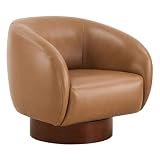
2. CHITA Genuine Leather Swivel Accent Chair, Saddle — Best Swivel Chair
CHITA hides a 360-degree swivel mechanism inside this chair’s wooden base, so it turns like a swivel chair without looking like office furniture. The upholstery is genuine leather in a warm Saddle tone, the wood components are FSC certified, and the mid-century track-arm design measures 30 inches wide by 33 inches deep by 33 inches high, with a 19-inch seat height, a 21.3-inch seat depth and a maker-rated capacity of 300 pounds. It also arrives fully assembled, which is rare at any price: unbox it and sit down.
Two honest caveats. First, CHITA says “genuine leather” without claiming top-grain or full-grain, so expect a more finished, uniform surface rather than aniline character — durable and easy to live with, but a different material from the Sorrento above. Second, the inside back height is about 15 inches, so support is mid-back at best, and any swivel chair needs a clear turning circle around its base. It suits open-plan living rooms and media rooms where you want to swing between conversation, a screen and a reading lamp.
3. HULALA HOME Leather Club Chair, Navy — Best Club Chair
If the classic club chair is the shape you want — button tufting, nailhead trim, curved arms — the HULALA HOME chair delivers it in top-grain genuine leather. The frame is solid and manufactured wood with turned solid wood legs, the back is button-tufted with foam fill, and the proportions are upright and reading-friendly: 32 inches wide by 33 inches deep by 37 inches high overall, with a 21-inch-wide, 22-inch-deep seat at 18.5 inches high. The Navy color is the other draw — a deep blue that works where the usual browns and blacks would disappear into the room.
The number to check before ordering is the weight capacity: HULALA HOME rates this chair at 250 pounds, the lowest in this guide, so it is not the pick for every household. At 37 inches, it is also the tallest chair here, which taller sitters will appreciate and small rooms may find imposing. Buy it for a study, a library corner or a living room that needs one traditional anchor piece in an unexpected color.

4. Lexicon Modern Accent Chair, Brown — Best for Small Spaces
At 26 inches wide by 31.5 inches deep by 33 inches high, the Lexicon is the compact option: a track-arm chair with tufted cushions, high-density foam and a solid wood frame on saber legs, sized for apartment corners, bedroom reading spots and desk-side perches where a 35-inch lounge chair simply will not fit. The upholstery is leather match, and Lexicon says so openly: genuine leather on the surfaces your body touches — seat, backrest and arms — with matching imitation leather on the outer sides and back, where wear is lowest.
That construction is a legitimate way to cut cost, but go in clear-eyed: the imitation panels will not age, soften or take conditioner the way the real leather sections do, and over many years the two materials can drift apart in sheen. The 26-inch width is also genuinely snug — fine for one average adult sitting upright, tight for curling up sideways or for broader frames. For a small room that still wants real leather where it counts, it is a sensible trade.

5. Christopher Knight Home Tafton Tufted Club Chair, Brown — Best Traditional Look
The Tafton is the deep-buttoned, rolled-silhouette club chair from storybooks, sized 33 inches wide by 35.25 inches deep by 33.75 inches high and rated by its maker, Great Deal Furniture, to 300 pounds. Its shape is exactly why people buy it: formal, symmetrical and instantly traditional. Now the material, stated plainly: the upholstery is bonded leather with a polyurethane finish. The manufacturer’s own product naming calls it bonded leather — ground leather fibers bonded into a sheet and coated — not a solid hide.
Bonded leather is the least durable material in this guide, and we would not rank it higher for that reason: the coating can crack and peel after a few years of daily use, especially in sun or dry heat. The sit is also firm and upright, built for conversation rather than sprawling. Choose the Tafton if a formal living room or office needs the classic club profile at a mid-range tier and the chair will see occasional rather than all-day use — with realistic expectations about lifespan.

6. Baxton Studio Sorrento Lounge Chair, Black — Best Budget
Our budget pick shares a name with our top pick and nothing else — this Sorrento is Baxton Studio’s mid-century lounge chair, and its upholstery is faux leather, a polyurethane material with no leather content, which Baxton Studio states openly. What you get for the budget tier is genuinely good design: a Danish-inspired sculptural frame in solid rubberwood with a dark walnut finish, button tufting with piped cushion edges, and a compact seat about 20.1 inches wide by 20.3 inches deep at a 17.2-inch seat height. It is made in Malaysia and arrives flat-packed for assembly.
Set expectations to the material. Polyurethane upholstery wipes clean and looks consistent, but it will never develop patina, and after years of use it typically cracks or flakes rather than softening — plan on it as a medium-term chair, not an heirloom. The seat is also on the small side for larger adults. For a rental, a first apartment, a guest room or a home office that needs the mid-century look without the leather price, it is the right tool for the job.

Best Picks by Category
- Best Overall: POLY & BARK Sorrento Lounge Chair, Cognac Tan — full-grain aniline leather, feather-topped cushions and a solid wood frame.
- Best Swivel Chair: CHITA Genuine Leather Swivel Accent Chair, Saddle — a hidden 360-degree swivel, fully assembled, rated to 300 pounds.
- Best Club Chair: HULALA HOME Leather Club Chair, Navy — top-grain leather, button tufting and nailhead trim in a stand-out color.
- Best for Small Spaces: Lexicon Modern Accent Chair, Brown — a 26-inch footprint with real leather on every contact surface.
- Best Traditional Look: Christopher Knight Home Tafton Club Chair, Brown — the classic deep-buttoned club profile in bonded leather.
- Best Budget: Baxton Studio Sorrento Lounge Chair, Black — mid-century rubberwood design in wipe-clean faux leather.
Notice the pattern: as the tier drops, what changes first is the upholstery material, not the shape. Decide which leather grade you are actually willing to pay for, then pick the silhouette.
How to Choose
Know what the leather words actually mean
Full-grain is the top of the hide with its surface intact — the strongest, longest-lived grade, and in aniline form the least processed. Top-grain is the same layer lightly sanded and finished, slightly more uniform and stain-resistant. “Genuine leather” is a broad legal term, not a grade: it means real leather, but often a lower split or corrected surface. Leather match means real leather on contact surfaces and imitation material elsewhere. Bonded leather is ground fibers in a polyurethane binder — the weakest option. Faux leather or PU is fully synthetic.
Measure the seat, not just the chair
Overall width and depth tell you whether the chair fits the room and the doorway; seat width, depth and height tell you whether it fits you. For reading and conversation, a seat height around 18 to 19 inches and a depth around 21 to 22 inches suit most adults, letting feet rest flat with the back supported. Deeper seats favor taller sitters or an ottoman. Compact chairs near 26 inches wide save real floor space but pinch broader frames, so compare the seat numbers on the listing.
Frame and cushion construction
Look for kiln-dried solid wood or a solid-and-engineered wood frame, and legs in solid wood or rubberwood rather than hollow plastic. In cushions, a high-resiliency foam core holds its shape for years; a feather or fiber topper adds surface softness without doing the structural work. Loose cushions with removable covers are easier to clean, rotate and eventually re-stuff.
Fixed legs or a swivel base
A swivel chair earns its place in open-plan rooms, media rooms and anywhere you turn between people, screens and windows — but it sweeps a circle as wide as its diagonal, so leave clearance behind and beside it. Fixed chairs are simpler, usually lighter, and can sit closer to walls and side tables.
Finish, color and how the surface ages
Aniline and semi-aniline leathers show natural marks and deepen in color with use — beautiful if you like character, stressful if you want a showroom surface. Pigmented and corrected leathers hide marks, wipe clean more easily and keep a uniform color, at the cost of some natural feel. Faux leather is the most uniform of all and the only one that will never change with age. One practical warning: model names repeat across brands — there are two unrelated “Sorrento” chairs in this very guide — so always shop by brand plus model, not by name alone.
Care and realistic lifespan
Genuine leather wants dusting or a wipe with a dry or slightly damp cloth, conditioner a few times a year, and distance from direct sun and heat vents, which dry it out. Aniline finishes need the most care because they absorb spills. Faux and bonded surfaces need only a damp cloth, but no care routine extends them past the point where their polyurethane coating starts to crack. Matched to its material, a full-grain chair is a decade-plus purchase, a leather-match or mid-tier chair a solid medium-term one, and bonded or PU a shorter-term one — buy with that horizon in mind.
Which leather accent chair should you buy?
The right leather accent chair depends on the upholstery you want and the room you have. Decide on the material first, then match the shape to this list.
- If you want the best leather and accept some patina and care, choose the POLY & BARK Sorrento Lounge Chair.
- If you turn between people and a screen, the CHITA Genuine Leather Swivel Accent Chair fits best.
- If you want a tufted, classic club shape in top-grain leather, go for the HULALA HOME Leather Club Chair.
- If floor space is tight, the Lexicon Modern Accent Chair has the smallest footprint of the six.
- If you want a formal, traditional look, the Christopher Knight Home Tafton Club Chair delivers the silhouette, in bonded leather.
- If budget and easy cleaning matter most, the Baxton Studio Sorrento Lounge Chair is the faux leather option.
Two chairs share the Sorrento name, so confirm the brand on the listing before you order.
Think about how the chair will be used day to day. A chair for reading and long evenings should be judged on seat height, depth and back support, not only on the look of the leather. A chair that mainly adds style to a corner can put appearance first. If children or pets share the room, lean toward a finish that wipes clean and hides small marks, and be realistic about how much care you will give real leather.
What to check before you buy a leather accent chair, and who should skip it
Before buying a leather accent chair, check what the upholstery really is, whether the chair fits your space, and what the seller says about returns. The material wording on the listing matters more than the photos.
- Read the exact leather wording: full-grain, top-grain, genuine, bonded or faux are different materials.
- Measure the doorway, stairwell and the spot where the chair will sit.
- Check the stated weight capacity against everyone who will use it.
- Look at seat height and depth if you want it for reading or long sits.
- Confirm whether assembly is needed and what hardware is included.
- Read the warranty and return terms on the listing, since large furniture can be costly to send back.
- Think about sun and heat vents, which dry out real leather.
Honest trade-offs: better leather costs more and needs conditioning, and aniline leather shows scratches and spills. Bonded and faux leather are easier to wipe and kinder to a budget, but they tend to crack or flake with age. Color can also look different on your screen than in your room.
Who should skip it: households with pets that scratch, or anyone who wants a spotless surface with no care, may be happier with a performance fabric. If leather still appeals, compare the picks above, check the current listing for size and what is included, then choose the one that fits how you will use it.
Frequently Asked Questions
Is “genuine leather” the best grade of leather?
No. “Genuine leather” simply certifies that the material is real leather; it says nothing about which part of the hide it came from. Full-grain and top-grain are the premium grades. When a listing only says genuine leather, assume a corrected or split surface unless the maker specifies more, and compare it against chairs that name their grade.
Will a leather accent chair crack or peel?
Full-grain and top-grain leather rarely peel; they can dry and surface-crack if never conditioned, but they mostly soften and gain patina. Peeling and flaking are the failure mode of bonded leather and polyurethane faux, whose coatings break down with age, sun and friction. If a chair will be sat in daily for years, the grade matters more than the style.
Is faux leather a bad choice for an accent chair?
Not automatically. Faux leather is the budget-friendly option, it wipes clean, shrugs off spills that would stain aniline leather, and keeps a perfectly uniform color. The trade is lifespan and feel: it stays cool and slightly plasticky to the touch and will not soften or develop character. For guest rooms, rentals and low-traffic corners, that trade is often worth it.
How do I clean and condition a leather chair?
Start with a soft dry cloth for dust, and a slightly damp cloth for marks. Use a conditioner made for upholstery leather a few times a year on genuine leather to keep it supple, and keep the chair out of constant direct sunlight and away from radiators. Skip household sprays and saddle soap unless the maker recommends them, and never condition faux or bonded surfaces — a damp wipe is all they take.
What seat height and depth are best for reading?
For most adults, a seat height of 18 to 19 inches with a depth of 21 to 22 inches lets you sit back with feet flat and a book at a comfortable angle — the CHITA and HULALA HOME picks here both sit in that range. Shorter readers may prefer a slightly lower seat or an ottoman; taller readers should look for deeper seats and taller backs.
Why does the same chair name appear from different brands?
Furniture model names are not unique trademarks across the industry, and popular names get reused — this guide alone includes a POLY & BARK Sorrento and a Baxton Studio Sorrento that share nothing but the word. Always verify the brand, the model number and the material description on the listing before ordering.
Is a leather accent chair worth it?
It can be, if you pick real leather and will look after it. Good leather softens and develops character over years, while coated or faux surfaces tend to wear out sooner. The answer depends on how long you want the chair to last.
Where should you place a leather chair in a room?
Keep it away from direct sun, radiators and heat vents, which dry and fade leather. Leave a little space between the chair and the wall for airflow. A spot near a window with curtains or blinds works well.
Do leather accent chairs stick to your skin in summer?
Leather can feel warm and slightly sticky in hot weather, especially with bare skin. Real leather breathes a little better than polyurethane faux leather. A throw or lightweight cover helps if this bothers you.
How do you remove a scratch from a leather chair?
Light scratches on real leather can often be rubbed smooth with a clean finger and a little conditioner. Deeper marks may need a repair kit made for upholstery leather. Test any product on a hidden spot first.
Can you put a leather accent chair next to a fireplace?
Keep it well back from the fire. Heat dries leather and can crack coated surfaces. Follow the care notes on the listing for safe distances.
How do you tell real leather from faux leather?
Check the listing wording first, since honest sellers state the material. Real leather has an uneven grain and usually a distinct smell, while faux leather looks uniform. Terms like bonded or leather-match mean the chair is not solid hide throughout.
Bottom Line
Buy the material first and the silhouette second. If you want the best leather in this guide, the POLY & BARK Sorrento’s full-grain aniline hide makes it our top recommendation; the CHITA swivel adds genuine leather that turns, and the HULALA HOME brings top-grain to the classic club shape. On tighter budgets or in tighter rooms, the Lexicon’s leather-match build, the Tafton’s bonded-leather traditional look and the Baxton Studio’s faux mid-century design each make an honest trade — as long as you know which one you are making. Check the seat dimensions and the current price before you order.