Disclosure: As an Amazon Associate, UMT Smart Tool earns from qualifying purchases. This guide is built from product listings and maker specifications, not from our own hands-on testing. Prices are approximate and can change, so check the current price before you buy. Last updated: November 10, 2026.
Start with an honest definition, because “Persian rug” covers two very different products. A genuine Persian rug is hand-knotted in Iran from wool, one knot at a time, and priced accordingly — authentic pieces are sold by specialist dealers and rarely appear as regular Amazon listings. Almost everything sold as a Persian rug on Amazon is a Persian-style rug: a machine-made rug, usually power-loomed polypropylene, printed or woven with the classic medallion, Herati and border patterns of Tabriz, Kashan and Heriz originals. That is not a scam as long as the listing is honest about it, and a good Persian-style rug is the practical way to get the look. This guide separates the two clearly: five machine-made picks for everyday rooms, plus one hand-tufted wool rug for buyers who want real wool and handmade construction.
In this guide
Quick Picks
The short version: six Persian and Persian-style rugs we would look at first, one per use case.
| Pick | Type | Best for |
|---|---|---|
| SAFAVIEH Lyndhurst | Power-loomed medallion rug | The classic Persian look with easy care |
| Surya Caesar | Hand-tufted wool rug | Real wool pile and handmade construction |
| BoutiqueRugs Morcott | Washable flatweave | A faded vintage look you can machine wash |
| Home Dynamix Premium Sakarya | Power-loomed traditional rug | Traditional pattern on a tight budget |
| Momeni Isabella | Polyester flatweave | Dining rooms where chairs need to slide |
| Livabliss Odelia | Machine-woven vintage rug | Warm faded color for larger rooms |
Our Picks

1. SAFAVIEH Lyndhurst (LNH338B), 8′ x 10′, Cream & Beige — Best Overall
The Lyndhurst is the safest answer for most rooms because it gets the fundamentals right. Safavieh’s listing is upfront that this is a power-loomed rug in durable polypropylene — a machine-made Persian-style design, not a hand-knotted carpet — with a traditional medallion field, floral vine detailing and a delicate ivory border. The low pile, about 0.375 inch, is dense enough to feel substantial underfoot yet short enough for doors to clear and dining chairs to move. Polypropylene does not shed, resists stains well for a patterned rug, and vacuums clean without special settings.
The trade-offs are the usual ones for synthetic fiber. It will never develop the patina or the soft, lanolin-rich hand of wool, and the cream and beige palette shows the pattern more subtly than the deep reds of an antique original — good for bright rooms, less dramatic in a dark study. Safavieh sells the same design in a wide range of sizes and colorways, so measure first and order the exact variant you priced. For a classic Persian medallion look that survives kids, dogs and daily traffic, this is the pick to beat.

2. Surya Caesar (CAE-1003), 8′ x 10′ Oval, Forest — Best Handmade Wool
The Caesar is the one pick here that follows the traditional recipe most closely: a 100 percent wool pile, hand-tufted in India, in the dense floral style Surya describes as a classic Persian garden design. Wool is the fiber real Persian rugs are made from, and it behaves like it — resilient under furniture, naturally soil-hiding between the fibers, and warmer and quieter underfoot than any synthetic on this list. The deep forest green colorway, edged with chocolate, beige and wine tones, suits traditional living rooms and libraries. Note the format: this verified listing is the 8′ x 10′ oval, a shape that softens boxy rooms and works well under round dining tables.
Hand-tufted is not hand-knotted, and the difference matters. Tufted rugs are made by punching wool through a backing rather than knotting each tuft, so a Caesar will not last generations like a knotted antique, and it sits in a premium tier rather than a collector tier. Expect some initial shedding, use a rug pad to protect the backing and stop slip, and vacuum without a beater bar. Choose it if real wool and handmade construction matter more to you than easy washing.

3. BoutiqueRugs Morcott, 7’6″ x 9’6″ — Best Washable Vintage Look
The Morcott answers the question busy households actually ask: can a Persian-style rug go in the washing machine? BoutiqueRugs builds this one as a machine-made flatweave with a distressed medallion-and-border design — the pattern is deliberately faded, like a vintage rug that has been in the family for years, in a black, ivory and medium gray palette that hides everyday dirt well. Because it is a flatweave with no pile to trap grit, spills sit on the surface and the rug itself is machine washable, which puts it ahead of every pile rug here for kitchens, entryways and homes with pets.
Flatweave also means thin. There is no cushion underfoot, so budget for a pad if the rug goes in a room where you stand or play on the floor, and expect the lightweight body to need the pad’s grip to stay put on hard floors. The distressed look is a style choice, not wear — check the listing photos closely, because the fading is uneven by design and reads more casual than formal. For a low-maintenance vintage Persian pattern at family-proof effort, the Morcott is the practical pick.

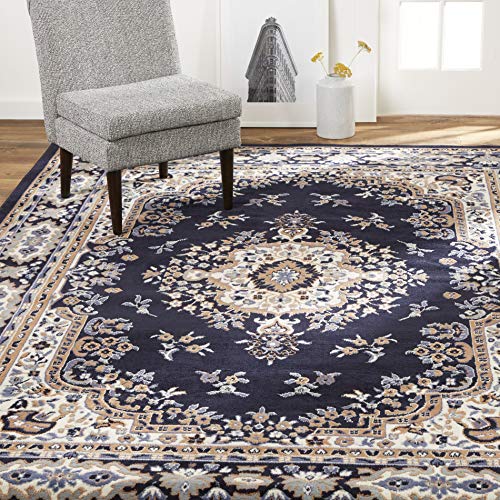
4. Home Dynamix Premium Sakarya, 5’2″ x 7’4″, Silver — Best Budget Traditional
The Sakarya line has been Home Dynamix’s Persian-inspired staple for years: a center medallion framed by scroll patterns, floral accents and a traditional border, power-loomed from polypropylene yarns the maker describes as soft underfoot. This 5’2″ x 7’4″ silver colorway is the budget-friendly way to put a formal pattern in a bedroom, study or small living room, and the cool gray palette is an easier match for modern furniture than the red-heavy classics. Like the Lyndhurst, it is honestly a machine-made rug — the value here is a detailed traditional pattern and easy-care fiber at an entry-level tier.
At this tier, accept the compromises. The pile is thinner than the mid-range picks, the pattern resolution is softer up close, and smaller sizes mean the medallion dominates the room rather than anchoring a full seating group — measure so the front legs of your furniture land on the rug, or the room will look undersized. A rug pad is close to mandatory on hard floors. For renters, first apartments and guest rooms that need the Persian look without the Persian budget, the Sakarya earns its place.


5. Momeni Isabella, 4′ x 6′, Grey — Best Flatweave for Dining Rooms
Momeni’s Isabella takes the over-dye route: a traditional medallion design washed in a single grey tone, so the pattern reads as texture rather than contrast. It is flat-woven from 100 percent polyester and made in Turkey, and the flat weave is the functional point — dining chairs slide in and out without catching a pile edge, crumbs vacuum straight off, and the rug sits low enough for doors and chair legs. The 4′ x 6′ size suits a small dining nook, a desk area or layered over a larger plain rug in a living room.
Keep expectations in line with the construction. A flatweave has no cushion and can feel firm on bare floors, the muted over-dyed palette will not deliver the jewel tones people picture with a Persian rug, and polyester flatweaves can show traffic lanes sooner than wool. It also needs a pad to stay planted. But for the specific job of a Persian-pattern rug under a table that gets used three times a day, the Isabella’s low profile and easy cleaning beat thicker, prettier options that fight every chair.


6. Livabliss Odelia, 7’10” x 10’3″, Orange & Navy — Best Faded Color for Large Rooms
The Odelia is the color pick. Livabliss — Surya’s consumer brand — machine-weaves this rug in Turkey from 100 percent polypropylene, with a traditional medallion design in a warm orange and navy palette that has been given a vintage, slightly faded finish. Where the Lyndhurst plays it neutral, the Odelia commits to the rich end of the Persian palette, and at 7’10” x 10’3″ it is sized for a full living-room seating group rather than a corner accent. The low synthetic pile keeps the easy-care story: no shedding, straightforward vacuuming, and a pattern busy enough to disguise the evidence of daily life between cleans.
Two cautions. First, the faded finish is printed into the design — it looks aged on day one and will not develop real patina, so if you want crisp pattern definition, choose the Lyndhurst instead. Second, marketplace availability on this listing comes and goes; if the orange and navy variant is out of stock, stay within the Odelia collection’s other colorways rather than substituting a lookalike with an unverified pattern. For a big room that needs warmth and pattern at a mid-range tier, it is the most characterful machine-made option here.

Best Picks by Category
- Classic medallion, easy care: SAFAVIEH Lyndhurst — power-loomed polypropylene with a traditional border and no shedding.
- Handmade wool: Surya Caesar — hand-tufted 100 percent wool in a Persian garden design, the closest construction here to a traditional rug.
- Washable: BoutiqueRugs Morcott — machine-washable flatweave with a distressed vintage pattern.
- Budget: Home Dynamix Premium Sakarya — a detailed traditional medallion at an entry-level tier.
- Dining room: Momeni Isabella — flat weave that lets chairs slide and vacuums clean in seconds.
- Large rooms and color: Livabliss Odelia — a big, warm orange-and-navy medallion with a faded vintage finish.
Notice what the list does not contain: a hand-knotted rug woven in Iran. If that is what you want, the honest route is a specialist rug dealer who can document origin, knot count and materials — not a marketplace listing. Everything above is either clearly machine-made or, in the Caesar’s case, handmade in a different, faster technique.
How to Choose
Real Persian vs Persian-style: know what you are buying
A genuine Persian rug is hand-knotted in Iran, usually wool on a cotton foundation, and a room-size piece represents months of labor — prices run to thousands, and authenticity is documented by dealers. Persian-style rugs reproduce the patterns by machine at a fraction of the cost. Neither is the wrong purchase, but they are not the same product. Read listings literally: “hand-tufted” means punched through a backing, “power-loomed” and “machine-made” mean woven by machine, and only “hand-knotted” means knotted. If a listing at a budget price claims to be a genuine antique Persian carpet, treat that as marketing, not fact.
Size and room layout
In a living room, the front legs of sofas and chairs should sit on the rug — 8′ x 10′ is the working standard, 9′ x 12′ for large rooms. In dining rooms, add roughly 24 inches on every side of the table so chair legs stay on the rug when pulled out. Runners for hallways should leave a few inches of floor visible on each side. Measure the room and tape the outline on the floor before ordering; Persian patterns are scaled to the rug, so a medallion that looks balanced at 8′ x 10′ can look crowded at 5′ x 7′.
Materials: wool, polypropylene and polyester
Wool is the traditional fiber for a reason: it is resilient, hides soil between fibers, feels warm, and ages gracefully — but it costs more, sheds at first, and wants gentler cleaning. Polypropylene is the workhorse of Persian-style rugs: stain-resistant, non-shedding, easy to vacuum and budget-friendly, with a slightly synthetic sheen and less depth underfoot. Polyester appears in flatweaves and washable rugs, where its smooth, low-profile face is an advantage for chairs and washing machines. Match the fiber to the room’s traffic first, and to the pattern second.
Pile height and construction
Low pile (around 0.25–0.4 inch) is the practical default for Persian patterns: it shows the design crisply, fits under doors, and keeps dining chairs stable. Flatweaves have no pile at all — best for dining rooms, kitchens and washable designs, but firm underfoot without a pad. Hand-tufted wool sits higher and plusher, at the cost of shedding and slower drying. Construction also sets lifespan: a power-loomed synthetic is a years-long rug, a hand-tufted wool rug lasts longer with care, and a hand-knotted rug is the generational option.
Pattern and color
The classic layouts are the central medallion (best under a coffee table, where the medallion can center the room), all-over Herati or floral repeats (forgiving in big rooms and under dining tables, where a medallion would be hidden), and bordered geometric designs in the Heriz style (strong in entryways and studies). Deep reds and navy are the traditional palette; faded and over-dyed versions trade formality for a softer, more casual room. Busy patterns are a feature, not a flaw — they disguise crumbs, pet hair and traffic between vacuuming.
Rug pads, care and shedding
Use a pad under every rug here. It stops slipping on hard floors, adds the cushion flatweaves lack, and protects both the floor and the rug’s backing. Vacuum pile rugs with suction or a soft brush roll; a spinning beater bar can worry tufted wool. Blot spills immediately — polypropylene forgives most, wool does not forgive delay. Expect a new wool rug to shed loose fibers for the first weeks; that is normal and slows down. Synthetic Persian-style rugs do not shed, but their edges can curl after shipping — reverse-roll or weight the corners for a few days.
Which Persian rug should you buy?
Pick the Persian rug that matches your room’s traffic and your tolerance for upkeep, then confirm the size. Each pick in this guide solves a different problem.
- If you want the classic medallion look with easy care: go for the SAFAVIEH Lyndhurst.
- If real wool and handmade construction matter most: choose the Surya Caesar, and plan for a rug pad and some early shedding.
- If you have pets, kids or a kitchen: the BoutiqueRugs Morcott is the washable flatweave.
- If the budget is tight: the Home Dynamix Premium Sakarya brings a traditional pattern at an entry-level tier.
- If you need chairs to slide under a table: the Momeni Isabella flat weave is built for that job.
- If you want a big, warm, faded-color rug: the Livabliss Odelia suits a full seating group.
Size should be settled before color. A rug that is too small makes a room look cut up, so measure the seating area or table first, then pick the design that fits within those limits.
If you cannot decide between two, ask which problem you are solving: cleaning, comfort, color or cost. The rug that solves your biggest problem is usually the right one.
What to check before you buy a Persian-style rug, and who should skip it
Before you buy a Persian-style rug, check the construction wording, the exact size and colorway, and whether a pad is included. The listing is the only reliable source for these details.
- Construction: look for the words hand-knotted, hand-tufted, power-loomed or flatweave, and read them literally.
- Size and shape: measure the room, tape the outline and confirm the listing’s exact dimensions and shape.
- Care: confirm whether the rug is machine washable, spot clean only or needs professional cleaning.
- Floor protection: decide on a pad, especially for flatweaves on hard floors.
- Returns: check the return terms, since rugs are bulky and the colors can look different on your screen.
Some honest trade-offs. The machine-made picks will not gain the patina of wool, and the faded finishes are printed on rather than earned. Hand-tufted wool costs more and sheds at first. Flatweaves are firm underfoot without a pad.
Who should skip it: collectors who want an authentic hand-knotted piece from Iran should work with a specialist dealer instead, and anyone who dislikes busy patterns may prefer a plain rug.
Compare the picks above, check the listing for exact size, colorway and care instructions, then choose the rug that fits how your room is used.
Choosing Among These Picks: Authenticity, Material and the Room’s Real Life
Persian-style rugs reward buyers who are clear about what they are actually purchasing. None of the value in this guide depends on pretending a machine-made rug is an antique; it depends on matching construction and material to the room’s traffic, light and budget.
The balanced traditional versus the handmade wool
The SAFAVIEH Lyndhurst in the top spot, in an 8 x 10 cream and beige, is the versatile center: a traditional pattern in gentle neutrals that can anchor a living room without dictating its palette, in the size most living rooms actually need. Choose it if you want the Persian look as a foundation rather than a statement, and if easy-care synthetic construction suits a home where the rug must simply work, week after week. Its honest limitation is the one shared by all machine-made synthetic picks here — it will not develop the patina, hand or long story of real wool, and buyers who care about those qualities will feel the difference every time they walk on it barefoot.
The Surya Caesar, a handmade wool piece in an oval 8 x 10 in forest tones, is the connoisseur’s choice within this lineup. Choose it if natural fiber matters to you, if the oval shape suits a dining area or an open room where a rectangle fights the furniture, and if you are prepared to give wool the care this guide describes, including its early shedding. Its deep green character is a commitment: it will set the room’s mood rather than blend into it. Skip it if your room needs a neutral foundation, if heavy pet traffic will test wool daily, or if the discipline of wool care sounds like a burden rather than part of the pleasure of owning a handmade piece.
Washable vintage looks and budget tradition
The BoutiqueRugs Morcott answers a modern problem: households that love the faded vintage look but live with spills, pets and children that make a precious rug a source of anxiety. A washable rug changes the emotional contract — a spill becomes a laundry task, not a disaster. Choose it for family living rooms, dining areas and any space where food and drink regularly travel. The trade-off is feel and presence: washable rugs are generally thinner and lighter than piled rugs, lie differently underfoot, and benefit from a good pad to feel substantial. Buy it for its practicality and look together, not expecting the plushness of a piled wool or synthetic rug.
The Home Dynamix Premium Sakarya, in a smaller 5’2 x 7’4 silver, is the budget traditional entry for apartments, bedrooms and first homes. Choose it to bring pattern and warmth to a modest room at the gentlest cost in this guide. Its size is its boundary: in a large living room it will float awkwardly rather than anchor furniture, so measure honestly and resist stretching a small rug across a big room’s job. Within a right-sized room, it delivers the style honestly.
Flatweave practicality and faded color at scale
The Momeni Isabella, a 4 x 6 grey flatweave, is the dining-room and high-traffic specialist in miniature: a flat surface that chairs can slide across, in a forgiving grey that suits modern traditional rooms. Choose it under smaller dining sets, in entryways that suit its size, or layered in a reading corner. Flatweave means no pile to cushion, so pair it with a pad where comfort underfoot matters and accept its lighter, crisper character as the point of the construction.
The Livabliss Odelia, at 7’10 x 10’3 in orange and navy, is the bold large-room choice: faded, warm color that can carry a big, plain room — long sofas, pale walls, lots of floor — and give it a center. Choose it when your room is under-furnished in feeling rather than in objects, and when its warm palette harmonizes with your wood and upholstery tones. Skip it in small or already colorful rooms, where its scale and saturation will compete with everything else you own.
Living With a Persian-Style Rug: Placement, Pads and Patience
The first fortnight
New rugs need settling time. Creases from rolling relax over days, helped by reverse-rolling, by placing furniture weight on stubborn areas, and simply by walking the rug in. Corners that curl usually calm as the rug relaxes on a proper pad. Judge pattern and color in your own light across a full day before deciding anything — showroom and screen colors are promises, but morning and evening light in your room are the truth, and traditional patterns in particular shift character beautifully between the two.
Shedding, where it occurs, is front-loaded: wool and some synthetic piles release loose fibers early, and frequent gentle vacuuming in the first weeks reduces it steadily. Panic is unwarranted; a rug that sheds lightly at first and then settles is behaving normally. What deserves attention is shedding that remains heavy long after the settling period, which is worth raising with the seller while the purchase is recent.
The pad is not an accessory
Treat a rug pad as part of the rug purchase for every pick in this guide. A pad prevents slipping, adds the underfoot cushion that makes even a flatweave feel generous, reduces wear by stopping the rug grinding against the floor, and protects the flooring beneath. Size the pad slightly smaller than the rug so it stays hidden, and choose its type for your floor surface. Owners who skip the pad often conclude a rug feels thin or cheap when the missing layer, not the rug, is the problem.
Rotation and care rhythm
Rotate the rug periodically so traffic paths and sunlight move across different parts of the pattern; traditional designs hide this wear gracefully, but rotation is what lets them age evenly for years. Vacuum with the pile-appropriate approach described in this guide, attend to spills promptly by blotting rather than scrubbing the pattern, and keep the area under the rug in the cleaning rotation too — grit trapped beneath is abrasive to both rug backing and floor.
In dining rooms, the test of success is chair movement: chairs should slide on and off the rug without catching its edge dozens of times a meal. If edges catch, the rug is slightly small for the table or the pad needs adjustment, and fixing that geometry will do more for the rug’s life than any cleaning product.
Decision Checklist Before You Commit
Decide authenticity expectations first, then measure the room with furniture included, then choose material for your traffic. Neutral versatility points to the Lyndhurst; handmade wool character to the Surya Caesar; washable family life to the Morcott; a right-sized budget room to the Sakarya; flatweave dining practicality to the Isabella; bold large-room color to the Odelia.
On the listing, confirm the exact dimensions, the stated construction and fiber content, and what is included regarding pads or care guidance. With rugs, a few minutes with a tape measure and the listing’s own specifications prevent the most common and most avoidable disappointment in the category.
Real Rooms, Real Choices: Scenario Walkthroughs
Consider a busy family living room: children on the floor, a dog with opinions, drinks in transit. The romance of handmade wool will be tested daily here, and the wise purchase is the Morcott washable for its spill forgiveness or the Lyndhurst for its durable, neutral practicality. This room teaches the guide’s central lesson — the best rug is the one whose care requirements match the household’s real life, because a rug that makes its owners anxious is failing at its first job, which is making a room feel good to live in.
Next, a formal dining room used weekly for real dinners, with chairs sliding in and out and a table that seats eight. The Surya Caesar oval in wool brings ceremony that suits the room, its shape easing the geometry of chairs around a large table, while the Isabella flatweave serves a smaller, more casual dining setup where chair movement is constant and pile would fight every meal. Dining rugs succeed or fail on chair behavior more than on pattern, so rehearse that movement mentally — chairs pulled out with a seated guest’s weight in mind — before falling for any design.
Third, a large, pale, newly built living room that echoes: long walls, a big sofa, and a feeling its owner describes as unfinished despite plenty of furniture. This is the Odelia’s moment. A big, warmly colored faded rug gives the room a center and a temperature, absorbing visual and acoustic emptiness at once. The Lyndhurst would be tasteful here and slightly invisible; the room does not need taste, it needs presence. Conversely, the same Odelia in a small, already layered room would shout — scale and saturation must be matched to the room’s need, not to the rug’s beauty in isolation.
Pattern scale and color in your own light
Traditional Persian patterns read differently at different sizes: a design that looks intricate and jewel-like in a small rug can feel busy at 8 x 10, while a bold medallion that overwhelms a product thumbnail settles into calm grandeur at full size. Where a pick offers multiple sizes, remember the pattern is usually scaled or cropped differently across them, so the listing’s image of your exact size is the one to study. Live with the delivered rug through a full day of changing light before final judgment, and view it from the doorway you actually enter by — rugs are read from standing height, in motion, far more than from above in a photograph.
Color coordination should start from the room’s fixed elements — floor tone, wall color, the largest upholstery — rather than from accessories you can change cheaply. A rug that harmonizes with the floor and sofa can carry cushions and curtains along with it; a rug chosen against them will fight for years. Cream and beige foundations like the Lyndhurst forgive many palettes, which is precisely their virtue in rooms that evolve; committed colors like the Surya’s forest or the Odelia’s orange and navy reward rooms whose owners know their palette and intend to keep it.
Value, honestly framed
Across this guide, price differences track construction and fiber, and the honest way to judge them is cost against years of suitable service in your room. A budget synthetic that suits a rental for three years is good value; the same rug asked to anchor a decade of family life will disappoint, not because it was cheaply made but because it was wrongly assigned. The handmade wool pick reverses the equation: its higher commitment buys fiber and construction that can serve far longer, provided its care suits your household. Buy the rug whose lifespan matches your horizon, in the material your traffic allows, and the Persian pattern — centuries-proven at making rooms feel complete — will do the rest.
A Last Reminder Before You Order
Before you order, measure the room one final time with its furniture in place, and mark the rug’s footprint on the floor with tape if you possibly can, then live with that outline for a day. Walking around taped edges, pulling dining chairs in and out across them, and seeing whether front legs of sofas land where this guide suggests teaches more than any size chart, and it costs nothing but a few minutes. Decide your material by traffic rather than by romance: who walks here, in what shoes, carrying what drinks, accompanied by which animals. Then read the listing for the exact dimensions, the stated construction and fiber, and the maker’s care guidance, and order the pad in the same breath, sized just under the rug, so the rug can be laid properly the day it arrives instead of sliding through its first month. When it comes, unroll it, let it relax, and view it in morning and evening light from the doorway before you judge its color, because traditional patterns are designed to live in changing light and often look their best once the room’s own light has had a full day to introduce itself. A Persian-style rug chosen by measurement, material and honest traffic is not a gamble on taste; it is the oldest proven way of making a room feel finished, working exactly as it has always worked.
Frequently Asked Questions
Are the Persian rugs sold on Amazon authentic?
Almost always, they are Persian-style: machine-made rugs with Persian patterns, and reputable listings say so in the construction details. Genuine hand-knotted rugs from Iran are specialist products with specialist prices. Judge a listing by its stated construction, fiber and country of manufacture — not by the word “Persian” in the title, which legally describes the pattern style as much as the origin.
What is the difference between hand-knotted, hand-tufted and machine-made?
Hand-knotted rugs are tied knot by knot on a loom — the slowest method and the one used for authentic Persian carpets. Hand-tufted rugs punch yarn through a canvas backing that is then glued and covered; they are genuinely handmade and use real wool, as the Surya Caesar here does, but they are faster to make and do not last as long. Machine-made (power-loomed) rugs are woven by automated looms in minutes, which is why a detailed medallion pattern can sell at a budget tier.
Which material is best for a Persian rug in a busy living room?
For most households, polypropylene. It shrugs off spills, does not shed, and the busy pattern hides what the vacuum missed. Wool is the better long-term material if your budget reaches it and your traffic is adult rather than toddler — it is more resilient over years and feels noticeably richer. Polyester flatweaves win when washability or chair movement matters more than cushion.
Do Persian-style rugs shed?
Synthetic machine-made rugs (polypropylene and polyester) are effectively non-shedding, which is one of their main selling points. Wool rugs shed loose surface fibers at first — hand-tufted more than hand-knotted — and settle after several weeks of regular vacuuming. Persistent heavy shedding from a wool rug after two or three months is not normal break-in; it suggests short, low-grade staple fiber.
Can I machine wash a Persian-style rug?
Only if the listing says the rug is machine washable — the BoutiqueRugs Morcott in this guide is built for it, with a flat weave that fits and survives a wash cycle. Pile rugs, tufted rugs and anything with a glued backing should never go in a machine; wash them by spot cleaning or professional rug cleaning instead. When in doubt, the care instructions on the specific listing outrank any general advice.
What size Persian rug do I need for a living room?
Start with 8′ x 10′: it anchors a standard sofa-and-chairs arrangement with the front legs on the rug. Go to 9′ x 12′ if all four legs of the seating should fit or the room is large, and drop to 5′ x 7′ only for small rooms or a single statement chair. The medallion should sit centered under the coffee table — if your layout pushes it off-center, choose an all-over pattern instead, which looks intentional from every angle.
How can I tell if a Persian rug is hand-knotted?
Look at the back of the rug, where a hand-knotted piece shows the pattern clearly with individual knots. A printed or tufted rug often has a backing or a blurry reverse. The listing should also state the construction directly.
Do I need a rug pad under a Persian-style rug?
Yes, in most cases. A pad stops slipping on hard floors, adds cushion and protects the backing. It matters most under flatweaves.
Will a Persian-style rug work in a modern home?
It can. Faded or over-dyed designs in gray or muted tones blend more easily with modern furniture than deep red classics. Use one patterned rug as an accent and keep other patterns simple.
How do I stop the corners of a new rug from curling?
Unroll it and weight the corners with heavy objects for a few days, or reverse-roll it. A rug pad also helps keep edges flat. Let it settle before judging the result.
Can I put a Persian-style rug in a dining room?
Yes, if the rug is large enough that chair legs stay on it when pulled out. A low pile or flatweave works best because chairs slide easily. Easy-to-clean fibers help with crumbs and spills.
How often should I vacuum a Persian-style rug?
Once or twice a week suits most households, more often in high-traffic rooms. Use suction or a soft brush setting on pile and wool rugs. Check the care label for anything specific to your rug.
Bottom Line
For most rooms, start with the SAFAVIEH Lyndhurst: an honest, machine-made medallion rug that delivers the Persian look with non-shedding, easy-care practicality. If you want the real material and handmade construction, the Surya Caesar’s hand-tufted wool is the step up; if your life needs a wash cycle, the BoutiqueRugs Morcott is the one that survives it. The Home Dynamix Sakarya covers tight budgets, the Momeni Isabella solves the dining-chair problem, and the Livabliss Odelia brings the color. Whichever you choose, confirm the exact size and colorway on the listing before ordering — with rugs, the variant is the product.