Disclosure: As an Amazon Associate, umtsmarttool.com earns from qualifying purchases. Links to Amazon on this page are affiliate links; they cost you nothing extra. Prices and availability change often, so check the current Amazon listing before you buy.
Where to buy
Short on time? Start with the Citizen Promaster Nighthawk BJ7000-52E, the standout pick in this guide to the best pilot watches. The full shortlist:
- Citizen Promaster Nighthawk BJ7000-52E — Check on Amazon
- Seiko Flightmaster SNA411 — Check on Amazon
- Laco Augsburg 42 (861688) — Check on Amazon
- AVI-8 Hawker Hurricane Clowes Automatic AV-4097-03 — Check on Amazon
- Hamilton Khaki Aviation Pilot Day Date H64615135
- AVI-8 Hawker Hurricane Classic Chronograph AV-4011-01 — Check on Amazon
Read the full guide ↓
The best pilot watches share a design brief written in cockpits nearly a century ago: a dial that can be read in a fraction of a second, in turbulence, in poor light, with gloved hands nearby and no time to squint. That brief produced the most legible watch style ever made — big high-contrast numerals, bold hands, generous lume — and it is why pilot watches remain the easiest watches in the world to read, whether or not you ever leave the ground.
Modern pilot watches split into families, and this guide covers the honest spread of them. There are the authentic “flieger” watches descended from the German B-Uhr observation watches of the Second World War, represented here by Laco, one of the original manufacturers. There are the instrument chronographs with slide-rule bezels that let pilots compute fuel burn and ground speed, represented by the Citizen Nighthawk and the Seiko Flightmaster. There are the aviation-heritage automatics like Hamilton’s Khaki Aviation, and the story-driven British designs of AVI-8, which build watches around specific aircraft and squadrons. What unites them is legibility and a tool-watch honesty that fashion styling cannot fake for long.
Two of the six — the Hamilton Khaki Aviation Pilot and the Seiko Flightmaster SNA411 — are listed without an Amazon link because we could not verify a correct Amazon ASIN for either exact reference from an opened source; they appear as prose-only recommendations rather than guessed links, and the article says so openly. Everything else is linked and specified from manufacturer or retailer data. Readers who want the second-time-zone function that grew out of this same cockpit tradition should see the best gmt watches guide, and those who want the stopwatch side developed further will find it in best chronograph watches.
In this guide
Quick Picks
| Watch | Badge | Key spec |
|---|---|---|
| Citizen Promaster Nighthawk BJ7000-52E | Best Overall | Eco-Drive dual time, slide rule, 200 m |
| Seiko Flightmaster SNA411 | Best Pilot Chronograph | 7T62 quartz alarm chronograph, slide rule, 200 m |
| Laco Augsburg 42 (861688) | Most Authentic Flieger | Miyota 821A automatic, sapphire, Type A dial |
| AVI-8 Hawker Hurricane Clowes AV-4097-03 | Best Big Pilot Watch | NH35 automatic, 46 mm, sapphire |
| Hamilton Khaki Aviation Pilot Day Date H64615135 | Best Premium Pilot | H-40 automatic, 80-hour reserve, 42 mm |
| AVI-8 Hawker Hurricane Classic Chronograph AV-4011-01 | Best Budget Pilot Chronograph | Japanese quartz chronograph, 42 mm |
How These Picks Were Chosen
A pilot watch earns its name through legibility, so that was the first test: large, high-contrast hour markers, hands that cannot be confused with each other at a glance, and lume that works in a dark cabin or a dark bedroom. Every pick passes it, though they pass it in different dialects — the Laco’s stark Type A triangle-and-numerals layout, the Nighthawk’s instrument density, the Hamilton’s clean day-date face. Watches with small, dressy, or low-contrast dials marketed as “pilot style” were cut.
The second test was specification honesty. Movement, case size, crystal and water resistance for each pick come from the manufacturer or from established retailer listings that we opened and cross-checked; where a figure could not be confirmed for an exact reference, it was left out of that watch’s spec box rather than filled in from a sibling model. The Hamilton and the Seiko Flightmaster are prose-only for the related reason that their Amazon ASINs could not be verified from an opened source — we would rather lose the links than guess them. Badges were then assigned across the real ways people buy pilot watches: the all-round instrument, the chronograph, the authentic flieger, the oversized statement, the premium automatic and the budget chronograph. Prices are not printed anywhere in this guide, per our standing rule; every linked pick says check price on Amazon, because pilot-watch pricing moves with retailer promotions too often for a printed figure to stay true.
A third, quieter test ran through the shortlist: could this watch plausibly have earned its place in a cockpit of its era? That question is really about design coherence — whether the dial layout, case proportions and complications belong to the same idea. It is why the list contains no pilot watch with a date magnifier, no skeletonised flieger, and no chronograph whose subdials imitate a cockpit clock without measuring anything. Coherence sounds like an aesthetic judgement, but for a tool category it is a functional one: a watch designed around one clear idea is easier to read, easier to operate and easier to trust than a collage of aviation references.
The 6 Best Pilot Watches
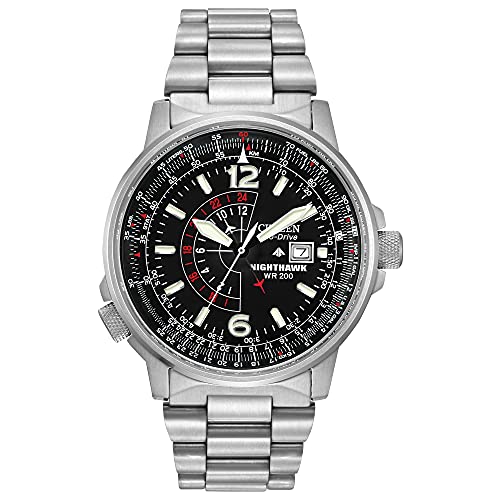
Citizen Promaster Nighthawk BJ7000-52E — Best Overall
The Nighthawk suits the buyer who wants the complete pilot instrument in one watch and never wants to maintain it. Citizen’s Eco-Drive movement charges from any light, so the watch runs for years — with roughly six months of reserve in total darkness — without a battery change. Its B877 calibre adds a dual-time display for a second time zone, and the inner slide-rule bezel, turned by the crown at eight o’clock, still performs the classic pilot calculations: fuel consumption, ground speed, distance and unit conversions. It is the most functionally complete watch in this guide.
- Movement: Citizen Eco-Drive B877, light-powered quartz, dual time
- Case: 42 mm stainless steel
- Crystal: Mineral
- Water resistance: 200 m
- Features: Pilot slide-rule inner bezel, 24-hour dual-time hand, date
Strengths
- Eco-Drive solar power removes battery changes permanently
- Slide rule plus dual time is the fullest pilot toolkit here
- 200 m water resistance — it is a Promaster, built to be used hard
Trade-offs
- Densest dial in this guide; small print on the slide rule needs good eyes
- Mineral crystal rather than sapphire
- Design is unapologetically technical, not dressy
The Nighthawk’s reputation among actual pilots and flight instructors is the strongest of any watch here, and it is earned through the combination rather than any single feature. Quartz accuracy means the watch can serve as a timing reference; the dual-time hand means home base is always visible; the slide rule means the E6B flight computer on your wrist is not a metaphor. Worn on its steel bracelet it has the heft of an instrument, and Citizen’s Promaster case finishing shrugs off the knocks of a working life. Buyers who like the formula but want a simpler field-watch dial will find Citizen’s other Eco-Drive models in our best citizen watches guide.
The honest limitation is dial density. Between the slide-rule scales, the dual-time track and the date, the Nighthawk asks more of your eyes than any other pick; in exchange for its capabilities you accept a busier read. Buyers over forty who need reading glasses for small print should handle one before committing, or choose the Laco’s stark clarity instead.
Best for: pilots and instrument lovers who want everything in one solar watch / Not suited for: buyers wanting a clean, minimal dial
Seiko Flightmaster SNA411 — Best Pilot Chronograph
The Flightmaster suits the buyer who wants the slide-rule chronograph in its purest affordable form. Seiko’s 7T62 quartz movement combines a chronograph, an alarm and a date in a 42 mm steel case with a bidirectional slide-rule bezel, and the black dial with yellow chronograph hands has become a minor icon — few watches at any price are as instantly recognisable to other enthusiasts. It is also rated to 200 m, remarkable for a chronograph, which makes it the most water-capable stopwatch in this guide.
- Movement: Seiko 7T62 quartz alarm chronograph
- Case: 42 mm stainless steel
- Crystal: Hardlex
- Water resistance: 200 m
- Features: Slide-rule bezel, alarm, chronograph, date
Strengths
- Chronograph, alarm and slide rule in one proven movement
- 200 m water resistance is exceptional for a chronograph
- Iconic high-contrast dial with superb legibility
Trade-offs
- Long out of regular production, so listings vary — check the seller carefully
- Hardlex crystal instead of sapphire
- Busy bezel graphics are function-first, not subtle
What keeps the SNA411 beloved is that everything on it works. The slide rule is fine enough for real calculations, the alarm is a genuinely useful travel feature in a pre-smartphone way that still earns its keep in hotel rooms with unreliable wake-up calls, and the chronograph pushers have the positive Seiko click. The yellow hands are not decoration: against the black dial they separate the stopwatch functions from time-of-day at a glance, exactly as cockpit design demands. Seiko’s wider range is covered in our best seiko watches roundup for readers who catch the brand bug from this watch.
The honest limitation is availability and age. The SNA411 has been in and out of production for years, prices and condition vary between sellers, and a used or old-stock example may need a battery and a gasket check before you trust its 200 m rating. Buy from a reputable seller, budget for a service if the watch has sat in a warehouse, and it will reward you for decades.
Best for: chronograph fans who want the definitive affordable flight watch / Not suited for: buyers who need a guaranteed-new, current-production watch
Check on Amazon

Laco Augsburg 42 (861688) — Most Authentic Flieger
The Augsburg suits the buyer who wants the real thing: a flieger made by one of the five original B-Uhr manufacturers. Laco built observation watches for pilots in the 1940s to a government specification — 55 mm cases, Type A dials with a triangle at twelve, luminous Arabic numerals, no logo clutter — and the Augsburg reproduces that dial faithfully at a wearable 42 mm. Inside is a Miyota 821A automatic movement with a display back, under a sapphire crystal, in a satin-finished steel case made in Germany.
- Movement: Miyota 821A automatic (Laco 2S family)
- Case: 42 mm satin stainless steel
- Crystal: Sapphire, with sapphire display back
- Water resistance: 5 ATM (50 m)
- Dial: Type A flieger layout, Super-LumiNova C3
Strengths
- Genuine B-Uhr heritage from an original manufacturer
- Sapphire crystal front and back at this price is rare
- Type A dial is the most legible layout ever fitted to a watch
Trade-offs
- 50 m rating is splash-proof only — the lowest here
- No date window; the dial stays true to the original spec
- Leather pilot strap suits the style but not the water
The Augsburg’s charm is its discipline. There is nothing on the dial that does not help you read the time, the onion crown can be operated with gloves as the original spec demanded, and the straight lugs and riveted leather strap complete a silhouette that has not needed improvement in eighty years. The modern concessions — sapphire, an automatic movement with hacking seconds in current production, a display back — improve ownership without touching the formula. Readers who fall for this style often end up exploring straps next; the riveted original is easily swapped using the guidance in our best leather watch straps guide.
The honest limitation is water. Five atmospheres is rain-and-splashes territory, the weakest rating in this guide, and the leather strap reinforces the message: this is a watch for the cockpit and the street, not the sea. If your pilot watch must swim, the Nighthawk or Flightmaster above are your picks.
Best for: heritage buyers and legibility purists / Not suited for: swimmers or anyone who needs a date window

AVI-8 Hawker Hurricane Clowes Automatic AV-4097-03 — Best Big Pilot Watch
The Clowes Automatic suits the buyer who wants the oversized pilot silhouette of the original B-Uhr era with modern automatic running gear. At 46 mm it is the largest watch in this guide — a deliberate echo of the 55 mm observation watches, toned down to something a modern wrist can carry — and it is powered by the Seiko NH35 automatic movement, the workhorse calibre behind a generation of affordable mechanical watches. The model honours Clowes, a Hawker Hurricane squadron association, and AVI-8 builds the story into the dial and caseback detailing.
- Movement: Seiko NH35 automatic, 24 jewels
- Case: 46 mm stainless steel
- Crystal: Sapphire with anti-reflective coating
- Water resistance: 50 m
- Strap: Genuine leather
Strengths
- NH35 automatic is reliable, hackable and serviceable anywhere
- Sapphire crystal with anti-reflective coating
- 46 mm presence delivers the true vintage pilot proportion
Trade-offs
- 46 mm is too large for wrists under about 7 inches
- 50 m water resistance only
- Story-driven design details divide opinion among purists
AVI-8’s approach is storytelling through specification: the Hurricane connection is not a sticker but the organising idea of the watch, from the dial layout to the caseback. The NH35 inside is the sensible part of the package — it hacks, hand-winds, keeps parts and service available worldwide, and its approximately 41-hour reserve (the calibre’s standard figure) covers a weekend off the wrist. On the supplied leather strap the big case sits flatter than its diameter suggests, though there is no escaping that this is a watch that enters the room before you do.
The honest limitation is proportion. A 46 mm case with long lugs will overhang a slim wrist and slide around on it, which ruins both comfort and the legibility that is the pilot watch’s whole purpose. Measure before you buy; if the Clowes is too much watch, the 42 mm Laco gives you the same era’s design in a size that fits almost everyone.
Best for: large wrists wanting authentic oversized pilot proportions / Not suited for: slim wrists
Hamilton Khaki Aviation Pilot Day Date H64615135 — Best Premium Pilot
The Hamilton suits the buyer stepping up to a Swiss-American automatic with real aviation heritage — this is the brand that timed early American airmail and supplied the cockpit clocks and wristwatches of generations of pilots. The Khaki Aviation Pilot Day Date pairs a 42 mm steel case with Hamilton’s H-40 automatic movement and its long 80-hour power reserve, a full day-date display, and a black pilot dial of exemplary clarity. It is the premium pick of this guide and the one most likely to be a reader’s “one good watch.”
- Movement: Hamilton H-40 automatic, 80-hour power reserve
- Case: 42 mm stainless steel
- Water resistance: 100 m
- Functions: Day and date display, pilot dial with Arabic numerals
Strengths
- 80-hour reserve means it survives a long weekend unworn
- Superb dial clarity and the strongest brand heritage here
- 100 m rating makes it a true everyday automatic
Trade-offs
- Costs several times the Japanese picks in this guide
- No slide rule or chronograph — it is a pure time-and-calendar watch
- Listed prose-only here: no verified Amazon ASIN was available at research time
What the premium buys is refinement in the places you touch daily: crown action, case finishing, bracelet articulation, and a dial whose typography and proportions have been polished by a century of aviation watches. The day-date complication is the practical kind — the information you actually check — and the H-40’s reserve means the watch picked up on Monday morning after a weekend off is still running and still right. Hamilton sells through authorised jewellers and its own channels; because we could not verify an Amazon listing for this exact reference from an opened source, this guide lists it without a purchase link rather than risk pointing you at the wrong watch.
The honest limitation is scope. The Hamilton does less than the Nighthawk — no second zone, no slide rule, no stopwatch — and costs more. What it offers instead is the best-executed simple pilot watch in this guide. If your flying is metaphorical and your standards are high, that trade is the right one; if you want instruments, scroll up.
Best for: buyers wanting one premium automatic pilot watch / Not suited for: feature hunters or tight budgets

AVI-8 Hawker Hurricane Classic Chronograph AV-4011-01 — Best Budget Pilot Chronograph
The AV-4011 suits the buyer who wants the pilot chronograph look and a working stopwatch at an entry price. AVI-8’s Hawker Hurricane line draws on the RAF’s workhorse fighter, and the Classic Chronograph renders that theme in a 42 mm case with a Japanese quartz chronograph movement, a cream “classic white” dial option among its colourways, and a leather strap. At 42 mm it is the wearable alternative to its 46 mm automatic sibling above.
- Movement: Japanese quartz chronograph
- Case: 42 mm stainless steel
- Strap: Leather
- Functions: Chronograph, date
Strengths
- Pilot chronograph style at the lowest price in this guide
- 42 mm case fits most wrists, unlike the 46 mm Clowes
- Quartz movement is accurate and maintenance-light
Trade-offs
- Quartz movement needs periodic battery changes
- Lacks the slide rule of the Citizen and Seiko picks
- Brand is a fashion-forward microbrand, not an instrument maker
The AV-4011’s job in this guide is to be the honest entry point. Its chronograph genuinely works — a claim not every budget pilot-styled watch can make — and the dial keeps the big-numeral pilot legibility that defines the category. It will not be mistaken for the Flightmaster’s tool-grade density or the Nighthawk’s engineering, and it does not try to be; it is a characterful, affordable way into the style. Readers comparing it against pure stopwatches should also weigh the Casio Edifice in our best chronograph watches guide, the budget benchmark there.
The honest limitation is depth. AVI-8 designs evocative watches, but the movement is an anonymous quartz module, the water resistance is modest (confirm the figure on the listing before swimming — we did not print it because sources for this reference varied), and long-term parts support is a microbrand question rather than a Seiko certainty. Buy it for style and story at a fair price, and it delivers.
Best for: first pilot watch or RAF-story fans on a budget / Not suited for: buyers wanting instrument-grade specifications
Comparison Table
| Watch | Movement | Case | Crystal | Water resistance |
|---|---|---|---|---|
| Citizen Nighthawk BJ7000-52E | Eco-Drive solar quartz | 42 mm | Mineral | 200 m |
| Seiko Flightmaster SNA411 | 7T62 quartz chrono | 42 mm | Hardlex | 200 m |
| Laco Augsburg 42 | Miyota 821A automatic | 42 mm | Sapphire | 50 m |
| AVI-8 Clowes AV-4097-03 | NH35 automatic | 46 mm | Sapphire | 50 m |
| Hamilton Khaki Aviation H64615135 | H-40 automatic | 42 mm | — | 100 m |
| AVI-8 Classic Chronograph AV-4011-01 | Japanese quartz chrono | 42 mm | — | — |
The B-Uhr: The Original Pilot Watch
Every watch in this guide descends from a single government specification. In the late 1930s and early 1940s, the German air ministry commissioned Beobachtungsuhren — observation watches, abbreviated B-Uhr — from five manufacturers: A. Lange & Söhne, IWC, Laco, Stowa and Wempe. The specification was ruthless about function. The case was 55 mm across so the dial could be read instantly and the oversized crown wound with gloves. The movement was a pocket-watch calibre with hacking seconds, because navigation timing required synchronising to the second. The dial came in the two layouts — Type A and Type B — still used today, printed in luminous paint with no branding to distract. The strap was long enough to fit over a flight jacket.
Those watches were issued equipment, returned after each mission, and their design language — triangle at twelve, sword hands, stark numerals — became the permanent grammar of the pilot watch. When Laco sells an Augsburg today, it is selling its own back catalogue; when any other brand draws a triangle at twelve, it is quoting the B-Uhr. The Allied side developed its own tradition in parallel: smaller, rugged field watches for ground crews and the famous navigation watches of the RAF, whose descendants show up in AVI-8’s Hawker Hurricane storytelling. Understanding the split explains this guide’s shape: German-descended watches chase stark legibility, British-descended watches chase squadron character, and the American tradition — Hamilton — splits the difference with polished, practical instruments. None of the three is more authentic; they are authentic to different air forces.
How to Choose a Pilot Watch
Start by choosing your dialect of pilot watch, because the four families wear very differently. The flieger (Laco) is a pure time-teller: maximum legibility, no complications, heritage in every line. The slide-rule instrument (Citizen, Seiko) is a cockpit computer that also tells time — denser, more technical, and the choice of people who enjoy using tools. The aviation automatic (Hamilton) trades features for refinement. The story watch (AVI-8) trades heritage depth for design character and price. None is the “real” pilot watch; each descends from a different corner of aviation history, and the right one is the corner that appeals to you.
Size is the second decision, and pilot watches punish mistakes because the style runs large by design. The original B-Uhr was 55 mm because it was worn over a flight jacket and read in a vibrating cockpit; on a modern wrist under a shirt cuff, 42 mm is the versatile centre of the category, 46 mm is a statement for large wrists, and anything you buy should be checked by lug-to-lug distance as much as diameter — overhang at both ends is what makes a watch wear badly, not the number on the spec sheet. Third, decide whether the slide rule matters to you. It is a real calculating instrument, and learning it is part of the pleasure for many owners; but if you will never compute a fuel burn, its scales are dial clutter you pay for in legibility, and the clean flieger or Hamilton dials will serve you better.
Finally, weigh movement and water resistance against your actual life. Solar quartz (Nighthawk) is the zero-maintenance instrument; Japanese quartz (Flightmaster, AVI-8 chrono) is accurate and cheap to run; automatics (Laco, AVI-8 Clowes, Hamilton) offer mechanical charm at the cost of needing wear or winding. Water resistance divides the list sharply: the 200 m Citizen and Seiko are genuine all-activity watches, while the 50 m automatics are fair-weather instruments. A pilot watch worn daily through rain, gyms and travel should be bought with the same honesty as any tool — for the conditions it will actually meet. The strap completes the picture: riveted leather is the period-correct choice, steel is the durable one, and fabric is the traveller’s compromise, as our best watch bands guide explores.
Crowns deserve their own sentence in this category. The oversized “onion” or diamond crown of the flieger tradition exists to be wound with gloves, and on a modern wrist its charm is real — but check that it does not press into your hand in your normal wearing position, because a crown that digs will exile an otherwise perfect watch to the drawer. Screw-down crowns, where fitted, trade that vintage ease for water security; push-pull crowns on the 50 m automatics are one more sign those watches are meant for dry land. Small details, but pilot watches are a category built from small details that were once matters of safety, and the good ones still treat them that way.
Key Takeaways
- Legibility is the pilot watch’s defining spec: big numerals, bold hands, strong lume.
- Flieger, slide-rule instrument, aviation automatic and story watch are four different products wearing one name.
- 42 mm is the versatile size; 46 mm and above is for large wrists by design.
- The Citizen and Seiko here are 200 m all-activity watches; the automatics are 50–100 m fair-weather tools.
- Solar power suits the instrument role best: a reference watch should never be found stopped.
Lume: The Pilot Watch’s Night Shift
No specification separates real pilot watches from pilot-styled ones faster than luminescence. The original B-Uhr dials were painted with radioactive luminous material so navigators could read them in blacked-out cabins; modern watches use safe phosphorescent compounds, principally Super-LumiNova, which charges in light and glows for hours. Grades and application matter more than the brand name on the spec sheet: a thick, even application on large markers — the Laco’s C3-filled numerals are the textbook example — will out-glow a thin printed layer on a fashion dial by a wide margin, and hands matter as much as markers, because a glowing dial with dark hands is a torch with no pointer.
Judge lume by three practical tests when a watch arrives. Charge it under a bright light for thirty seconds, then check it in a dark room immediately (brightness), after twenty minutes (useful glow), and — the real test — at 4 a.m. after a night on the bedside table (endurance). Most owners only ever need the third: a pilot watch that cannot be read in the small hours has failed its founding brief. Seiko’s LumiBrite, on the Flightmaster, has a decades-long reputation for exactly this endurance, and Citizen’s Promaster lume is applied with the same seriousness because the same cases go diving. If night legibility is your top priority in this guide, the ranking is Laco and Seiko at the front, Citizen close behind, and the fashion-leaning picks at the back — another reason the badges in this guide are assigned by use rather than by price.
How to Use a Slide-Rule Bezel
The slide rule on the Nighthawk and Flightmaster is a circular logarithmic calculator, and one worked example teaches the whole system:
- Find the two scales: the outer scale rotates (bezel on the Seiko, inner ring via the second crown on the Citizen); the inner scale is fixed to the dial.
- To convert units — say, statute miles to kilometres — set the “STAT” marker against the distance on one scale and read the answer against “KM” on the other. All conversions on the rule work this way: align the two unit markers, then read any number against its counterpart.
- For speed and fuel calculations, align the rate index (usually the marker at 60) with the quantity used, then read consumption or remaining time against any point on the scales.
- Practise on the ground with conversions you can verify against your phone until the alignment logic is automatic.
Two troubleshooting patterns cover most beginner frustration. Problem: your conversions are off by a factor of ten. Fix: slide rules do not track decimal places — you must supply the magnitude yourself, so sanity-check every reading (a car does not burn 400 gallons an hour). Problem: the bezel or ring will not turn, or turns too freely. Fix: on the Citizen the ring is driven by the crown at eight o’clock, not by turning the bezel itself; on any watch, grit under a rotating bezel usually clears with a rinse in clean water — never force it.
Legibility technique matters as much as the instrument. The pilot’s habit worth copying is the structured glance: read the hour hand’s position first as a shape, then the minute hand, then — only if needed — the fine scales. Big-dial watches reward this because their information is layered by size: time is huge, the date is medium, the slide rule is small print for stationary moments. If you find yourself squinting at a pilot watch in normal use, the watch is either too small for your eyes or too busy for your taste, and the fix is a different dialect from the buying guide above, not a brighter torch. At night, give lume a proper charge — a few seconds under a bright light or a phone torch before lights-out — and even the modestly lumed dials here will read clearly for hours; Super-LumiNova C3 of the Laco’s grade will outlast your sleep.
Fitting and Wearing a Pilot Watch
Pilot watches reward a slightly different fit from dress watches. Because the cases are large and the crowns oversized by design, wear the strap a notch looser than you would a dress watch: the crown should never dig into the back of your hand when your wrist flexes, which is the classic complaint about big-crown fliegers and the reason some historical models moved the crown or wore the watch higher on the wrist. On a bracelet, the watch should sit above the wrist bone and stay there when you shake your arm; if a 42 mm steel pilot watch slides, size the bracelet before blaming the watch.
Strap choice changes the category more than any other accessory decision. The riveted leather strap is the heritage default and the best match for the Laco and AVI-8 designs, but it is a fair-weather partner. A steel bracelet turns the Nighthawk and Flightmaster into all-season instruments. A fabric pass-through strap lightens the big cases, survives sweat and washing, and adds the security of a second spring-bar path — the traveller’s favourite for good reason. Whichever you fit, check the lug width first (the pilot picks here cluster around common widths, but verify your exact model), keep the original strap stored flat, and remember that a strap change is also the cheapest way to make one pilot watch serve both a flight jacket and a suit jacket.
Common Buying Mistakes
The first mistake is buying the diameter in the photograph. Pilot watches are styled oversized, product shots use large wrists, and a 46 mm case that looks heroic online can look like a wall clock on a 6.5-inch wrist. Measure your wrist, check lug-to-lug, and favour the 42 mm class unless you are sure. The second mistake is paying for a slide rule you will never learn and then complaining the dial is busy — the clutter is the function. If you want clean, buy the flieger.
The third mistake is treating “pilot” as a specification. It is a style with a history, not a certification; no authority approves pilot watches for flight, and any watch here is a backup instrument at best in a real cockpit, where certified panel instruments and modern avionics rule. Buy the pilot watch for legibility and character, not as equipment. The fourth mistake is ignoring production status: beloved models like the Flightmaster drift in and out of production, and prices, condition and warranty support vary accordingly — buy the seller as carefully as the watch.
Final Recommendation
The Citizen Nighthawk is the pilot watch most readers should buy: solar-powered, dual-time, slide-rule equipped and sealed to 200 m, it is the fullest expression of the pilot instrument at a sane price. It is also the pick that asks the least of its owner over a decade — no batteries, no winding, no servicing schedule — which is exactly the quality a working instrument should have, and why it leads a list that also contains more romantic watches. The runner-up is the Laco Augsburg, for everyone who hears “pilot watch” and pictures the stark flieger dial — it is the most historically honest watch in this guide and the easiest of all to read. Between those two poles, every other pick serves a defined taste: chronograph, oversize, premium or budget. If your travels also demand a second time zone in a cleaner package, the best gmt watches guide is the natural next read, and the best field watches roundup covers the pilot watch’s ground-based cousins.
Frequently Asked Questions
What makes a watch a pilot watch?
Legibility under pressure. The defining traits are a large, high-contrast dial with bold Arabic numerals or markers, hands that are easy to distinguish, strong luminescence, and a case sized to be read — and often operated — quickly. Complications like slide rules, chronographs and dual-time displays come from specific cockpit needs, but the readable dial is the constant.
What is the difference between a Type A and Type B flieger dial?
The two layouts come from the original German observation-watch specification. Type A is the simpler dial: hours marked with Arabic numerals and a triangle with two dots at twelve o’clock — the Laco Augsburg’s layout. Type B adds an inner hour track and puts large minute numerals (5 to 55) around the outside, favouring minute-reading precision for navigation timing. Type A is cleaner; Type B is busier and more technical.
Can a pilot watch be worn every day?
Yes — it is one of the most wearable styles precisely because legibility never goes out of fashion. Choose the 42 mm class for office compatibility, mind the water resistance for your routine (200 m picks for swimmers, 50 m picks for dry land), and expect the larger models to fight with tight shirt cuffs.
Do real pilots wear pilot watches?
Many do, as personal and backup instruments — the Nighthawk and Flightmaster have genuine followings in general aviation. But no wristwatch is a certified flight instrument, and modern cockpits run on panel avionics and tablets. The honest framing is that a pilot watch is a superb everyday instrument with aviation heritage, not flight equipment.
What does the slide rule on a pilot watch actually calculate?
Multiplication, division and anything built from them: unit conversions (miles to kilometres, gallons to litres), speed from time and distance, fuel burn and remaining endurance, and climb or descent rates. It is a general-purpose analogue calculator arranged in a circle, operated by aligning two logarithmic scales.
Is an automatic or quartz movement better for a pilot watch?
For pure instrument duty, quartz — especially solar quartz — wins on accuracy and zero maintenance, which is why the top pick here is Eco-Drive. Automatics like the Laco, AVI-8 Clowes and Hamilton answer a different desire: mechanical craft and heritage. Neither is wrong; they are different definitions of what the watch is for.
How big should a pilot watch be?
As big as your wrist carries well, and no bigger. The style’s heritage is oversized, but the modern sweet spot is 40–42 mm for average wrists, with 44–46 mm reserved for wrists around 7.5 inches and up. Judge by lug-to-lug distance against the width of your wrist: if the lugs overhang, the watch will wear badly whatever the diameter says. When in doubt between two sizes of pilot watch, choose the smaller — legibility comes from contrast, not millimetres. Remember too that a pilot watch’s crown is deliberately oversized for gloved hands, and on a small wrist that crown, more than the case, is what digs in and catches sleeves; it is the detail most often behind returns of otherwise well-chosen fliegers.
What strap suits a pilot watch best?
The period-correct answer is a riveted leather strap in the 1940s pattern, as supplied with the Laco and the AVI-8 models, and it remains the best-looking choice for daily wear. For travel and weather, a steel bracelet (Nighthawk, Flightmaster) or a washable fabric strap survives more and asks less. Match the strap to your climate first and the photograph second: leather in a humid summer will age in months, while steel and fabric shrug it off.
Why do pilot watches have a triangle at twelve o’clock?
The triangle, usually flanked by two dots, comes straight from the B-Uhr specification. In a dark, vibrating cockpit, a pilot glancing at the watch needed to know its orientation instantly — which way was up — before reading the time, and a distinctive marker at twelve provides that orientation faster than any numeral. It survives today as the flieger’s signature, and on a genuine Type A dial like the Laco’s it is not decoration but the fastest orientation cue in watch design. Once you have worn one, the triangle becomes the first thing your eye finds, which is precisely what it was designed to be in 1940. It is also the quickest authenticity test when shopping: a pilot watch whose twelve o’clock marker is a plain numeral or an applied logo may still be a fine watch, but it is speaking the language of fashion rather than the grammar of the B-Uhr, and buyers who care about the genre’s history should know the difference before they spend.